

Authored by Edmond Malaj. Translated by Petrit Latifi.



Summary
In this paper are given the first results of the trail about the Ragusa noble families of Albanian origin and the presence of Albanians in Ragusa during the Middle Age. The papers presents historical data and for some of them are given the emblems. The data are mainly extracted from the published volumes and from the papers of different authors that have written about the Ragusa history and about Middle Age studies.
There are many Ragusan noble families originating from Albanian lands. Albanians in the Republic of Ragusa, within the city and in the surrounding areas, began to settle in the century,because in their country there were destructions caused mainly by the influx of Slavs but also of other populations.
Later, there was another wave at the beginning of the century. XII2, and then continuing with other arrivals especially in the c. XIV and XV, the latter also caused by the Ottoman invasions. As a result, we come to the conclusion that there must be a large number of families of Albanian origin, either early or later. According to researcher Irmgard Mahnken, they constituted almost 15% of the noble houses (nobiles) of the Republic of Ragusa. So, the role of Albanians in the development and progress of this republic is indisputable.
In the following article, we will try to trace these families, to provide the first data regarding them and their contribution to Ragusa, placing in some cases also the coats of arms. For this information, we mainly relied on published documentary data, such as the various volumes of the large and very important corpus for the history of the Middle Ages in the Balkans entitled “Monumenta spectantia historiam Slavorum meridionalium” (Monuments dealing with the history of the Slavs of the South), published mainly in Zagreb (Croatia) over a considerable period of time by the Academy of Sciences and Arts of Yugoslavia, but also in the volume of documents entitled “Gjergj Kastrioti Skënderbeu in the funds of the State Archives of Dubrovnik” prepared by John Berisha.
In addition to these documentary volumes, a certain number of works and articles were also used, from which we extract information about these families. The article by the German researcher Irmgard Mahnken “Relationship between the Ragusans and the Albanians during the Middle Ages”, as well as her paper entitled “The Ragusan Patrician of the XIV century”, a work which we could not consult in full, but only in fragmentary way.
Further important are the work of Konstandin Jireçek entitled “The Romans in the cities of Dalmatia during the Middle Ages”8 in three parts, and the many articles of Jahja Drançolli which are mainly published in the volume entitled “Arbrit between the West and the East during the Middle Ages”. Their works provided us with valuable material regarding the presence of Albanians in Ragusa.
In addition to the search for information on these families, we also did research in the direction of heraldry and tried to sometimes provide the coats of arms and emblems of these families, although not for all of them it was possible to find the corresponding coats of arms. We hope that in the future the data on the noble families of Albanian origin in Ragusa can be completed and further specified, since here only some of them are treated in an introductory way.
During the research of this topic, we encountered many problems: for example, the main problem is the lack of documents here in our archives (in Albania) for these families, so we were content for the moment with the published documents that we had at our disposal. Another problem is the way the origin of families is given in different sources and works, e.g. sh. in one source a family is given as having Albanian origin, while in other sources the same family is given as originating from Bosnia, Kotor or Italy.
We have mentioned such cases here as well, citing the relevant literature. A third problem is the writing of names in different variants, thus often making it difficult to identify and belong to them.
Closing this introductory part here, we are further presenting the first results of this research. The following continues the data on families in alphabetical order.
Alexi (Allesio, Allexio)
They were originally from Shkodra, but apparently in Shkodra they also came from the provinces of Naples. In 1322 Mr. Mateo de Alexio is mentioned (Dominum Matheum de Allexio), according to Ranjina this noble family died out in 1286. There are many possibilities. that here it is also about different families with the same last name. We have no information about the coat of arms of this family.
Arbanass de Bosiljevo
During the research on the families, two Dalmatian noble families were also discovered, which actually do not belong to those of Ragusa, but to areas near it. These families are Arbanass de Bosiljevo and Arbanas de Also-Lomnica, who drew our attention to them because of their name Arbanas.
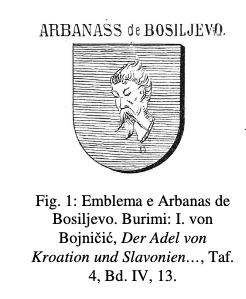
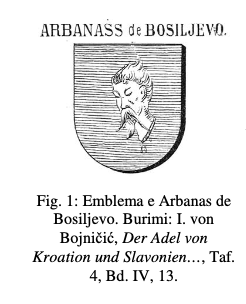
The Arbanass de Bosiljevo family may be of Albanian origin based on the very name it bears. This family must have moved to Dalmatia at the time of the Ottoman conquests, and the family’s coat of arms, which shows a severed Turk’s head on a blue background, can be an indication of this. The document for recognizing them as nobles and for the emblem of yre was issued by King Vladislav II in Buda of Hungary and on October 4, 1502 to Ambrosius Arbanasi de Bosiljevo.
Later, the name of this family was also announced in the Croatian assembly in 1604. It is found in the Register of Nobility of Zagreb and also belonged to its Committee (Agramer Comitat). According to their second name, they must have lived in Bosiljevo in Karlovac (Croatia).
Arbanas de Also-Lomnica
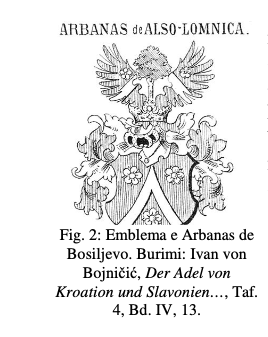
Arbanas de Also-Lomnica is also among the early Dalmatian noble families and the document for their recognition as nobles and for their emblem issued by Emperor Ferdinand I around 1560, they seem to have resided for a long time in Dolnja Lomnica in the Province of Zagreb (Croatia). We have no information that he is related to the aforementioned family (Arbanas de Bosiljevo). From their name Arbanas, we are of the opinion that they must have been of Albanian origin.
Bassegli (Basilio)
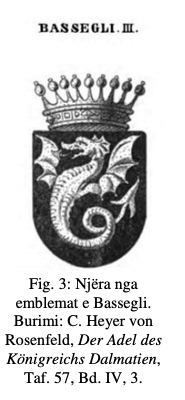
The Bassegli or Bessagli family (other forms of their surname are Basselo, Basegio, Baseyo, Basiljevi, Vasiljevi), according to Jahja Drançolli, were of Albanian origin, while in other sources they are given as originating from Kotor, such as to Konstantin Jireček, who ranked this family among the nobles of Kotor, and since 1309, as a branch of the nobility of Ragusa. From this family we can mention the theologian
Dominican Toma Bassegli from Ragusa, born and died in that city (* Ragusa, 1438 – † Ragusa, 1512) who received his doctorate in Padua in 1438 and he taught there until 1474.

Later he became professor of studies for the province of the order Dominican of Hungary until 1479 and since from 1487 he was vicar general of the special Congregation of Ragusa. G. Lukari lists this in the list of noble families that still existed in 1605.
Regarding the further connections of this family with the Albanian land, we should mention here Vasiljevic (Vassiglievich), an ambassador of dom Giovanni Navarro, apostolic nunc of the Crusades, who through this ambassador requested in 1458 facilities and a ship for passed in Arbëri to Skënderbeu. While the brothers Paulus and Antonius Vassiglievich are mentioned about the trade of Ragusa with the Albanian lands, who were engaged in the trade of wood and other goods in Ishem and Rodon. This family was ranked among the noble family of Ragusa until century XVIII and existed at the beginning of the century. of the century XX, known as the Gozze-Bassegli Counts.
Berisina, Brissina, Berisna, Berissa
According to J. Drançolli, the Berissa family is also mentioned in Ragusa in the year 1430. We still do not have further information about the presence of this family in Ragusa. Through documents we find some names of members of this family, such as: Piçinegus de Berrisina (1278)24, further, Petrus de Berisna (1280-1304), his brother Laurentius de Berisna (1280-1304), Piçinegus Pasque de Berrissina, Grubessa de Berisina, Blasius de Berrisina, Pasque de Grubessa de Brissina, etc. Regarding the name Berisha (Beriša), Jiereček makes the assumption that it could also be a derivative of the name Berislav.
Curaca, Curaça (Curaza)
Another noble family of Albanian origin was the Kuraca originating from Durrës (de Durazo d’Arbania). Through Ragusan documents and annals, several members of this family appear. One of them, named Mauric de Kuraxa (Maurexa de Juraza), appears in 1303 as a member of the Great Council, while another person named Savingia de Kuraca ( Savingia de Curuza), a member of this family, appears in 1305 as count of Malfi and is also mentioned in the Book Reformatorium of Ragusa. According to Ranjina, who mentions this family under the name Craza, this door was extinguished in 1363.
Gondola, Gondula, Gundula (Gunduli),
The Gondola family, according to Jahja Drançolli, was of Albanian origin, with distant origins from Lezha, as it is a branch of the Lukari family. However, in the Anonymous Annals of Ragusa, they record their origin from Morinje of Zeta. According to Jireček, the name Gondola, outside of Dubrovnik, is found only in Zare, where in 1199, a “tribunus Dobre de Gondola” is mentioned. According to him, this is the same person as “Dobre de Gundula”, who is mentioned in 1205 in a trade agreement between Rabi and Senja.
Another family with the surname Gondola, from which the Dukes (Grafen von Gondola) have sprung, is given in the literature as originating in Old Etruria (Tuscia in Central Italy) and documented in Ragusa as early as 930, in Lucca and in Tirol. In a document from 1252, a Grubessa Gundule is also mentioned, who was a sworn judge (jurati judices). Regarding various persons of the Gondola family we can mention here: Paul de Gondola noble of Ragusa who participates as a witness in Dubrovnik in drawing up a power of attorney on July 12, 1407 to the aforementioned Venetian merchant Tade Kresp.
Jakob de Gondola, the annual law judge of the municipality of Ragusa, as well as the nobleman and merchant from Tivari Marince Miroshi, also participated in this power of attorney. Other people with this surname are also mentioned by Jireçek, such as p. sh. Mr. Paul de Gondola with his daughter Donna de Gondola mentioned in 1442 and G. the daughter of Mr. Nikolin de Gondola mentioned in 1446.
Also known is Johannes di Gondola from Dubrovnik, who in 1523 published Tabula Terrae Sancte (Map of the Holy Land) and a few years later wrote the work “Itinerario a pellegrinaggio in Tera Sancta” (Itinerary for a pilgrimage to the Holy Land) ). In relation to the history of Skanderbeg from the Gondola family, there is also an ambassador who served near Skanderbeg for relations with Ragusa. This is Paladino de Gondola and his activity in the service of Skanderbeg is documented in the last ten years of the hero’s life.
Gozula, Gozulo (Gazulli)
In Ragusa we have also documented the Gozulo (Gazulli) family of Albanian origin. The Gazullors in the c. XV we have documented them in two branches, one in Arbëri and the other in Ragusa. Jireček mentions them as Gasulus, Gaçolus, Slav. Gazul, who were citizens of Ragusa, who lived in Ragusa mainly during the century. XV and who were Albanians originally from Zadrima e Lezha, where in 1416 there was also a village called Gasoli (Gazulli). They should not be confused with the noble family from Ragusa with very similar names Gauzoli, Gauzolo, Gauçolo, of who were also part of the Ragusa nobility from 1239 to 1326 (Nobiles von Ragusa 1239-1326).
From this family have come several descendants who have contributed to Albanian history, especially to that of Skënderbeu. Here we can mention Skenderbeu’s ambassadors, firstly Monsignor Pal Gazullin who served Skenderbeu in the years 1452-1459 in relations with Ragusa, the magister Gjon Gazulli who was also sent to Skenderbeu from the Senate of Ragusa and Andrea Gazullin, who also held the office of Skanderbeg’s ambassador, especially in 1462.
A branch of this family seems to have moved to Ragusa in the century. XV and the first of them there was Gjon Gazulli, who was the father of Gjon (II) Gazulli, the famous astronomer and diplomat. About whom we are giving some data. Gjon Gazulli (Johannes Gasulus) was born in Gjadër (today a village between Lezha and Shkodra), in 1400, however G. Valentini is of the opinion that he was born in Ragusa.
As it seems, his family must have fled from the surroundings of Shkodra since Gjoni was a small child. He was the brother of Pal Gazulli whom we mentioned above. John became a Dominican cleric, studied in Ragusa and in Padua, studies which he must have completed in 1425, while he received his doctorate on 31 Siena together with the Hungarian king Sigismund.
Accompanying the king during this time was a diplomatic mission assigned to him by the Republic of Ragusa, which later assigned this mission to Pope Nicholas V. His diplomatic missions assigned by the Republic of Ragusa there were many. Later, he also represented Skanderbeg’s interests, either in Ragusa or in Italy.
In 1433, he was appointed professor of mathematics and astronomy at the University of Padua, and in addition to teaching, he devoted himself to the construction of various instruments for astronomy. In 1445, the magister Gjon Gazulli is found again in Rome and this is confirmed by a document dated June 22, where it is about an exchange of letters between him and the Republic of Ragusa.
In 1469, Matia Corvini became the king of Hungary, who called Gjon Gazulli to his court. Gazzulli does not go to Budapest, but sends Corvinus a work of his own, regarding the astronomical research he had done.
Lucari, Lucari, Lucarus, Lucaro
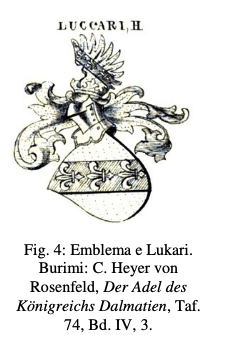
The Lukari family was originally from the city of Lezha58, came to Ragusa in 914. Their old name was Lucar and in the Ragusan annals, they are mentioned as coming from Lezha e Slavisa (di Lasia di Slabia), or from (Alessio di Slavia ) but in fact it is about Lezha e Arbërija. Jireček also mentions many people who bear this surname, but also the name Lukar, without giving us any clarification regarding their origin.

In connection with this family, some of its descendants are mentioned . Others include Stefan de Lukaris, a nobleman from Ragusa, who participates as a Dubrovnik witness in drawing up a power of attorney.
on July 12, 1407 to a Venetian merchant, called Tade Crespi who had his activity merchant with the city of Ulcinj. This family should not be confused with another family with the same name Lukari that is mentioned in Zara in 1283, when Saint Simenon was declared holy.
An important figure of this family was Jacob, the son of Peter Lukari (Giacomo di Pietro Luccari), who in 1605 published in Venice a work entitled “Summary of abundant of Ragusa’s annals” (Copiaso
Ristretto degli Annali di Rausa), this work of important not only for the history of Ragusa, but also for Albanian history65, since there are also data on events directly related to Skënderbeu and the environment around him.
What is interesting here is the mention of an unknown source for the history of Albania, authored by Angiolo di Drivasto, which alongside Marino di Scutaro (must be Marin Barleti) Luccari cites for an event in 1435, where it is about expelled Turks from Arbëria by Andrea Topië. Could it be that this author “Angiolo di Drivasto” is Archbishop Pal Engjëlli originally from Drishti and the work in question is Anonimi Tivaras, a work that Gammaria Biemmi mentions later in his history of Skënderbeu published in 1756 (Explicit Historia Scanderbegi edita per quendam albanensem), but today it is no longer found anywhere and no one else has seen it? An interesting piece of information is given in this paper. Sometime in the first half of the century XV, a plague falls in Ragusa, brought by war fugitives who had fled from Arbëria.
Marinus (Marini)
With the name Marini, we first come across a noble family from Ulqin (Nobiles von Dulcigno), from which two people are mentioned in the Venetian documents, Mr. Helia Marini, sworn judge (Ser Helya Marini juratus judex) mentioned in 1386 and Kalenda Marini mentioned in 1388.69 With this last name “Marini” we also come across a noble family that existed in Ragusa, according to Jireček, during the years 1195-1285 (Nobiles von Ragusa 1195-1285).
From the available literature we cannot we have yet to determine if these families with the same surname had the same origin, however, the possibility that they were related is not excluded. We also meet people with this surname in other places in Dalmatia, as nobles in Trogir (XIII-XIV centuries), where a village named Arbanija (on the island of iovo) still exists not far away; further as nobles of the island of Arbe (Nobiles de Marini) around 1334, mentioned in the islands of Veglia (Croat. Krk) around 1198 and Cherso (Croat. Cres) in 1208 and 1226.
Martini
We cannot stay here without mentioning the noble family Martini from Split that is documented during the century. XVIII-XVI. We also find people with this last name in Ulcinj, like p. sh. Stephanus Marini Martini from Ulcinj mentioned in 1391. As in the case above, it is currently impossible to establish a connection between them.
Menze (Mence / Menceti )
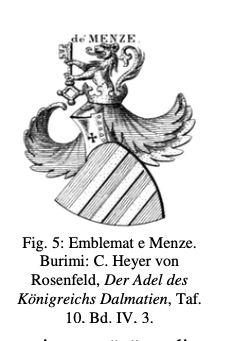
Even the Menze family, according to J. Drançolli, it is thought to be of Albanian origin. The name we find them in documents in several variants, as: Menze, Mencii, Mentii, Mence, Minzeti. Jireček defines them as Tivar nobles in the century XV, and defines them as Ragusan nobles
for century XIII-XIX.
Through the Ragusan documents they appear since the c. XIII, such as Laurentius Welcinne Mencius 1234, Rosinus de Menze, Menge 1243, Dimitrius Mencii, de Mence through documents during the years 1246-1285, and in one document of 1252, Dimitrius de Menze, he is mentioned as a councilor in one of the city councils, either in the small one or in the big one, but that is not defined more precisely in the document (nos consiliari de parvo et magno consillio). K. Jireçek mentions many names bearing this surname and as a Ragusan family it appears as such in the year 1234.
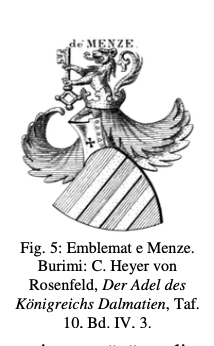
In the Books of Reforms, on December 1, 1358, a rector of Ragusa named Marin de Mence (d. rectoris ser Marini de Mence) is mentioned, who gave an order to the city’s tellal that no one was allowed to shelter Miloslava, servant of Nicholas the Albanian (Nicole Arbanensis), and that no one was allowed to remove her from the country, neither by land nor by sea, because otherwise the persons who committed this offense would be punished. Here it is not further explained why it was required this woman, but of course the cause was some theft or other violation that she may have committed either against her boss Nikollë Albanian, or against any other person. This same year (1358) there are also other names that belonged to the Mence family, such as Mence Laurencii de Mence, Mate Mencei de Mence, Nixa Marini de Mence March de Mence, Perce Lampre de Mence, etc.
In 1357, Mate Nicole de Menze is encountered, as vicecomes de Malfi. And in 1443, a rector of Ragusa named Damiano de Mence is mentioned, in connection with a complaint presented to him by the captain of a boat, which was looted in the province of Ishmi in Arberia. The name of Damiano de Mence is also mentioned in another document dated June 3 in connection with a testimony about the transport of a piece of wood from Ishmi to Ulcinj and then to Ragusa .
In this document, Damiano is not referred to as rector of Ragusa, and it is very possible that he could be a different person from the first one. Likewise, in 1465, the judge Nicola de Menze comes across a book by Gjon Gazulli, which was bequeathed to Mr. Juni M. de Giorgio. Previously, this family had the name Menza and was among the families that had continuity until the beginning of the century. XVII, at the time when the work of Jakob Lukari was published (1605), who lists this in the list of noble families that still existed at that time.
Nale, Nalchus
The Nale family, according to Drançolli, was of Albanian origin, but remains completely unknown to this day. Jireček gives a lot of information about people who bore this name, either as a surname or as a personal name. Among other things, he mentions the trading family Nale (Naliescovich) of the century. XIV-XVI, without giving any specification regarding their origin.
Jireček also defines the word Nale as a diminutive of the name Natalis: “Natalis, Natalinus, Nad-, diminutive Nale (-is), Nallius, Nalcho, Nalescus, sl . Naljesko” and among other things says that as a personal name (and not as a surname) it was often encountered in the cities of Sač, Ulcin and Tivar.
Numali (Numari?)
The Numali or Numari family originated from Tivari and died out in 1297. Regarding this family, Gervasius Naymeri, mentioned in Ljubić in documents from 1232 (Gervasio Naymerii) and 1238 as one of the judges, can be considered a member of this family. sworn in connection with a case (iurati iudices). His name must have been confused by the copyist.
The Croatian researcher Speratus Nodili (or Natko Nodilo [1834-1912]), is of the opinion that the person named Jakob Negomiri, who in 1253 is mentioned as a member of the Small Council (consiglio minore), could be a member of this family.
Recusi (Rechusi, or Recusi)
The Rekusi family was originally from Durrës95 and must have arrived in Ragusa in 1313; a little later, in 1323, Simon de Recux is mentioned in the Book of Reforms (Liber Reformatorium) as a sworn judge (juratis iudicibus), whose name should be Albanian Rekush (Recuš). G. Lukari in 1605 ranks him in the list of extinct noble families and gives him the name Racusi.
Sagat (Sakati)
The noble family Sagat (Sakati) was also of Albanian origin, which came from the province of Pulti. One of the members of this family is documented in Ragusa on 29. 7. 1379, as a citizen of Ragusa. This family, according to Shuteriq, existed in Budva (Montenegro) and in relation to their Albanian origin, according to Shuteriq, the name of the village Sakat in Pukë serves as proof. This family was related to the Balshajs and the Zakarias and , apparently, Gjergj Araniti’s mother was from this tribe. 102Skuba,
Skuba, Saruba (Schuba [Saruba])
The Skuba or Saruba103 family was originally from Ulqini104. According to Jireçek, Saruba or Sarubba, Zarubba, Carubba was known as a noble family of Ragusa (Nobiles von Ragusa) during the years, 1284-1349. Jireçek does not say anything about their origin. In 1303 Pascua de Saruba is mentioned in the Book of Reforms (Liber Reformatorium).
And in Jireček we find Picinigus son of Pasque de Saruba who is mentioned in 1315 (Picinichus filius Pasque de Saruba 1315).107According to the Anonymous Ragusan Annals, this family was extinguished in 1348, while Ranjina is of the opinion that the family must have been extinguished in 1363. The Ragusan chronicler Nikolai Ranjina must be right about the date of the extinction of this family, because one of its members appears in the Book of Reforms (Liber Reformatorium) in 1348, and this is Niko de Saruba (Nicho de Saruba) advocate of the Small Curia (avocati parve curie). He (Nichus de Saruba) also appears in 1349.
Slanze (Slavze)
The Slanze family is found in different forms due to clerical errors (other forms are: Slavze, Slauze due to confusion in the writing of the letters n, u, v), it was originally from Shkodra and, according to the Anonymous Annals, became extinct in the year 1415. Through the Books of Reforms (Liber Reformatorium) the name Slavce, Slavoe, Slavi is encountered, and it is possible that it is about the same family. Ranjina dates their extinction in the year 1450.
In Jireček we find several families that have similar forms of this surname, as the first we are mentioning the cleric from Ulcinj Zan de Slau (Slav) who is found in the Ragusan documents in 1242, further Slavi or Slavice, a noble family from Kotor during the century. XIV-XV which was identical to the Maneina family. So, we must say that the data on this family or tribe are few and, because this llagap is very frequent, it is not always a question of a single family but of several, which are not even related to each other.
Sorgo, Sorco, Surgo (Sorgoevi
Sorgo was one of the most powerful families in the Republic of Ragusa115 and originated from Arbëria116, according to Ranjina from Redoni i Durrës. After leaving their place of origin, they settled in Kotorr. The noble title (nobiles) of Ragusa must have been acquired since the century. XIII. In the year 1295, we have also documented them with Surgo or Sorco, especially in the c. XIV, or Surco on 1305.
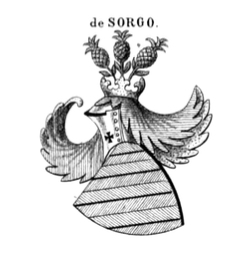
They kept the ties with their country of origin even later so that in the year 1292 (or 1272120), during a great famine a pinjoll of this family called Sorgo and a merchant from Arbëria sent a large amount of millet and grains to Ragusa others and therefore, there were favors (beneficiato) from the Great Council iRagusa. The word “beneficiato” contained in the text icited above, may also mean the elevation of this family to the rank of patricians and nobles (nobiles) of the republic.
Ragusan anonymous sources write that he became a noble of Ragusa by vote (alla fine, fu fatto per balote gentilhuomo di Ragusa). This person from Sorgove, whose name is not given but who helped the Ragusa people during the three years of famine, earned a lot of money and he was very kind-hearted, he helped the poor and gave money on credit, he eased the situation, where he could, thus becoming a great friend, companion, partner and sworn brother (fratello giurato) to many Ragusa people.
In Jireček we also find other data about people who bore this surname, such as Sergius Marini de Sorgo who is mentioned in 1283, Drazha, the wife of Giv Pasque de Sorgo, (Drase uxor Giue Pasque de Sorgo), mentioned in 1346, Dragoe de Sorgo, Dobroslav de Sorgo, or Tamara, the widow of Mr. Luche de Sorgo, mentioned in 1443 (Tamara, 1443 relicta Ser Luche de Sorgo), etc.
According to Lukari, before this family had the name Sargulo and was part of the families that had continuity until the beginning of the century. XVII, at the time when the work of G. Lukari was published (1605), who lists this in the list of noble families that still existed at that time. Jireček mentions in his work the surname Sergulo who is found in 1119 in Split, but it says nothing about their origin.
Butthis probably has nothing to do with the last name Sargulo that Lukari mentions. According to Jireček, this family also had a line that was known in Ragusaalso with the last name Pastusina. According to Jireček,in the century XIX this family was already extinguished inRagusa, but in Hungary they must haveits descendants continue to exist, precisely from the Pastusina line that we mentioned above, and that was also found there in the Pesta variant.
Spani (Spanich)
Regarding Spanich (Spaniq), we think that in this case it is a branch of the Spani family.

The Spani family
(Span, Ispanus, Yspanus) was originally from Shkodra and was among the main noble familiesin the medieval city of Drishti. According to J.It is found in Drançolli in 1380 and inRagusa. A branch of this family with the surname Spanich (Spaniç) Jireček is found on the island of Curzola in the century. XVI, and another branch in Sibenik (Sebenico).
Sozigal
The Sozigal family was originally from Durrës and must have been extinguished in 1374. Members of this family are also found with the surname Scoziliza in the Books of Reforms (Liber Reformatorium). Perhaps it is also about them when the surnames So ibabi or Sa ibabi are mentioned in F. Miklosić’s documentary volume “Mononumenta Serbica”.
Spavo (Spavaldo)
Spavo or Spavaldo (erroneously also given as Spanaldo) was a family originating from Tivari, which according to the Anonymous Raguzine Annals, disappeared in 1310. The Annals of N. Ranjina give the date of extinction of this family in 1363. A family with such a surname Spavaldi (Spavaldo) documented during the years 1278-1319 is also mentioned by Jireçek, who says that it was a line of the Crosi, Crosio or Crusi, who were originally from Kotor and are known as nobles of Ragusa in the century. XII-XVII.
The Reformation Books (Liber Reformatorium) give this family documented in different years in relation to different issues: In 1301 Giorgio Spavaldo is mentioned who is obliged to go to Ragusa with his whole family within a certain period, and if he would be late, he would be fined a heavy fine of 500 perper. Giorgio went on the appointed date accompanied by Johannes Spavaldus.
The text does not mention the reason for this forced trip by the Rogat Council.In 1305, the wife of Gergj Spavaldo (uxor Georgii de Spavaldo) is mentioned, who had to go to the queen in connection with giving something or paying a debt, but the text does not specify what it is. For the trip to the queen, George’s wife would receive 80 perpet from the municipality of Ragusa.
In case she did not go, then all the properties would be handed over to an envoy of the queen. Further, Marinus de Spavaldo is mentioned in 1347, and Mara e Marin de Spavaldo (Maroe Marini de Spavaldo) is mentioned in 1363.
The Stano family
The Stano family, according to Drançolli, was of Albanian origin, but remains completely unknown to this day. Jireçek mentions another form of Stanoje which belongs as a surname to a merchant family and which was apparently of Slavic origin , but this, we think, has nothing to do with the aforementioned Stano family.
Stila (Stilla)
The Stila family was of Albanian origin and remains quite unknown.
We only know that it was originally from Shkodra and must have been extinguished either in 1390 according to the anonymous Annals, or in 1400, according to the chronicler Nikolai Ragnina. In a Ragusan document from 1435, a judge named Nicola Stella is mentioned, in connection with a work contract for making a leather travel suitcase for Gjon Gazulli.
And in 1439, a chancellor and procurator named Niksha de Stella is mentioned, to whom are deposited several letters of Gjergj Kastrioti (Skënderbeu) and his mother Jella (?) addressed to the Republic of Ragusa for the continuation of commercial ties. We are of the opinion that here it can be a question of the Stilla family and that Llagapi may have undergone transformations through documents by different writers.
Strepaza (Stepaza)
The Strepaza family was originally from Shkodra and according to the Anonymous Annals it must have been extinguished in Ragusa in 1319. Whereas Ranjina gives the date of their extinction in 1348, a date that must be wrong since this family is not mentioned in the Books of Reforms (Liber Reformatorium). The name of this noble house is also mentioned in other documentary sources, such as p. sh. in a document belonging to the year 1190.150
Valkaselo
Valchaselo (Volcoslavo?) according to the anonymous Ragusan Annals, were from Shkodra. They appear in Ragusan documents from the c. XIII. In a document from 1252, a certain Velcassus Johannis is also mentioned, who was a councilor in one of the councils, either the small or the big one, but the document does not specify which one (nos consiliari de parvo et magno consillio).
For this person we think belonged to this family.This name is not certain, as in the documents it is strangely deformed as p. sh. Volcay, Volcax, etc., as can be seen in the year 1312 in the long register of magistrates and councilors of Ragusa, where Petrus de Balisela is mentioned, who may also be a person from the Balislava tribe.
Valchaselos are found in Ranjina with the name Volchossavo, while in the annals of Stirani and Lukari, they come under the name Volcosto. According to the anonymous Ragusan Annals, this family died out in 1313, however, their name appears even later as p. sh. in the Books of Reforms of different years. Among them we can mention Laurenc de Volkacion (Laurencius de Volcazio), who in 1359 became supervisor of the grain (massarius) of the municipality of Ragusa, taking an oath before the rector.
Researchers Irena Benyovsky Latin and Stipe Ladi in their study mention this family with the surname Volcassio (Vukasovi) and describe it as one of the most powerful families of Ragusa in the century. XIII with a large real estate, but they say that the origin of the family was from Bosnia. Now regarding our Albanian history, during the 50s of the century. XV mentions a deacon who served as ambassador between Skenderbeu and Ragusa.
This person is given to us sometimes only by name and sometimes by name and surname in different forms such as p. sh. in 1459, Ninec Vikosaliq and Ninac Vukosaliq. We are of the opinion that this is a member of this family and that the name is written in different versions due to the inaccuracy of the chancellors and their scribes.
Tani
Now the Ragusan noble family Tani was of Albanian origin,162 but remains completely unknown to this day.
In 1465, a certain Nikollë Tani is mentioned (Nicolam Tanus) as witnesses of the will of the magistrate Gjon Gazulli, which we mentioned above. This one is mentioned in the Ragusan documents under the name dom Nicola Tani from Novomonte (dom Nicola de Tanus de Nouamonte).
Veceffi (Veresti)
The Veceffi or Veresti family were from Shkodra. In a document from 1252, a Mateus Veresti is also mentioned, who was a member of the Great Council (consiglio maggiore) and later also a Johannes, whom Ranjina mentions with the surname Vezeffi. J. Drançolli gives the last name of this family as Vecessi.
Vlaich
The Vlaichi family, according to J. Drançolli, was of Albanian origin, but remains completely unknown to this day.
Vilanelli
The Vilanelli or Villano (or Vilano) family was from Ulcinj and may have been extinguished in 1361. The members of this family are found with unchanged names in the Books of Reforms. They were also called Vetrano, and should not be confused with the Vetrani family, which was originally from Kotor.
Vitaly
According to Nikola Ranjina, the Vitali family was from Ulqin and must have been extinguished in the century.XIV. He must have belonged to this family Pere Ufl Vital, who in 1304 was a memberin the Council of Prayers (Consiglio deiprepare). The name Vital comes across a lotthe Ragusan documents, but it must be said herethat this name is not only a family llagap, butalso a favorite name in Ragusa since the times ofearly and as a result, not every Vital belongsto the aforementioned family.
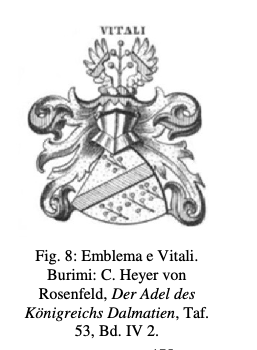
Among the persons whohave this surname we can also mentionthe cleric Bubana de Vitali, who served asnotary under the archbishop of Ragusa during the period 1255-1262, but we have no further information about him.
Viterbo
The Viterbo family came from Shkodra, but its ancient origins were from Rome and came to Ragusa with King Radoslav of Bosnia.
Zarxaras
According to the anonymous Annals of Ragusa and the Ragusa historian N. Ranjina, the Zarzaras were originally from Shkodra 1310. In the first years of the century. of XIV, in the Books of Reforms also appear the similar surnames Zozolus, Zezulus, Zuzulio, which were held by a person named Marin (Marin Zuzulio), who was a patrician from Ragusa and in the years 1303 and 1304 he also had duties in the municipality of Ragusa.
His son Antonius (Antonius filius Marini Zuzulio) is also mentioned as a functionary in the year 1314, more precisely, he becomes supervisor of the salt market (salinarius) in the same year (1314).
Zepre (Çepre)
Zepre family was originally from Tivari and seems to have disappeared in the year 1361. Ranjina gives the year 1364 as the year of extinction, and calls it by the name Zerpe.
While in the form Zepie we find it in the Annals of Storani and in the Work of Lukari.184 Jireček also mentions this family in his study, giving the form “Cyprianus” as an alternative surname, but with a question mark. He ranked it among the noble families of Ragusa (Nobiles von Ragusa) for the period 1284-1335.
Other members of this family or of this noble house also come across with changed names, or rather misspelled names, such as p. sh. Andrea de Nicola de Zigo, who in 1312 was a member of the Great Council (consiglio maggiore) and Vole de Zige, who is noted as a noble man (nobil’uomo) and who in April 1324 was appointed night watchman of the city , whereas in the Reformation Books (Libri reformationum), apparently Zepret also encounter the surnames Zuperio, such as Marinus de Nicola de Zuperio, who became a scribe (scribanus) in the year 1312; further as surnames in the variants Zuperi, Zupari (Tolisclavi Zupari (1312); Marinus de Zupari (1343)), Zopre; but in relation to these names it cannot be clearly seen that they belonged to the patrician families of Ragusa.
Among the people who bore this surname, we also encountered Stoiano de Zepre, who was a scribe in Ragusa during the years 1312-1319. Because Jireček in the above-mentioned work places it in the list of Roman families, it is possible that it had a Roman origin, even why the author himself expresses reservations about the origin of many of these families in Dalmatia, due to insufficient sources. We have no other data about this family.
Reference
NË GJURMË TË FAMILJEVE FISNIKE RAGUZANE ME ORIGJINË NGA TROJET SHQIPTARE. Edmond Malaj. 2019. https://www.academia.edu/40997205/N%C3%AB_gjurm%C3%AB_t%C3%AB_familjeve_fisnike_raguzane_me_origjin%C3%AB_nga_trojet_shqiptare_On_the_trails_of_the_noble_Ragusan_families_of_Albanian_origin_


 Balkan Academia