

Written by Petrit Latifi
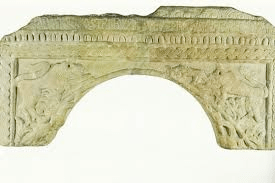
In the National Museum of Belgrad, there is a ciroborium from Ulqin dated from the 9th century. Considering the Catholic heritage of this Ulqin ciroborium, and most likely an Albanian one, it is not surprising that this is in fact another stolen artefact, just like the other stolen Illyro-Dardanian artefacts of Kosovo which Serbia has yet to return.
What is a ciborium?
“A ciborium (plural ciboria; Medieval Latin ciborium “drinking cup”, from the Ancient Greek κιβώριον kibōrion, “drinking cup”) is a vessel, normally in metal. It was originally a particular shape of drinking cup in Ancient Greece and Rome, but the word later came to refer to a large covered cup designed to hold hosts for, and after, the Eucharist, thus the counterpart (for the bread) of the chalice (for the wine).
In medieval Latin, and in English, “Ciborium” more commonly refers to a covered container used in Roman Catholic, Anglican, Lutheran and related churches to store the consecrated hosts of the sacrament of Holy Communion. It resembles the shape of a chalice but its bowl is more round than conical, and takes its name from its cover (surmounted by a cross or other sacred design.
In the early Catholic Church, Holy Communion was not kept in churches for fear of sacrilege or desecration; the religion was still largely illegal and subject to frequent persecutions. Later, the first ciboria were kept at homes to be handy for the Last Rites where needed. In churches, a ciborium is usually kept in a tabernacle or aumbry. In some cases, it may be veiled (see photograph below) to indicate the presence of the consecrated hosts. It is typically made, or at least plated, in a precious metal.”
Stolen from the Ulqin between the two world wars
“The best preserved arcade has been discovered in archaeological strata of the church within the citadel of Ulcinj in the period between the two World Wars and is kept today at the National Museum in Belgrade (ig. 3). Other fragments of the ciborium, along with the parts bearing the inscription, have been discovered in the course of the subsequent decades on various locations witin the oldest part of the city.”1
SVB TEMPORIBVS DOMINI NOSTRI PIS PERPETVO AGVSTI DN LEO ET DN CS
On the Ulqin ciborium, the text “SVB TEMPORIBVS DOMINI NOSTRI PIS PERPETVO AGVSTI DN LEO ET DN CS” is inscribed. This is Byzantine-Latin and not Slavonic.2
The ciborium was made when a regional ecclesiastic organization existed
“In a word, what must have stood “under” this part of the Ulcinj inscription was Cosma’s will and testament. Because such documents were normally tied to the church, it could only have been ratiied by the bishop, which, in turn, speaks of the existence of a municipal or regional ecclesiastic organization at the time of production of the ciborium.”3
Ulqin as a Hellenic-Illyrian-Roman emporium
“Ulcinj was one of them, an ancient Hellenic-Illyric-Roman emporium, the location of the early medieval ciborium whose textual/visual contents are the subject of study of this paper.”4

There are no Catholic Latin ciboriums of Serbian origin

Source here.
Ciborium in Roman capital letters and the proto-romanic ornament
“… the ciborium of Ulcinj , dating from 813-828 , in Roman capital letters mentioning donator Guzma . The decorative motives on this monument de-monstrate the widespread influence that proto-romanic ornament had unifying Langobardian …”5
The Ulqin ciborium sepresent a separate group
“The square font and ciborium in Kotor, the pluteus and the fragments of a ciborium from Prevlaka in Boka Kotorska, the fragment of a ciborium in Komolac (Rijeka Dubrovačka) and the ciborium in Ulcinj represent a separate group.”6
The Ulqin ciborium bares the name of Emperors Leo V the Armenian.
“… Ulcinj ciborium bares the names of Emperors Leo V the Armenian and his son Constantine (813–820), and an inscription from Budva is dated to 840.”7
Two lions, a palmette and the tree of life depicted on the Ulqin ciborium
“… ciborium from Ulcinj . On this ciborium ( on one side ) two lions are shown on opposite sides . One is shown with a palmette , the tree of life , while the other one is catching a small animal .”8
Western art of the ciborium
“These are the remains of a ciborium, which stylistically belongs to Western art, but M. believes that the Byzantine emperors mentioned in the fragmentary Latin inscription are Leo V the Armenian and his son Constantine.”9
References
- https://www.academia.edu/31015437/Emperor_in_the_Altar_An_Iconoclastic_Era_Ciborium_from_Ulcinj_Montenegro_in_Texts_Inscriptions_Images_Art_Readings_2016_eds_E_Moutafov_J_Erdeljan_Sofia_2016_2017_49_67 ↩︎
- Ivan Stevovic, 2017, p. 54. imbid. ↩︎
- imbid. p.58 ↩︎
- imbid. p.52 ↩︎
- https://books.google.se/books?id=PvwMAQAAIAAJ&q=The+ciborium+from+Ulcinj&dq=The+ciborium+from+Ulcinj&hl=sv&newbks=1&newbks_redir=1&printsec=frontcover&sa=X&ved=2ahUKEwi6-be82tqHAxW7AhAIHb71NEoQ6AF6BAgLEAI ↩︎
- https://www.google.se/books/edition/Croatia_in_the_Early_Middle_Ages/jGkMAQAAMAAJ?hl=sv&gbpv=1&bsq=The+ciborium+from+Ulcinj&dq=The+ciborium+from+Ulcinj&printsec=frontcover ↩︎
- https://books.google.se/books?id=gpByDwAAQBAJ&pg=PA35&dq=The+ciborium+from+Ulcinj&hl=sv&newbks=1&newbks_redir=1&sa=X&ved=2ahUKEwi6-be82tqHAxW7AhAIHb71NEoQ6AF6BAgIEAI ↩︎
- https://www.google.se/books/edition/Starohrvatska_prosvjeta/3HexGoJbQG4C?hl=sv&gbpv=1&bsq=The+ciborium+from+Ulcinj&dq=The+ciborium+from+Ulcinj&printsec=frontcover ↩︎
- https://www.google.se/books/edition/Byzantinische_Zeitschrift/Lu5YAAAAMAAJ?hl=sv&gbpv=1&bsq=The+ciborium+from+Ulcinj&dq=The+ciborium+from+Ulcinj&printsec=frontcover ↩︎


 Balkan Academia