
Saxed from Quora and written by Arbër.
I received the account of the terrible massacre of the Vejsa family, in Gjakovë, by the criminal Serbian military forces, in cooperation with local Serbian residents dressed as paramilitaries, immediately after the 1999 war in Kosovo, from Mrs. Nesrete Vejsa-Nuka from Gjakovë, then a 42-year-old woman.
According to Mrs. Nesrete Vejsa-Nuka, during the war waged by the Serbian military and paramilitary forces in the three months of the spring of 1999 in Gjakovë, many Albanian residents were killed in their homes, massacred in the most cruel ways and burned alive together with with the houses.
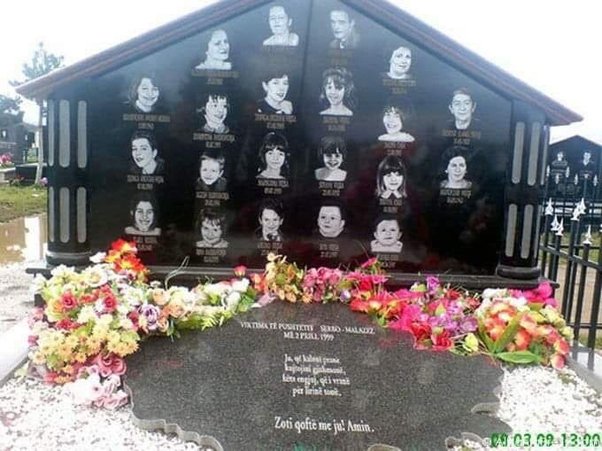
On April 2, 1999, Serbian criminal fascists massacred and burned her family members, the dearest of her heart, along with the house: her mother Fetije, 60 years old, her brother’s daughter-in-law (Lulzim Vejsa), Tringa, 30 years old, together with their five children, her 10-year-old Dorina, 8-year-old Marigona, 6-year-old Sihana, 4-year-old Arlindi and one-year-old Rita.
Little Rita had been sucking mother Tringa’s milk when Serbian military criminals with sharp knives had split her skull in half.
Tringa, horrified by the crime committed against them, had tried with all her spiritual being and with all her last strength to protect the creature of her soul, but the criminals had killed her with a volley of bullets and slaughtered her with knives, cutting her toned and beautiful figure to pieces.
Nesrete’s sister, Valbona Vejsa-Haxhiavdija, 38 years old, was also killed there, along with her three children: Doruntina, 9 years old, Egzona, 4 years old, and Rina, 3 years old. All of them had been killed and at the same time burned to ashes. Nesrete and all their loved ones, who had remained alive, had dried up their souls forever.
Nesrete’s sister, Valbona Vejsa Haxhiavdia, on the night that the fire of war had engulfed Teçenë and many other houses around her house, in the neighborhood of Hadum in Gjakova, had left her house and gone to take shelter in the house of her mother. There was no other way out but to leave, because the children had almost gone mad when they saw the sad all-encompassing fire and when they heard the many crackling of different weapons right in front of the door of their house. The fire and the many cracklings had not stopped during that terrible night. Valbona had fled through the bullets and had taken shelter at the house of her mother and brother, Lulzim Vejsa, thinking that maybe it will be calmer there. It hadn’t turned out the way Valbona had thought… In her mother’s house, instead of peace and salvation, she had found sadness and terrible death. Serbian military criminals there had made the slaughterhouse of unprecedented human crime…
According to Ms. Nesrete Vejsa Nuka, in her brother’s house, her aunt Valbona Caka, 33 years old, had been massacred and burned, along with her three daughters: Dalina, 13 years old, Delvina, 6 years old, and Diona, 2 years old. Valbona Caka had gone with her three daughters and her son, Dren Caka, to shelter in the basement of the new house of her husband’s uncles, thinking that the newly built house will be a stronger and safer shelter to resist the powerful and unstoppable bombardment, which the Serbian criminals made on the defenseless city, on her beloved Gjakova. He had also gone with the idea that by staying together as a majority, they would give each other courage for the center and for survival over the incomparable horrors that were being done to them.
Other sheltered in Lulzim Vejsa’s house were Tringa’s mother – Shahindere Hoxha, 60 years old, together with her daughter, Flaka, 16 years old. In the blink of an eye, Flaka Hoxha’s beautiful body was writhing and burning in the blazing fire, which had engulfed the room with lightning speed. Nesrete’s uncle Hyseni, sick and lonely, and her mother’s two neighbors, 72-year-old Shirine Nuçi, together with her daughter, 52-year-old Mandushe, were sheltered in that house.
All those sheltered in Lulzim Vejsa’s house in Gjakova were women of different ages and children.
There were 12 children, who at the beginning of their childhood had forever lost hope for the coming springs. They were brutally killed by Serbian military criminals who cut them with knives.
For 4-year-old Rina and 2-year-old Diona, on the day of their birth, which they had that night, the candles of their childhood dreams were extinguished, never to be lit again in their lives. They had not even enjoyed life enough, because the Serbian military criminals, from the beginning, had stoned the steps of their childhood joys. The children didn’t quite understand why “people” kill people’s lives?!
Only the 10-year-old boy, Dren Caka, escaped from that horrific butchery, wounded in the arm, to witness the hell of organized crime. Within that half hour that sad horror had lasted in the dining room of uncle Lulzim Vejsa, Dren had seen how the Serbian criminals poured volleys of bullets into the flesh of the Albanian man. He had seen streams of blood from his loved ones and acquaintances snaking their way across the floor, while the many human body parts scattered across the room burned wildly in the all-consuming flames of the scorching fire.
Dren was saved because it was lucky to be saved! When the criminals had fired a volley of bullets into the room, one bullet had shot Dren in the arm and laid him on the floor. The other slain and massacred had fallen on top of him and he had escaped beneath them. When the criminals had entered the room to check the success of their criminality, he had pretended to be dead. Coming out, the Serbian military barbarians had set Lulzim Vejsa’s room and house on fire, to burn and disappear all traces of the crime committed.
Dreni, who had escaped alive, slowly with the wound that continuously bled, had slowly dragged itself to the window of the room, which had been slightly open, and had thrown itself into the yard. He had not been hurt much in jumping from the window, for he had not fallen directly to the ground, but had fallen into some of his uncle Luli’s billiard-boxes, which had been propped up against the wall, under the eaves. Because he was a very flexible child, even with the serious wound on his body, he had overcome wall after wall in the neighborhood and reached his own house, where grandfather Xhemil Caka and grandmother Nakije Caka were.
Don’t wait for them, because they are no more, they killed them and after slaughtering them, they were completely destroyed by Serbian criminals…! – Dren had said to his grandparents, with the saddened pain that only a very intelligent child, like him, who had grown into a man before the maturity of his age could have…
They had only looked at the boy in horror and had never been able to come to terms with the bitter reality. They thought that maybe Dreni was slurring from the agony of the wound. The worried grandparents of Dren were thinking about everything…!
Actually Dren Caka had not been in agony. He had faced the wound stoically and had been very clear about what he was talking about, the killing and burning of his loved ones by Serbian military criminals, in the house of uncle Lulzim Vejsa. He had not been able to save any of them, because they had all killed and mortally wounded the criminals. Neither his beloved mother Tringa, nor little Diona could save Dreni, who even now says that her childish voice somehow echoes: “Baca, don’t leave me in the fire…!”.
Arlindi, the son of his beloved uncle Luli, who had also had an inseparable childhood friend and whom he had been close to during the time of the crime against them. He had tried to move him and to wake up Arlindi to run away with him from that slaughterhouse, but after three or four deep breaths that Arlindi had taken, he had given no more signs of life. Then Dreni put his hand under Arlind’s jacket to check his heartbeat, but he was terrified, because his hand was swollen from the unstoppable blood bubbles.
The grandparents, left open-mouthed by the horror of what their beloved grandson, Dreni, was confessing to them and almost maddened by the terrible tragedy that was likely to happen to him, were too late to give quick help to the boy. Where did they send him and where did the poor grandparents go, when the whole city of Gjakova was in the flames of great evil that night?! How could they get through the armed Serbian military forces and through the many tanks that had stormed the city and wreaked havoc by firing shells and grenades from their mouths?!
However, Dren’s grandparents had decided to do the impossible, relying on luck, and with their son in hand, they set off through the smoke and flames on the road towards the city center. With great difficulty, being very afraid, lest the Serbian military criminals stop them and take their son, or kill them in front of their eyes, they arrived at the hospital, where several Albanian doctors had been working until that night. The Albanian doctors, with great parental and professional care, had removed the bullet and bandaged Dren Caka’s wound…
The organized action of terror that night in Gjakovë had involved almost all the neighborhoods of the city. At least 75 people, mostly women, children and old people, were killed in the “Mahalla e Qerimi” neighborhood, str. “Sadik Stavileci”?! The screams and clamor of the people who were being trafficked there were heard everywhere, from one end to the other end of the city, and the echo of that scream had created the impression among people that it reached even the dome of the sky…!
The night of April 2, 1999 in the city of Gjakova was a terrible night. It was St. Bartholomew’s night… In all parts of the city, scenes of all kinds of sad crimes had been caused, and smoke and flames had gone all over the city from the burning of houses.
The action of terror on the defenseless Albanian population in Gjakovë had started after midnight, starting on April 2, 1999. The leaders of the action were all kinds of Serbian military-police and paramilitary formations, which had entered everywhere, house by house in the city and wherever they entered, they beat and killed Albanians and burned their houses.
Local Serbs, mainly residents of the neighborhood, dressed as paramilitaries, committed the crime in the house of the Vesajs of Gjakova.
Lazar Drašković a Roma-Serb of Klina, called “Crni Laza”, had entered the houses from door to door and driven the Albanians out of the neighborhood and out of the city entirely. He knew how to speak Albanian without mistakes, and was a regular militiaman in Gjakovë for a long time. He is always remembered for his arrogance towards Albanians. Where the Crni Laza militia was on the ground, Albanian blood was definitely shed.
According to the narrator, Nesrete Vejsa Nuka, the massacre in the house of the Vesaj family in Gjakovë is a serious tragedy of the war and an enigmatic event in itself, deciphered only partially from the narrow angle of knowledge of a very intelligent child, which was Dren Caka. Other witnesses were killed and burned to dust.
During the entire three-month war, the neighborhood had been under the strict control of the Serbian forces, since all their heavy weaponry had been concentrated there, withdrawn from the barracks, to protect themselves from NATO air attacks. The main headquarters of the Serbian military forces had also been there, and until the complete withdrawal of the Serbian forces from the city, the Albanian foot had not dared to set foot there first.
In addition to the Vejsa family members, also members of the following families were killed:
Caka, Deda, Haxhiu, Haxhiavdija, Hoxha, Gërçari, Nuqi, Gashi. Dalina Ali Caka (14), Delvina Ali Caka (8), Diona Ali Caka (2), Valbona Valdet Caka (34), Arlind Lulzim Vejsa (6), Dorina Lulzim Vejsa (6), Marigona Lulzim Vejsa (9), Rita Lulzim Vejsa (2), Sihana Lulzim Vejsa (7), Tringa Honi (Hoxha) –Vejsa (34), Fetije Gashi-Vejsa (60), Flaka Honi Hoxha (16), Shahindere Jusuf (Nushi)-Hoxha (56), Doruntina Behar Haxhiavdija (8), Egzon Behar Haxhiavdija (5), Rina Behar Haxhiavdija (4), Valbona Mehdi (Vejsa)- Haxhiavdija (39), Mandushe Lutfi Nuqi (57), Shirine Lama – Nuqi (78) and Hysen Shaban Gashi (53).
Other families that suffered from Serbian forces are:
The Haxhiu family: Hasan Haxhiu, Myzafere Jonuzi – Haxhiu, Adem Haxhiu and Berat Haxhiu;
The Cana family: Jonuz Cana, Ganimete Rexha – Cana, Shpresa Cana and Fatmir Cana;
The Deda family: Hysen Islom Deda (77), Nisa Pruthi – Deda (61), Afërdita Deda – Demjaha (38) and Argjend Ylber Demjaha (6)
The members of Dinaj family (Hereq): Murteza (Bekë) Dinaj (35), Luan Murteza Dinaj (25), Gani (Bekë) Dinaj (43), Bajram (Zenun) Dervishaj (33), Nuredin (Musë) Aliaj (66) and Besmir Gani Dinaj (8);
The Gërçari family: Sulejman (Murat) Gërçari (Kola), Skënder Gërçari (Kola), Haxhi (Sulejman) Gërçari (Kola) and Albert (Sulejman) Gërçari (Kola),
Halil Rexhë Guci (45), Shukri Ramë Hoxhaj (15), Blerim Xhevdet Bardoniqi (38), Sahit Xhevdet Hasi (33), Bujar Faruk Tetrica (32), was wounded on the chest, on his way to Albania he died of wounds in Krumë (Albania). Mazllom Kasim Kavaja (48) from Mitrovica, Naser Nexhmedin Dylatahu (37) and Skënder Nexhmedin Dylatahu (38), Kimete Rasim Lleshi (1958) and her husband Fehmi Hamid Lleshi (1953), Gëzim Adem Alija (30), Sokol Adem Berisha (1957), Sabaudin Ramë Gllogjani (27), Hasan Osman Rexha (66), Fadil Beqir Krasniqi (34), Melaim Musa Qarkagjia (38).
References
Excerpt from the book “THE BROKEN SOUL – Serbian violence against Albanian women in Kosovo 1997-1999” – Naxhije Doçi.


 Balkan Academia