
Translated and written by Petrit Latifi.
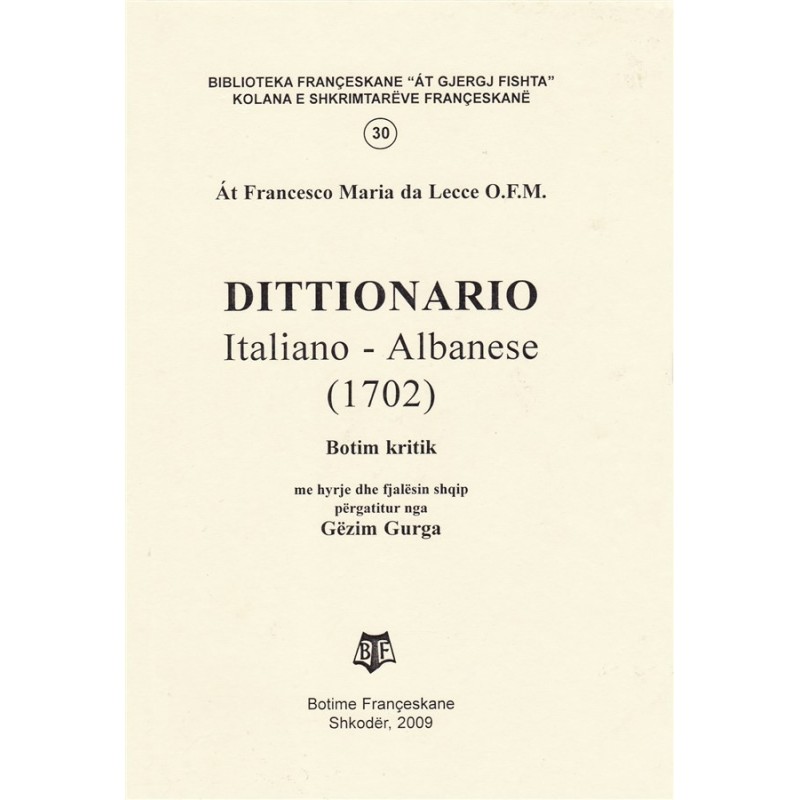
Friar Francesco Maria da Lecce†, after several years of intensive research, in 1702 completed the compilation of the “Dittionario italiano-albanese”, an imposing work of 562 pages, containing 11,200 lexical units. The words of the Italian language have been translated into the Gegënishte dialect, which is related to the fact that he served in the territories of central and northern Arberia.
The Italiano-Albanese dictionary is preserved in its entirety in manuscript. The reasons why it remained unpublished are unknown. On the cover of this major work there is an autograph, which indicates that the manuscript of the dictionary belongs to Papa Filippo Matrenga (Appartenga a Papa Filippo Matrenga), which makes us think that the author, Francesco da Lecce, had perhaps sent it to the Arbëresh Matrenga, for advice. This may be the reason why this dictionary is preserved in the Central Library “A. Bombace” of the Region of Sicily.
A feature of the dictionary is that Friar Francesco da Lecce wrote the Albanian language using the Latin alphabet, but for the double vowels dh, th, ll, xh, sh, zh, nj, which he calls special letters, he used letters borrowed from the alphabet of Monsignor Pietro Bogdani, i.e. He used the same alphabet as in the work “The Company of the Prophets”, and even for the letter LL he used the Greek letter λ, just like Bogdani. Francesco da Lecce named this dictionary “Alfabeto Albano”.
This fact is important, as it expresses the continuity of writings in the Albanian language, with an original Albanian alphabet, which in later years served for writing books in our native language, before the approval of the alphabet at the Congress of Manastir.
The letter ё is missing from Francesco da Lecce’s alphabet, and he did not even use it in the text of the Grammar, which he published in 1716, just as it was missing and not used by his predecessors and successors.
But in the midst of the darkness, the question of teaching in Albanian, and the closely connected question of the alphabet, begins to tease the minds. Since the Franciscan missionary Francesco Maria da Lecce had composed (1702) his Albanian-Italian Dictionary and then published the Grammatical Observations in the Albanian Language (1716), there had been no shortage, in the Age of Enlightenment, of grammarians, translators, or lexicographers.
Marko Boçari the Albanian who died for Hellas.
We will not list their names, limiting ourselves to recalling a lexicon due to the pen of Marko Boçari (Marco Bozzari) (1790-1823), one of the many Albanians who fought and died for Hellas. A leap in importance came with Vangjel Meksi, whose work was studied and appreciated, at least as a stimulus, by the greatest grammarians, philologists and glottologists of Europe. Vangjel Meksi (1770-1821) was one of Ali Pasha’s personal physicians. He had studied at the University of Naples. After leaving Janina’s court, he began to take an interest in his own language, composing a (lost) Albanian Grammar. Having come into contact with the British and Foreign Bible.
Reference

 Balkan Academia