

Written by Petrit Latifi.
The following article cites various publications on the history of the Albanians of Sandzak, today assimilated into Bosniaks due to Serbian slavization policies.
The Albanians of the Vukli tribe around Sjenica
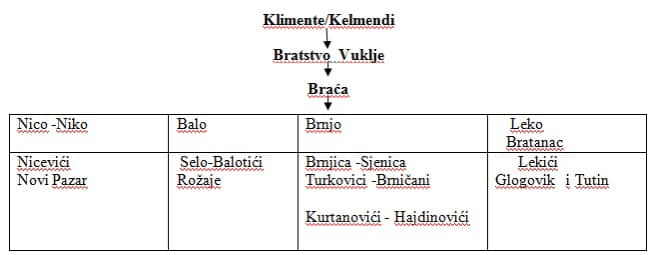
Prof. Dr. Ramo Kurtović, doctor of geological sciences, from Sarajevo, did his work out of love for the ethnogenesis of his people. In the book “Brnjica torn from hearts”, he describes his roots from the settlement of Brnjica near Sjenica. This settlement is made up of several neighborhoods located between Sjenica and Novi Pazar. He refers to more sources regarding the origin of this population on the Pesterit Plateau, and the oral traditions of his ancestors, which were passed down from generation to generation.
Everyone agrees that the Brničans are part of the Vukli tribe of the Kelmend (Kliment) tribe, and that they were three brothers: Nika, Bala and Bërnji. According to this version, Nika remained in Jasenovik, Bala went to Balotić, now in Rozaje, and the third Bërnji to Brnjić, and with them Leka, who was their cousin, since converting to Islam, these brothers now number about 12 generations or about 300 years.
This settlement was the border with Serbia and Turkey and the inhabitants were border guards, this border was always problematic, so the situation resulted in the Bërnjians with consequences and frequent departures in the wars of Turkey and Austria, so most of them never returned.
The Bërnjians were organized according to customary law. The lineage of this brotherhood was from Vukli, from them the Turković-Bërnjians, the Hajdinovićs and now the Kurtanoivics. Many of them are derived from them, such as the Aliçët, Ademović[t, Nucevic, Idrizovićët, Zekićët, Nikulićët, Sulevićët, Luburët. and many other surnames.
Let us mention here that today there are none of these families in Brnca, since the arrival of Serbia in these areas, all of them have moved to Turkey and elsewhere in the world.”1
Albanians of the Brničani tribe
“In 1876, the Albanians of the Brničani tribe (Sandzak region) were attacked near the village of Brnicza and completely defeated.”2
Albanian troops of Novi Pazar led by the Albanian Muktija Effendi in 1879
“In addition, there were strong influxes of several thousand Arnauts from the Sanjak of Novibazar, always ready to fight, under the leadership of the Albanian Muktija Effendi, who had turned grey on the battlefields of the Balkans and who soon afterwards became the actual military leader of the whole movement.”3
References
- https://www.facebook.com/photo.php?fbid=3363387163677792&id=1239849312698265&set=a.1332112416805287 ↩︎
- https://www.google.se/books/edition/Troppauer_Zeitung/EW8YJxfjqdAC?hl=en&gbpv=1&dq=Arnauten+aus&pg=PA27-IA10&printsec=frontcover ↩︎
- https://books.google.se/books?id=Nx4DAAAAYAAJ&pg=PA452&dq=Arnauten+aus&hl=en&newbks=1&newbks_redir=1&sa=X&ved=2ahUKEwiQju6JzPSJAxVwKhAIHZySKcc4bhDoAXoECAcQAg ↩︎


 Balkan Academia