
Translated by Petrit Latifi. Written by Enver Maloku.
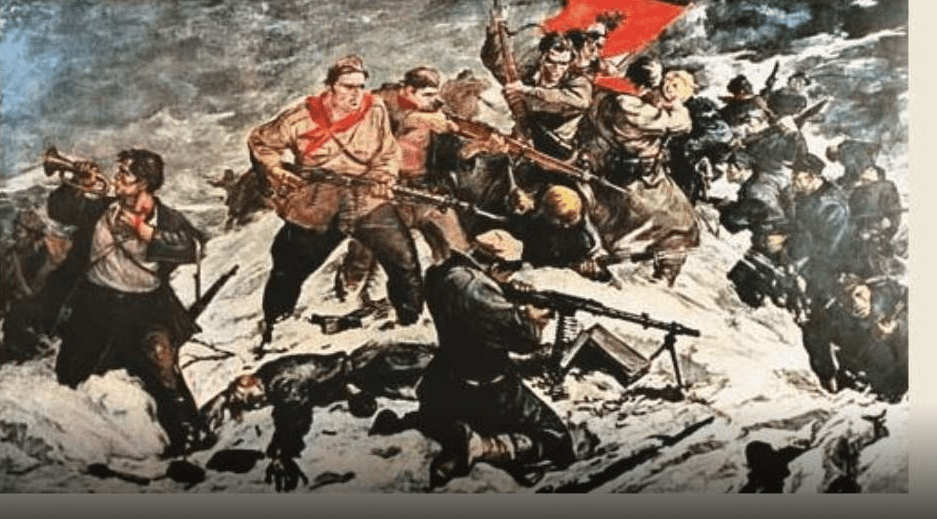
In late autumn, namely in November 1944, in Pločica of the then municipality of Kijevo (now the municipality of Malisheva), a bloody war took place between the Albanian patriotic forces and the Slavic communist, Chetnik and partisan forces, known as the War of Pločica.
In Kosovo, resistance against the invaders has continued in all periods of history. The opposition has been carried out with all forms of resistance, from assemblies in chambers, various gatherings to armed struggle. Pločica has a rich and sensational history full of notable events, such as the 1944 War against the partisan-Chetnik battalion of Rakoš, which was launched by the boys and men of this village, to be joined by other villagers from the surrounding area. Every time and at every time, the Maloku family has shown itself for its bravery and generosity. Therefore, Plloçica has often been burned and roasted.
The sons and daughters of this village have been killed and massacred, pursued and persecuted, in different periods. There were brave and elderly Plloçicas, whose word went to the Assembly log, along with other leaders in the voice. They were men of their word, but also of the rifle. The clashes with the Turkish, Serbo-Montenegrin, Austro-Hungarian and Bulgarian hordes are remembered. They were on the side of Bajram Curri, Isa Boletini, Sadik Rama of Gjurgjevik the Great, Ramadan Shaban of Kijeva, Alush Smajli of Llazica, Shaban Polluzha.
However, this village is known for the armed resistance against the Slavic-communist and Chetnik forces, in the autumn of 1944. This bloody clash, known as the Battle of Plloçica, was a war against the Serbo-Slavic forces. The Yugoslav regimes had considered it resistance against Yugoslavia, communism and partisan forces. However, this resistance was silenced and forgotten, but not because of the consequences of the murders, burnings and imprisonments that this village and its inhabitants had experienced over the years under Serbian rule, even to the point of deprivation of every civil right, including education.
This year marks 80 years since this glorious war of resistance and the disagreements of being in captivity and subjugation, even at any price, took place. The reasons that even the Serbian and Yugoslav authorities have not given it publicity and echo, whether in the media or other forms, are also due to the fact that this was the first armed resistance against an occupying power that was coming.
And to leave the impression that in Kosovo there was no opposition to Kosovo remaining unjustly under Serbia and Yugoslavia. On the other hand, other experts on this event have not had any opportunity to write or publish something like this. Thus, the sources for this historical event are few.
Ismet Shaqiri mentions it in passing in his book “I Remember”, of course in a negative context and according to his version, giving the Pločica war a hostile and anti-Yugoslav character.
But this does not mean that in various circles of the Yugoslav Communist Party and various state bodies, police and prosecution bodies, there was no discussion and compilation of files. For now, the evidence of this war are the accounts of people who experienced this war and the consequences they suffered from this War. Another authentic evidence is the archival case no. K.or.79/52 of the prison sentence in the Prizren District Court in 1952, of one of the fighters and protagonists of this war, Zenel Mosh Malokut.
This file was found in the Kosovo Archives, which describes this “hostile” war for the power of the time, as well as a reportage by the writer, writer, publicist and literary critic Prend Buzhala, published in the newspaper Bujku dated October 9, 1996 on the confessions of Zenel Maloku, the only participant convicted of the charge of participating in the Plocica War and the murder of the partisan (Chetnik) Milan Pllesha from Gorazhdeci in the Peja District, as well as a broadcast on Prishtina Television in 1985, prepared by Sadri Morina. Therefore, this treatment also refers more to these sources.
Why only one person was convicted, this also had the character of diminishing and minimizing this war, as the first armed resistance against the Slavocommunists and Serbian Chetniks and other opponents of Kosovo. The Battle of Pločica took place at the end of November 1944, after which in 1945 the Battle of Drenica took place, led by the brave Commander Shaban Polluzha. The Battle of Pločica has never been amnestied or forgiven. This is evidenced by many records left by its participants, but also by others. Even the later Yugoslav governments have not left any detailed records about the Battle of Pločica. But this does not mean that it was not discussed in narrow party circles and security bodies.
Files and letters, evidence and labels of various kinds have been created, especially when it was necessary to issue a document or request a permit for an activity. The answer was always negative. Pločica had shown readiness and resistance to all invasions over the centuries, from the Ottoman Empire, the years 1878-1900, the years 1912/13, the 1920s, to the Pločica War of 1944, and to the last, most glorious war of the Kosovo Liberation Army, against the criminal and genocidal regime of Serbia, against the Serbian army and police.
History
Zeqir Osmani and Hisen Hajrizi against the Ottoman forces
Against the Turkish invaders, Zeqir Osmani and Hisen Hajrizi had fallen in Idriz Seferi’s Koshare, about whose bravery the verse of the song says “Zeqir Osmani and Hisen Hajrizi were brave, who for their faith and bravery had no tribe”. Even in the wars of 1878, known for the capture of Karadak, the saying “Rugovë and Podgur 72 martinë, from Llapushë Ibish Vermica and Ibish Maloku” was passed down among the elders.
The Albanian League of Peja, implementing the decisions of the Albanian League of Prizren, organized an uprising to protect Albanian lands in Montenegro, after the Decisions of the Berlin Congress (1878). Haxhi Zeka had issued a decree to protect Albanian territories from Montenegro. The Albanians of Peja and the surrounding area had responded positively to that decree. Meanwhile, Haxhi Zeka had organized the uprising and supplied it with weapons, ammunition, bread and clothing.
Among those who responded to Haxhi Zeka’s Kushtrim were brave men from the village of Pllaqicë: Bajram Mustafa-Maloku (killed in Montenegro), Balë Maloku, Bajram Syla-Gashi and others. Bajram Syla, in the war for the defense of Berana (now a territory and city in Montenegro), was distinguished for his bravery and skill. He had taken the “two prides” of the Montenegrin warriors and had taken the corpse of an Albanian comrade, carrying it on his back to Peja, to prevent the Montenegrins from taking his head. For his rare bravery and sacrifice, Haxhi Zeka had gifted him with an English rifle (manzere with a key), which Bajram Syla had carried until his death.
Bajram Mustafa Maloku and Balë Maloku in the Battle of Berane against Montenegro
Therefore, the battles in Berana, Montenegro, where Bajram Mustafa-Maloku had bravely fallen in a confrontation with the Montenegrin forces, are also known. There was also Balë Maloku, who, together with other fighters, had pulled Mustafa’s body, so as not to leave it on Montenegrin soil. Osman Hajdari was also distinguished, who had been informed about the raising of the Flag in Vlora in 1912.
Boys and men of the Malokus had also joined Bajram Curri in the Highlands, where Avdyl Bala was the youngest of Bajram Curri’s soldiers. They were also in Albania with Isa Boletini in support of him. Among the elders, the stories of Haxhi Zeka-Maloku, one of Isa Boletini’s supporters, who had been very close to Isa Boletini’s family, are told.
Rexhé Avdyl Maloku
Meanwhile, Rexhë Avdyli-Maloku, the gunner, former member of the “Skënderbeg” Regiment in the Battle of Koloshin, against the Chetnik hordes, was known as the best gunner of the regiment. He hit the Chetnik targets with his cannon. It is known when he blew up the Milentije tower with his cannon along with the Chetniks who were inside it.
This Pločica had also returned the rifle to the partisan-Chetnik battalion of Rakoš in November 1944. In revenge, the “Bokelska Brigada” of Kotor burned Pločica with fire and iron and killed and tortured many Pločica residents. Consequently, the most important event was the Battle of Pločica in November 1944, due to participation in this war, its national, anti-Serbo-Slavic and anti-communist character, it gave punishments and other consequences throughout the Yugoslav regime, being discriminated against in various forms in employment and education.
This war had not occurred with any prior preparation, but as a revolt and armed resistance against the arrival of the Rakoš Brigade in the village, without any warning. The partisan brigade was composed of Serbs and Montenegrins, as well as Albanians. It was not known who they were exactly, because Chetniks also infiltrated the partisan brigades. Then that period was known as the “Time of Albania”, where the local government was led by Albanians, even patriots and authoritative people. In Kijevë, the leader was Alush Smajli, a brave patriot known for the freedom of Kosovo, a staunch opponent of the Slavo-communist partisans and Chetniks.
Alush Smajli “Qarrataja”, Hajdar Osmani Maloku, Miftar Ramoshi, Halil Rexhepi and others in the Pločica battle
Alush Smajli, known as “Qarrataja”, had helped the Plóčica War, and he had even continued the war in 1945 against the Chetnik partisan forces, in the mountains of Gulboc and Plóčica until his heroic fall. With him were the famous brave men of Plóčica, Hajdar Osmani-Maloku, Miftar Ramoshi-Maloku, Halil Rexhepi, and others. Plóčica did not want the war, but it was imposed by the Slavo-communist partisan and Chetnik ranks.
An attempt was even made to avoid armed conflict. Shaban Basha, a former Spanish fighter who was also involved in the liberation movement, but who was viewed as suspicious by the partisan leaders, had also come to talk to the village representatives and was not trusted. He knew the Maloks and was their friend and ally. There is no evidence that Shaban Basha was part of these Slavic communist military formations.
The Rakosh Brigade was led by Ismet Shaqiri and Portiq Radosav (killed in the Battle of Plòčica). The conversation took place between Shaban Basha and representatives of Plòčica, Mosh Bala-Malok and Hadar Osmani-Malok. They had requested the removal of these aradhes from the village. However, Ismet Shaqiri had ignored this request, and had even arrogantly replied “The Germans could not stop me, and the Maloks of Plòčica are stopping me”.
After this, a bloody clash occurred between the villagers and the Slavic communist partisans. In this war, Tafil Sejdia-Maloku and Zeqir Sejdia-Maloku were killed from Plòçica, whose remains were reburied in September 1999, along with 24 martyrs killed by the Serbian army and criminal police in the last war. Vesel Zeka died from his wounds.
Hajdar Osmani-Maloku, Xhemë Osmani-Maloku, Halil Rexhepi-Maloku (wounded), Hisen Veseli-Maloku, also wounded, Zenel Moshi-Maloku, sentenced to prison for this war, Qazim Rexhepi and other villagers from Plòçica and surrounding villages, Memë Bashota, from Cerovik, wounded, Bajram Bilalli from Gullboc, Demush Loshi from Rixheva, and others also participated in this war.
On the part of the partisans, Portiq Radosav, Milan Pllesha, Adem Bajrami were killed and 8 were wounded, according to Ismet Shaqiri’s book “I Remember”. The participants in the Battle of Plločica had created an organizational structure, the combat units operated without any command hierarchy. Everyone was the same, equal, volunteers to repel the invaders.
Fear had already spread not only in Llapushë but also throughout Kosovo, that another trap was being prepared for the Albanians and Kosovo, so even well-known and patriotic names were understanding the deception, so they began to abandon the partisan ranks, in which there were also Chetniks of Drazha Mihajlovic, who instead of Chetnik cockades were putting on the five-pointed communist star.
Events were flowing at great speed, to the disadvantage of Kosovo. Criticisms and remarks had already begun about the Bujan Conference, which was held from December 31, 1943 to January 2, 1944. The painful acts of the Kosovar-Albanian tragedy were replacing each other towards the tragic end of the war (World War II). Ruined towers. Ruined soul. Ruined sky. Shackles.
In Bujan, as is known, a resolution was adopted, recognizing Kosovo’s right to self-determination up to secession and the realization of the desire of the Albanian people of Kosovo for unification with Albania.
The Yugoslav leadership and the PKJ had sent a letter to the Bujan Conference, demanding that the resolution on the unification of Kosovo with Albania be annulled.
All these created circumstances caused dissatisfaction and resentment among Albanians. Even those familiar with the circumstances of that time in Kosovo, as well as its people, were realizing that new invasions and reconquests were being prepared for Kosovo. Kosovo had suffered under Serbian occupation. The facts prove this, then and even later, about the Serbian genocide carried out against Albanians, where all kinds of plans and elaborates were woven for the extermination of Albanians.
This has also increased hatred towards all military-police powers. Out of distrust and brutality, for the same reason for which they were oppressed, before the war, and were not spared even after the end of the Second World War. The project of Vasa Čubrillović, for the Albanians worked for the government in 1944, in which the same and similar fate was determined in the project for the solution of the Albanian question in 1937, which then continued in other periods, the murder of mobilized Albanians, in Tivar in 1945, the liquidations of many Albanians, mysterious deaths, the ban on the use of the national flag, the registration of Albanians as Turks, the trials mounted in Prizren, the action of collecting weapons, the mistreatment, the terror of the Udbaš until the fall of Aleksandar Ranković.
This policy has continued systematically. It was the Kosovo Liberation Army that changed the course of History. The Battle of Pločica marked the armed opposition against the Slavic communist partisans. The village, the participants of the war suffered from the Yugoslav regime. “The earth will never become a paradise for humanity, it will never unite with God…, but when you know which side you belong to, you live more freely”.
The Pločica war clearly showed the national orientation of this village and the entire side of Llapusha, although with the burning of the village, the murder of sons and brothers in the lap of their mother and sister, as happened with Zeqir Sejdinë-Maloku, then with the deprivation of every civil right of the inhabitants of this village, until the fall of Ranković. They were insulted, offended, belittled by the Slavo-communist partisans, calling them bashibozuks, lackeys, enemies, reactionaries and other insults.
Traitors remain those who killed, persecuted the village, while the War of Plocica, took its deserved place for the armed resistance against the Chetnik partisans, and other collaborators, unfortunately also some Albanians, who betrayed the ideals of the nation for freedom. After the withdrawal of the Slavo-communists, and after they had arrived in Berisha, their Slavo-communist leaders analyzed their defeat in Plocica.
They express regret that they did not kill even more civilians, and even consider it a mistake that they did not shoot the innocent residents in front of them, as human shields, and that they did not kill the owner of the house and his family, that they did not burn and destroy everything in the village. They had done this too. In Berisha, the Slavo-communist partisans and their leaders said that “after the battle of Plocica, the Rakoshi Battalion had gained fame and gained a voice in the fight against the bashibuzuks of Alush Smajli, the mayor of the Municipality of Kijeva”.
In Berisha, in the guest house of Kaje Novosella, a Serb, a partisan, named Bozha, had scheduled a meeting of the battalion’s Party organization. At this meeting, an assessment of the war that took place in Plocica was made. Derogatory accusations were made against the villagers, who had returned their rifles to the partisan-Chetniks. They had nowhere to go beyond their village.
The partisan-Chetniks justified the loss by the battalion’s carelessness, saying: “We did not provide guards, we were careless when we settled in Plocica. We had to dig a well around the village, not to allow anyone to leave the village without our knowledge. Not only that. When the were gun fire in the village, we somehow lost our nerve, instead of capturing and bringing forward the owners of the inns, we began to retreat.
It seemed to me that we showed ourselves more Catholic than partisan. The answer should have been with fire and bullets. If we had shot them or taken and brought forward the owners of the houses tied up and burned some houses, the matter would have developed differently” (Ismet Shaqir, I Remember, page 248). These horrors had also happened in Plloçica, as will be seen later.
The arrival of the partisan battalion in Berisha and the anger, bitterness and hatred vented against the participants in the Battle of Plloçica were not well received by well-known personalities and men in Drenica. The cracks and disagreements with the leaders of the Slavo-communist partisans had begun even earlier. But now the masks had fallen on the character and the national liberation war, that it would be a war for liberation, equality and democracy.
The true faces had been revealed, the patriots and well-known men of Kosovo were openly exposed, that earlier the partisan-Chetnil leaders had sought the support of the LNÇ, through demagogy and repeated tales. Banush Sedllari, Tahir Berisha, Rifat Berisha and Brahim Banushi, in conversations with Ismet Shaqiri and the Slavocommunist partisans, had expressed distrust and doubt about the future of Kosovo.
Ismet Shaqiri wanted to have everything under control, even about the people who went to Banush Sedllari’s tower. In his “memoirs” he writes about the meeting with Rifat Berisha and Ibrahim Sedllari, who pointed out to him the military and operational strength of Mehmet Gradica. “I asked those who personally, as officers who had been during Zogolli’s reign and as locals who know the terrain, to participate together with the partisans in the fight against Mehmet Gradica and his thugs, but this also went wrong”, page 251, says a disappointed Ismet Shaqiri.
Ibrahimi and Rifati categorically tell Ismet that Tahir Berisha and Banush Sedllari do not allow us in Drenica to kill each other. Ismet Shaqiri had had a meeting with Banush Sedllari, had asked for his support, as well as the surrender of a group of Albanian officers and soldiers who were fighting against the partisan-Chetnik forces. This group had been in Banush’s guest house, but he had categorically refused their surrender.
Shaqiri had told Banush that in this way he would become their partner. They had also talked about the Battle of Plocica. Banush Sedllari had disagreed with Ismet Shaqiri on many things. At a moment of increasing tension, he addressed him with these words: “You are young, Biro. Keep your mouth shut, you lazy bum. I am an old wolf…”, Banush Sedllari had said, adding that as long as he was alive they could not do what they wanted, that only when he died could they do it.
That was where everything ended. Banush and his sons went outside. Banush Sedllari had shown himself to be determined, nationalistic and brave, not agreeing with those who were betraying the ideals of freedom and independence of Kosovo. The paths had already parted forever, although in the first meetings there had been sparks of disagreement about the character and approach of the partisans’ war. Patriots, such as Banush Sedllari, Tahir Berisha, Rifat Berisha, Ibrahim Banushi, were categorical in favor of the definitive liberation of Kosovo and for the unification with Albania, the leaders of the partisans were for Kosovo to remain under Serbia and Yugoslavia.
Time, later I will prove everything, the above-mentioned men were right. All these four-time citizens proved that they had emerged as the masters of Kosovo, along with the wars fought for Kosovo and Albania, such as the War of Pločica-1944, the War of Drenica-!945, culminating in the sublime War of the Liberation Army-1988/1999. which brought the freedom and independence long-awaited for centuries.
What is Greater Serbian hegemony has been understood by everyone, and especially the Albanians in the Yugoslav kingdom, so the Albanians in Serbia have also seen and experienced the oppressor and the terrorizer. Albanians were deprived of any national rights. Persecutions and murders increased especially after the War of Pločica, in these parts.
Yugoslavia, dominated by Serbs, spoke the language of violence, oppression and bullets until 1966, but unfortunately even after 1981, the 90s, when the most glorious KLA War in the history of Kosovo and the liberation of the country from the genocidal regime of Serbia took place.
After the War of Pločica and the establishment of the Slavic-communist partisans in Beriša in Kosovo, events developed dramatically.
The division occurred. On one side, partisans and Chetniks supported Yugoslavia and Serbia for the annexation of Kosovo and the murder and persecution of Albanian patriots, and on the other side, Albanians led by the leaders of the nation were fighting the Serb-Slav hordes. On the other hand, the beginning of 1945 for Pločica was horror, real horror. Revenge was carried out by all means and forms of violence.
In January of this year, Ploçica was on fire. The Bokeshka Brigade, the third Serbian and Montenegrin, burned and raided Albanian villages. The village was surrounded. A fierce Partisan-Chetnik siege. They set fire to Hajdar Osman’s tower, then burned down Halil Rexhepi’s house. They threw the clothes out of Mosh Bala’s house with his family. They also burned down the house of Neza Ali and Sejdi.
They looted everywhere, took 150 sheep, cows, goats and horses. No food. It was very cold. The occupation and re-occupation of Kosovo took place. In 1945, a military administration was established in Kosovo. Tahir Berisha, Rifat Berisha, Mehmet Gradica and Shaban Polluzha were killed. Banush Sedllari was imprisoned and sentenced to 20 years in prison. In the Niš prison, he died from the bestial tortures inflicted by the guards on the instructions of the UDB.
Banush’s son, Ibrahim Sedllari, was also sentenced to life imprisonment, but with an amnesty that was granted, his sentence was reduced, but he never returned alive. The remains of Banush and his son Ibrahim were never returned, although the family has not stopped searching. All these personalities were declared traitors by the Titoist regime of Yugoslavia. However, after the liberation of Kosovo and the expulsion of the Serbian army and police from Kosovo, all of them were declared heroes, as they were, while all those who were against them received what they deserved, betrayal, sold-out hands and collaborators of the Slavo-communists.
The aforementioned patriotic figures were always loved and respected by the Albanian people. Today, squares, streets and schools bear their names. They have been decorated by the highest institutions with state and national decorations and gratitude. The Battle of Pločica was also recognized as a historical and national event, and the characters of this war are talked about and written about.
Zenel Moshi, sentenced to prison for this war, was posthumously awarded the “Hasan Prishtina” Order by the former President of Kosovo, Hashim Thaçi, on 8.10.2018, with the motivation for his contribution to patriotic activities. After the Second World War, Pločica suffered greatly.
Meanwhile, prosecutions and arrests for participation in the Battle of Pločica began. The UDB was compiling files. The first trials began. The secret archives will be opened, from closed drawers, secret files with fabricated data, statements and letters sent to the UDB will be taken out. The first witnesses will also be called to tell their tales, which will also lack the moral for the tales.
The persecutions and persecutions of Albanians were becoming more and more massive. The trials began, in the so-called Prizren Process. In these staged trials, the Pločica War was not spared either. On 15.07. 1952, Zenel Mosh Maloku was arrested, accused of participating in the Pločica War and the murder of the Serbian partisan Milan Pllesha, in the clashes between the Ballista groups and the partisans.
It is interesting that, although many participants had participated in this war, only one person was tried. The Prizren District Court sentenced Maloku to the maximum sentence, five years of heavy prison, because at the time of the crime he was not over 18 years old (the capital punishment for minors is five years). He served his sentence in the Niš prison. There had been neither pardon nor amnesty for him. He was rejected twice on the grounds that prison had no effect on him, and then the local government of the Municipality of Kijevo also sent him a negative reference.
The first decision of the Federal Executive Council, no. 3610/53, dated 28 October 1953, Belgrade and the other Decision by which the Pardon and Amnesty No. 432/55 – 4043/54, dated 25.II.1955, Belgrade. Both of these decisions are signed by Aleksandar Ranković, vice-president of the Federal Executive Council.
For many years, the Pločica War of 1944 had consequences for the inhabitants of this village, without the right to education at the middle and higher levels, without the right to employment, and other basic human rights. The madness of the totalitarian and oppressive Yugoslav system had gone so far that it did not even allow the village council to be elected from Pločica.
Thus, in those years, the village council government had appointed the field guard Zenë Arllati, but he had shot a good and honest man. Meanwhile, a glaring example is the deprivation of the right to education. Skënder Maloku, who is now close to ninety, had to change his surname from Maloku to Gashi in order to continue his secondary education, as the Maloku are from the Gashi tribe.
Skënder had completed high school in economics in Ferizaj. Skënder had also been saved by his surname in the last war. In the Gullboc massacre of 1998 and other murders in 1999, when 24 residents of Plloçica were killed, Skënder was also in the group to be executed, but his surname saved him; the Serbian execution units took him out of his fellow villagers, thanks to his surname, and that is why he is still alive today.
Discrimination continued until the fall of Ranković. After this period, many young people continued their education. The first generation to receive state scholarships for secondary-normal school are Bali Maloku, Xhafer Maloku and Shaban Maloku. Since then, education and emancipation have continued rapidly. Today, there are cadres of all profiles, teachers, professors, economists, lawyers, lecturers in faculties, journalists, doctors, specialists, writers, ambassadors, workers in consular services and others.
The Battle of Pločica in 1944 remains among the most important events, which was left in oblivion. Kosovo was a “terra incognita”, which was deliberately left by all the invaders, old and new. Forgetting, the erasure of historical memory was certainly the greatest crime that was committed against Kosovo. And precisely the bloodshed for freedom is among the strongest assets, despite the tendency to leave them in the dust of oblivion, as were many events and wars, and in this context the Battle of Pločica. But in Kosovo, a new relationship and reality has finally been established, now of a historical dimension and of a new political and legal quality.
Reference


 Balkan Academia