

Written by Qerim Luta. Translated by Petit Latifi
Bulgarians’ Terror During August 1942 in the Presheva Valley and Skopje (DOCUMENTS)
08.2023

Considering that Bulgarian crimes, tortures, and barbarism of that time extended across all Albanian settlements under Bulgarian occupation, in this issue of the Albanian newspaper KOHA – Skopje, we publish the document titled “The Condition of Albanians Under Bulgaria”, prepared by the editor of the Albanian newspaper KOSOVA, Mazar Sopoti.
He provides a chronological summary of the Bulgarian violence and terror against the Albanian population in the Presheva Valley during August 1942, as well as the arrest of Ataullah Efendi Kurtishi and Qemal Rustem Bey.
Last month, we published the report of the Albanian consul in Skopje, Hamit Kokolari, which described the terror inflicted by the Bulgarian army and police on the Albanians of Skopje following the great demonstration held on May 11, 1941, in this ancient Albanian city. Thousands of Albanian demonstrators demanded that “Skopje, Kumanovo, and Presheva be included within the ethnic Albanian borders.”
Given that Bulgarian crimes, tortures, and barbarism of that time extended to all Albanian settlements under Bulgarian occupation, we are now publishing the document titled “The Condition of Albanians Under Bulgaria”, prepared by Mazar Sopoti, editor of the Albanian newspaper KOSOVA.
Bulgarian crimes reported in Shkup

The document presents a chronological account of the Bulgarian violence and terror in the Presheva Valley during August 1942, as well as the arrest of Ataullah Efendi Kurtishi and Qemal Rustem Bey, two prominent religious and national figures of Skopje and beyond.
It must be emphasized that the entire document is based on statements given by Jahja Karaveliu, the representative of Albanians from the Presheva Valley, and Rexhep Stable-Dibra, a former employee of the Albanian Consulate in Skopje. These statements were provided to Mr. Sopoti on September 18 and August 25, 1942, respectively. The 4-page document was discovered during my research at the Central State Archive in Tirana, within fund 196 (Ministry of Culture).
Editorial of the Newspaper “Kosova”
THE CONDITION OF ALBANIANS UNDER BULGARIA
Today, on September 18, 1942, Mr. Jahja Karavelija from Presheva in Skopje, residing in the village of Shjak, arrived at the editorial office of the newspaper “Kosova.” He stated that he had come from Presheva and, as a delegate of the Albanian people of that sub-prefecture, was delivering news about the development of Albanians’ situation under Bulgaria.
As the editor of the newspaper “Kosova,” to which Mr. Karavelija’s information was addressed, I summarize his statements as follows. Mr. Karavelija explicitly said:
Terror in the Village of Muçibab
“On August 13, 1942, in the village of Muçibab, within the Presheva sub-prefecture, before dawn, around fifty Bulgarian soldiers, dressed and equipped as part of the regular Bulgarian army, along with Serbs from the village of Posjan, dressed in Bulgarian military uniforms, arrived and surrounded the village of Muçibab. When daylight broke, the entire village was surrounded. Following this, the Bulgarian army and Serbs accompanying them fired several shots into the air and then, under the pretense that someone from the Albanian population of the village had resisted, entered homes and arrested these Albanian villagers as culprits:
- Qazim Sherifi, a 27-year-old man,
- Sejdi Dalipi, (25),
- Selim Shaban Myrtezi, (22).
These individuals were executed by a volley of gunfire. The youngest of them, Selim Shaban Myrtezi, had married just two weeks earlier. While being shot, he managed to escape in the darkness of the night, although wounded. He fled into the Reka Stream, where he was found by a friend riding a donkey on his way to the mill. The friend hid him somewhere in the forest.
On the same day in Muçibab, the Bulgarian army severely beat the following individuals:
- Zymber Ajeti, (36),
- Said Elezi, (32),
- Sejfedin Dalipi, (30),
- Bajram Saidi, (45),
- Said Rashid Ajeti, (30),
- H.H., (27).
The last of these individuals, H.H., had married just three weeks earlier. After brutally beating H.H., the Bulgarian soldiers captured his young wife. Seventeen Bulgarian soldiers raped her, leaving her covered in blood and bite marks, violating her one after another.”
Torture in the Village of Pograxhë

Following the events in Muçibab, the Albanian population of Pograxhë, located two hours away from Muçibab, was deeply terrorized. The residents, including women and children, decided unanimously to leave and secretly cross into Albania. However, the Bulgarian authorities learned of their preparations. Without warning, the Bulgarian army arrived in Pograxhë and immediately began torturing the population on August 14, 1942, severely beating the following men:
- Hajrullah Nuredini,
- Cen Zahir Jakupi,
- Ahmet Isaku,
- Shefki Rexhepi,
- Mehmet Isaku,
- Hysen Fetahi,
- Shaqir Ismaili,
- Shaqir Selmani,
- Mulla Ismaili,
- Murad Hyda.
Executions in the Village of Tërnavë
On August 30, 1942, the regular Bulgarian army surrounded the entire village of Tërnavë, inhabited solely by Albanians. That night, part of the army approached the home of Arif Misini, where five brothers lived. Anticipating the army’s arrival, the men took the women and fled into the mountains. However, one of the brothers, Halit, was caught in the house and brutally beaten to near death. He was later transported to the village of Zhunicë, where he was submerged in cold water for four consecutive hours to hide evidence of the beating.
The Bulgarian army systematically carries out torture in an organized manner, even using medical specialists to conceal the signs of their crimes. Doctors assist during the torture and, at the final stage, intervene with injections and other methods to erase evidence of their atrocities.
Still in Tërnavë, after torturing Halit Misini, the Bulgarian army captured:
- Hafiz Shabani, (32),
- Kasëm Alija, (28),
- Emin Ismaili, (26),
- Mustafa Alija, (28),
- Elmas Isa, (25).
The first three were executed immediately, while the last two managed to escape under cover of darkness.
The atrocities described in this document provide a chilling account of the Bulgarian occupation’s impact on Albanian communities, shedding light on a harrowing chapter of history.
A wave of massacres occurred against the Albanian population in Skopje and Tetovo in May 1941 by the Bulgarian army, which had penetrated these areas during World War II.
Continuation of Bulgarian atrocities according to Albanian sources
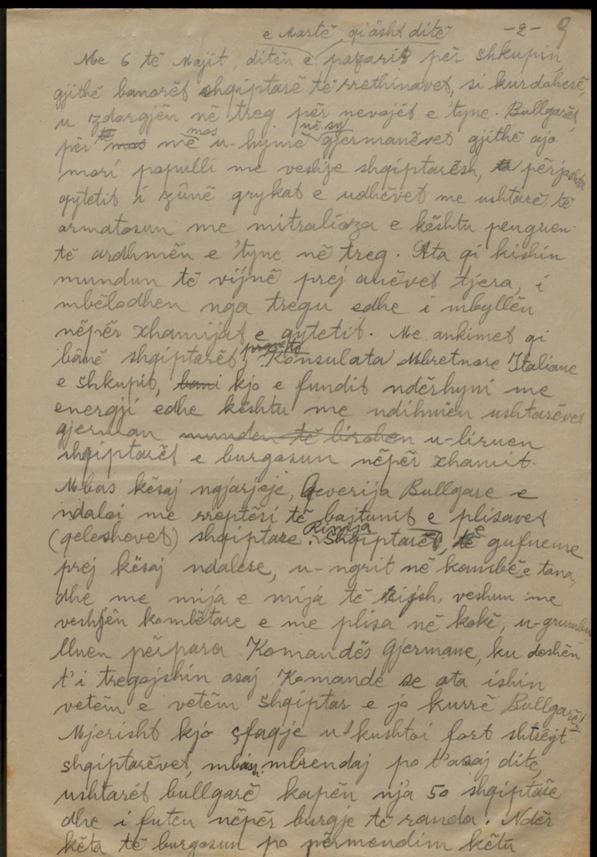
It was a time when Albania had united with all its territories in Macedonia, Kosovo, and Montenegro, expanding to its natural borders.
The Tirana government had launched its recovery programs from the very first days, particularly in the field of education, aiming to strengthen the national sentiment among Albanians. However, at the same time, the Slavs retaliated through attacks and massacres against the Albanian population whenever they had the opportunity, taking advantage of the war conditions.
May 1941, as evidenced by this document we bring exclusively, marked dozens of attacks, arrests, rapes, and other massacres against the Albanian population, threatening and forcing them not to wear the white qeleshe (traditional Albanian hat), which was the distinguishing symbol of Albanians in these lands.
The denunciation of the massacres was made by a group of men from the Albanian elite of Skopje, who managed to escape from Skopje to Tetovo and from there to Tirana. They arrived at the doors of the Council of Ministers and the Ministry of Interior to denounce the massacres they had witnessed, simultaneously demanding that the Albanian government take action to release those arrested and stop this terror.
Below, we present the full denunciation sent to the then Prime Minister, Shefqet Bej Vërlaci:
26 May 1941
To His Excellency
Shefqet Bej Vërlaci
Chairman of the Council of Ministers
Tirana
We have the honor to attach a memorandum submitted by a deputation that came directly from Skopje regarding the sufferings and persecutions of the Albanian population in these areas.
General Director
Dr. N. Lo Russo Attoma
Memorandum for the General Directorate
In recent days, at the Press Directorate, Mr. Bexhet Beg Presheva, accompanied by Skënder Leshi, Mahmut Tetova, Jashar Shkupi, and Ramadan Kosova—all Albanians from Skopje—presented themselves. They had secretly escaped on 16 May 1941, arriving the next day in Tetovo and continuing their journey to Tirana, where they appeared before the Council of Ministers and the Ministry of Interior. Speaking on behalf of the entire Albanian population of Skopje, its surrounding areas, and Tetovo, they requested intervention from the high authorities to save their oppressed brothers under Bulgarian rule.
Here is a summary of their statements:
- The Bulgarian army is oppressing the Albanian population in the recently occupied regions only because they are Albanian. In the Presheva region, among many centers, they have beaten many people and forcibly taken 7,000 kilos of corn and 20,000 kilos of hay from the population.
- They entered mosques, taking carpets and other valuable items.
- In the center of Presheva, a large part of the population was subjected to severe torture. They entered homes under the pretext of searching for weapons but, during these searches, took valuable items such as women’s expensive clothes, gold, and silver watches.
- In many houses, under the usual pretext of searching for weapons, women were raped.
- On 11 May 1941, in Skopje, the Bulgarian army arrested Albanian lawyer Shaip Presheva, Jahja Kumanova, Ejup Verisoviq, along with 50 other Albanians, all accused of a single crime: wearing the white qeleshe, which symbolizes their Albanian nationality. On 12 May 1941, this event was reported to the Royal Italian Consulate in Skopje. However, there is no information about the prisoners’ whereabouts—whether they are still alive or massacred.
- On 12 May 1941, in Skopje, Mahmut and Haki Jonuzi, traders of white qeleshe—a craft they had practiced for 50 years—were arrested. On 13 May 1941, one of the brothers, the elder one, was found killed outside the walls of Skopje prison.
- On 13 May 1941, which was market day in Skopje, Bulgarian army units were stationed with rifles and machine guns on the city’s main roads, where Albanians from surrounding villages gathered. Their task was to forcibly remove the Albanians’ white qeleshe. However, since the qeleshe symbolizes the Albanians’ national identity, they refused to remove it. Consequently, the Bulgarian army arrested more than 300 Albanians on a single main road. That same day, on Tophane Street, the army forcibly took over 300 white qeleshes from Albanian villagers and tore them apart in front of them. Those who refused to surrender their qeleshes on other roads were also arrested and imprisoned. The number of imprisoned Albanians in Skopje exceeds 600.
References

 Balkan Academia