
Written by Dr.Marenglen Verli. Translated by Petrit Latifi.
Elmaz Plava was born in Plav on May 18, 1902. He was the son of Bejtullah and Zade. He completed his primary education in his hometown, which he completed in 1911. In 1917, his family moved to Shkodër.
He completed his secondary education at the city’s gymnasium.
In 1928, he began working as a non-commissioned officer in a military unit in Tirana. A year later, he attended a 1-year veterinary course in Durrës. After completing it in 1930, he began working as a veterinarian in Pogradec. With his own income, he supported his family in Tirana (his mother, sister and, since 1931, his father, who had just returned from Turkey).
On June 20, 1931, Elmaz married Hamide Feri (daughter of HASAN FERI). From this marriage, 4 children were born, 2 sons and 2 daughters, who are still alive today. From September 1942 to October 1944, Elmaz served in Plav as a commune secretary, while in November 1944 he resumed work as a veterinarian in Shijak. He died there and was buried on August 25, 1965.
During the last 20 years of his life, Elmaz, in addition to his profession as a secondary veterinarian, with a special passion, collected materials and documents about the history of his birthplace, thus continuing a work that his father had started.
He was even committed to processing them in the form of a book until the last moment of his life.
Of course, the material that Elmaz had the opportunity to research on the history of the Plav – Gucia region is not exhaustive. In assessments of historical events and figures, there may also be inaccuracies and subjectivity. However, the material is relatively abundant and, as far as the memories collected by contemporaries of the events are concerned, irreplaceable. Meanwhile, the conclusions in general, even today when we know a much wider documentation, have stood the test of time.
Some concepts of the author, or dates of events, may be discussed or not, which is natural for works where memories occupy a considerable volume in the entirety of the material used, or when the view is cast over quite early periods; however, the work as a whole is an achievement of the author. After the careful processing and adaptation that was made to it, respecting the criteria for the publication of materials of this nature, it saw the light of day in 1995 and was welcomed by the reader.
In closing these few words dedicated to the author and his work, the initiative of Mr. MUHAREM PLAVA to encourage the publication of this book must always be saluted. At the same time, I would like to thank Mr. S.AHMETI for some of the photos provided to enrich the illustrations. I also sincerely thank all those who helped in the realization of the reprint, which is given to the readers with new writings and documents and with photographic illustrations.
Tirana 2002 prof.Dr.Marenglen VERLI
Prelude
It has been a great desire for me in my youth to learn about the role that the region of Plav and Guci has played in the National history with its bloody efforts throughout the centuries, against the various occupiers who have attacked it.
To speak in detail, it would take volumes to describe “the history of the centuries-old suffering of the REGION”, but I tried to point out some of the most important facts (these are stories of some local patriotic elders, also based on historical facts). I had carefully kept these notes for 20 years, and I always dreamed that they could be published in the form of a volume.
Although the entire text belongs directly to the region in question, its value transcends local borders, because the history of PLAVS and GUCISË is closely linked, sooner or later, to the various regions of ETHNIC Albania, especially in the bloody wars fought for “freedom and independence”.
The narrators of the events, who were alive 20 years ago, such as HASAN FERI, ISMAIL ADEM MEKULI (HOXHË NOKSHICI) and ISLAM REXHEPAGAJ, had left me a bequest (message) that no changes of opinion should be made outside the themes, except for linguistic and grammatical corrections and editorial interventions to any expression when the work was being prepared for printing.
20 years ago, it never occurred to any of my friends to collect accurate stories and written documents, or at least to help me, so that this work could be processed and the necessary interventions for publication could be made.
Today, encouraged by some patriotic friends of my province, first of all by OMER MEKULAJT, who gave me all the necessary help. I tried to summarize the collected material. I listed some of the important events of the history of the province in question, thinking that they would have some value and connection with the numerous events of KOSOVO (which also resided in the joint efforts for “NATIONAL Freedom and Independence”).
I knew that these descriptions had to be compiled by competent writers, because I lacked the technical – artistic and aesthetic skills, but, also thinking about the promise I had made to the three old patriots, from whom I had written the stories,
I would like to present them as memories and historical data for the Plav – Gucia region, with the aim of encouraging other intellectuals in the future, so that something more can be done in the development of the work they have begun. Whoever will deal with the elaboration of this work will encounter episodes of heroism, bravery and great sacrifices that our ancestors have made to resist the age-old enemy.
In short, in this material is found the true idea of the determination of a population, however small, but heroic, in the defense of the common homeland.
The reader will be surprised how a small province, such as Plava with Gucia, in cases of emergency immediately dealt with the different provinces of Albania, but it is true that when the province was attacked by the enemy, from all other provinces, both close and distant, with all the difficulties of communication, the men ran to the border in case of need within 24 hours.
Their strong will, which made them exceed the speed of any means of transport, surprised the enemies and made them say that “Albanians in cases of war seem to descend from the sky”. Of course, for the successful defense of the homeland from the enemy attacking the border it was not only the rifle but also a number of other factors and good organization. As ALI PASHË GUCIA himself said, for this other means and maneuverability are also needed.
In the years 1879 – 1881 Plava with Guci was defended from all directions, and therefore it was successful. At that time, from the south of Albania, the region was defended by the voice and pen of ABDYL FRASHËRI and his friends; The provision of bread for the front fighters was done by HAXHI ZEKA; the volunteer cannons of Rrapsh of DUKAGJINI were sent by SYLEJMAN VOKSHI; Shkodra contributed with various material aid, while DIBRA with OHER through ILIAZ PASHA sent weapons and money and so on. So, this is how the PRIZREN LEAGUE operated at that time, which for the defense of the homeland as a whole protected every inch of ARBN land wherever the enemies sought to occupy it. This cooperation is called “National Union for the Protection of the Homeland”
Author year 1964, H Y R J A
A few words about the region
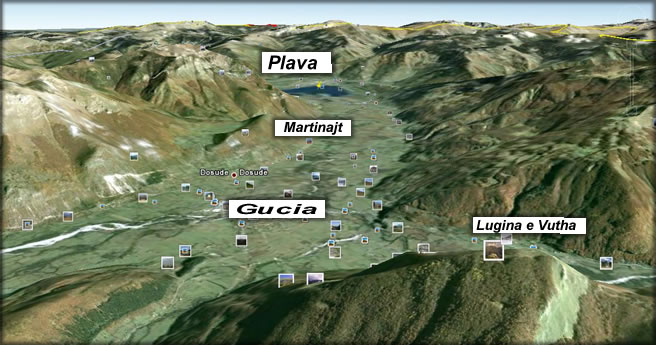
In the north of Albania, on the border with Montenegro, is the region of Plav and Gucia. It is composed of a valley stretched between high mountains, which surround it like a crown, with a beauty that only poets can describe. The ridges and the entire landscape represent one of the rare wonders that nature has invented. But the Region does not lack diverse assets, which enable a prosperous economic life. It has very fertile lands, suitable for the cultivation of corn, legumes, potatoes and several types of vegetables. Fruit trees also grow well.
As for the mountain pastures, meadows, forests and meadows, Plav and Gucia would be the envy of many Balkan regions.
Due to its numerous resources, as well as its favorable geographical position, the Plav and Guci regions have for centuries been the object of Serbian-Montenegrin greed. Their efforts to separate this region from Albania are not unknown to the world. Perhaps more well-known should be the sacrifices of the Albanians, for the protection of this “Eagle’s Nest on the Border”.
In this context, first of all, the sacrifices of the inhabitants of the region should be highlighted, who have written a glorious history with their blood. In other words, it is an indisputable truth that the Plav and Guci regions for the Albanians for centuries have been “an altar of the common homeland within the framework of Ethnic Albania”. The population of this region has rightly boasted that from here began the “national epic of renaissance”, because from here began the effort of our pioneers for the “Freedom and independence of Albania”.
This region was also the “First Fortress” for the protection of the Dukagjin Plain, one of the most important and prosperous national territories. Although Plav – Gucia is among the regions with a valuable contribution to the Albanian National Movement, the Serbo-Montenegrin chauvinist circles have expressed and continue to express absurd claims, as if this region is “their native land” and that its population, “of Serbian origin”, lost the Christian religion only after the Ottoman occupation, when it was forcibly forced to convert to Islam.
These claims are not supported by facts, but this had little importance for the ideators of “Greater Serbia”. For them, it was important to find the means to achieve hegemony in the widest possible territories, at the expense of the peoples neighboring the Serbs, especially the non-Slavic peoples. In this context, denationalization methods were also developed, which did not exclude the physical disappearance or extermination of the Albanian people.
It would be superfluous to list the works of observers and historians from around the world, who provide data on the ethnic borders of Albania, contrary to the Serbian-Montenegrin considerations. As for the data on the origin of the people with the sons of the Dukagjini plain.
But the most serious catastrophe, comparable to that of 1919, when the region was caught between two fires, the Serbs on one side and the Montenegrins on the other, came at the end of the Second World War. Instead of being liberated from the fascist occupier, this region, in 1944, suffered great misery and losses from the communist-Chetnik forces.
During this Slavic re-occupation, many innocent people were killed, and the country was terribly destroyed. After 1944, the Tito regime reduced the region of Plav and Guci to “gravel”. Terror and various methods of violence for the denationalization of the population in the first instance continued without interruption. The Belgrade authorities initially closed the 4 or 5 Albanian primary schools that had functioned during the years 1941-1944, during the fascist occupation, and even earlier, during the years 1916-1918, during the Austro-Hungarian occupation.
A permanent chauvinistic policy followed, which aimed to force Albanians to abandon their homes. Any impartial observer who had the opportunity to get to know the country closely would conclude that this policy continues even today.
References
http://www.plaveguci.eu. S. GjonBala


 Balkan Academia