
Written by Elmaz Plava. Translated by Petrit Latifi.
1. Foreign invaders against the Albanian language
Once, the Albanian patriot and writer Pjetër Bogdani, who was on a religious mission in Skopje as a Catholic archbishop, had said that the Albanian language was in danger of disappearing altogether in the areas of Kosovo, due to the Turkish invasions. These words appear in his work entitled ”CUNEUS PROPHETARUM” published in Padua, Italy in 1680.
The patriot PJETĆ BOGDANI predicted the way, based on the goals that the Asian conqueror had in the Balkans, because the Turks behaved differently with the Albanian people and differently with the Slavic peoples: In Serbia and Montenegro, they left the church propaganda activity completely free, while in the Albanian territories, for the purposes of nationalization, they encouraged Islamization in assimilation proportions.
This policy influenced the Serbs to advance in two directions, to equip themselves with knowledge and to grow as a Balkan power. It is precisely these two factors “power and civilization” that the Albanian people lacked. However, thanks to the “strength of character”, this vital people, connected to national memories and customs, always self-defensive in their activity, faced the challenge and resisted the disfigurement, saving their national language from extinction.
Serbs, as always before, today present the unfounded claim that not only the region of Plav and Guci, but also the whole of Kosovo, was their region. They have arbitrarily baptized these Albanian lands with the term “old Serbia” and have spread the idea that part of the people there are newcomers (poturica), while the majority consists of elements of Serbian race and blood, who during the Ottoman occupation were forced to change their religion and become Muslims. Serbs also claim that “in the cities of Kosovo the majority of the population speaks Slavic languages, a minority Turkish and only a few use the Albanian language”.
Serbs have never liked the historical truth about the belonging of Plav-Guci and the whole of Kosovo, therefore they have always manipulated the facts. For example, for the above claim, they have exploited the existence of bilingualism in some urban centers or in specific settlements.
Any reasoning without prejudice makes it clear that bilingualism is a natural phenomenon in commercial and administrative centers, in the most exposed points during the invasions and occupations of the past, as well as during the normal infiltrations and movements of neighboring populations, namely Serbian, Macedonian, etc.
Moreover, there is no doubt about the ethnic affiliation of a region, when the composition of the rural population is uniform. In the case of the Albanian territories claimed by the Serbs, the rural population did not know the Turkish and Slavic languages for the simple fact that they were foreign to the population and, for the structure of the organization of rural life at the time, unnecessary to learn. In this rural base, the Albanian language still prevails today.
It should be clarified that the use of the Slavic-Bosnian language in the centers of Plav and Guci belongs to an influence that begins with the Ottoman occupier, in whose hordes the Bosnian spahis also found themselves over time. They even appeared as the first factors in the change of religion, on the one hand because of their political power and, on the other hand, because with the opening of the roads BERANA – ROZHAJ – BIELLOPOLJE, as well as TUTINĘ etc., up to Sandzak and Herzegovina, they also found themselves in the position of economic partners.
Gradually, mutual relations between the tribes developed. However, despite the mixing of the local element with the Bosnian element and the penetration to some extent of another culture and religion, the race, origin and language of the autochthons in the region of Plav and Guci were still preserved.
The majority of the peasantry of this region did not submit to the Salvation of ‘foreigners’, did not lose their Albanian character and in general neither the Albanian language. Today, facing various pressures over the years, they have cultivated with the greatest jealousy and fanaticism the native Albanian language, which has always remained and will remain for centuries as a “family language”.
In this way, Plavë – Gucia has managed to avoid denationalization, to preserve its Albanian identity and to remain ethnically and psychologically inseparable from Kosovo and other Albanian regions. Whatever means the Belgrade and Cetina ruling circles use in the future for the “radical denationalization” of the Plav – Guci Province, they will not succeed, because the people there can never forget the violence and inhuman massacres that all Serbian – Montenegrin regimes, even under the Yugoslav label, have committed against them.
2. The inhabitants of these provinces.
“The people of the Plav and Guci Province belong only to the “Albanian tribe”.
IN PLAV: The entire REXHEPAGAJ Tribe has its origin from the GRUEMIRA of Shkodra. The SHABAJT — FERAJT are in a brotherhood with the LUHAR and DINO of Shkodra. MEDUNAJ, REXHAJ and REXHEMETAJ, DESHAJ, SHEHAJ, SHARKINAJ, JUSAJ — CANAJ, JEDADAJ, SUKAJ are simply KELMENDAJ from SELCA, VUKLI and NIKÇI.
—— In GUCI: NIKOÇAJ, SEFERAJ, PJETRAJ, CURANAJ, LUCAJ, DERVISHAJ are DUKAGJINĖ, KASTRATĖ, HOTĖ and GRUDĖ.
— Even the villages around the two centers Guci and Plavė descend from the above tribes, KELMENDAJ and DUKAGJIN ( HOT villages), SELIMAJ, NDOKAJ ( NOKSHIQ ), PEPAJ ( PEPAJ ), MARTINAJ ( MARTINAJ ), VUTHAJ with GJONBALAJ, QOSAJ, VUÇETAJ and AHMETAJ etc.
—– But from the origin of the Albanian tribes mentioned above, with related generations, there are brotherhoods that extend also through the KUÇ and Vasović of Montenegro. From these, some also descended to DALMATIA, BOSNIA and HERZEGOVINA.
—Montenegrins, with pride, call Malsija of the Albanian Krasniqa “of a brotherhood with VASOVIQ” (they mean that KRASA and VASA were two brothers).
— Also from the Albanian tribe is the KUÇI of KELMENDI himself, who has formed a voivodeship (large province) in Montenegro….
—-It would be excessive to go into details, so we are limiting ourselves to pointing out that the Albanian tribes populate the entire plain of Kosovo. They also extend to the mountain side from the north, being present in Berane, Rozaje, Tut and throughout the sandzak called Jeni – Pazari TREGOVISHTA. Even in these areas, the inhabitants have their origin from the aforementioned Albanian tribes.
Everywhere, the Albanian venoms and character have been preserved with the greatest jealousy and national fanaticism. Even today, in the most remote villages of TREGOVISHTA on the border with Herzegovina, in the daily speech of the Bosnian language, the most useful expressions of the Albanian language are encountered as remnants of the past from Albanian life.
For example, during communication with friends, the greeting is exchanged in Albanian: “A je burrë si je”: at the ebuka table, “për të mire” is wished and after the meal “Të baftmirë”. Also, the traveler who meets the farmer and the worker greets him with the expression “pun e mbare”, and in response receives: “O mšćir paç moree” etc. A careful observation of the conversations that take place in the Bosnian language also highlights the use of many Albanian word roots (in the form of adjective inflections).
But the foreign visitor who has knowledge of the Albanian world would probably notice a characteristic detail that is present at weddings. Brides, accompanied by groomsmen, as in Kosovo and other undisputed Albanian regions, are covered with the so-called “DUVAK TË KUQ”, which consists of a piece of red cloth or silk, which apparently commemorates and symbolizes the Albanian flag.
— The mentioned facts prove that the Serbs – Montenegrins, despite all their efforts, have not been able to eradicate the customs – venoms and character of the Albanian Tribe and even less to annihilate the Albanian element. In many of the peripheral provinces with Plav and Guci and wider with Kosovo, this element lives even today and has for its hearth its native land, which has been called “The Albanian Autochthonous Land”.
— So, the indisputable truth is that the Albanians are not newcomers to a foreign land, but autochthonous in their own land, with specific venoms and customs (THE CANON OF THE LEKË DUKAGJIN) that differ visibly from those of other Balkan peoples. In the vast majority they have preserved their Albanian language pure. Even where assimilation has done its job and has brought deformities to the language, there are other elements related to conscience and character, which are inherited and cannot be lost.
BIANCONI
In his previously cited work, “CARTES COMERCIALE” (1888), mentioning Albania, the Albanians and their language, among other things says:
“A large number of Albanians are also found in the SANJAK of NOVIPAZAR and in the newly created SANJAK of SENICA and TASLIXA”.
— The same view was also expressed by the English LORD FITZMAURICE, both in a report sent to the FOREIN OFFICE and in the book “BRUZZE”, published in 1880.
- How the names were inherited
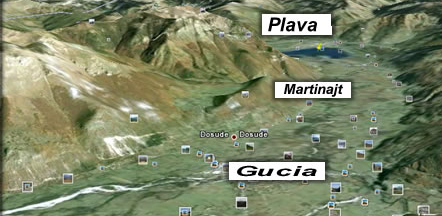
The province of Plav and Gucia lies in a valley, under the so-called “UNFORTUNATE MOUNTAINS of the VISITORS and of the KOMAVITS”. There is a square-shaped area of land with a rare beauty, composed partly of plains and partly of hills. It is surrounded by mountains, the peaks of which stand above it like majestic crowns.
—The province, although with little land and a small population, has been considered by other provinces of Albania as a strategic place on the border with Montenegro. Until the Balkan War of 1912, it was an undivided land of ETHNIC Albania.
— The Ottoman conquerors called the province of Plav and Gucia “KAZAJA E MEMLEQETIT TË GUCIË”. In their administrative division of the 18th and 19th centuries, it was initially placed under the jurisdiction of the Vilayet of SHKODAR, and later under that of the Vilayet of Kosovo, where it was included in the prefecture of Peja.
— The region has two small urban centers. One of them, Gucia, was called “SELF-DEFENDING FORTRESS” because of its highly protected position. It could only be penetrated from the east, through a gorge through which the Bistrica and Poçamkëz rivers flow. The side between Hani i JUSUFI and KUÇI is closed by the valley of the LIM river. Here is the gorge of the historical Sutjëska, which is remembered for the continuous fighting that took place over the centuries between Albanians and Montenegrins. While on the other side the GËRÇAR river runs through the plain.
— The town of GUCISA at the time of the Albanian LEADERSHIP of PRIZREN, in 1878, consisted of 400 houses, all Albanians, where about 4500 people lived. Another 6000 people counted the rural population of the city’s surroundings.
— The GUCISA market had 50 shops and in the middle a beautiful square called “BEGLLAK”. There was also the Residence of ALI PASHA GUCISA, with a palace quite magnificent for the place, which was called “KËRSHLA”.
— The other center of the province, PLAVA, was also a small town, but with an earlier historical past compared to Guci. Until 1919, there was archaeological evidence for its significant development during the period of the ROMAN occupation. These are finely carved marble stones and pillars, which were eventually adopted by the inhabitants and used in the construction of their towers. However, the old ruins constitute irrefutable evidence for the development of the Plava region in the period of antiquity. There is even some claim that during the years of the flourishing of the ROMAN civilization, Plava was “an independent republic”.
— Having been the most important center of the province for a long time, the town of Plav has been the object of Serbian attacks several times and was destroyed by them. History repeated itself during the Ottoman occupation. Due to the heroic resistance, it was again bled. But, despite the repeated destruction by various invaders, Plav at the time of the League of PRIZEREN was a center with 360 houses and a population of about 4,000 people. While the peasantry numbered about 10,000 people.
— The development of Plav as a city cannot be understood without its economic development. The passage roads that crossed it in several directions gave the city the opportunity to communicate, through horse caravans, with the DUKAGJIN Plain on one side and with Shkodra on the other. This created the opportunity for the trade of the country’s livestock products to be concentrated there.
But the growth of the Plav market was also favored by the transit of livestock products from PESHTER, which gravitated towards Shkodra. The sale of dairy products, wool, skins, and even livestock, especially sheep of the famous “PESHTERI” breed, which descended towards the big city and the sea coast, caused the Plav market to grow more than that of Gucia.
At the beginning of our century, it consisted of about 100 shops. The residential sectors were also renovated hand in hand, which were organized into 7 small neighborhoods built on 7 picturesque hills, which curved next to each other, creating a rare panorama. The architecture of the city was completed by 3 mosques, but the real jewel was for it the “CITY CASTLE”, an old historical building of value, realized with 3 round towers reinforced with ramparts.
— Due to its position, but also its turbulent history, Plava has been called the “INVINCIBLE CASTLE” of the country and the “SHIELD of the DUKAGJIN Plain”.
- Some published data on the Province
— It would be of interest that, in order to complete the reader’s view of the values of the geographical position and natural resources of the Province of Plava and Guci, we present it first through the eyes of a Slavic author. Of course, in this case, the assessment that he made of the Albanian population of the Province should not be taken into account.
— For the above purpose, we chose a description by L. Iveziq published in the Belgrade newspaper “Vreme” on August 5, 1940. We are reproducing the article according to the translation of the original:
“Under the Branch of the Unholy Mountains”
Anyone who asks in Montenegro what is worth visiting in the Zeta region, the author emphasized, will answer without thinking: Visit Plav and its lake, because that region has a lot of beauty and fabulous natural wealth.
If you visit Plav, Guca and the Plav lake, you will reach the branches of the Unholy Mountains of Visir and Komavi. You will not regret it. When you have seen this Region, you will be convinced that it has a very great importance. The entire Region is filled with various natural beauties, it is full of life and attractive vitality.
The road that leads towards Plava, the lake and Guci, passes through Plimle (beautiful too), then describes the foothills of the Komavi and Çakorri branches and emerges in Visitor and under the snow-covered branches of the Bjeshka se Në.
mun, which leads you to a fertile valley, where long ago it was supposed to build villas and tourist clubs, so that the shores of Lake Plav could enjoy the happiness of progress.
The beauties of the Plav valley are so ideal that there will be few writers who will be able to describe it. Mr. Dragisa Boročić, writer and high school principal, wrote something about it, but again this region still remains unknown. The hand of man has not yet changed its appearance. It has remained romantic, but unregulated by nature. It is still waiting for the plow (wooden plow) in places to make way for the sown grains.
It is true that we Yugoslavs do not have the concept of tourist profit, we do not know how to show the world our most beautiful treasures, the wonders of nature. We lack the sense of advertising, while other regions, which are bad places and have nothing romantic about them, are being advertised as “the most beautiful places in the world…”.
Twenty-two years since our liberation, we have still not been able to get to know the most beautiful regions, such as Plava with its district and lake.
–A friend of mine from Belgrade once told me: “Believe me, I have never seen such beautiful places in any of my travels. We really need to have a broad understanding of tourism, so that the issue of this region can be resolved properly. The region is filled with such diverse and fabulous beauty that can be seen in few places in the world, but it does not have the favorable and necessary conditions for the development of tourism, neither good roads, nor hotels, nor vacation spots for tourists, and the population of this region (Muslim Albanians) does not have the slightest concept about tourism….
–Lake Plav is quite large, but its surface area of over two and a half (square) kilometers is unregulated. Not a single good boat is seen on the lake, and motorboats should not even be mentioned. There are no beaches, nor cabins or regular pavilions near the lake. Everything is desert. There is enough beauty, but there is more desert. The entire Plav Lake is surrounded by mud (firidhe) and resembles a large swamp. The hand of man has not tried to remove these to give the lake a real appearance; therefore, everything has been left behind and has not been arranged.
–It is known that the Nemanjas had given the proper importance to the Plav Lake. The lake area had its own beautiful summer places. The lake was a fishing area for the royal court and for the priests of the patriarchate and of DECAN.
–Even in the time of the Turks, this lake was given its proper importance. High officials of the Turkish government spent their time in this lake. The agallars and beylers of Guci had jealously guarded this lake.
- The Region’s Affiliation According to Folk Traditions
Since we lack historical data, as well as etymological-onomastic bases, we are forced to mention those contained in the folk tradition of the region.
— On inherited names: The name Plavë should probably be derived from the similar name “PLLAJA”, since the place is surrounded by mountains and hills, which are pastures for livestock. In reality, the entire region is known as a livestock area. While the name GUSI or GUCI, may be a transformation of the name “PUSI”, meaning it indicates a strategic place suitable for ambushes against enemies who attacked it. GUCIANS have always been considered the most courageous people of the Region. Since ancient times they have been considered such by the Montenegrins themselves. According to tradition, Montenegrins always said in conversations that “GUCJANA ARE PEOPLE” “AZGONA” ….
— Around the above-mentioned centers of Plav and Guci, we encounter many toponyms that sound simply in Albanian. For example, we have the high peak of the mountain above Plav called “QAFA e DIELLIT”, a place that is positioned to the east. Then RUGOVA, a Kreshnik province neighboring Plav, probably got that name because the “ROAD of the MOUNTAINS” once passed there. Also encountered are the toponyms “MAJA e KARAFILAVE”, MAJA e VEZIRIT”, “MAJA e ROSAVE”, ” VORRI i HANËS”, ” BJESHKA e MEMËS”, ” GROPA e SMAJLIT” (in the village of Martinaj) etc. Even in the villages, one can find many expressions of the Albanian language or names of origin, such as VUTHAJT, PEPAJT, NDOKAJT, METEHAJT, KOMARJT. HOTI, ZABELI, GËRÇARI, PËRNJAVORRI etc.
— Further, it should be emphasized the origin of the names of rivers and streams from the Albanian language. Thus, for example, the LIM river derives from the word lym, perhaps because this river has its source in the marshy land. Whereas the Gërçar river and the VRRUJË ( VRIDHË ) river in Albanian would be understood as ” NGRICË ” and ” UJT e VRULLSHMËM ” etc.
— For the forts that existed in the Plavë – Guci region, until recently, the Albanian names they had are still known today. Thus, there existed the GELIKU Castle under the city of PLAVA, a name that is a transformation of the word Çelik, meaning steel castle, also the ZABELI Castle in the village of HOT in Plava, the former PALI castle near PRELIMPALI.
over Lake Plava. Even below Moraça, there were Albanian fortresses, which were used during the fighting with the KU”CIT tribe, and partly with Montenegro. These are mentioned in “LAHUTEN E MALCISË”, but the one that is well remembered by the Albanian population was the Kulla e SHEREMETI.
–There are also Slavic names around the province. Such are the names of the villages Arzhanicë, Bogicë, Bogajqe, Bjelluhë, Brezovicë. But we also find the legacy of Slavic names in Kosovo, and even in some internal areas of Albania, including the southern areas.
Regarding Slavic toponymy in Albania, which has nothing to do with the ethnic composition of the population, it is enough to mention the conclusions reached by foreign scholars. In the “Encyclopedia Britannica”, on “historical rights for the various regions of Albania” it is written:
— “The occurrence of a number of Slavic names also in The various regions of Albania, even in those regions where there is no trace of Slavic peoples, are evidence of the great influx of Serbian and Bulgarians at the beginning of the “Middle Ages”. However, the autochthonous inhabitants (Albanians) had gradually repelled the newcomers. As is known, one of the conquerors of Albania, the Serbian Tsar Stefan Dushan, did not have a long reign here and after his death the Albanian element and the national dynasties took revenge on the Serbian element and their Slavic dynasties.
— So, the Slavic names, which still appear sporadically in the regions of Albania, have remained as relics of the Slavic conquests in the Balkans, namely the Serbian, Montenegrin and Bulgarian conquests.
— As can be seen, the claims of the Serbo-Montenegrins that the Albanian natives in Kosovo, in general, as well as in the Plav and Guci regions, were originally “Serbs”, who later became Albanianized by changing their religion (belief), are unfounded. The thesis to present the Albanians as “polygynous”, that is, as immigrants to a foreign land, by denying them their autochthonousness, is of course not supported by scientific arguments and aims to give in to chauvinistic political goals.
–As in the past, the chauvinistic Serbo-Montenegrin circles continue to distort the truth about Albania and the Albanian people. In favor of their grandiose idea, they still categorically deny the existence of a homogeneous Albanian people, deny the homeland of the Albanians and the Albanian language. Particularly aggressive is their denialist stance when it comes to the province of Plavë – Gucië, which they did not want to acknowledge in any way its Albanian affiliation.
For this purpose, they have not failed to falsify official statistics. It is ridiculous to read, for example, the data of the population census of Plavë and Gucië, from 1953. According to them, the province resulted in 75 percent of the population being Serb – Muslim and 25 percent Serb – Orthodox, while it is known that Muslim Serbs do not exist, and Muslim Bosnia is quite far away.
–Meanwhile, the people of the province consider themselves “of the same blood” with the “homogeneous Albanian tribe”. According to him, from the earliest times and during the Middle Ages, Plavë and Gucië included a vast land region, extending from the top of Mount TROJAN to the NECK of the SUN. The province included more than half of today’s KELMENDI, in the west-east direction, and the territory from QAFA e VRANICA to MORAÇÄ in the north-south direction.
The above-mentioned borders also included in Plavë and Guci some places of the province of VASOVIĆ from the SUQANSKA side, as well as some villages of the so-called “KOMIT i KUÇIT” from the other side and on the border of VETERNIK. While the total population was estimated at up to 80 thousand inhabitants.
— With this extension, always according to the oral tradition, the Province was called the “small principality of the ILLYRIAN KINGDOM”, while during the period of Roman rule it constituted a “SMALL REPUBLIC”. The province has existed with its physiognomy even during other invasions, including the Serbian invasion and then the Ottoman one.
Although under the dictates of the occupiers, the Province was always able to maintain a certain autonomy and was generally administered by local elements, according to the tradition originating from the door of the DUKAGJIN. However, the Ottoman occupation was quite severe and brought great misery and destruction to Plavë and Gucië. During this period, the Province gradually lost its “independence”.
- The Ottoman invasion
According to legend, the outbreak of the Ottoman invasion in the Balkans around 1389, which was called “FURTUNË” or “RREBESH”, was led by the terrible Sultan Murat himself. The forces of the Balkan allies, under the leadership of the Serbian Tsar, Lazar, which also included Albanians with the princes of various provinces at the head, were so badly defeated on the Kosovo field that in a short time the local state formations collapsed one after the other. But, while they were subject to Ottoman occupation, the Province of Plav and Guci, thanks to its protected natural position and the strong resistance of its inhabitants, preserved even for a time its freedom.
Surrounded on one side by the DUKAGJIN of GURIT and with KELMEND from the TROJAN mountain, as well as having the outpost RUGOVA from the QAFA e DIELLIT and ÇAKORRI, the Province heroically resisted the Ottoman onslaught, like few others in the Balkans. That Albanian front of the LEKS of the MOUNTAINS has been called the “DRAGOJS’ SELLING ZONE” precisely because in these areas, both the sultan’s army and the auxiliary forces of the Bosnian mercenaries who supported it, had suffered successive heavy defeats.
The Bosniaks until recently had commemorated the war for the conquest of Plav and Gucië, and because of the losses they had, the Province was called the “PROVINCE CURSED with the TROJAN MOUNTAIN of XHINDOSUN”. During the occupation of the Province, Plava, the “most strategic object” in the entire region, was burned and demolished.
The villages around it also suffered great destruction. Gucia, on the other hand, suffered somewhat less, because, as it is said, its leadership, from the LEK brotherhood, led by the BALSHAJ of SHKODERA, had entered into an agreement with the Ottoman military forces, which had taken over the Albanian forts and fortifications.
— Many years after the occupation of Kosovo and the subjugation of the Yenipazari regions, according to tradition, the popular resistance in the highlands of Plava and Gucia, Kelmendi and Dukagjin, was still alive. Most of the feudal leaders of these strategic regions continued not to submit to the sultan. They had also established “BELIEFS” with the other regions on the banks of the LIM River and the highlands beyond Tutin, Peshter, etc.
However, as Bosnia, Herzegovina and other regions fell one after another into the hands of the Ottomans and gradually changed their religion to Islam, relations between their Albanian populations (the KUÇËT of KELMENDI and the tribes of DUKAGJINI) and the Albanians of the territories of Plav, Guci, Kelmendi and Dukagjini, became increasingly tense.
The consequence of this hostility was the closure of the Peshteri road with the Rugova side, as well as the LIMIT coast road with BERANA. After this isolation, the Turkish-Bosnian hordes burst from two directions towards the Province. Plav and Rugova were heroically defended on the eastern front, but the break in the front in the west, from the LIM river bank, where the terrain was flat, reversed the situation.
–The traditions do not indicate the dates of the attacks for the conquest of Plav and Gucia, as well as the Kelmen and Dukagjin highlands, but, as has been commented, these must have occurred around 1409 or 1410. Regarding the circumstances of that invasion, the elders tell us this:
— “The Turks, seeing that the mountainous regions, Plavë – Gucia, Dukagjini and Kelmendi, as strategic nodes, were not being laid, although all of Kosovo was occupied, prepared special expeditions. The operations were entrusted to the sandzaks – beylers from Rumelia and Bosnia. So the Turkish horde mixed with Bosnian mercenaries, after bloody battles, occupied and burned Plavë.
According to tradition, the attacks were directed from both sides of the borders, from the upper Rrugova side and from the lower Lim river bank side. As the commander-in-chief of the operation was a certain Mahmut Bajraktari, an Anatolian, and his assistant a certain Ismail Banderi, a Bosnian. Plav was conquered from the Lim river bank side, where in Çelik – grad (formerly called the GELIK fortress) a the first Turkish flag”.
After Plava was conquered, Gucija was also surrendered, but this one with less damage. Then, as tradition recalls, Plava was rebuilt by order of the Turkish occupier, but, after a short time, it was flooded by the waters of the lake. About that flood it is said thus:
— “After the Turkish invasion, most of the local Albanians settled in the arable land, joining the Kelmends and Dukagjinas. Once they attacked and occupied the fortresses of Gucia and from the mouth of the LIM river the main dams of the river collapsed. Its waters flooded down to the plain and flooded the city of Plav.
The citizens, knowing this, were prepared in advance and climbed the 7 surrounding hills. After this, the new city was called the city of “seven hills”, because new buildings were built on them, while the old city, during the flood and expansion of the lake, remained under water”.
–The Montenegrin folk tradition presents the flooding of the city of Plava as having been caused by other circumstances:
— “Sveti Sava (Saint Sava), in order to test the character of the Albanians, went as a friend to Plava and sought shelter for one night, for himself and his horse. In the morning he left the house where he had taken refuge and headed out of the city, but some young men followed him, stopped him and accused him of having stolen a rooster from the house where he had spent the night as a guest, which he had slaughtered and put in the horse’s saddlebags.
During the inspection of the saddlebags, a slaughtered rooster was indeed found, so that, severely insulted, Sveti Sava raised his staff towards the city and prayed to God – Christ that Plava would drown in the waters of the lake. At that moment, the dam of the Lim River burst and the waters covered the city of Plava. Most of the inhabitants were able to escape, but their souls were were drowned”.
— According to Montenegrin folklore, it is understood that Albanians and Montenegrins have been at enmity since ancient times. This hostility must have been particularly pronounced between the Albanian inhabitants of the province in question and the Montenegrins on the border. These hostile relations are also highlighted by the folklore of the local Albanians: Even today, Albanians still call a Montenegrin or a Serb by the contemptuous name “shkja”.
Quite significant is the hostility towards the Albanian tribe of KUÇI, who are said to have forgotten their nationality and the traditions of Albanianism, as well as abandoned the Catholic religion of their ancestors to embrace the Orthodox rites. The Albanian population of the province has always maintained a hostile attitude towards any fellow citizen who changed their “religion (faith) of the first”, considering this a betrayal of the nation and homeland.
–Hostility centuries between Albanians and Montenegrins has also found expression in the everyday popular vocabulary of the Province. It is not uncommon for an angry Albanian mother to curse her son with the words: “Oh son, may the devil cut off his head”.
–Finally, it should be noted that the expression of hostility towards Albanians is also commonly found in Montenegrin tradition. For example, in the stories of saints, where a blind national fanaticism found ground, miracles were performed by cursing Albanians, causing them various misfortunes, such as the flood of Plav, etc.
— It is undoubtedly neither the Serbian saint Sveti Sava (according to the Montenegrin “poslovice”) nor the Turkish saint, Hazret HIZRI (as the Turkish soldiers of the time said), who for ordinary reasons punished the Province with their curses. Plava and Gucia were considered “THE CURSED PROVINCE” by the invaders, to whom the protected position of the country and the bravery of its inhabitants cost them dearly, and therefore they sought revenge with fire and iron.
First, the Serbo-Montenegrins, due to the losses they suffered during the invasion and the subsequent resistance of the Albanians, called the Province “the CURSED” or in their language “prokletije”. The same meaning is also given to the name “SHEITAN TEPE” with which the Ottomans baptized the JEÇMISHTAJE hill above Plava where they had left many dead, during the war for the conquest of the Province.
— Hoxha Nokshiqi, one of the best experts on the tradition and early legends about Plav and Guci, confirming the above, has emphasized that, although in other parts of Albania and the Balkans there are harsh and difficult to reach places, they rarely bear such names. “CURSED” were called in the language of the conquerors only the places where they encountered extraordinary obstacles, due to the strong resistance of the local inhabitants.
— Hoxha Nokshiqi has also given us the version of the popular tradition about the hostility of the Region with the KUÇI tribe. According to this version, in the conquest of Plav and Guci by the Serbs around 1331 or 1332, the KUÇI tribe also participated, and went to the aid of the attacking forces of Tsar Stefan Dushan. The members of this tribe, who were within the borders of Montenegro, had at that time left the Catholic religion and had converted to the Serbian Orthodox religion.
Due to their cooperation with the Serbs, the Albanians of Plav and Guci called them “OCCUPIERS”, just like the enemies of Slavic blood.
The Serbian horde, after occupying the town of Plav, burned it to the ground to avenge the great losses. To escape the terror, the people of Plav took refuge in Guci, where a second camp was organized. On this occasion, this settlement became the center of coordination of actions on a common war front with Kelmendi and Dukagjin.
— After the occupation of Plav, the camp of the Serbian army was set up in the field in front of Guci, which would later be called “VOJNOSELLO”, which means “ARMY TOWN, war”. According to the story, the occupation of Guci was not easy. The Albanians had blocked the gorges leading to the town. They put up particularly fierce resistance in the Sutjeska gorge, which was constantly attacked by the Kuçi tribe and by units of the Serbian army.
— Since they were unable to break through with the usual means of attack, the Serbs decided to equip their army with “SHAKE SHELLS”. The advance after such effective shields against the blows given by the defenders, yielded results. The Albanians began to be surrounded and to escape annihilation for the most part they were forced to close themselves inside the fortified buildings with stakes driven into the ground.
The penetration of the Serbian forces into these fortifications was impossible and cost them many lives, because it forced the attackers to come out in front of the defenders. Ultimately, the fate of the battle was determined by the betrayal of the warriors of the KUÇI tribe who, alongside the Albanian forces, were defending Sutjeska. They surrendered the Sutjeska fortresses to the Kuçians recruited into the Serbian army, which was attacking from that direction. Only after this defeat did the Albanian defenders, thinned by the fighting and weakened by the betrayal, surrender.
— Generally, the various folk tales of Plav and Guci converge with the version presented by HOXHË NOKSHICI. According to them, the Sutjeska gorge was the only fortified place or the most important fortification for the inhabitants of Guci. It was guarded by members of the Kuçi tribe who lived in Guci.
However, they betrayed by joining their cousins who were located inside Montenegro and who served foreigners, so they abandoned the fortified positions. So the hostility of the Plav and Guci region with the Kuçi tribe is ancient. After this, the Kuçi tribe was considered the same as the other enemy tribes of Vasović of Piper, etc.
–Kuçjan was also the famous Voivode of Montenegro, Mark Milani, who, unfortunately, although of Albanian blood and origin, fought like few others against the homeland of his ancestors.
It is enough to remember the wars of MORAÇA and NOKSHIC, of the years 1867 – 1879 and the frequent attacks on Plav, where in 1880 it was badly defeated by the forces of the Albanian ALLIANCE led by ALI PASHË GUCIA.
— In the old rhapsody entitled “DUKAGJIN e KELMEND”, which Albanian singers such as HOXHË KAJA etc. they sang it with the LAUTE and where the unceasing war of the Province against the enemies is evidenced, it also talks about the clashes that have occurred with the KUÇ tribe:
“DUKAJINI and KELMENDI”
“The Trojan Hours fly,
They are the Leks of Malsija
They are the dragons of Guci.
They shoot with arrows and stones
And they never surrender.
But one day,
The Gucija collapsed,
The country was divided,
Malsija surrendered.
I curse the Zana tribe of Kuç,
A plague was released in the mountains:
May faith kill you, may bread kill you!
Fuck off, Zana, through those sukkas!
Through the sukkas with stones and rocks
May your child not grow up in the cradle “….
- The consequences of the Ottoman invasion
— According to the stories of the elders of Plav and Gucija, especially of ISLAM REXHEPAGAJ, the Province at the time it was conquered by the Ottomans constituted a region populated by about 70 thousand people, where the early civilization, which dated back to times immemorial, was particularly evident in the ancient objects found in the two main cities. According to popular tradition, the first of the “LEKĖ of MALSIĆ”, who administered the country as a small Republic, lived there. At the head of the council of 12 members stood a leader from the door of the DUKAJINV (later called GJINAJ), whose position according to feudal rules was hereditary.
— The resistance of the inhabitants of the Province against the old ROMAN, Venetian, Slavic and Ottoman invaders, has been heroic and always very bloody. But the greatest damage was suffered by the Ottoman invasion, which was more devastating there than in many other Albanian provinces. Since they could not subjugate or physically exterminate the population of this province, the Ottoman invaders tried to denationalize it by changing its religion.
But, although Islam gradually became the only religion in Plav and Guci, the province was not denationalized. Gradually, also because of the Montenegrin threat on the border, the Ottoman authorities began to show more tolerance towards its population. Their first step in seeking cooperation to confront the common Montenegrin enemy was the “RESEARCH of the country’s self-government”.
In this context, the Turkish military ruler of the province, MAHMUR BAJRAKTARI, who was mentioned earlier, recruited two local Albanians who had converted to Islam, REXHEPI and OMERI, from Plav and Guci respectively. These were sent to the Sultan from whom they received titles and returned to their homeland with positions: REXHEP AGA became the ruler of Plav, while OMER AGA the ruler of Gucia.
Moreover, later, since the Province had administratively expanded in terms of territory, including some areas from BERANA – KOLLASHIN and BJELLOPOLJA, REXHEP AGA was appointed sanjakbey by a firman of the Sublime Porte. From that time until the later period of the Komëtare Renaissance, according to tradition, the house of Rexhepagaj was the first leadership and the most religious door of Plav and Gucia. Its last sucker was ALI PASHË GUCIA.
— According to the oral tradition, REXHEP and OMER had previously been salaried servants in the service of the house of GJINAJ, which governed the Province. They came from the villages of GRUHOMIRA and LUHAR in SHKODRA and had initially been Catholics.
Always, according to the story, these mercenaries accepted the proposal of the Turkish ruler to go to the sultan and receive “RYTBE” (position and title) from him, because none of the nobility of the Province was willing to respond to the offer.
From that time on, the LEKS of Malsia, REXHEP AGĖ Plavė had called “QIROS of GRUHOMIĖS”.
Later, the Montenegrins would call him that to insult ALI PASHĖ Guci, whom they hated for the heavy defeat he caused them when they wanted to conquer the Province.
— According to Elder ISLAM REXHEPAGAJ, in another tradition, the life story of “QIROS of GRUHOMIRA” is treated as follows:
— “The fugitives DEDĖ SOKOLI from Gruhomira and GJRGJ NIKOLLI from DINOSHI or LUHARI, had taken refuge near the door of GJIN
AJE who was the very leader of the people of the Plav Province with Guci. These were kept in “BESA” after they had killed people from the Kelmendi principality. So the head of the Province considered these to be “brave after themselves” and called them “sergeants”.
— When the wars of the Province with the Turks were taking place, “Qirosi of Gruhomirës”, DEDË SOKOLI, stood out for his bravery, and therefore the head of the Province decided to marry him in NIKAJ – MËRTUR. On the appointed day, the grooms went to take the bride. The grooms were led by an Albanian nobleman and friend of the head of the Province named GJONI i BALIT, who was the head of the village of VUTHAJ.
— When the grooms and bride arrived at the Guci hut, a wild donkey came down from the TROJAN mountain with 12 pigs (pigs) blocking the way for the bride and groom and disappearing on the other side of the mountain.
— According to superstitions (old prejudices), JOHN of BAL tells his friends that this event for the Province is a “BLACK OMEN” and means that this bride will give birth to 12 boys over time, from whom 12 ships will be created by a brotherhood, so 12 people from such a brotherhood will have a provincial councilor, whom the people will see the trouble, because they will become Turks and will rule us.
— Over time, when the rule of the Province, according to the will of Istanbul, fell into the hands of the serf, the people began to talk that the prophecy of JOHN of BAL came true. But the elder ISLAM Rexhepagaj did not consider the “BLACK OMEN” of the transfer of power from GJINAJ to REXHEPAGAJ and expressed himself with the words: “Ani, he is also a son of the Arbnuer tribe, as well as his 12 brothers”.
— As can be seen from the above-mentioned legends, in the events related to the political changes in the Province of Plav and Guci after the Ottoman conquest, the first changes of a religious character in the authoritative elite of the country are also mentioned. It is known that the change of the previous Christian religion (Catholic in the majority) to the Islamic one was in the Albanian regions one of the most obvious consequences of the Ottoman conquest, but as far as Plav and Guci are concerned, it is noted that the new religion completely dominated the previous one.
It is perhaps still difficult to determine exactly when the Albanian Catholic believers of the Province began to convert en masse, but what is remembered is that the invaders made every effort to achieve this change. All methods were used, both violence and privileges, accompanied by intensive propaganda by groups of missionaries brought specially from distant lands.
— It should be emphasized that the blade of this intensive campaign for converting religion, further for religious education in the Turkish-Arabic language, is said to have been directed only at the Albanians of Plav and Gucië, because such was the decision of the head of religion (SHEIHUL-ISLAM) and the Sultan.
The Slavic element in the neighboring region of Montenegro was not disturbed, although that region was also conquered by the Turks. The intention to denationalize and assimilate the Albanians was clearly visible. In this context, in addition to the military and the administration, a special role was played by the hoxhallari, who had the task of teaching the locals the “new faith” and preparing them to enter the “new society” with a different character and character.
— According to Hoxha Nokshiqi, the invading Turks had given great importance to the Kelmend and Dukagjin highlands, whose tribes extended along the borders around Montenegro (Karadak), in order to denationalize the Albanian tribes as much as possible.
During the organization of the country’s state administration, they used the military power of the Bosnian spahis (who quickly became mercenaries in the Turkish army). Although the Turks granted some privileges to the Albanian regions, such as allowing their sons (Albanians) to lead the country, or allowing the canon of LEK DUKAGJIN to remain in force, with their activities to eradicate the Albanian language, to eradicate the main traditions and customs, they proved that they aimed at denationalizing the country. In this context, the invaders also encouraged demographic movements and mixing, namely marriage and social ties with the population of Bosnia.
–The consequences of all this activity were visible, first of all, in the areas of Podgorica, while the Plav and Guci region, according to Hoxha Nokshiqi, “could not be included by that influence more than 30 percent”.
Through trade and commerce, the Bosnian language spread widely in the Sanjak of Tërgovište (Novi Pazar). This spread was particularly favored by the Slavic-speaking Muslim clergy of Bosnia, whom the Ottoman authorities commissioned to serve beyond Bosnia, everywhere in the surrounding areas, where the Christian religion was being replaced by Islam.
–With all these efforts of the Turks, according to Hoxha Nokshiqi, “your goal could not be realized, because the Albanians with the greatest national fanaticism preserved their character, customs and traditions, costumes and, most importantly, the Albanian race”.
- Economic situation and administration during Ottoman rule
— As has been mentioned, the popular traditions of the country, related to the administration of the Province of Plav and Gucia by the Ottoman conquerors, refers to REXHEPI and OMERI, who by the sultan’s decree received the titles and were appointed to govern the localities of Plav and Gucia respectively. Then REXHEPI was promoted to “BEJ” and enjoyed “The rights of the greatest feudal lord” in the province. Thus the Province began to be ruled by a wealthy Albanian feudal bey, who had also benefited from the sultan with many fiefs.
— High Ottoman authorities, after becoming acquainted with the past history of the Province and appreciating its strategic position as a border area with Montenegro, eventually found it reasonable, or were forced, to recognize a certain autonomy. This explains the establishment of a local administration and the recognition of the “CANON of LEK DUKAJIN” as a legal regulator.
The rule of the country by the Rexhepagi family continued from generation to generation until the last quarter of the 19th century. The last of this family, ALI PASHË GUCIA, who was killed in 1889, was the 12th or 13th REXHEPAGI who ruled the Province.
— During the long period of Ottoman rule, the economic situation of the Province of Plav and Gucë was generally difficult. The majority of the population was forced to cope with the deprivations of the mountainous terrain of the Province, the violence of the government or local authorities appointed by it, and the hostility of the Montenegrin neighbors.
In the 19th century, each family owned an average of 2-3 hectares of agricultural land, with which they could ensure a poor life.
Meanwhile, about 2/3 of the lands were the property of the sultan and a limited number of wealthy families in his service. According to the stories of the elders, about 75 percent of the Albanian population was poor and had little land.
Meanwhile, the properties of the fiefligers were worked by “fiefçinj”, somewhere for half and somewhere for a third of the “HASILAT” (of the production in nature), which in large part were the Montenegrin element. Among the people they were also known as the “raja of the country”.
— According to popular tradition in Plav and Guci Bey was not only the direct beneficiary, but also the “sovereign of the sultan’s wealth”. He administered the imperial wealth and the sultan sent him the value in money from the sale of the production in nature. The sultan’s fiefs, called “Ylqet e sultanit”, were numerous especially in the villages along the border. Such were found in Meshnica, Ullatinja, Polimlje, along the course of the Moraca, Suqanska and Berane. Rozhaja, Shekullar, etc.
— However, the “Montenegrin gogol”, who wanted to rob the people of both their homes and their land, was at the doorstep, so the social unrest in Plav and Guci always remained in the background. This situation was exploited by both the Sublime Porte and the local feudal ruling class.
— Of the Beyler rulers of the Province, the people had consideration and gratitude only for GJYL BEG and ALI PASHA, whom the course of events affirmed as patriots and put in charge of the measures for organizing the defense against the Montenegrin “sworn enemies”.
— GJYL BEG of Gucia, ruler of the Province at the end of the 18th century, is said to have been in alliance with Kara Mahmut, the Pasha of Shkodra. Their good relations were in the continuation of the friendly relations that his predecessors, subordinates of the Vizier of Shkodra, had had with the governors of Shkodra. GJYL Beg in 17778 – 1780 was alongside Kara Mahmut in the expedition against Montenegro.
He distinguished himself as the conqueror of the Medun fortress, then together with Busjatli the Great entered CETINĘ, while on the way to return, were treacherously killed by the Montenegrins. In this expedition Gjyl Beg had with him nearly 4000 warriors from his province. In the stories of the elders of the Province it is also admitted without a doubt that Kara – Mahmut also had volunteers from Plavë and Gucië with him in the war against the Turks, who came to his aid together with the volunteers of HOT and GRUDĘ.
— Traces of Kara – Mahmut in Plavë and Guci are still found in the toponymy of the Province. A mountain peak above Guci and a shore above the Plavë lake are called “Maja e Vezir”. Both of these places were the “summer residences” of Kara-Mahmud, where every year in the summer the vizier would go to spend a few days of rest and to meet with the leaders and bajraktars of the Highlands, with whom he would talk and conclude an “alliance” (trust) for cooperation against Istanbul.
- The dissatisfaction of the people with the oppression of the beylers
— Like the other regions of Albania, Plav and Gucia have suffered for several centuries under the rule of local or foreign feudal lords. But, unlike the interior of Albania, as has been mentioned, the “Montenegrin gogol” that stood at the head prevented social unrest in the region from reaching armed revolts.
Due to the external danger, the resistance of the peasantry against the feudal arbitrariness of the country’s beylers and the local Ottoman administration remained mainly within the framework of peaceful expression or in many special spontaneous confrontations. Consequently, popular dissatisfaction about p
The land disputes and demands for justice in this area, where the violence of the beys, agallars and Ottoman authorities found its main expression, were generally not fruitful.
— According to Hoxha Nokshiqi, the lack of agricultural land was always an open wound for the peasantry of the Province. In conditions when 90% of the farmers worked “for hire” as laborers, or as sharecroppers (for half or a third of the production) on the lands of the rich, the peasant masses suffered for their livelihood.
Traditionally, the worst period for them was considered the time of the rule in Guci as kajmekam of Zija beg Rexhepagaj, who, on his initiative, removed from the properties of the beys 360 Albanian peasant houses from the villages of Gjuric, Brezvica, Vojnosellë, Livade etc. and placed 360 Montenegrin “rajah” houses in them.
The peasantry had sent a commission to the kajmekam to ask for explanations about this decision, but received the answer that: “Albanian farmers are not skilled in agriculture. We Albanians, the beg had said, are only good at rifles, while Montenegrins are more skilled in agriculture”. The Albanian revolt in this regard had proven to be completely useless.
— The pragmatic policy of the government and the sultan himself in Albanian-Montenegrin relations had always had consequences for the Province. Thus, when Montenegro in combination with the Montenegrin raj within the province created a tense situation through provocations or insurrectionary movements, the Ottoman authorities would intervene with the Albanians to stabilize the situation.
In such cases, the Albanians were promised that the Montenegrins would be expelled from the Albanian lands and those lands would be divided up for them, and then the promises were forgotten. The Sultan issued a new farm (decreed) amnesty for the rajat (Montenegrin element), who again remained in the lands they had occupied.
Of course, the concessions made by the Sultan were also influenced by external (foreign) pressure, which forced him to follow a “free-tighten” policy.
— Generation after generation, some memories have been preserved by local elders about the conflicts over land between the bey and the Albanian peasants of Plav and Gucia. According to these memories, around 1720, according to an order of the Sublime Porte, the kajmekem of Gucia, a certain Ejup Beg, accompanied by a commission and under the protection of military forces, went through the villages near the border with Montenegro in the area north of Plav.
In Polimlen, Meshnica, Ullotinja and up to Murina – Velika, he determined the lands and carried out the installation of 300 Montenegrin families, newly arrived from Montenegro. In the presence of a representative of the government of Montenegro, specially sent from Cetinje, the land was handed over with all official formalities.
The families of the settlers were guaranteed inviolability and protection. In this way, the country’s administration implemented the will and desire of the sultan who showed “mercy” (mercy) and charity towards the poor people of Montenegro.
— This time the peasantry had lost patience. At the head of the peasantry came the bajraktar RAHMAN BASHULI, who raised the villages of Vuthaj, Martinaj, Hot, Nokshiq and Pepaj with Arzhanicë. The Kajmakam in Guci was asked to oppose the government and the sultan for the settlement of Montenegrins in Albanian lands, because those “free lands”, as they were called, should be divided to the “memleqet fukara” (poor people).
It was also requested that the Albanians be given many other lands, which the beylers and agallars had appropriated within the “shehres”, of Plav and Guci, as well as around them. The rebels threatened that, if the demands were not taken into account, an uprising would break out.
— The demands presented by RAHMAN BAJRAKTARI shocked Bey kajmakam. According to orders from the center, he imposed a “curfew” in the province and, with the help of “zaptins, kurduns, asqers and nizams” (i.e., police, gendarmerie, and border guards), began the pursuit, especially of the rebel Bajraktar.
Many people were captured and “syrgjynos” (exiled), but Rahman could not be captured. After spending several days on the run in the mountains, he gathered around him about 1,000 men from the “memleqet” peasantry and attacked the “hyqymet” (subprefecture) and the military garrison in Guci by surprise.
Many Guci residents also joined the rebels, who helped capture and burn the buildings of the “hyqymet”, the garrison command, and the kajmekam’s palaces. During the fighting, the son of the kajmekam, Zenel Begu, was killed, along with several guards and a “zaptinjesh çaush’ (police). After the first successes, about 3000 insurgents headed to the areas where the Montenegrin settlers had settled. In Polimlje and Meshnica they burned their homes.
The situation stabilized only after the intervention of regular military and Bashibozuka forces sent from other areas. During the suppression of the uprising, Bajraktar RAHMANI was also captured, who was sentenced to death and executed on the gallows in front of the “government” in Guci.
–Suppression of the uprising did not suppress the people’s revolt. Another uprising, even more massive than the first, broke out 3 years later. Almost all the tribes of the province participated in it. A certain OSMAN MEDUNI from Plava was placed at its head. Osman had gone out as a herald from village to village, in the mountains and in the plains, propagating justice in land ownership. His speeches attacked the ruling beylers, but also the agallars who owned fiefs. According to OSMAN, they also robbed the income of the mountains, forests and endowments.
During the general revolt, the people surrounded the “government” in Guci. People shouted: “We want the land”, “RAHMAN BAJRAKTARI was right!” (right), “Bey, agallars and thieves are gone!”. The kajmekam came out to talk to the tourna to disperse, but to no avail. The insults were directed at him and the government.
In the chaos, someone from the people shot EJUP BEGUN with a “gun” of that time, called “XHEVERDARE”, leaving him dead. After the murder of the kajmekam, the entire people attacked the houses of the beylers and agallars in Guci and Plav and set them on fire. According to legend, it took the Ottoman authorities 3 months to suppress this uprising, in which 6 thousand people participated.
The leader of the uprising, OSMAN MEDUNI, after its suppression, was forced to flee to Montenegro, but the Montenegrins handed him over to Guci. The new kajmekam SHAHSIVAR BEG hung OSMAN on the gallows in front of the “hyqymet” one market day, for all the people to see, but instead of fear there, in the midst of the crowd of people gathered, a song was heard, which would later be sung on the LAUTE by the local lute player BILKO BELIJA:
” Xheverdarja dances in Guci,
Our beg was killed with a spear,
Our beg and his son were killed,
Xheverdarja with a harp,
With a harp and two kuburas,
Reach out, O Rahman Deliii,
Rahman Deli and Osman Deliiiiii!”
–After the suppression of the two uprisings, the Sublime Porte found it necessary to reinforce the armed forces in Plavë and Guci, so the beylers and the shiremen seized the situation again, while the people, despite all the efforts they made, could not gain a single inch of land.
Of course, The feudal leaders – beylers used all sorts of “tricks” and then, willy-nilly, the majority of the people followed them, but the greatest help to them was given by the aggressive attitude of the neighboring Montenegrins, which rooted a fierce hostility over several centuries, where the revenge of “blood for blood” prevailed.
— In the wake of the conflicts over land, in 1886 the murder of Shaker Bey also occurred in Plav. As Hoxha Nokshiqi told, “a man named SELMAN DESHA from Plava had a field of bread (3 dunyams of land) in the village called Brezovica e poshat. Nearby was a 5 ha farm belonging to Shaer Beg, which Selman Dasha himself worked with half of the produce.
And having a Montenegrin prince nearby, Millutin Gali, took over the beg’s farm (of course with the beg’s authorization).
— When Selman Dasha was informed that the beg had taken him out of the land and put the farm in the work bag of Milutin, because Milutin had brought the beg a jar of butter, to make amends, he went to Sheqer Beg’s shop one day during the market and asked him about changing the butter.
The beg answered him harshly and added that he had more interests in the Montenegrin farmer because every week the to bring them a cup of tlyen. In that response Selman Desha pulled out the gun from his belt and killed Sheqer Beg, who was the first of Plava.
His cousin Shasivar Beg, kajmekam in Guci, to quell the commotion, after a short time officially pardoned Selman Desha. There and then the prestige of the beylers fell and although they were in leadership, the people began to fear them. “
- Mass opposition to the Tanzimat reforms in the years 1864 – 1867
— At a time when the danger from Montenegro was increasing year after year, the pressure on the population of Plav and Guci was also increased by the Ottoman authorities, who in 1864 had begun to implement the Tanzimat reforms.
The deterioration of the situation brought about by the implementation of these reforms determined the negative attitude of the Albanian people towards them in all the areas where they lived, including Kosovo.
In this context, as in many Albanian territories, in the districts of Gjakova and Peja, faced with the imposition of accepting the reforms, the entire population was ready for a mass movement.
— OSMAN OMERAGA and BALI DEMA participated in this movement from the Guci leadership, while for Plav, MON aga SHEHU, ZEQ FERI and ADEM SHAHMANI. ALI also joined the movement BEG GUCIA, although he did not personally declare himself as a participant. With his help, the insurgent nobility of Plavë and Gucië entered into cooperation with the nobility of Krasniqa and Gashi (BINAK ALINË with friends).
— About 4 thousand armed men, in order to put pressure on the Sublime Porte, occupied the PASSES of ÇAKORRI and DIELLIT.
Faced with a serious confrontation, the mytesarif of Peja was forced to accept the transmission to Istanbul of the demands of the insurgents who insisted 🙂
a – to suppress the administration of new taxes
b – to exempt military conscription according to the new order, and even, c – to remove some taxes that existed before the Tanzimat reforms in the highlands.
— The readiness of the peasant masses of the districts of Gjakova and Peja to oppose the reforms with weapons apparently had an effect, because their implementation in these areas was delayed. As Hoxha Nokshiqi recalled, in the spring of 1867 the kajmekam of the Province was notified by telegraph in Guci that “the issue of new state reforms will be partially decided in the vilayets, with the greatest calm” …
— But while the Sublime Porte was waiting for a more suitable time to strengthen its power over the outskirts of the Empire, its weakness was being exploited by Slavic states led by Russia.
Reference
Elmaz Plava “LAVA E GUCIA DERI NE FILLIMET E
RILINDJES KOMBETARE”.


 Balkan Academia