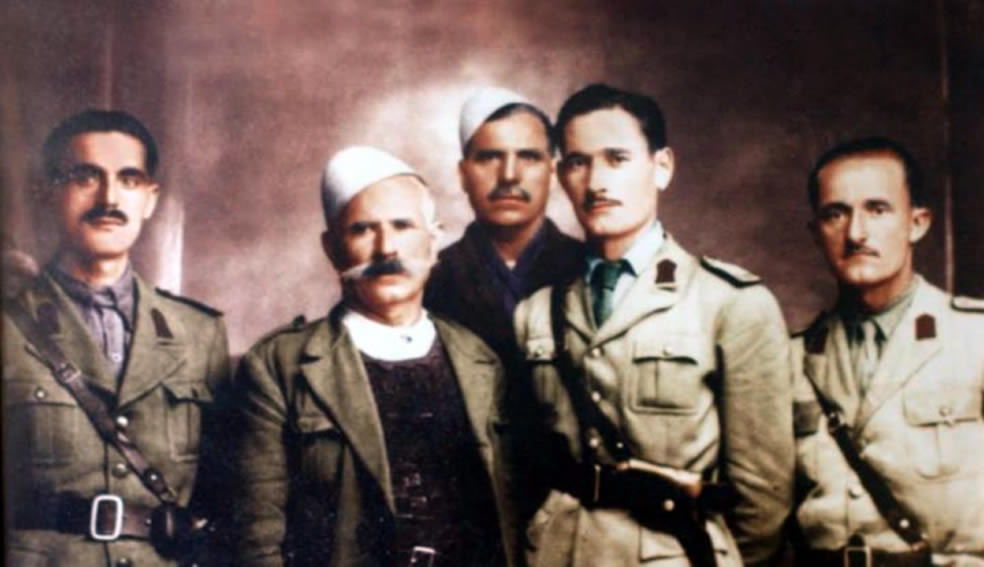

Written by Petrit Latifi
Mark Tunxhi and Vuksan Preka were Albanian nationalist fighters who was executed in 1947 by the Yugoslav communists. Mark Tunxhi was the Bajraktar of the Nikaj of Merturi. Vuksan Preka was from Qafa e Kolqit of Merturi. Vuksan Prekas spouse Drande Jakja spent many years in the prison camp of Tepelena. The two Albanians were shot while going out into the prison yard, supposedly releasing the prisoners.
The communist hunt against the Albanians
“According to the honest words of Len Marasha, one of the closest friends of the Marash Pal family was Mark Tunxh Vatnikaj, the son of the flag bearer of Mërtur, Tunxh Miftari from 1914 to 1944. Mark was the grandson of Sadri Gjelosh Palnikaj, while Sadria is the father of Martin Sadria from the village of Curraj i Poshtëm.
Mark Tunxhi is remembered as one of the most skilled men in war, he is remembered as a great battle strategist and an eternal loyalist to national ideals and interests, to religion and to the best values of family and Albanian life. Mark Tunxhi was part of Nik Sokoli’s anti-communist group, which also included other well-known nationalists from the region such as Vuksan Preka, Kadri Ceca, Nik Delia, Shpend Sadiku, Brahim Cani, Mark Sadiku, Sokol Boçi, Pjetër Mehmeti, etc., who resisted with weapons in hand until the end of 1948, when they fled abroad.
Mark Tunxhi Vatnikaj had three sons, Zefi, Prela and Gjon. It is known that the eldest son Zef Marku was killed on March 1, 1947, near the Stakaj neighborhood, while he was crossing the river to the village to get bread, food and clothing for the people who were spending the winter hidden in the high snowy mountains. In 1948, Mark Tunxhi’s life on the run had become very difficult due to the numerous army and police forces that were deployed in Nikaj-Mërtura as well as the numerous recruitments of spies from among the poor villagers of the area.”1
Vuksan Prekas grandson Gëzim Nika gave an interview about his grandfather

“My family has been and remains a family of anti-communist patriots. My grandfather Vuksan Preka was executed by Yugoslav communists in Kosovo in collaboration with the Albanian secret service because of his activity in favor of democracy and the national ideal, in Albania and Kosovo. This giant man of the Albanian mountains, who refused to submit to communism, wanted Albania and Kosovo to be free and today makes me feel proud.
He was executed in Peja, Kosovo, together with 102 anti-communist Albanian patriots, who represented most of the well-known families of northern Albania, accused of being collaborators of the American CIA.
After my grandfather escaped to Yugoslavia, on October 5, 1948, my grandmother Drane was interned with her 4 children in the Tepelena camp. They interned her together with her two daughters and two sons, my father, then 7, and Zefi, 2 years old. She was subjected to forced labor in conditions of slavery.
Left in hellish conditions, during August 1949 alone, 33 children lost their lives in one night in the Turan Camp. Among the child victims of that night was Dranje’s little son, 2-year-old Zefi.
Grandma Drane herself took care of the burial of her little son Zefi with hands that trembled for fear that they would also destroy his remains. For six months she watered the grave of her baby boy with tears until she left to return to our village, in the ruined house she exhumed Zefi’s corpse, taking it with her. The corpse of her son (my 2-year-old uncle), wrapped in goatskin and hidden in her bosom.
After a seven-day journey by car and on foot from the internment camp in Btosha, grandmother Drane buried little two-year-old Zefi next to his grandfather, Prekë Ndout, in Zeqir Dema’s troll, in his native village. So this is not a legend, although it crosses the boundaries of imagination for those pseudo-historians or Albanian “intellectuals”, who today and yesterday try their best to retouch the tragic history of the Albanian people under communism.
My grandmother herself, whom I loved with all my heart, has said: “in twenty-four hours, thirty-three children died in the Turan camp. In every corner of the barracks, inside and outside, you could only hear screams and wailing. Great sadness for the death of those little ones, in this abyss of the government and the deep despair of the families, there was not enough time to open the graves…”
I believe that there is no need for more. Protecting yourself from even the accusation of a crime does not make you innocent, at least morally. The camp must be built!
The historical memory of the Albanians must not be killed by oblivion. The history of this camp has nothing to do with the people of Tepelena or Tropoja, because no one asked them, but with communism and its crimes, with the past and the different future of Albania.”2
According to the CIA information report, titled “RDP82-00457R002700460003-3“, published January 1949, the following can be read:
“In the mountains of the north, small groups of nationalist guerrillas are very numerous. Such groups extend as far south as the Elbasan area, but the strongest are those of Puke, Mirdita, and Mat. The Puke group is led by Ndoc Mirakaj and Pal Bib Mirakaj, that of Mirdita by Major Ndue Bajraktari, and that of Mat by Captain Bilal Kola. A sub-group in the Dukagjin region, headed by Captain Mark Tunxhi and Lieutenant Nik Sokoli, is under the control of the Puke group. In addition, around Peshkopije, in the Dibra region, there exists a limited number of guerrillas headed by Cen Elezi and Dan Kaloshi. The latter are cooperating with the Yugo-slav authorities, and it is not definitely known whether they are at present in Albanian or Yugoslav territory.”
DRANDE JAKJA, SPOUSE OF VUKSAN PREKA
Albanian author Ramiz Lushaj published a review of Pjetër Metas monograph, where Meta writes of Drande Jakja, spouse of Vuksan Preka, where we can read the following:
“… The second issue after Doruntina of this ancient Illyrian ballade is the present and real “legend”, the Big Mother Drande Jakja, otherwise the modern Doruntina. A girl grown in riverside of Drini from the generous and noble house of Jak Gjoni in Fierzathat is called the place of light. The spouse of the irrevocable martyr Vuksan Prek Ndou, the son of Nikaj-Mërturi, from the house of patriot and wealthy erudite, Zeqir Dema of Btosha, who has lived with dekades in Bukova, in the valley of the highland of Gjakova. She has exceeded lordly through six regimes surviving through big challenges. She is reaching the century of her life; she is now 98 old years. She has carried in her lap the great-grandchildren of the fifth generation.
The present Doruntina Drande Jakja of Btosha, in the end of November 1948, when the Iron Mist of East (communists) has fallen as a big rock in the midst of Albania and Kosovo she has greeted for the last time her husband, guerrilla that time, Vuksan, who has challenged the communism system by resisting when the partisan brigade entered in saddle of Kolçi in November 1944 with the purpose to dominate Nikaj-Mërturi. Drande has given her word to her husband Vuksan (p. 137) that she will raise his sons in his land and that she will give his daughters as good brides in generous houses. At that time the minor of their four children, Zefi, was only 10 days old.
The modern Doruntina, Drande Jakja, is a alive legend, that, otherwise from ancient Doruntina who travelled by riding together with her dead brother, the risen Kostandini, this highlander with vital strength, has travelled twice by foot alongside of her husband Vuksan Preka, going-returning from Btosha to Nikshiq of Montenegro, victimized from the state regimen of Zogu, the king, because they rejected to hand over the weapons. Moreover, they have combatted together with the youth of the region of Btosha the legates of the government.
Again as in legends, they have crossed seven mountains in Nikshiq, the place dwelled mostly by Slavs than Albanians. They crossed seven rivers till river Zeta that bands together with Moraça before outpouring to Adriatic Sea.
The present Drande Jakja isn’t Doruntina of the ancient ballade neither Doruntina of the novel of Kadare, that gets married far away from her homeland and returns by riding with her dead brother. On the contrary, this new Doruntina has been a combatant in the mountains alongside with her powerful husband, Vuksan Preka, in the earlier years of her bride hood, as well as in her earlier months of pregnancy. At the time that is considered the most special time in the life of a couple, they had to emigrate from their home to mountains of the region of the Plane of Dukagjin.
During the Second World War, Vuksan and Drande, one of the best couples at this region, lived pacifically and blessed for four years in the land of Btoshi. In the end of November 1944 Vuksan Prek Ndou, alongside with other fellows from Btoshi has taken part in the resistance against communists in Nikaj-Mërturi, and until the border was closed up in 1948 he continued to be a combatant in the mountains where often he would take the risk by meeting his family in Btosha, until in 1952 he got condemned without trial with shooting together with other two fellows from the ex-Yugoslavian security, in the region of Kosovo.”3
This article, by prof. dr. Lush Susaj, writes of Len Marashja who spent 9 years in the Tepelena camp, where she remembered Drande Jakja, spouse of Vuksan Preka
“Len Marashja: 9 vjet në kampin e Tepelenës, njëherë u ngopa me bukë“
“…. He entered the Tepelena camp at the age of 6 and left after 9 years. He never forgets to remember how during all this time spent in the infamous communist-era camp, he had only had enough bread once. And then, it was secretly offered to him by a Labe mother who lived near the camp… This is just one of the details that Mirditora Len Marashja brings to “Albanian Free Press” about her personal experience in the camp that has been talked about so much recently. Adding further, others that show how entire Mirditora families were mistreated there…
In addition to the horror that Len Marashja saw and heard on the day of the siege of the apartment in Markaj and in the first three weeks of her stay in the Tropoja prison, she and her family spent another 9 years in the Tepelena camp. Regarding the latter, she tells how there, alongside the ignorant people filled with hatred, malice and violence, there were also very good people who helped people as much as they could. Lena also remembers the day that, together with the other children of the camp, they passed through the small holes in the wire and went to collect berries.
Near the camp, there was also a small 1-story house, in which lived a woman of about 60 years old, who had seen the barefoot and hungry children coming out for berries on other occasions. On that hot July day, the mother Labe had waved to the children to come closer and had brought them into the house. She had cooked them a wheat bread, which she had put in front of them with yogurt, butter and pieces of cheese. Lena remembers how while she and the other children were eating bread, her mother had stared at them and cried for the frightened children, who were emaciated from malnutrition…
Horror for those who came from Mirdita
Lena also remembers the horror she saw and experienced in the days when about 3,000 women, old people and children from Mirdita also arrived in the camp. After the camp was overcrowded with these families, according to her, there was no longer any care, no mercy, no space to live there, while the bread and food rations worsened even more.
The families who came from the mountainous regions of Mirdita, Puka, Dukagjini, Has and other regions of Mbishkodra had nothing to wear and nothing to lay down or cover themselves with. Most of them did not have anyone to visit them or bring them any clothes or food. In this context, Lena recalls four realities that are worth writing down and remembering.
First, she tells of how all the women and girls in the camp had no help from their distant families, they did not even have clothes to wear for their young children. In these conditions, the women and girls cut their hair and made headbands, socks and shirts for their young children. Lena also remembers how her mother collected her own and her daughters’ hair to make socks and vests for Kujtim Talushi, the son of Talushi Pal, who was born a few days after their family had arrived at the Tepelena camp.
Lena also recalls Mark Tunxhi’s wife, who cut her beautiful hair and used it to knit socks and sweaters for her son, Prel Marku. She also recalls Drande Jake, the wife of Vuksan Preka of the Bushgjokaj family, who remembered the grave of her dead son in the camp and a few days before her release managed to exhume it and secretly transport it to the family cemetery in Btosha. Secondly, from the 9 years of her stay in the Tepelena camp, Lena also remembers the great sacrifice of her uncle, Pal Alia, who traveled twice on foot from Curraj to Tepelena to see and help with clothes and food for his sister, nephews and nieces. Apart from him, during the 9 years of internment, no one else from Nikaj-Mërturi was able to visit the Tepelena camp.
Thirdly, Lena also remembers the scandalous food conditions. The food situation was so bad that during the winter, the dead were not immediately reported, in order to use up the bread and bean curd from their rations for a few meals. Many times, the children would sneak out from behind the fences and collect groundnuts (bean seeds), which they would roast and eat instead of bread.
Even during the harvest and threshing of the wheat, the children would come out from behind the fences and collect the ears of corn and grains of wheat left in the fields and boil them for food. She remembers how one of the ruthless camp policemen, named Selfa, would go and kick them every time he ordered the fires and the pots that were boiling the wheat.
In contrast to the behavior of this idiot, Lena also remembers the humane behavior of one of the daily camp inspectors who, every time he counted the children lying on the ground, would say in a low voice, “Help me, God,” and his eyes would always be filled with tears. Fourth, Len Marashja from the Gjakova Highlands to Tepelena, they managed to challenge the dictatorship by joining their fiancés imprisoned in the camp.
These girls, raised in the tradition and in the best homes of Albanianism, became brides in the Tepelena camp, based on their feelings and the word given by their father. They did not break the engagement or the word given according to the centuries-old custom of Albanian families, they did not replace the tradition or the word of their father with the dokras and the so-called “new norms of socialist life”.
For those who resisted and survived the attacks, the murders, the prisons and the camps of communism, for those who kept alive the tradition and the best customs of Albanianism, memory, congratulations, gratitude and all the thanks in this world, seem not to be enough. From this resistance and continuity, Albania and Albanian society have never had and will never have anything bad because our evil has originated and continues to originate from those who abandoned and violated tradition, customs and the word given.
How the baker who gave bread on top of the ration was hung from a tree, smeared with honey
Lena also remembers how Xheka, the kind-hearted baker of the Tepelena camp, escaped. Xheka helped families with many children by secretly giving them a morsel of bread on top of the ration. When the police caught him, they caught him, beat him in front of people, stripped him, smeared him with honey and tied him to the body of a thick oak tree full of ants (roaches). In less than 10 minutes, Xheka’s body was filled with roaches and he began to scream from the pain of the bites. But fortunately for him, on that day a small car with several inspectors arrived from Tirana for the camp. When the inspectors saw this kind of public torture, they were surprised and sought the cause and the perpetrators, who had invented this kind of horrible death. After learning the cause and the perpetrators, they ordered the immediate release and treatment of Xheka. (AFP.al)4
References
- http://limit.al/2021/04/02/kur-shuhet-arkiva-e-gjalle-e-kujteses-antikomuniste-nga-prof-dr-lush-susaj/ ↩︎
- https://shqiptarja.com/lajm/gezim-nika-historia-rrenqethese-e-gjyshes-time-ne-kampin-e-tepelenes ↩︎
- https://www.facebook.com/story.php?story_fbid=201611923371162&id=189168551282166&_rdr ↩︎
- https://pasqyrimi.wordpress.com/2018/09/08/len-marashja-9-vjet-ne-kampin-e-tepelenes-njehere-u-ngopa-me-buke/ ↩︎


 Balkan Academia