
Written by Petrit Latifi
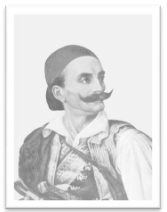
Kiço Xhavella
Kiço Xhavella, if not the most important of the great Suliot clan of the Xhavells, is certainly the most important of those who participated in the Uprising of 1821.
More important than Xhavella is considered Fotoja (1774-1809), about whom Kollokotroni said: “Marko Boçari was not captured, but Fotoja was perfection”. Kiço Xhavella grew up in Corfu, where the Suliots had been displaced after the conquest of Suli by Ali Pasha. In 1820 he returned to Suli after the efforts of the Suliots with Ali Pasha Tepelena and was proclaimed captain at the age of 19.
He went to Italy with the task of securing ammunition, but when he returned from there, Ali Pasha had been killed and the Suliots were displaced again from Suli by the Ottomans of the Sultan. Kiço Xhavella goes to Etolakanani and participates in all the battles of the area, either under the command of Marko Boçari or alone.
When Gheorghe Karaiskaci became the chief general of Rumelia, Kiço Xhavella the Mesuliots followed him despite the opposition he had at first. In 1835 King Otto made Kiço Xhavella a lieutenant general and general supervisor of the army and personal adjutant. Xhavella served in several high state positions as prosecutor, chief general after the death of Gheorghe Karaiskaci, Minister of Defense in 1843 in the government of Ioannis Colletti.
And in 1847-1848 he was prime minister112. He died in 1855 in Missolonghi. Prominent warriors from the Xhavella lineage were Marko, Jorgji, Llamroja, Kosta, Ziguri, etc.

Athanasio SKURTANIOTI (1793-1825)
The self-immolation of Thanas Skurtanioti in the Monastery of Saint Sotira of Mavromatis in Thiva on 26.10.1825 was a heroic and tragic event of the uprising in the province of Boeotia. Thanas Skurtanioti was from Dervenohori of Skurta. His real name was Thanas Jaci.
From the first days of the 1821 Uprising in Boeotia, Thanas Jaci became the leader of the Dervenohori and terrified the Ottomans of Boeotia, Attica and the Peloponnese. Shortly after the initial exploits, Captain Thanasi took the surname Skurtanioti after the name of his birthplace.
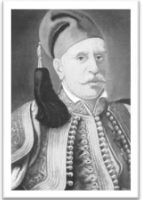
Nikolao KRIEZOTI (1785-1853)
Nikola Kriezoti is the greatest figure among the rebels of Euboea. He comes from the Arvanite villages of Karistas. The uprising in Euboea was a clash between the Orthodox Arvanites and the Muslim Arvanites.
And, if Kriezoti was prominent on the side of the Christian Arvanites, Alizoti was prominent on the side of the Muslim Arvanites. It is also a fact that the insurgent activity in Euboea was limited to those areas where there were Arvanites, namely in southern Euboea, on the Halkidiki-Kimi axis.
Nikola Kriezoti participated in the most important battles of Rumelia and Euboea, but after the liberation, the persecution of this hero began, imprisoning him, and eventually he was forced to self-isolate in Istanbul and Prusha, where he died108. His tragic irony is that after the liberation he found refuge with the Ottoman soldiers, who were heroes of the war of 1821. This is as tragic as it is sad. While Alizoti remained in Euboea and died in old age.
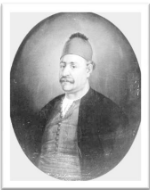
Andrea MIAULI (1769-1835)
The great admiral, Andrea Miauli was the son of Dimiter Bok or Voku, originally from Euboea. One of Andreas’ great-grandfathers changed his surname from Bok to Miauli, taking as his surname the name of the ship “Miauli”, where he worked for many years. Andrea Miauli was born on 20.5.1769 on the island of Hydra. He was a pirate in his youth. On one occasion, a Maltese pirate ship sank his ship, and his father, instead of saying any words of comfort, put him forward, saying: “Get out of here, he was a Kazantian. Get out of here once more, you hear me”!
Of course, they spoke in their native language, Albanian, like many heroes of the 1821 Uprising. He was a man of great character, a classic “Albanian head”, and in addition to his exploits in naval battles, a large number of interesting stories were dedicated to him. As such, Miauli had Albanian national qualities and characteristics.
In 1822, Andrea Miauli was elected commander of the Naval Fleet of the island of Hydra. He donated 250 thousand gold francs and three warships to the 1821 Uprising. Andrea Miauli was a simple and brave man. He spoke his native language, Albanian, and English. He did not know Greek, only he learned to write his name in Greek when he became an admiral.
He did not accept many decorations and privileges. Thus he refused the decoration of the “Cross of the Legion of Honor” given by the King of France, Charles X117. Miauli opposed the Russian policy which had greatly damaged the Uprising of 1821. The Prime Minister of Greece, the Arvanite Yannis Kapodistrias and some leading politicians, who were friends of Russian politics in 1827, would take it away from him.

Teodor KOLLOKOTRONI (1770-1843)
The “Old Man of Morea” was born on April 3, 1770, under a tree in old Messinia. From his youth he became a vagabond in the mountains.
Kollokotroni’s entire life was spent among the Arvanites, whether Muslims or Christians. Kollokotroni had become a brother to the Christian, Marko Boçari, and to a Muslim, Ali Farmaqi. Kollokotroni’s soldiers were Arvanites from Morea and Chameria. The epithet “Kollokotroni” is the exact translation of the Arvanite expression “buttocks” and was first given to his grandfather, Jani. The old surname is Çergjini, which is also an Albanian word composed of the word çer- smart, devil with strength, mind and the common Albanian name Gjin. Çer + gjin = Çergjini.

Kostandin KANARI (1793-1877)
Kostandin Kanari is known as the ship-burner, whose exploits inspired Greek and foreign painters and poets. His figure had become a legend. He was born on the island of Psara in 1793. The Kanari tribe originated from Himara, from where they went to Parga, and then to where many Arvanites fled during the Ottoman occupation, namely to Italy and, specifically, to Genoa.
From this city, a branch of the tribe went and settled in Corsica. The first flight of the Kanari from Chameria is thought to have occurred around 1320. To this day, the descendants of that tribe can be found in Genoa and Corsica. Many of the Kanari have held high noble titles. An emblem from the parents of the famous arsonist who belonged to Corsican ancestors, Theodore Canary, is the same as the emblem of the great Italian revolutionary Giuseppe Garibaldi, whose revolutionary army was composed of Arbëresh from central Italy.
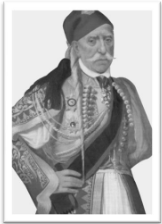
Dhimitër PLLAPUTA (1786-1864)
Dhimitër Pllaputa, the beloved general of Theodor Kollokotron, was the son of Kolë Pllaputa (1735-1826), who in 1750 left Trifilua to reside in the village of Pallumba in Gordinia.
Pallumba was founded by the Arvanites with the first invasions of the 15th century with dominant tribes such as the Kolët and the Buetët. The Pllaputas were Christian Arvanites, who had waged a prolonged war with their Muslim Arvanite neighbors and their fellow tribesmen, the Laliots. Although in the face of the destruction of Lala, the Plaputs, especially Dhimitër Plaput, helped the Muslim Arvanites to abandon the Ottomans, who shared the same religion, and to move from the Morea to Rumelia and Epirus, fighting the Londeas, to preserve the trust that he and Kollokotron had given to the Muslim Arvanites.
Dimitar Plaputa fought in Levidhi, Tripoli, Corinth, Andrichana, Dervenak and on the island of Nafplios. After the assassination of Yannis Kapodistras, he was elected a member of the government. He remained loyal to Kollokotron until the end, sharing with him the torments of the sensational trial and prison. In 1832, Dimitar Plaputa, like many Arvanite heroes of the Greek Uprising of 1821, was arrested by the Greek Government and sentenced to death, and after several years of imprisonment, he was pardoned and released. He became a member of parliament, died in July 1864 and was buried in Pallumbe.

Teodor GRIVA (1799-1862)
General Teodor Griva, son of Draco Griva, came from the largest Arvanite tribe at the court of Ali Pasha Tepelena. He participated in most of the battles of Rumelia. Teodor Griva married Elena Bubulina, who was the daughter of Laskarina Bubulina. After the liberation, he took up politics, and his entire life that followed was turbulent. In 1854, he became the leader of an Arvanite union, most of whom were fighters from 1821.
With their sons and his own son Dimitri, they marched with the aim of liberating Albania from the Ottomans132. This movement failed due to the intervention of the Western Great Powers, especially France. In the following years he set himself the goal of overthrowing the kingdom and establishing the Greek republic. In October 1862, with seven thousand men, he came from Bomica to Missolonghi, distributing the authorities.
The provisional government in Athens sent Venizelos Rufo and Emanuil Delijorgji to give him the general’s medal, but he was already dying in bed. He died of pneumonia on 24.10.1862133. His younger brother was Aleks Kardhiqoti, who took this surname from Ali Pasha for the courage he showed in defeating Kardhiq.

Laskarina BUBULINA (1771-1825)
Bubulina is one of the most heroic female figures of the war of 1821. Laskarina was born on May 11, 1771134. Her parents were from the island of Hydra, but after her first marriage she settled on the island of Speca. She married in 1788 the Arvanite Dimitër Januza, a captain from the island of Speca, who was killed by pirates in Spanish waters in 1797, leaving Laskarina a widow at a young age, with her three children, Jani, Jorgaq, and Marina.
After a few years, Laskarina married for the second time the brave Arvanite Dhimitër Bubuli. In 1811,135 Dhimitër Bubuli was killed by pirates in the waters of Algeria. Thus, a great hatred for the Ottomans had gathered in the soul of Laskarina Bubulina. The death of her father in the Ottoman prisons in Istanbul, and her two husbands killed by Ottoman pirates, led Laskarina Bubulina to fight for freedom.
Bubulina devoted herself to the cause of the liberation of the country, giving, in addition to her heroic contribution, her very large fortune that she inherited from both marriages. The fame of her manliness was so great that she became a legend. She fought in the liberation of the islands of Nafplio, Hydra, Speza and Tripoli. The Arvanite Muslims of northern Greece imagined her, in addition to being brave, as a beautiful maiden.
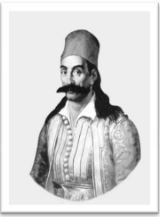
Gheorghe KARAISKAQI (1782-1827)
“The legendary son of a nun” was born in the village of Mavromat in Kardhica. Since childhood, he suffered from lung disease (leukemia). The legendary hero of Rumelia is from the lineage of Llalla-Jorgji of the Lower Swamp. The son of Jorgji Llalla was Dhimitër Llalla Isko, who was part of the cream of Ali Pasha’s braves.
Dhimitër Isko raped Zoina, the widow of Janaq Mavromatiot, a relative of the Arvanite hero Jorgji Baholla and an acquaintance of Ali Pasha, who was a nun at the time of the rape. Zoia, after the birth of her son, whom she named Georgio, son of Dimitar Llalla Iskos left the monastery to live in her birthplace. As an adult, Georgio was baptized a Christian by Ndre Karaisko, who gave him his surname, Karaiskaqi.
Georgio Karaiskaqi was a vagabond when he was captured by the soldiers of Ali Pasha Tepelena. Ali Pasha spared Georgio Karaiskaqi’s life, making him one of his most trusted men. Georgio Karaiskaqi and Odise Andruço remained loyal to him until the death of Ali Pasha Tepelena, who had his most trusted men.
In the Pasvanoglu uprising, Ali Pasha did indeed let him be captured on purpose and thus became the bearer of the agreement between Pasvanoglu and Ali. He entered the Daifana of Kaçiandon to convince him to cooperate with Ali Pasha. After the arrest and execution of Kaçiandon, he took over all of Daifana and included it in Ali Pasha’s forces. He led the defeat of the rebellion of Papathimio Vllahava and killed Papathimiu Vllahava’s brother, Dimitri, with his own hand.
He continued the line of national unification of Odise Andruços and this brought him much suffering in the first years of the uprising. In 1824, the Greek government declared Georgio Karaiskaq a traitor at the trial of Missolonghi, stripping him of all his ranks, but in 1826 he was pardoned, and thus regained his place in the army. When they saw that all of Rumelia had been defeated by the Ottomans, they were forced to give him permission to establish a base with fighting forces. Within a short time, he liberated all of Rumelia.
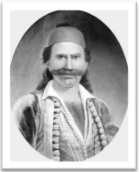
Odise ANDRUÇO (1790-1825)
“What a shame for a brave man who had done his country so many excellent services, to be humiliated, to appear and answer as guilty before the judges”.
“The Lion of Rumelia” Odise Andruço, was the son of the famous chief of the committee Andrea or Andruço Verushi, from the Levant of Locris. Odisea was born in Preveza, Chameria in 1790. When Odisea was four years old, his father died in prison from the tortures of the Ottomans in Istanbul.
Ali Pasha Tepelena, a friend and comrade-in-arms of his father, took him in after the death of Andruço Verushi. At the court of Ali Pasha, Odisea had a position that not even Ali’s sons had. He served Ali Pasha Tepelena with loyalty and pride. He helped him in all the wars against the Ottomans, the Sulyots and the Kardhiqots. But Odysseus’ close connection with Ali Pasha would damage him a lot after a few years.
He was the inspirer of the “Council of the Captains of Rumelia” which aimed to unify Greece without religious distinction and relied on Ali Pasha in his war against the Ottomans. Odysseus tried to dictate this policy even after the death of Ali Pasha Tepelena during the war for the liberation of Greece and this cost him his life under the accusation of being a “traitor”.
In 1821, Odysseus Andruço was the commander-in-chief of Eastern Greece with the rank of general, but by mid-1822, he resigned with honor as commander-in-chief, because he was not well regarded by his opponents.
The event that established Odysseus Andruço as a figure of 1821 was his resistance at the Grabia Inn. Odysseus had a brilliant political and military mind, his value was recognized by all the captains of Rumelia and they called him their natural leader. Gura, who became a blind tool in the hands of short-sighted politicians, linked his name to the murder of the hero, which took place one July night in 1825 on the Acropolis, in the prison where Odysseus had been imprisoned, bound in chains.
Reference
Arben P. LLALLA ARVANITËT THEMELUESIT E GREQISË SË RE (Mitet e historiografisë greke) (Heronjtë, kryeministrat, akademikët, piktorët. Botimet e para në gjuhën shqipe me shkronja greke, libra, shkrime, poema, poezi. Mitet e historiografisë greke). 2 Autor Arben P. LLALLA Redaktor Ahmet SELMANI Radhitja kompjuterike Ejup SHABANI Korrektor Lirim SHABANI llalla.arben@gmail.com Botues: Copyright © Autori Shtypur: Shtypshkronja Alma -Grafika, Skopje 1000 Tirazhi: 1.500 copë Botimi i Dytë, Mars 2021. https://pashtriku.org/arvanitet-themeluesit-e-greqise-se-re/


 Balkan Academia