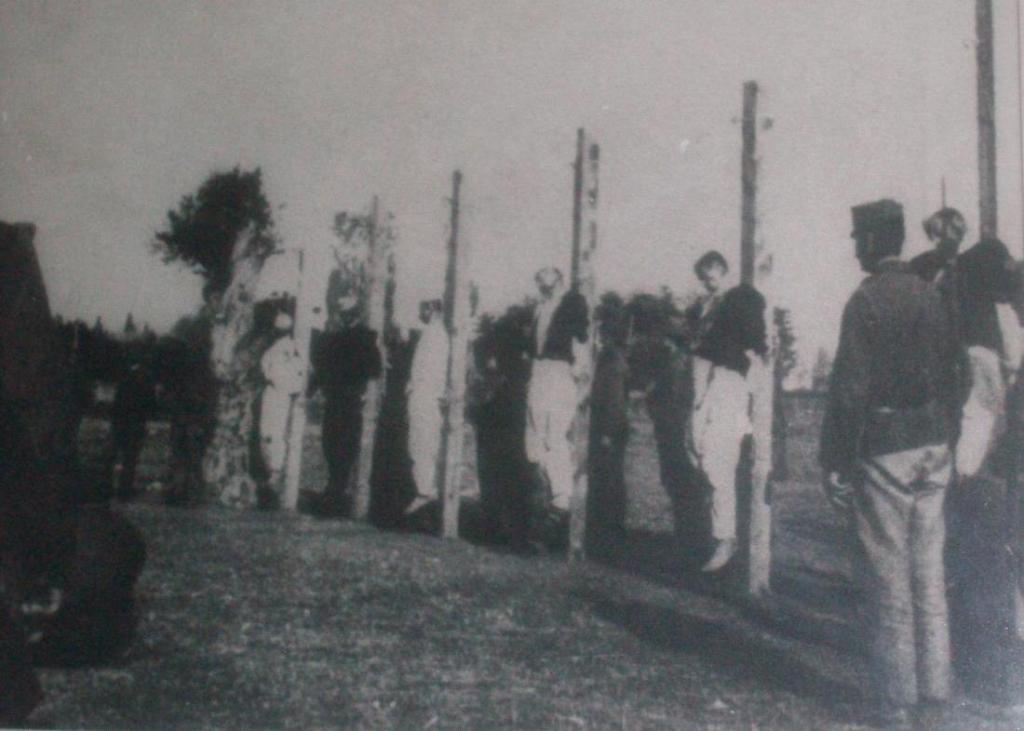

Abdulla Mediu, from Raveni i Gostivar, the Serbian army burned him alive in his house together with his 2 aunts.
Arangelli of Kicevo,,Typhoid fever,,. This disease was spread by the newly formed communist state itself, which, from prisons, “released” the sick, with the aim of spreading the disease to their families, clans and relatives, etc.,
Arangelli… which caused the death of 40 people within just 10 days – writes Safet Hyseni in one of his several writings, dedicated to the crimes of 1912-1913 in the region of Kićovo and beyond.
Arbëri of Kićovo. The Serbian army had killed all the Albanians of this village, so, according to Hyseni, there was not a single person left from this place to witness the manner of the crime, but it is known, he adds, that “They were slaughtered like cattle at the butcher’s and then burned in the fire of their houses”.
Bajazit Verbani. In the place “Sokolski dom”, Macedonia, the UDB cadres burned the eyes of this Albanian with cigarettes, then shot him, which was also done to dozens of other Albanians.
Beliçica of Mavrovo, Sergja. This, by order of the Mavrovo Partisan Brigade, or on his own initiative, had killed 50 Albanians – writes the late Dr. Fejzulla Shabani.
Bellçishte and Zlestë. Dr. Nebi Dervishi reports that around mid-October 1913, on the Feast of Eid, in the early morning hours, when the men were praying the Eid prayer, the Serbian army surrounded the village mosque…
Bellçishte and Zleste… After forcibly removing them from the mosque, they tied up and arrested 74 men, along with the imam, who were then all executed…,,
Bihor. Eugen Shehu writes that after the Second Albanian League of Prizren, there the Serbian Chetniks massacred over 4,000 Albanians.
Bigorski Monastery. On the grounds of this monastery, the Serbian army had thrown 27 Albanian boys alive into a pit with gravel.
Bllaca in Macedonia. “The 6th Macedonian Brigade surrounded the village and captured 284 men, including a father with his three sons, and brought them to the Kaçanik gorge where they were brutally killed,” says an internet text, adding that Bllaca, “In these crimes, for human shame, stands out Qemal Sejfullah’s wife, a Turk, named Qefsere, who, with a revolver in her hand, goes from corpse to corpse and mercilessly kills those who were lucky enough to be counting their last minutes,”.
Braçani, Kicevo. The Serbian army had killed all the Albanians of this village, so that, according to Safet Hyseni, there was not a single person left from this village to witness the manner of the crime, but it is known, he adds, that “they were slaughtered like cattle at the butcher’s and then burned in the fire of their homes.”
Brodeci of Tetovo, 2007 “Mountain Storm”: During the police action known by this name, 6 people were killed, 13 others were tried with a total of about 110 years (Lajmi, 27.8.2014).
Cerova i Gostivarit. In this village, the Serbian army, during 1913, had murdered 100 Albanians, which is why the place of execution is still called “Strelishte” (roughly: Place of murders).
Cervica i Kicevo, 1913. A massacre of 36 people took place and they were buried in a mass grave, which, to this day, has not been made known to the public, is emphasized in an internet text.
Chairi i Skopje. Dr. Xhemaili writes: “The police chief, Lazar Ilic, gathered 18 Albanians in Chair Square, whom he first locked in the school, and later killed, while throwing their bodies into a well, near the brick factory, near Skopje”.
Drenica, 1945. During this year, in this place, partisan units massacred about 4000 Albanians.
The Dubrovnik massacre of Albanians by poisonous gas
Dubrovnik, 1945. Thousands of Albanians were poisoned by the Yugoslav communists, although the victims were fighting for the liberation of the country from the German occupier, it is said in historical literature.
Dubrovnik, 1945. Kasam Kasam, reports:,,The poisoning took place in a place in this city,, and that,,In order to lose the traces, immediately after the release of the poisonous gas, the building where the poisoned Albanians were placed was set on fire, allegedly that this,,was a random incident, without malicious intent,, etc.!
Gorica and Trieste… Those in danger, instead of lying down, walking around with a rag in their noses, stood up, demolished the door, windows and roof. The smoke rising up, left them dead on the roof, windows and curled up in the door… the Chetniks with partisan stars from Skopje and Dubrovnik, as “specialists” in poisoning Albanians, will also be seen in Gorica, Trieste, where about 4,000 other Albanians will die from poisons.
,,Goli Otok, Sabit Fidani, I remember: ,,We experienced the horror that cannot be described… all day we broke stones, while the prison superiors mocked us, telling us that you are getting the stones ready to kill Enver and Stalin…”.
,,Goli Otok, Mustafa Veseli: “There is no greater sadness than when a prisoner kills a prisoner, thinking that they will release him from prison…”.
,,Goli Otok, Sherif Kazazi: “If there is a hell in this world sadder than Goli Otok, I volunteer to go”,.
Goli Otok, Xhafer Kodra, although he supported the victory of communism, from the suffering in Goli Otok, he became mentally ill and ended his life as such. Venko Markovski, after being released from the same prison, says that the Dibrani in question experienced unprecedented persecution and torture in that prison.,, Put in a pit, covered with stones and the sun shining on his head,,,.
Gjilan, 1945. In the “Fakti” of July 22, 2006, there is a note that on January 5, 7 and 8, 1945, more than 1,500 Albanians were shot from this town, including many women.
Gjylehare. The aforementioned Danish journalist, Fritez Magnussen, reports that, after the occupation of Skopje, in this village the Serbs cut open the stomach of a pregnant woman, pulling out her unborn baby.
Hani i Elezit. Near this place, partisan detachments shot 50 Albanians from Bllaca e Skopje. (Fakti November 28, 2005-Qerim Lita)
Hasi i Prizrenit. Albina Drançolli, in “Faktin” of September 27, 2006, writes: “In Has 300 people were killed and the only crime committed by them was that they had called themselves Albanian Catholics. We are talking about the Serbian genocide against the Albanian population”.
Jabolçishta e Velez. Bejtulla Musa, from this village, was thrown into the fire of a burning hut by the Bulgarian army.
Kicevo, 1944 onwards. In the Arena weekly, no. 35, Safet Hyseni reports that the people of Kicevo from that year, “in addition to being shot, about 500 men, women and elderly people, they, by the new system, that of coexistence, were sentenced to no less than 402 years in prison.
“Klisura”. In November of 1915, 87 residents of the village were hanged in this place. Debërcë of Polog.
Struga’s “Krasta”. In this place on the outskirts of the city In this town, the Serbian army, after the uprising of 1913, shot 12 people. (Dr. Nebi Dervishi, “Ethnoculture…”, p. 229).
Kratova, Eastern Macedonia. During 1912 or 1913, in this town the general of the Serbian 2nd Army, Stefanović, had killed 100 Albanian prisoners with his own hand, saying: “This brood must be exterminated,” writes Dr. Xhemaili.
Malisheva. In this place, the partisans killed 42 Albanians. (“Fakti”, November 29, 2005, author: Qerim Lita).
Mulla Sula, from Sellca e Tetovo, was burned by the Macedonian Partisan Brigade in front of his children.
Niš and the surrounding area, 1877-1878. During these years, Serbia, as an ally of Russia against Turkey, began to clear the lands south of Niš from the “Turks”, in which case 640 settlements with 160,000 Albanian inhabitants were depopulated, who were forced to leave their ethnic lands.
Ostrec i Manastir, 1913. During this year, from this village, the Serbian army strangled 26 Albanian boys to death. Here is how Ostreci’s peers, who still kept it as a fresh memory, describe this event,
Ostreci… when I interviewed them several decades ago:
“Immediately after the Turks left, our village was taken by the Serbs. Some left, others came. One captivity was replaced by another, even more severe… Ostreci…First, three Serbian knights wearing white Albanian caps came to the village, with the aim of acquiring our sympathies, or for some other purpose. The army also arrived. The village was surrounded. All the men they found in the village were lined up.
Ostreci… An old man-Dalip Bajrami (according to the memory of his son-Nazmi Bajrami, a resident of Manastir), unable to tolerate such behavior, tried to take out his revolver and shoot at the leader of the army, but a Serbian soldier noticed him and killed him. Ostreci…All tied up, mistreat them along the way, they sent them near the village of Orizar and there they massacred 26 people at the best age of 17-25 years old”.
Ostreci of Manastir, 1944, burning. After the occupiers left Manastir, a Macedonian-Serbian partisan brigade coming from Greece entered the village, inhabited only by Albanians and, under the pretext that there were weapons and ammunition there, they set fire to it, causing great material damage and burning several innocent people, including women and children.
Padalishta of Gostivar. Halim Fazliu, 25 years old, although physically disabled, the Serbian Chetniks took him into the house and burned him with him.
Peja, 1919-1921. In the villages of this city, during the action to collect weapons, the Serbian-Montenegrin armies burned 420 houses and massacred 231 residents – reports Hiqmet Kica in Fakt of May 29, 2006.
Pesoçani, 1913. Dr. Nebi Dervishi, in “Fakt” of April 23, 2005, speaking about the consequences of the September Uprising of 1913, among other things, reports: Duko Pesoçani, accompanied by the Serbian gendarmerie and the special territorial forces of the “Black Hand” and “Narodna Odbrana”, around mid-October 1913, on the Feast of Eid, in the early hours of the morning, when the men were performing the Eid prayer, surrounded the village mosque.
Pesocani, 1913…After being forcibly taken out of the village mosque, they tied up and arrested 74 men, along with the imam, who then executed them all, in the region between the villages of Bellçishte and Zleste, where even today the signs of the cemetery can be seen…”.
Pesocani, 1913…On another occasion in the same village, about 150 villagers were massacred, who were thrown into a well alive and massacred, thus avenging the murder of a Serbian gendarme by a Kaçak named Idriz, etc.
Pirok. In this village during 1944, the Macedonian NCO had killed 27 Albanians.
Preseka in Gostivar. In this village, towards the end of 1944, the Macedonian NCO had arrested and shot 12 Albanians from this area.
Prespa, 1947, a trap for the ballists. In a place on Mount Pelister, on the Prespa side, near the village of Nakolec, during the year in question, the Greek border was improvised and in this way, by the people of the Macedonian UDB, a group of prominent ballistas from Macedonia was disarmed and imprisoned, who were transferred via Shtip to Skopje, Prespa… where a terrible communist execution awaited them, on October 11 of the year in question. (“Fakti”, June 7, 2005, author: Sevdali Demiri).
This betrayal or trap was caused by the UDB’s puppets, such as Boro Çushkar, Naum Isof, etc., probably in support of some Albanian traitors. The latter, Isof, then presented himself as an English officer.
Preshevci i Gostivarit, 1944. In this village, the command of the Slavic-Macedonian partisan army ordered, on a December dusk of the year in question, that all the inhabitants gather in a meadow.
After that, under threats of knives and weapons, the men, in the presence of their relatives, shot them and left them in the holes previously opened by the shot themselves. (“Fakti”, November 29, 2005, author: Qerim Lita)
“Prroj i Muçajve” i Kićovo. In this place on the side of the city in question, in 1913 the Serbian army massacred 11 Albanians, also stabbing them with bayonets, without wasting a single bullet. (Fakti, August 26, 2006-Safet Hyseni).
Reka e Sipërme, Mustafa Tërnica. He was the commander of the National Front’s branches for the country in question, which is why the Macedonian communist government, with the help of traitors to the country, found his traces and liquidated him in 1947, while his wife had her breasts burned with gunpowder.
Upper Reka… When she returned home, she could not give her baby to suck. Her child knew few words and begged her mother, saying: “Give me something to drink so I can tell father Mustafa when he comes,” says an internet text.
Rugova. During the period 1919-1921, in the arms collection campaign, the Serbian-Montenegrin army looted and burned 13 villages in that area, with 410 houses and killed 846 inhabitants. In February 1919 alone, in 21 settlements of Rugova, Plav and Guci, he killed 1327 people. (Fakti, May 29, 2006, Hiqmet Kica).
Suhareka of Kosovo, Berisha. In an article by Shkëlzen Gashi, published in “Fakti” on August 9, 2006, the words of an English journalist are quoted that “the Serbs on March 26, 1999, killed no less than 44 members of the Berisha family in Suhareka, committing one of the most serious crimes of the entire war. The entire tribe was exterminated in cold blood, from Ismet Berisha, two years old, to Sait Berisha, 83 years old.
Suhareka… They gave everything for Kosovo and died with their heads held high at the hands of the Serbian barbarians. In the newspaper KOHA, 3. 2. 2009, it is stated: ,,The Suhareka massacre is one of the most macabre crimes in Kosovo in 1999. In this attack, 50 people were killed, 47 of them were members of the Berisha family, among them women, children and the elderly..,, In the newspaper Koha, 19 February 2008, it is stated that throughout 1999 in the municipality of Suhareka, 430 people were killed.
Svetolik Vuksanoviqi, about Serbian crimes. This Montenegrin author wrote: “At first, Albanians were killed with rifles and batons, but soon the order came that there was no point in spending ammunition, so Albanians would be slaughtered with knives. And so, the Albanians were divided into groups – groups of 40-50 people, lined up in two rows with their faces turned towards each other and then the officers or non-commissioned officers stabbed the Albanians one by one in the neck.
These unfortunate people, neither moved from their place nor screamed nor defended themselves, they were almost not conscious human beings, but calmly watched as their comrade was stabbed next to them and the knife was also tearing open his throat. I could not imagine such composure and endurance of people who look at death with open eyes. This is one of the most horrific scenes I experienced during the wars”.
Skopje, 1912-1913. During November 1912, some Catholic nuns of honor, in the city’s military hospital, had found 132 Albanians in bed, of whom only 20 survived the bayonet wounds.
Skopje, 1912-1913… During the years in question, 38 tankers loaded with Albanian corpses were registered, some 3,000 of them between Skopje and Kumanovo. The Serbian invaders massacred almost all Albanian Catholics, who in Skopje alone constituted 12% of the total population – it is said in historical literature.
Skopje and surroundings, 1945-1947. During these years, 1450 Albanians were liquidated.
Skopje, Nexhat Agolli, although he fought with all his heart for the victory of communism, because he succeeded in advancing the position of the Albanians, he died, and his grave is unknown.
Skopje, Nexhat Agolli… Surely, at the moment of imprisonment, he himself admitted the mistake of joining an anti-Albanian communist brigade, but it was too late, so every mistake is paid for….
Skopje, Nexhat Agolli… His name would remain alive and would be appreciated more as a ballist, and not as a communist. However, his first successes, related to the advancement of the position of the Albanians in Macedonia, should not be forgotten.
Tetovo, 1944…Monopoly, crimes.. In Flaka of October 22, 2003, the author of this article quotes the words of a witness: “We lived on the first floor and every day we heard screams and whimpers of our people who were on the floor above us. After the screams, drops of blood began to fall, at first a little, and then more in the cracks in the ceiling… “
Tetovo, 1944. Monopoly… “The blood was of slaughtered and murdered Albanians…. From the other cell, which was in the basement, the screams of an Albanian could be heard, who was begging the black butcher to take a bullet out of him or cut off his head. The black butcher finished his cigarette on the stomach of the Albanian who had fallen like a sacrifice, with the knife he had stuck in his throat…”
Tetovo. Near the river, Shkumbi, the communist OZNA burned alive Shaip Kamberi, a ballistics officer, and Kadri Saliu.
Tetovo, 1945-47. At the beginning of 1945, 500 boys from Tetovo were mobilized, under the pretext that they would be included in the 4th Albanian Brigade of Macedonia. On the way to Skopje, 300 of them were separated, cruelly shot, and then buried in a common grave.
Tetovo, 1945-47. Fehmi Ajvazi, in his article, published in “Faktin” on August 23, 2006, reports that the Macedonian communist government, during 1945 “only in the Tetovo region had arrested 10,000 people, of whom 1,200 were liquidated without trial”. According to Hakif Bajrami, 4100 Albanians were liquidated in Tetovo alone
Tërnje, Kosovo, 1999. In this village 24 people were killed, including 7 children (Koha, February 19, 2008).
I would like to mention the event at “Bird’s Bridge” in Albania, where, on March 29, 1945, about 50 Albanians were thrown into the abyss through an improvised cable car, which was taking them to Tivar.
Tovarnik in Srem. In the battle of this place, in 1945, the IV (VII) Albanian Brigade of Macedonia left 48 killed and 171 wounded.
Valkov in Tetovo. On October 24-25, 1944, in this village, by the communist OZN units, 40 young boys were kidnapped, supposedly they would arm them and send them to the north, to the front of the war against the Germans. However, they were thrown into the Vardar.
Vardar. In the waters of this river in Skopje, the Serbian government has thrown thousands of Albanians, whose bodies have ended up in the Aegean Sea, or have been eaten by fish.
Zajazit.,, Xhuma,, In this neighborhood of Zajazit in Kicevo, the organs of the OZN killed 54 Albanian men. (“Fakti”, December 8, 2004, author: dr. fejzulla Shabani).
Zajazi. In this village, according to the records of Shaban Braha, the Macedonian government’s OZNA massacred 320 men and young boys from the age of 13 and up, there behind the Gradica mountain, between Vrapčisht and Toplica, where everyone was tied up six by six.
Zdunje e Gostivar, 1913, the Serbian army burned 37 women and children alive.
Zhega e Gostivar. In this village, around the end of November, 1944, the Macedonian XVI Brigade arrested 12 men who then stripped them naked, pierced them with bayonets and finally took them out of the village and shot them.
References


 Balkan Academia