
Written by Petrit Latifi
Kraljevo (Karanovac)
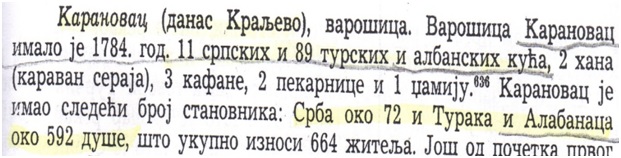
Tr: “Karanovac (today Kraljevo), small town. The town of Karanovac was founded in 1784. 11 Serbian and 89 Turkish and Albanian houses, 2 khans (caravan seraj), 3 taverns, 2 bakeries and 1 mosque. 636 Karanovac had the following number of inhabitants: Serbs about 72 and Turks and Albanians about 592 souls, which amounts to a total of 664 inhabitants. Ever since the beginning of the first one”…
Albanian (Arnaut) officers in the Serbian army
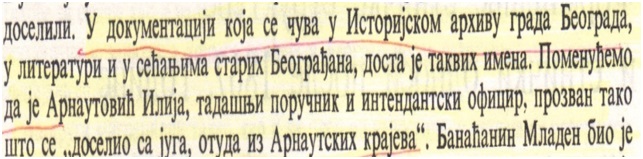
Tr: “immigrated. In the documentation kept in the Historical Archive of the City of Belgrade, in the literature and in the memories of the old citizens of Belgrade, there are plenty of such names. We will mention that Ilija Arnautović, the then lieutenant and quartermaster officer, was called because he moved from the south, hence from the Arnaut region”. Mladen was from Banac…”
In 1867, “a very bad Serbian” was spoken in Belgrad with accents from southern Serbia (meaning Albanian lands)
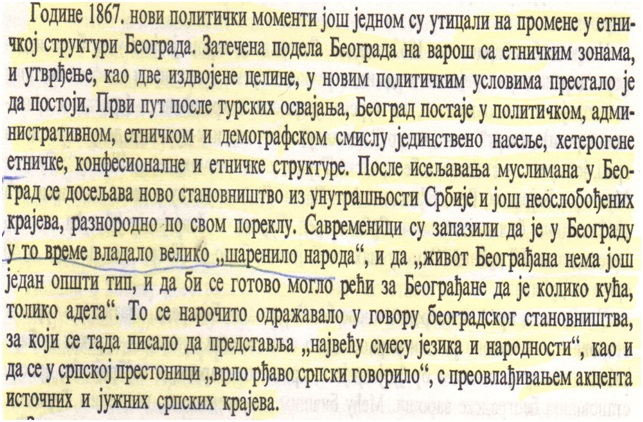
Tr: “In 1867, new political moments once again influenced changes in the ethnic structure of Belgrade. The sudden division of Belgrade into townships with ethnic zones, and the fortification, as two separate entities, ceased to exist in the new political conditions. For the first time after the Turkish conquests, Belgrade became a unique settlement in the political, administrative, ethnic and demographic sense, with heterogeneous ethnic, confessional and ethnic structures. After the emigration of the Muslims, a new population from the interior of Serbia and still unliberated regions immigrated to Belgrade, diverse in their origins. Contemporaries noticed that in Belgrade at that time there was a great “variety of people”, and that “the life of the Belgraders does not have another general type, and that it could almost be said of the Belgraders that there are as many houses as there are houses”. This was particularly reflected in in the speech of the Belgrade population, which was then said to represent “the biggest mixture language and nationality”, as well as that in the Serbian capital “very bad Serbian was spoken”, with accents from the eastern and southern Serbian regions predominating” …
35% of all homes in Belgrad were “Turkish” (Albanian)
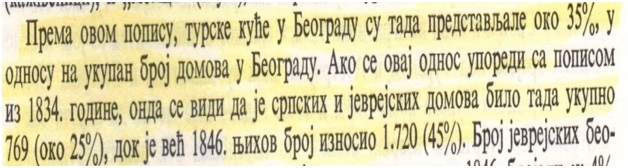
Tr: “According to this census, Turkish houses in Belgrade then represented about 35% of the total number of homes in Belgrade. If this relationship is compared with the census from 1834, then it can be seen that there were a total of 769 Serbian and Jewish homes (about 25%), while already in 1846 their number was 1,720 (45%). The number of Jewish white … “
Reference


 Balkan Academia