
Written by Petrit Latifi
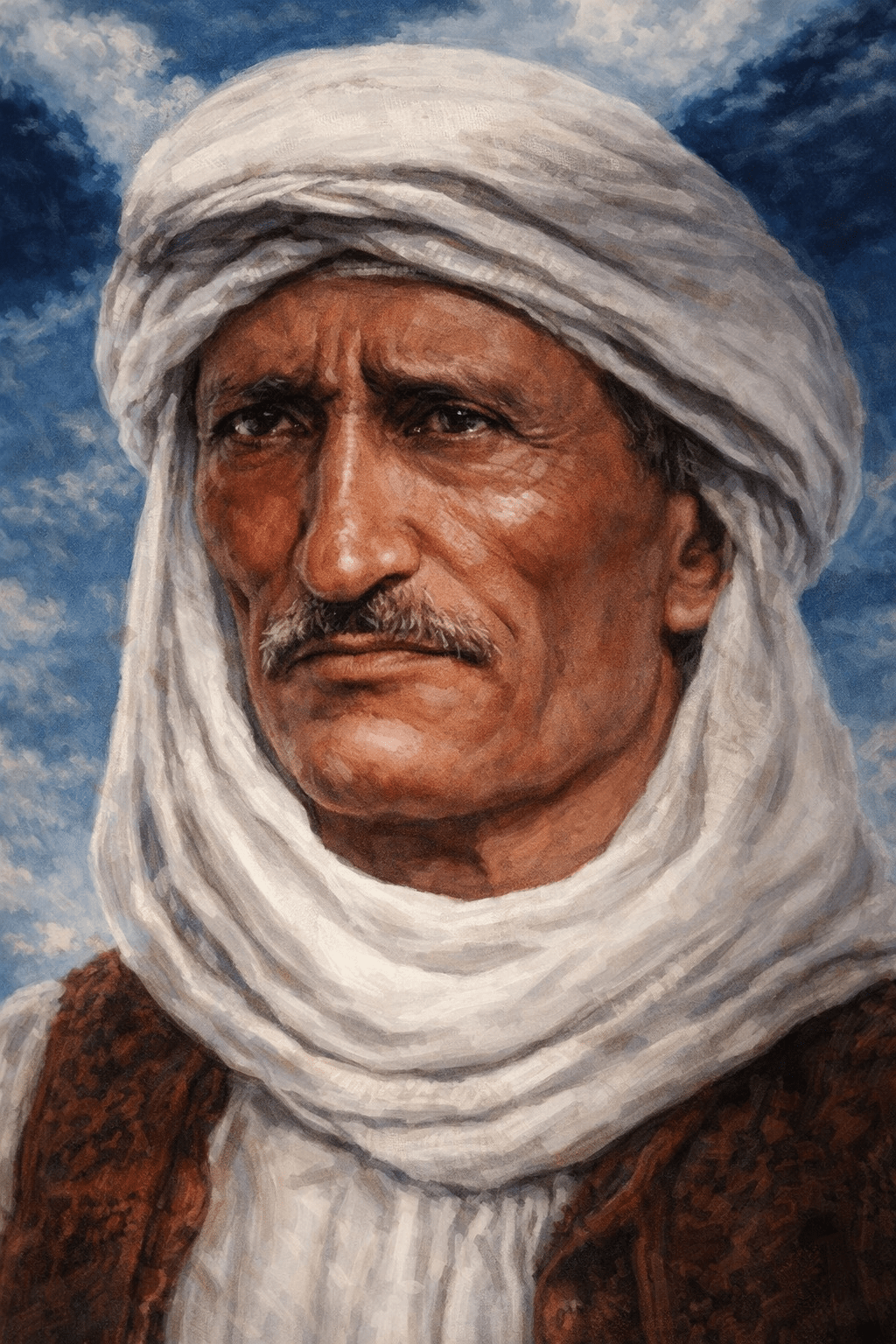
Bali Bajram Nokshiqi (1860–1944) was an Albanian patriot and martyr who died fighting Montenegrin forces on the Albanian-Montenegrin border. He also fought in the Battle of Nokshiqi (1879–1880) and during the Albanian independence of 1912 in the areas of Plav and Guci. He died during World War II with the Albanian flag in his hand. His son continued to fight and was killed in 1947 by Yugoslav forces. Bali Bajram Nokshiqi is today a revered figure among northern Albanians.[1]
Bali Bajram Nokshiqi Mekuli was born in 1860 in the tower of Bajram Hysi, a martyr. He was the fourth child of a patriotic family living in Guci and around the mountains of Gjakova. His father was a fighter under Ali Pasha of Guci and Jakup Ferri in the battle of 1879, from 6 January to 1880.
He fought against the invading Montenegrin forces led by the sworn anti-Albanian Marko Miljanov, in the battle known as the “Battle of Nokshiq”. During this battle, Bajram’s father destroyed the bridge over the Nokšić River, killing several hundred Montenegrin soldiers as they fell into the water.[2]
Battle of Nokshiq
Bajram Hysi, 65 years old at the time, was captured by the Montenegrins in the Nokshiq mosque. In front of the villagers, he was tied up and threatened to change his faith to Montenegrin Orthodox, for which he shouted: “I am Albanian! The Albanian’s faith is Albania!”. The Montenegrins, very angry, decided to burn a cross on his forehead. He was tortured until he died.

The heroic deeds of Bajramis’ father were remembered and are still mentioned in Albanian folklore today. Bali Bajramis’ sister became one of the female patriots who saved 100 civilians. The Montenegrins captured her and imprisoned her in her parents’ tower and set her on fire. Haxhi Zeka officially proclaimed her the “Albanian Heroine of Nokshiqi”. In the Battle of Nokshiqi, where young and old Albanians, such as Puro Mekuli, a 95-year-old, joined Bali Bajrami, a 20-year-old.
After the battle, there were reports claiming that the number of Montenegrin soldiers who had died was impossible to count, because all the fields were filled with corpses. In 1912, Bali Bajrami, with his three brothers, was persecuted by Serbo-Montenegrin massacre attempts in the villages of Nokshiqi. The Kelmendi tribe fled to Gjakova. During this period, the Montenegrins, under their command of the Vasović clan, avenged their previous defeat by massacring many Albanian civilians.
They burned the Bali Bajrami tower, which had been burned down six times between 1880 and 1944. Bali Bajrami Nokshiqi, along with his brothers, headed for Prizren where they officially declared the independence of Albania, but they were informed that they would be held in Vlora.[3]
Independence of Albania
During 1912–1914, Bali Bajrami continued to fight in the Gjakova highlands with his brother in the defense of Plavë and Gucisë. In 1941, by 6 August, Bali Bajrami became an irregular patriot and a commander of Albanian forces under the Balli Kombëtar. During the spring of 1941, he called for his Llugaj family in the Gjakova highlands to travel to Nokshiq, to his tower.
During a meeting among the highlanders, Cun Mulaj, 80 years old at the time, together with Shaban Begu and Preke Cali met with Captain Nika of Montenegro, with the aim of deciding that Plava and Guća would remain under some kind of prefecture, a district under the government. The army should contain Albanian irregulars in the militia. Bajram Nokshiqi’s tower was to remain as the headquarters of Velika, a region with an Albanian majority that had assimilated into the Montenegrin Orthodox Slavs.
Together they vowed to defend the lands of Plava and Guća. He continued to raise the Albanian flag on his tower, which angered the Serbo-Montenegrin forces. On 6 August 1944 Montenegrin forces attacked his castle and he fought until he died of his wounds.
Fascist Italy
In 1941, in the town of Plav, the irregulars held a meeting with Kole baba Miraka discussing with Bali Bajrami the occupation of Fascist Italy. When the Italian Marshal was greeted, Bali Bajrami demanded his weapons, which he took. When they asked for ammunition they were denied and when they asked for food, the Italian Marshal did not respond at all. Bajrami is supposed to have said: “I told the Italians to come to our border and when they did, they did not patrol the town of Plav”.
As the Albanians became angry over the passive actions of the Italians, they drove out the Italian forces and regained control of the town. They also looted their weapons, taking 3 cannons, 45 guns, 10 revolvers, and 50 grenades. Chetnik communists provoked Albanian irregulars under Bali Bajrami on 25 May 1943 in Zhanicë. The irregulars continued to defend the border from Chetnik-Montenegrin attacks.
During the battle, a Montenegrin soldier shot Bali Bajrami in the head with a sniper rifle, but missed while aiming for his white Malesorri hat. Bali Bajrami, quickly recovering from the shot, opened fire on the Montenegrin, killing him.[4]
Chetniks fighting
Bali Bajrami fought for three months against the Montenegrins and Serbs who continued to commit atrocities. Draža Mihajlovic’s forces attacked Nokshiq and Bali Bajrami’s family had to be evacuated. In 1944, Bali Bajrami, along with Xheme Arifi from Zhanica, were killed at the front during the Serbo-Montenegrin occupation of Plav and Gucia. Witnesses at the time later reported that Bali Bajrami was dying standing upright with the Albanian flag in his hand.
Family
His successor, Islam Bali Bajrami, was shot in Vrella, Mulliqi, in Gjakova. He was betrayed by Albanian communist partisans who collaborated with Montenegrins. He was arrested in his home in Llugaj. He was executed on 14 August 1947 after killing Montenegrin soldiers.
Hero
Bali Bajrami was declared “Hero of Albania”. His remaining descendants, who lived in the United States, contributed to the independence of Kosovo.
References
https://plavaeguciasot.com/bajram-hysi-i-mekuleve-dhe-masakra-e-previse/
https://www.voal-online.ch/index.php?mod=article&cat=INTERVIST%C3%8BPRESS&article=33019
http://www.shqiptari.eu/normandia-shqiptare-e-harruar-nokshiqi/


 Balkan Academia