
Written by Agron Shala. Translated and edited by Petrit Latifi.
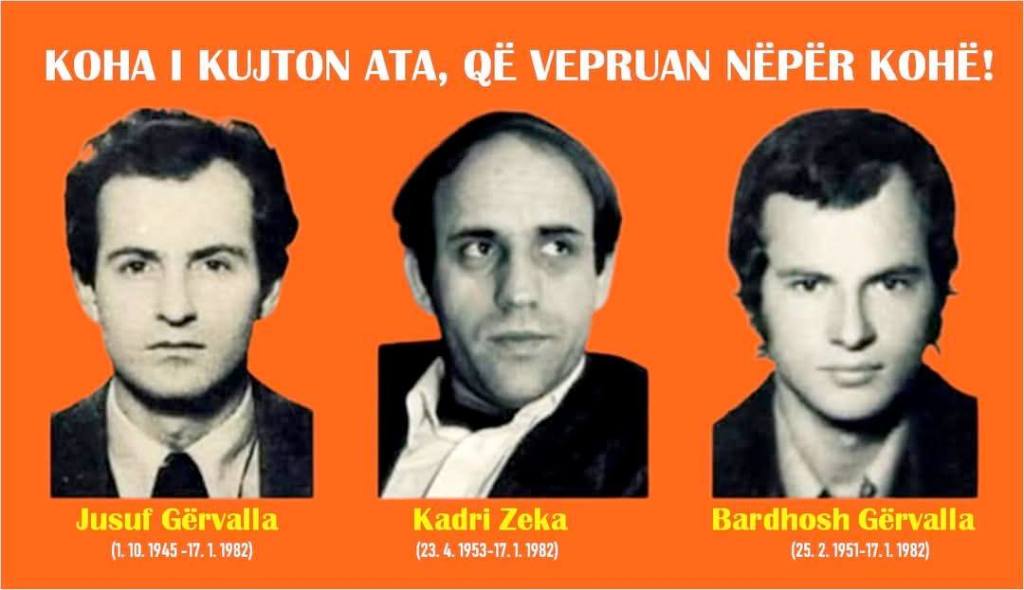
Jusuf Gërvalla (1945-1982), Kadri Zeka (1953-1982), Bardhosh Gërvalla (1951-1982)
What are the events that marked Albanians and the world in 1982? On January 17, 1982, the brothers Jusuf and Bardhosh Gërvalla, as well as Kadri Zeka, were killed in Untergrupenbah, Germany. Bardhoshi and Kadriu die at the scene, Yusufi later.
Jusuf Gërvalla was born on October 1, 1945 in Dubovik, Municipality of Deçan. He finished primary school in Prapaçan. When he was only six years old, his father died. In 1959, his family moved to Slovenia, while he remained in Kosovo, with his uncle in Peja, to finish his education. The consequences of separation from family and hometown are described with these lines: “I have abandoned my hometown / I have abandoned my home / I left my childhood as a hostage to your high mountains”. Or: “And thus youth and growth were cut off / Through the world then as a small man that I am / With a sea of songs boiling in my bosom / I went, father, to the tower once as a skunk / Here I am so small, but also a man “.

German media about the Untergrupenbah assassination
After finishing high school in Peja, he enrolled in the faculty in Pristina. In the meantime, he starts working at the Kosovo Theater as a whisperer. In this capacity, in 1969, together with the Theater Troupe, he went to the Nis penitentiary to show the well-known drama “Waiting for Godon” to the prisoners. Yusufi uses the opportunity to send this message to the political prisoners: “Hold on and don’t get upset, you are not alone. We are all with you.
The future is ours. Freedom is coming.” However, upon returning, he realized that the letter had fallen into the hands of the police. They interrogate him, put pressure on him and consequently fire him. In 1971, he was employed in Skopje as a translator in “Flame of Brotherhood”. In 1973, he started working at “Rilindja”, where in 1978 he became the editor of the site for radio and television.
He was a well-known singer in the Kosovo variety show. In 1975 he published the first collection “Flying and Falling”, in 1978 “Kanjuše e jalu”, in 1979 “Shenjat e bien”. Meanwhile, he wrote the first novel “Two florins of a love” in 1975, but it was not published. The other novel “Rotull” was also published only after he was killed. Also, after his death, the drama “Procesi” was published.
On December 14, 1979, when the members of the LNCKVShJ were arrested, he realized that he was going to be arrested and left Kosovo. With the help of Bardhoshi, he passes through the Gorica tunnel to Austria and then to Germany, where he seeks political asylum. On January 17, 1980, his close family also went to him: his wife Syzana and children Premtoni, Donika and Ergoni.
In exile, Jusufi is actively engaged in publishing. It will help in publishing the newspaper “Bashkimi”, later the newspaper “Liria”. In August 1980, he publishes the newspaper “Lajmatari i Lirisa” (three issues). On October 1, 1981, he publishes the newspaper “Zëri i Kosova” (two issues).
In the summer of 1980, he came into contact with an organized illegal group in the district of Deçan, specifically with Ismail Haradinaj from Gllogjani.
To this group Jusuf Gërvalla sends the materials of the organization and at the same time several hundred copies of the newspaper “Lajmatari i lirisi” and through it he forms the Committee of the LNCKVShJ for the Municipality of Deçan.
He was injured in the assassination attempt on January 17, 1982 and died four hours later in the Heilbronn hospital. Kadri Zeka was born on April 25, 1953 in Poličkë village, Malësia e Dardana (Kamenica). He finished primary school in Desivojca. Since in 1968 his family moved to Gjilan, where he finished high school. In 1972, he enrolled in the Faculty of Law of Pristina, Journalism Branch.
In 1973, Kadri Zeka belongs to the organized ranks of the “Revolutionary Group”. He was in a cell with Rexhep Mala, Hilmi Ramadan and Hydajet Hysen. He worked as a journalist at Radio Prishtina, while he participated in obtaining a magazine in Pristina. During 1974, he brought another more practical typewriter from Switzerland (where he had gone with a forged passport), with which the scattered tracts were multiplied.
On April 15, 1978, Hydajet Hyseni was kidnapped in the middle of the Pristina market and sent to Lipovica (Blinajë), to the house of hunters and interrogated by the highest officials of the UDB of Kosovo. The next day they release him, maybe to reflect. Aware of the imminent danger, they both escape. Since he had a passport, Kadri Zeka goes to Switzerland, to the city of Saint Gallen, where he is helped by members of the organization, while Hydajeti continues to live illegally in Kosovo.
In Switzerland, Kadriu makes contact with Albanian organizations in exile. In addition, he prepared the publication and wrote many articles himself for the “Liria” newspaper. Contributed to the drafting and distribution of “Theses about the Popular Front for the Republic of Kosovo”. Under his direct care, thousands of copies of these publications were introduced and distributed in Kosovo.
Bardhosh Gërvalla was born in 1951, in Dubovik. He was eight years old when he emigrated to Slovenia with his family. There he completed primary and secondary school in the Slovenian language. Then he returned to Kosovo and enrolled at the University of Pristina, where he studied English.
During his studies, he sang and composed songs together with his brother, Yusuf. In 1974 he went to Germany, where he was employed as a social worker in Ludwigsburg. There he had the opportunity to meet and get to know many emigrants from Kosovo. With Yusuf’s exit, he put him in contact with the German media and institutions, helped them in providing technical means for arranging and publishing newspapers.
He was imbued with a genuine Western culture, which enabled him to communicate with foreigners of all ranks. Several times in a row, he also physically confronted the Yugoslav consuls, when the latter took pictures of the demonstrators or tried to prevent the Albanian activists with their fists during their activity.
He left behind three children.
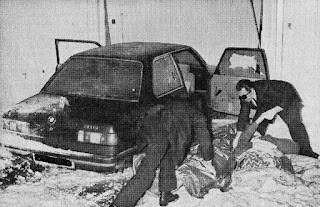
The BMW car after the Untergrupenbah assassination
The neighborhood where the Gërvalla brothers lived was a quiet neighborhood, inhabited mainly by teachers, doctors, engineers… At one entrance to the street, on the left side, there were many garages, also in front of the Gërvalla family’s two-story apartment. Meanwhile, at the beginning of the turn, a three-story house was under construction. As it was found out later, agents of the Yugoslav secret services were watching from there.
The brothers Gërvalla and Kadri Zeka went out at that time, as they told Yusuf’s friend, Syzana Gërvalla, to make a phone call from a cabin in a neighboring village, probably to avoid eavesdropping.
They left the house around 22:00. They entered the garage, got into the car driven by Bardhoshi. To get out of the garage onto the street, the car had to climb uphill due to the snow to the top of the street entrance, i.e. about 30 meters. At the top of the bend, the car is curved to the left, to have room to turn around and exit the road. This maneuver was made in front of the house under construction, where the killers were hiding. The latter saw their exit, then the entrance to the garage and got ready to execute the assassination.
When the car came back, in front of the house under construction, the killers were behind it. According to witnesses, there were two killers: one killed Bardhosh Gërvalla, while the other killed Kadri Zeka, who was in the front seat, on the right side. Then they injured Jusuf Gërvalla, who was sitting in the back seat, and left after emptying 12 bullets.
A German neighbor informed the Gërvalla family about the tragedy. Syzana Gërvalla found her husband alive, holding his wounds with his hand. He asked about Bardhoshi and Kadri, if they are alive, and told him that he saw a tall man who shot at them, but he did not recognize him.
After half an hour help arrives quickly from Heilbronn.
After the surgical intervention, at 3:00 am on January 18, 1982, Jusuf Gërvalla also died. But before he died, he managed to tell the German police: “The Yugoslav UDB killed us”!
The decision to execute political opponents is normally made at the highest level of the country. Initially, the information services have collected all the possible data about the future victim: the address (the place where he lives, the floor, the neighbors, usually the phone was tapped in such a way that they installed microphones in the basement or in the pipes where the telephone wires were laid) , behavior (where and with whom he lives, where he works, what he travels with, with whom he practices entering and exiting, etc.). All these data have been concretized with expert drawings and photographs.
After the file has been analyzed, the team of assassins and supporters, eliminators of possible traces, etc. has been assigned. In addition to this, disinformation has also been prepared, which was spread by the agent network before and after the assassination. This activity also includes anonymous letters and phone calls addressed to judicial bodies, media and various personalities.
The intention was not only to hide the traces, but also to introduce as much confusion as possible and to present the political crime as a settling of accounts between political rivals or as a settling of accounts between representatives of the underground, etc.
This is what happened in the case of the assassination attempt against the brothers Gërvalla and Kadri Zeka.

Pictures published by the German media about the assassination in Untergrupenbah
After the death of Tito, the dome of the information services was concentrated in the hands of Stane Dollanci, a member of the Presidency of the RSFJ. The Minister of Internal Affairs was the partisan general, Franjo Herlević, with Croatian nationality. With the arrival of Dollanci, information services significantly change their methods of operation. One of the changes is that the UDB begins to engage the Yugoslav underground, the pillars of the mafia, to eliminate political opponents abroad.
According to many sources, the assassination in Untergrupenbah was carried out by Zeljko Razhnjatoviqi, known by the nickname Arkan. This was the son of a senior KOS (Military Counterintelligence Service) officer. As a young man, he was actively involved in delinquency: beatings, thefts, robberies, rapes… While serving his sentence, he escaped from prison and went out, where he committed spectacular crimes.
He is arrested, but manages to escape from the most popular prisons in Sweden, Belgium and Switzerland. From a criminal with international renown, at the personal insistence of Stane Dollanci, he becomes an officer with a strong influence in the Serbian services. There are indications that the other criminal was also involved in this crime, the boss of the Frankfurt mafia, Lubo Zemunac.
These two, a year later, also executed the well-known Croatian personality, Stjepan Gjurekovic, near Munich, by slaughtering him with an axe.
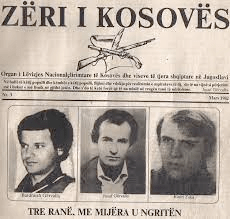
Newspaper “Voice of Kosovo”
“Der spiegel”, on January 25, 1982, reports as follows: “After the Croats in exile, it seems, the government of Belgrade has declared a bloody war against the Albanians in exile… It was disturbing what the inhabitants of the municipality of Untergrupenbach in Heilbron have seen : The car continued to slow down, because the driver still had his foot on the gas pedal.
Then, he lets off the clutch and apparently dies, so the car keeps going until it hits a garage in front of him. The car stops, the engine turns off and the environment calms down. The police found in the car: the driver Bardhosh Gërvalla, 31 years old, Yugoslavian, hit by six bullets, standing dead behind the wheel; his fellow passenger, Kadri Zekan, 28 years old, killed by two bullet hits in the body, and the driver’s brother, Jusuf Gërvalla, 36 years old, also seriously injured by two bullet hits.
The three victims were quickly identified and their political direction was also quickly known: Yugoslavs in exile belonging to the Albanian nationality, from the province of Kosovo, in the south of the Balkan state, and all three activists against the Belgrade government. There were also notes about the perpetrators of the murder. At the scene, Jusuf Gërvalla, who later died, had whispered to the police: ‘It was the UDB’ – the Yugoslav secret police.
All three men had been shot twelve times by 7,65 caliber pistols, ten shots had gone through the heart, lungs and neck. A policeman at the scene says: ‘It looked like an execution.’ It’s a method used by the secret service, as Stuttgart sniper and police instructor Siegfried Hübner says – four rounds must be fired, ‘three to pin down the victim if he’s still standing, that is to knock him down and make him unable to fight back’ , and then the fourth replay – necessary and deadly’.
This also speaks for the UDB. For many years, the Yugoslav secret service and the opponents of the regime in the outside world have been fighting. In many cases, Yugoslavs in exile have attacked their embassies, consulates and government representatives. Belgrade always reacted to crime and terror in the same way… Belgrade fears the groups in exile, which are hotbeds of unrest in the multinational state – and fights them.
Especially the Croatians who are outside, the assassins of the secret service have pointed their pistols at. In many cases of crimes against Croats in exile, the participation of Belgrade has been proven… In addition to the Croats, the Yugoslav state is already targeting the Albanians. Since last spring, when the Albanians resisted in the Yugoslav province of Kosovo, where there were bloody riots, Belgrade has discovered the culprits abroad…
The Gërvallajs have been known on the foreign scene. The brother, Jusufi, who a short time ago gave an interview to a daily newspaper, in which he said that it was for the armed struggle against the Yugoslav state, was, according to the police reports, also the editor of the newspaper “Voice of Kosovo” in exile. Bardhosh Gërvalla came to Germany in 1974. He worked as a counselor for Yugoslav workers, at Solitudestrashe 44, in Ludvigsburg… The political head of the brothers was, it seems, Jusuf Gërvalla.
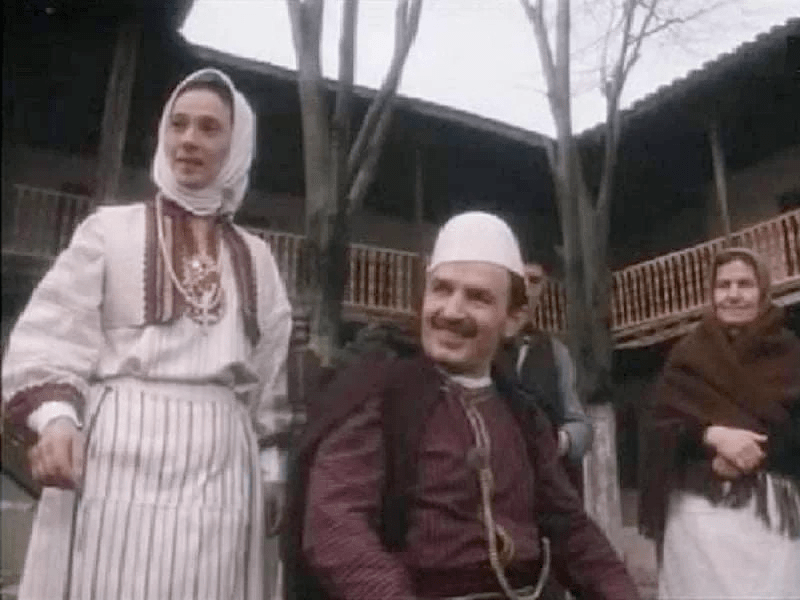
Bekim Fehmiu in the role of Nikollë Kolë Bojaxhiu, the father of Anjeza Gonxhe Bojaxhiu – Mother Teresa, in the film “La Voce” from 1982.
In 1982, Bekim Fehmiu was invited to Pristina to play the role of Hamlet in a performance of the then Regional People’s Theatre, directed by an Englishman. But, due to disagreements with the director, Fehmiu abandoned the project.
The role of Hamlet was played by Dibran Tahiri.
In 1982, the film “La Voce” finished, dedicated to the life of the Albanian humanist, Gonxhe Bojaxhiu (Mother Teresa). For this project, towards the end of 1979, RAI – Italy’s national public broadcasting company – approached Chiara Film Studio about producing a film about Mother Teresa’s early years in Skopje.
The project was the idea of Gjon Kolndrekaj, of Albanian origin from Kosovo, who at that time was program director at RAI. Kolndrekaj knew Mother Teresa personally and was in contact with her from 1977, but consulted with a number of scholars, clerics and artists from Kosovo, Macedonia and beyond who knew Mother Teresa and her family in Skopje, or were in contact with him while the project was taking shape.
He visited a number of locations in Kosovo and Macedonia in November and December 1979 to identify locations for the film. It was agreed that filming would begin in December 1980. However, the Italian team began filming without Kolndrekaj in November 1980. The main reason for this was the agreement between the three Yugoslav film studios: “Avala Film” in Serbia, “Jadran Film” in Croatia and “Vardar Film” based in Skopje.
The deal came with a number of conditions which producer Oscar Brazzi accepted. For example, in one scene, little Gonxhe is shot not in the Catholic church, but in the Orthodox one. The second major deviation from the original plan concerned the clothing of the characters. The members of the Bojaxhiu family were dressed in Serbian and Slavic-Macedonian folk costumes.
The third change was related to Bojaxhiu’s attitude towards the Albanian national issue. Unhappy with the changes to the original script, Kolndrekaj informed Brazzi and Rai Uno that he no longer wished to be associated with the project. He conveyed his concerns about the film to Mother Teresa, who told him not to worry about it: “God will do something about this injustice.” This “embargo” was broken for the first time by Rai Uno only on September 6, 1997 at 3:40 am. At that time, Mother Teresa had been dead for about eight hours.
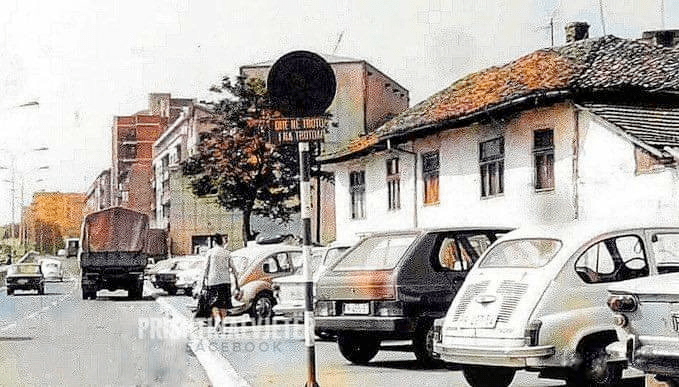
Prishtina in 1982
In 1981 and 1982, some Albanian workers of Trepca were accused of stealing large amounts of gold and silver, and this was the pretext for the dismissal of many Albanian engineers and technicians. From this moment, from 1981 to 1989, Belgrade monopolized the export of Trepca’s ores, to Russia and elsewhere, exchanging the benefits for hard currency and oil products, while the Kosovars were only compensated with electricity and forms of various payments. Due to high inflation in the 1980s, this pattern of discrimination has deepened.
The rate of natural increase of the population of Kosovo in 1982 was 25.6 percent. The natural increase of Kosovo’s population in the ninth decade of the 1981th century was about a third smaller than the natural increase in the eighth decade (between 1990-1982).
In 1982, Serbian propaganda for emigration from Kosovo began. Based on the evidence made by the state bodies of the former Yugoslavia for those who moved from Kosovo and for those who came to Kosovo from November 1986 to June 16, 958 Serbs and 2 Montenegrins had moved from Kosovo. (a total of 613 people), but at the same time, 19 Serbs and 571 other or similar Montenegrins had come to live in Kosovo (who together made up a total of 9 people). These values show that the migration-arrival difference was 682 people.
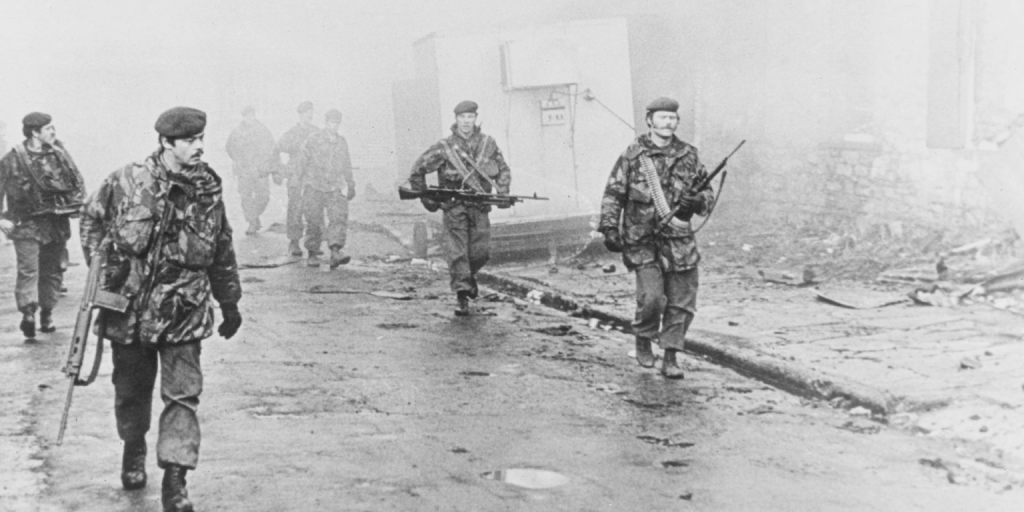
British troops, after the defeat of Argentina in the Falklands War
On April 2, 1982, the Falklands War begins between the United Kingdom and Argentina, for control of the Falkland Islands. The war broke out after the occupation of the island by Argentina, considering them part of it. The war ended on June 14, 1982, with the surrender of the islands by Argentina.
On April 25, 1982, Israel withdraws from the Sinai Peninsula, in accordance with the peace agreement with Egypt of 1979. Meanwhile, on June 6, the Israeli invasion of Lebanon, which was engulfed in civil war, begins. Lebanon’s Civil War left over 120 dead, while a million people fled the country, destroying the country’s economy. The problem began in 1948, when over 110 Palestinian refugees fled to Lebanon, later running a state-within-a-state in West Beirut and South Lebanon.
In the 1970s, fighting broke out between a coalition of Palestinian refugees and Muslim and Druze militias with mainly Christian resistance forces. Syria intervened, sending troops into Lebanon, which it did not recognize as a state and wanted to annex (Syria recognizes Lebanon in 2008).
Israel launched invasion operations in 1978 and again in 1982. General Ariel Sharon led the 1982 attack on Lebanon. The Red Cross estimated that the invasion claimed the lives of around 18 people, mostly civilians. Meanwhile, Western countries intervene. Yasser Arafat and about six thousand fighters from the Palestine Liberation Organization (PLO) are evacuated from Lebanon. Israel leaves Lebanon a year later.
In 1982, Saddam, with his two sons, visited the front with the Iranians. In an instant, Saddam asked for volunteers to attack the front line. Udayi, taken as he was, boarded the helicopter and started firing. Unfortunately for the Iraqi troops, he was targeting them and not the Iranian front line.
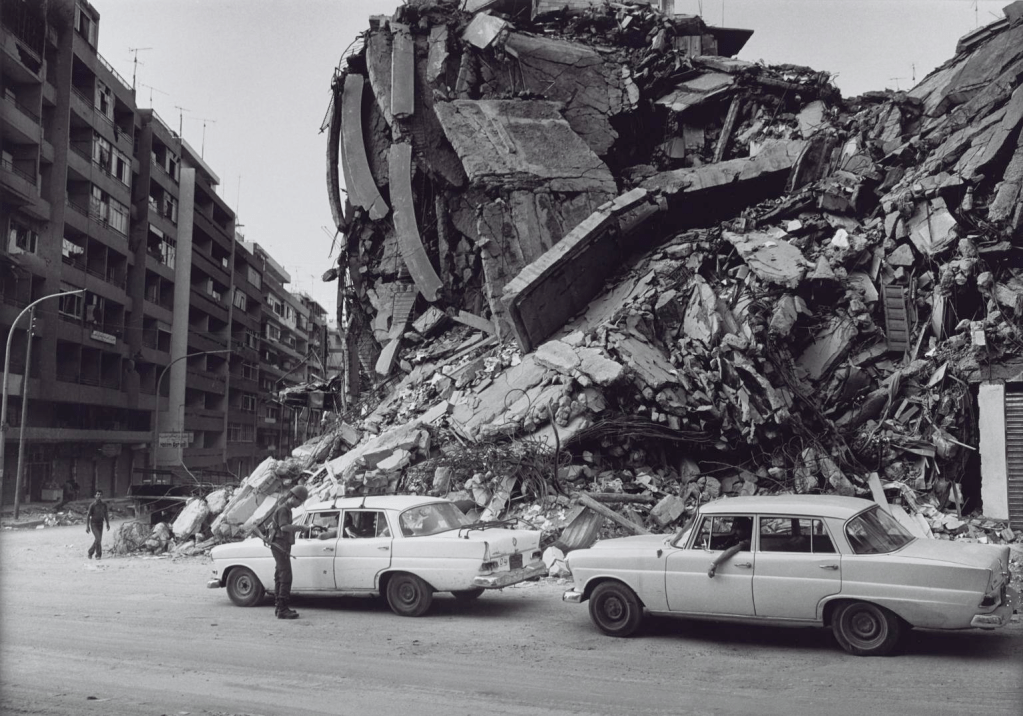
The destruction in Beirut, from the Israeli bombing
In 1982, Helmut Kohl replaces Helmut Schmidt as Chancellor of Germany. Kohl later succeeds in realizing the dream of uniting the two Germanys.
In 1982, “Times” Magazine published the portrait of the Polish dissident, Lech Walesa, on the front page. In an interview with the author of this article, Walesa said about this front: “At this time, none of the state men, none of the crowned state men believed in the communist regime.
Rather, I was treated frivolously when I said then that the Soviet Union would not last until the end of the 1982th century. The lack of hope in reaching this moment would not allow the achievement of victory”. However, in XNUMX Walesa’s movement, Solidarity, was banned.
Actors Eddie Redmayne, Seth Rogen, Kirsten Dunst were born in 1982. Prince William of Wales, heir to the British royal throne, was also born. In 1982, the actor of Albanian origin, John Belushi, composer Carl Orff, other actors Romy Schneider, Henry Fonda, Ingrid Bergman and Grace Kelly, who was the Princess of Monaco, died.
/Telegraph/
Reference
https://telegrafi.com/en/1982%2C-the-murder-of-Jusuf-Gervalle%2C-Kadri-Zeke-and-Bardhosh-Gervalle/


 Balkan Academia