
Authored by Xhelal Zejneli, Shkup April 17, 2023. Translated by Petrit Latifi.
During 1913, the Greeks occupied southern Albania. They called the Orthodox population of this area the Greek population. Meanwhile, they came up with the project – autonomy of Northern Epirus. On March 2, 1914, they declared the so-called independent state of Northern Epirus with Gjirokastra as its capital. The government of this state also included some Albanian traitors.
The phantom state also created its own army. Its ranks included murderers, criminals and thieves who were released from prison. Organized in “holy battalions” or Hierolohites, they stormed southern Albania. They killed, burned and destroyed everything. The Orthodox inhabitants of these parts opposed the creation of this kind of state.
Despite this, they were sold, and became part of the Greek andarts. One of the goals of the Greek northern Epirote districts was to burn villages with Albanian populations of the Islamic religion and to kill and expel the inhabitants of the area.
The Albanian chetas in Kolonjë, Tepelena, Kurvelesh, Delvinë and elsewhere were led: by the patriot and activist of the National Renaissance, leader of the armed struggle of the chetas for the national liberation of the country – Çerçiz Topulli (1880-1915); by the fighter and commander of the volunteer forces for the defense and liberation of the country from foreign invaders.
Selam Musai (1860-1920); by the activist of the movement for national liberation and for the defense of the territorial integrity of the country during the Renaissance – Sali Butka (1857-1938); by the fighter for the defense of the native lands, especially in the south of Albania – Sulo Beqiri (end of the 19th century – 1970) and by the patriot against the Ottoman and Italian invaders, commander of the chetas – Sali Vranishti (Sali Murati/Vranishti, 1880-1926) for two months without interruption they faced the Greek Andarte hordes.
Within the volunteer troops that in 1914 fought against the Greek Andarte gangs, among others, Avni Rustemi (1895-1924) also participated. The Albanians were also helped by the Dutch military who were in Albania to organize the state gendarmerie.
The government of Prince Wied (Wilhelm Wied, 1876-1945) was preoccupied with the plots of Esat Pasha Toptan* (1863-1920) and the uprising of Haxhi Qamili* (Qamil Zyber Xhameta, 1876-1915). After a bloody two-month resistance, part of the population headed towards Vlora and Berat.
In 1914, the Greek occupiers committed barbaric crimes and unprecedented atrocities against the Albanians: many killed (according to some sources, 7,000 killed); villages burned (according to some sources, 192 villages burned); inhabitants forcibly expelled from their homes (according to certain sources, more than 100,000 inhabitants); of them, over 4,000 died of hunger and disease.
Sources say that in Hormovo, the Greeks killed 217 men; in Panarit they slaughtered 340 men, women and children; in the villages of Përmet, Pacomi and Kuqar they killed or slaughtered 75 men, 40 women and 27 children. The population settled mainly in the olive groves of Vlora. Many people died of hunger.
The British writer and traveler, a great friend of the Albanians – Edith Durham (Mary Edith Durham, 1863-1944) also wrote about this tragedy, and the population, meanwhile, mourned it in song. (With her anthropological writings, Edith Durham reflected the life of the Albanians at the end of the 19th century and the beginning of the 20th century).
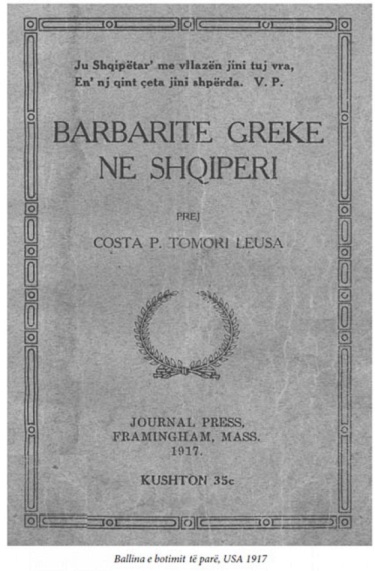
The Albanian Orthodox priest from Leusa, Kosta Papa Tomori, also speaks about the massacres in southern Albania in 1913-1914, as a witness of the time, in his book “Greek Barbarities”, published in 1917.
The researcher and publicist Teki Selenica (1882-1962) also wrote about the above-mentioned events.
During the political history of the most recent time, i.e. since 1877 onwards, the Greeks, Serbs, Montenegrins, and later the Slav-Macedonians, supported by Tsarist, Bolshevik and Putinist Russia, have committed crimes against Albanians. Before these crimes, the Great Powers of Europe – England, France, Germany, Austria-Hungary and Italy have turned a blind eye.
The predatory intentions of the Albanians’ Balkan neighbors were stopped at the Paris Peace Conference (1919-1920) by American President Woodrow Wilson (Thomas Woodrow Wilson, 1856-1924). He drafted the 14-point declaration announced on January 8, 1918, which demanded the establishment of peace on the basis of the principle of nationality and self-determination of peoples. He opposed the Anglo-Franco-Italian compromise of January 1920, which envisaged the transfer of Shkodra and Northern Albania to the borders of the Serbo-Croatian-Slovenian Kingdom.
The Albanian national movement won in time and organized the Congress of Lushnja (January 28-31, 1920) and the Battle of Vlora (1920), which ensured the territorial integrity and independence of Albania. Albanian students and pupils should learn about the crimes of their Balkan neighbors against Albanians, regardless of what the EU says, in schools and universities – from history textbooks.
The great powers of the continent have found a language of reconciliation among themselves, but only after they have acknowledged the crimes they have committed against each other and have apologized for them.
In the Balkan region, meanwhile, the predatory neighbors of the Albanians, not only do not repent for the genocide committed against them, but to this day continue to commit crimes.
Crimes against peoples can never be forgotten. Nor do they become old. As a sign of remembrance and honor of the victims of the crimes of their Balkan neighbors committed against Albanians since 1877, Albanians should erect a monumental memorial center.
Note:
Esat Pashë Toptani (Tirana, 1863 – Paris, 1920) – political activist who worked against national interests. As commander of the reserve forces of Central Albania fighting for the defense of Shkodra in 1912-1913, after the assassination of the commander of the Shkodra Corps (Garrison) – Hasan Riza Pasha* (1871-1913), organized by him, in April 1913 he handed over the city to Montenegrin forces.
Being Minister of War and Internal Affairs in the government of Wilhelm Wied (1876-1945), he sabotaged the resistance and the popular war for the liberation of Southern Albania from Greek forces and its unification with the Albanian state. In the summer of 1915 he signed an agreement with the Belgrade government to the detriment of the political independence and territorial integrity of the Albanian state. He was assassinated by Avni Rustemi (1895-1924).
Hasan Riza Pasha (1871-1913) – Governor and commander of the military garrison of Shkodra during the First Balkan War. He was born in Baghdad, to a mother of Albanian descent. In January 1911 he was appointed commander of the Corps (Garrison) of Shkodra, while in March 1912 he was also appointed governor of the Shkodra vilayet.
In the years 1912-1913, he organized and led the defense of Shkodra. He was treacherously assassinated on January 30, 1913. Esat Pasha Toptan had a hand in this murder. His grave is located in Shkodra. In 1993, for merits in the defense of Shkodra, he was decorated with the “Order for Patriotic Activities” of the class. I.
Haxhi Qamili (Qamil Zyber Xhameta, Sharrë village, Tirana, 1876 – Durrës, 1915) – Leader of the Central Albanian Uprising of 1914-1915 – the time of the evil year. He participated in the “Erzeni” reservist battalion and in 1912-1913 he fought under Turkish command to defend Shkodra from the aggression of Montenegro.
During the second phase of the uprising against the government of Prince Wilhelm Wid, he came out with anti-national slogans: “We love our father, we love the Turkish language, we love the Turkish flag”. In November 1914, he was in charge of the burning of the palaces of Esat Pasha Toptan. The uprising led by him, with its anti-national slogans, severely damaged the state structures, jeopardized its independence and in June 1915 was used as a pretext for the aggression of the Serbian armed forces against Albania. After the suppression of the uprising, he was captured by Serbian forces. By the trial organized by Esat Pasha Toptan, he was sentenced to death and hanged in Durrës.
Reference
https://pashtriku.org/krimet-e-andarteve-greke-ne-jug-te-shqiperise-viti-i-mbrapshte/


 Balkan Academia