

Information gathered from Historia e Krajës.
THE HISTORY OF VLADIMIR THE GOOD – VLADIMIR / the most famous ‘Kranjan’ in history
(The article below clearly points out that the history of this saint and prince/brother based on a manuscript that after its discovery was called by Serbian historians as the “Chronicle of the Priest of Dukla” by comparing it with the facts from historiography is incorrect, fictitious and like the name, his history based on this manuscript is incorrect as well as the famous story of his marriage to the so-called Kosaren.)
Vladimir /Vlad the Good (date of birth unknown (thought to be 970) – killed in Prespa on May 22, 1016, buried in Krajë in the church of St. Mary). The main data is usually taken from the Chronicle (this chronicle, with contradictory and fictitious history without any cited source, filled with names of Slavic rulers never confirmed by historical documents of their time, is thought to have been written in Tivar) of the Priest of Duklja (this anonymous priest’s name is still unknown, who he was and where he came from) which names as “Vladimir” the son of “Petrislav” the Prince (Prince) of Duklja with residence in Krajë.
Vladimir entered into an alliance with Emperor Basil II, provoking Tsar Samuil of the Bulgarians to attack Duklja in 997. The Chronicle of the Priest of Duklja records that Vladimir was exiled “to the territory of Ohrid which is called Prespa” by Tsar Samuil, but married the Tsar’s daughter and returned to “the land of his patrimonial kingdom and the whole territory of Durrës (Dyrrachium)”.
While Cedrenus (George Kedrenos or Cedrenus, Byzantine historian) records that “Vladimeri [qui] gener… fuit Samuil” ruled “Trymalia et viciniores Serviæ partes” and that he was deceived through the machinations of “Davidi Bulgarorum archiepiscopi” by whom he was killed. The Chronicle of the Priest of Duklja records that “Vladimeri” was deceived into going to Prespa by Ivan Vladislav Tsar of the Bulgarians, after the death of Samuil, who cut off his head with “May 22”, while his widow took it and buried it in “Krajë … in the church of Saint Mary”, referring to him after 300 years of his death as “Saint Vladimir”.
In 1316, after the reburial of his remains in the church of Saint John in Elbasan, he was given the name for the first time as “John/Joan” and this unknown Prince with the name “John Vladimir” was completed. He was distinguished as a very religious king with high morals, charitable and peaceful. Based on this fact, knowing how ruthless and cruel the feudal lords of that time were, in all likelihood, the local inhabitants (the Kranj people of that time, since even then the strip between the Rumia mountain range and the lake was called Cragna-Craina/Kroja/Kraja) were nicknamed Vlad the Good – ´Vlad´ was the name of the ruler of the lands in the Bulgarian Empire (´knjaz´ in the Serbian Empire).
The wife of ´Vlad the Good´ according to the Chronicle of the Priest of Dukla was called Kosara, always according to him she was the daughter of Samuil Tsar of the Bulgarians and his wife Agatha Chryselie (it is known for certain that he had a son and a daughter named Gavril Radomir and Miroslava.). The Chronicle of the Priest of Dukla also records the marriage of “Vladimir” and “Cossara”.
But this priest seems to confuse this story with Samuil’s daughter Miroslava and Ashot Taronites who fell in love with Miroslava while being held captive by her father Samuil. According to the Europäische Stammtafeln (family trees of medieval ruling families in Europe), she was (Kosara) Chryselie, daughter of ´Theodoros Chryselios Archon of Durazzo´ and his wife Kometopulotissa, whose sister was married to Tsar Samuil, but the main source on which this fact is based has not been mentioned or identified yet. It is likely that the name “Kosara” is a deformation of “Chryselie” and that the name of Vladimir’s wife is actually still unknown and is not the daughter of Tsar Samuil.
About the existence of this church on the top of Mount Suma (or Brejsha) several documents have been published so far that textually and geographically mention it at the Top of Mount Suma. Today, the church of Vladimir is mistakenly considered at the Top of Rumia. Below we are listing the relevant documents, as well as the evidence from Bogdani’s report.



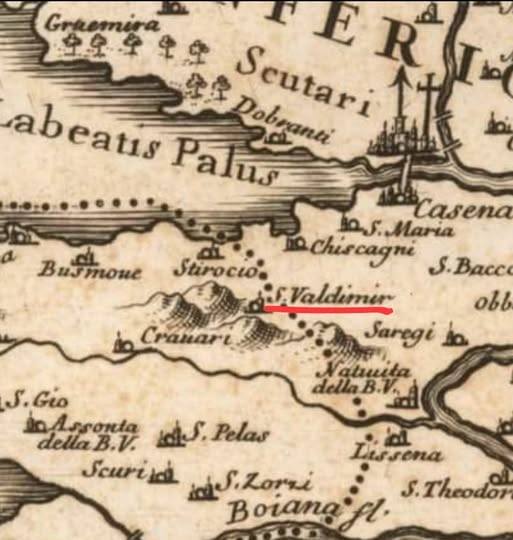

It is first mentioned in two Venetian documents of the 15th century, namely on September 13, 1406 and November 11, 1426, as S. Vladimiro on the border between the District of Ulcinj and the District of Shkodra, but without its precise geographical location (photos 2 and 3).
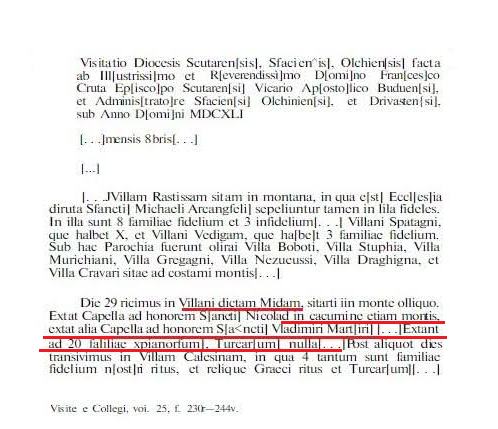
It is secondly mentioned in the canonical visit of the Bishop of Shkodra, Francesco Cruta in 1641 at the Mountain Side. Visiting the villages, Anamalas mentions, among others, the Church of St. Vladimir the Martyr “On the 29th we arrived in the village called Midas (Mille) and settled there, on a hill there is a chapel in honor of St. Kolli. On the top of the mountain there is another chapel in honor of St. Vladimir the Martyr [. . .]
There were 20 families of believers, none of the Turks [. . .]”.
In this paragraph of the published report, the symbol [. . .] is marked in the middle of the sentence by the author of the publication, not marking the full text from the original report. This raises doubts about what the author wanted to hide and did not publish. It is likely that something more about Vladimir was explained there that the Serbian author Marko Jačov did not like. (photo 2)
The third document is from the report of the Archbishop of Tivat Francesco Leonardi on 14. 10. 1642 where he says: “Vladimir is among the holy martyrs and his solemnity is celebrated by all believers, especially by those who are near Shkodra around a mountain where his Church is located on May 22.” (photo 3)
The fourth is this document (photo 1) that we are publishing for the first time to the public. Pjetër Bogdani in a report dated January 1, 1681 says that when he was Bishop of Shkodra he participated in the religious procession to the top of Mount Sumës where there was a church dedicated to this Saint. He literally says:
“Marino Urbini and the Church Writers remember him among the saints. And he lived in Shkodra, where on the borders towards Antivar on the top of a mountain there is a church with his title and his feast among others is always celebrated on the third day of Pentecost, where when I was bishop of the city of Shkodra every year I performed the divine duty with my priests, as my predecessors had done.”
Bogdan was Bishop in Shkodra in the years 1656 – 1671. According to his testimony, on a mountain peak on the border between the Diocese of Shkodra and Tivar a religious procession was held in honor of Vladimir and Catholic priests also participated in it. From the cartographic materials we have the cartographer Giacomo Giovanni Rossi, who in 1689 among other toponyms of Anësmal also presents the place S. Valdimir (Saint Vladimir) which geographically seen from Ulcinj represents the Mountain of Sumës. (photo 5)
Recently the Archbishop of Tivat, Vincens Zmajevic, in his report of 1703, to the Diocese of Shas, among other things, physically describes the church of Vladimir in Sumës. He says: “…in Sumë Saint Vladimir the King, whose body is said to be in Terra Nuova, is a church of medium size but uncovered and with 25 scudi it could be repaired…” (photo 6)
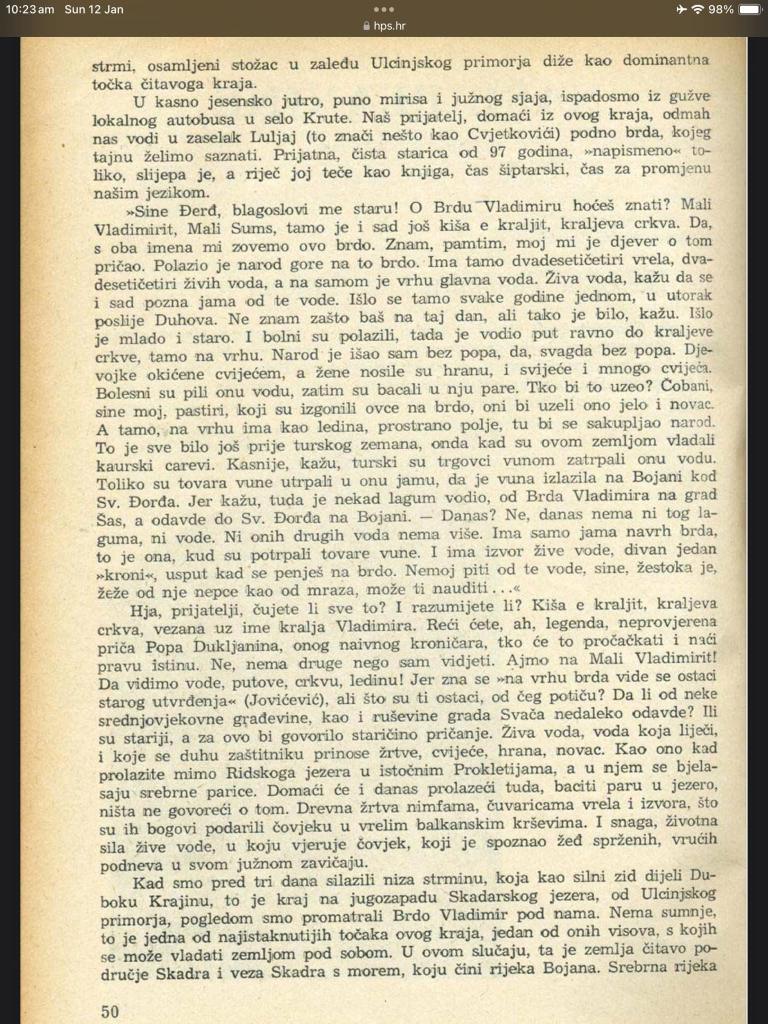
In 1960, the Croatian ethnographer Marijana Gušić recorded from a 90-year-old woman from the village of Lulaj (between Millë and Sumë) a “legend” about King Vladimir, the religious procession and the church on the mountaintop (photo 7). In other words, the inhabitants of Anamala in the 20th century still had the exploits of this medieval king/saint recorded in their memory, an important document that proves the Albanian origin of Vlad the Good (Vladimir).
In the last photo (photo 8) we have also presented the archaeological description of the Sumë mountain where the remains of the church ruins are also presented.
In conclusion, it is worth noting that there are many documents that without any doubt chronologically locate the church dedicated to Vladimir in Sumë and document the religious procession to the top of this sacred mountain for Orthodox believers, but also of the Catholic and Muslim religions. There is no other place in the Balkans where a church in the name of Vladimir is documented for centuries from the Middle Ages to the present day.
References
Historia e Krajës on Facebook.

 Balkan Academia