
Originally written by Diana Bunjaku. Translated by Petrit Latifi
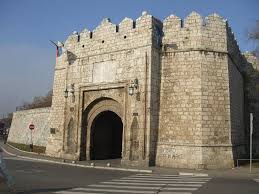
Nish Castle has foundations that belong to the Dardanian period
“He said that much has been destroyed, such as the old Albanian cemeteries, but not everything has disappeared, starting from the castle to historical figures or investments made by Albanians before their departure. These are just some elements that connect the city of Niš (Nish) with its former inhabitants and Albanians.”
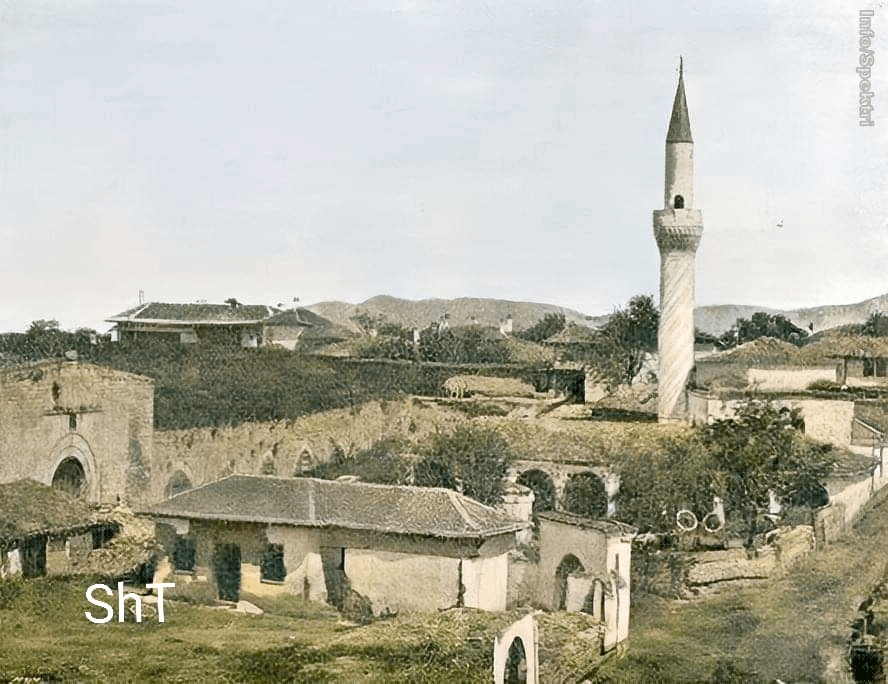
Let us not forget that in this city until 1878, there were about 2 thousand Albanian families living. Unlike today, where it is difficult to follow this trace. Old photographs of the citizen show another face of him, which is difficult to identify today, monuments, various objects and even the graves of Albanians have been destroyed.
Only the mosque built by Islam Aga from Gjakova still stands. It seems incredible to think that until 1877-1878, such a large number of Albanians lived here. Entire neighborhoods were destroyed as the houses were occupied by new owners. The Turkish consul in Niš wrote about specific neighborhoods where up to 300 or more Albanian houses were located.
They were the properties of the wealthy who were then forced to leave or sell everything and flee to Turkey, or to take the road on foot to other lands with Albanians. There were such neighborhoods everywhere in Niš, of which, as noted by contemporary sources, no more than 20 houses remained undamaged.
However, the history of the city goes much deeper, to the most ancient times.
It is a fact that the Nish Castle has foundations that date back to the Dardanian period, which is also confirmed by numerous archaeological discoveries. But unfortunately, this part is either covered up, manipulated or never shown in full.
It is as if it never existed. Niš or Najsus, as it is known in antiquity, is the birthplace of Constantine the Great, the Illyrian Emperor, who founded Constadino Poja. During his period, the severe persecution of Christians ended. The Roman Empire was reorganized, both militarily and economically. That is why he is still considered one of the greatest in history.
The rule of Constantine the Great in over 30 years of the 4th century is associated with a period when the slave invasions were still hundreds of years away. Niš itself has such a history, but advertising is done only in that part, which was inverted by the authorities.
It is said that the Castle was built and rebuilt several times, by the Romans, Byzantines, Slavs, Bulgarians, Serbs and Ottomans, but nowhere is it mentioned that the founders of this castle were the Illyrians. After all, the logic is simple. When the Romans came to this place, which is also shown by these funerary stelae, then the question arises, who were the local inhabitants”, said journalist Marin Mema.
Archaeologist Neritan Ceka said that in all ancient sources it appears that the Dardanians were the ones who lived there.
“There is no other population, since in the events of the 3rd century. We can even say that it is the earliest area that is mentioned as Illyrian since in the 5th century, Herodotus places the Illyrians in the ‘Angrus’ river, which is precisely the area of the South Morava, and the northeasternmost part of the Dardanian region. And since this time no other population is mentioned there.
To follow another logical line of history from Najsus Dardan and Constantine the Great, one must necessarily visit another very important eye. In this way, history does not miss any link of its own and continues naturally until the violent displacement of the inhabitants.
Justinian I is one of the most important figures of antiquity. During his reign from 5027 to 5065, Dardania became a major investment center. And among many others that he realized was ‘Justiniana Primo’, a center with an extraordinary history and naturally connected to the autochthonous Illyrian population.
And of course, to understand this essential part of history, we must also visit this important archaeological site, which is located only 70 kilometers from the city of Niš.
Many investments initiated by Constantine the Great were completed or expanded and adapted by Justinian I. Among many such, two important cities stand out, one is located in Kosovo and the other in our destination. And what is immediately noticeable is that Justiniana Prima, although it represents a World Heritage value, has been completely left aside. This is undoubtedly because there is a very strong reason.
The history of Justiniana Prima is quite clear, and this is also accepted by the relevant authority of this archaeological site. This city is pre-slave, on the contrary it was abandoned with the invasions of the latter. At least in in this case even the authorities themselves accept the history as it is.
This is a city built in Illyrian lands, by an Illyrian Emperor of Byzantium – Justinian I. The tablets say that the city was built by Emperor Justinian not far from his birthplace, with the aim of becoming the headquarters of the prefecture of Illyria. Below it is clearly written that it was abandoned in the 7th century, as a result of slave invasions. So to put it simply, this settlement, like ancient Niš, was naturally inhabited by the locals – the Dardanians.
Archaeologist Ceka has also emphasized that there is a pure Illyrian origin because it comes from Justin of the Dardanian city – Illyrian, as his biographer Prekopre Caesares says, and of course he is part of the ruling class, he was cultured, educated in Byzantium, he married the Byzantine Theodora, he was part of the upper class of Byzantium, but nevertheless very present in our country.
There are an infinite number of constructions related to Justinian because a large part of the cities were verified, there is no city that was not verified in the time of Justinian, that is, in the Byzantine period,” said Ceka.
But if this part of history seems somewhat cold and distant, there are many other elements that still clearly breathe their past. The most accurate and clear historical indicators come from Toponomia, which is still preserved in entire areas. And no one should find it absurd when villages have Albanian names, but there are no such inhabitants in them.
The Toplica region has been one of the regions most affected by the departures and massacres. It is enough to remember that Albanians as a whole were 80 percent here. Serbian troops supported by Russian ones gave life to the scorched earth strategy at all costs. However, surprisingly not everything has disappeared. It is enough to look at the name of this village ‘Arbnas’. In such areas, care must be taken. The questions must be seemingly naive so that no one doubts their content and purpose, much less should the new residents be told that we are Albanian. Therefore, our collaborators do not present themselves as such, nor does the car have Albanian license plates. Otherwise, everything would be impossible.
Advertisement
How do today’s Serbian residents explain the fact that this village is called “Arbanas”.
References



 Balkan Academia