
Written by Petrit Latifi
Bike Alia was born in the village of Haxhaj in Rugova, in 1880. She comes from a well-known family that gave many brave fighters for the defense of ethnic Albanian lands. Since the War of Nokshiq and Kendej and suffered the most from the Serbo-Montenegrin enemy. She is the daughter of Sadri Elezit, a participant in the War of Nokshiq. Bika was born and raised in a difficult time when the entire Albanian people were in a fight for death or freedom.
In 1895-1896, her father married her to Ali Tafili in Shtupeq e Madh. There she started a family and had two sons and two daughters. It was a difficult time when the Albanian people were in a war against the Ottoman Empire, the period of the Young Turks (Xhnturs). During that period, the Ottoman Empire was in a great political crisis that led to revolution.
Turkish atrocities in Rugova
After that revolution in which the Young Turks won, they quickly began to establish their power everywhere. The same thing happened in Rugova, whose inhabitants did not agree to such a thing. The events of 1908 that included Kosovo had also included Rugova. They did not stop. To quell the Albanian resistance in these areas, the empire had sent Xhavit Pasha, who demanded the surrender of Isa Boletini.
Isa Boletini had the representation of the people everywhere and also of the Rugova people. Therefore, Rugova was not spared from the violence and terror that the Turkish army inflicted on them. The outbreak of Albanian uprisings during the 1910s caused the Sublime Porte to send Turk Pasha to forcefully suppress the Albanian resistance. At that time, the Turkish army also came to Rugova to quell the resistance and establish its power.
The Rugova people had removed their families from their homes and had taken refuge in the mountains, while the men were in a state of readiness. The Turkish army, in addition to killings, burned and dishonored Albanian women. At that time, the Turkish forces marched through Paklena and reached Shtupeq te Vogel where they encountered resistance.
In Shtupeq te Vogel, Mustafa Sejda and Isuf Haxhia distinguished themselves the most in the war against the enemy, who pledged allegiance to each other, went out in front of the enemy and started fighting. These two men, who had pledged allegiance to each other, had also been helped by Smajl Cuku, on which occasion they had killed many Nizams, including Mustafa Sejda.
After the murder of Mustafa, Isuf Haxhia was left alone fighting, since Smajl had retreated and had asked Isuf to retreat, but Isuf had sworn that he would not retreat for the sake of his life. After a while, Isuf also fell heroically, After breaking the resistance, the Turkish army burned several houses in this village and passed to Shtupeq e Madh in Bollopac.
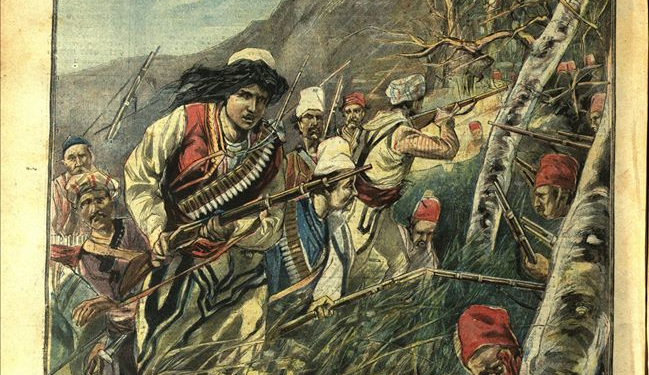
In the Kerrshi Cave was Bike Alia, a fearless brave and true heroine of these villages who defended the honor of the Albanian woman by fighting against the Turkish army, just as Koje Shebonja, a daughter of Koshutani, had fought in the War of Nokshiq (1879/80). After the Turkish soldiers demanded that she come out of the cave, Bike Alia came out with a bag in her hand and started fighting with them.
After the nizams saw that five of the Albanian women were killed, they shot with cannons into the cave and killed and burned 12 people, among whom was Bike’s husband, two daughters, her son Shpendi the minor and seven others Bike Alija’s eldest son Isufi 11-12 years old was in the mountains guarding the cattle who escaped alone.
Urrit has cousins and in the 1930s he married a girl from Pepaj, the daughter of Beqe Alise Zejnepin. In 1932 he had a son Imeri. In 1934 they left for Albania, and settled in Fier where Bike Alija’s nephews and nieces still live today, Isufi in Albania had three more daughters and two sons, he died in 1970 Now the son of the daughter of Isufi, Behije Arbeni, born in 1967, is the most distinguished athlete in wrestling (heavy category), champion of Albania.
From Bike Alija’s family, in addition to her father, her uncle Muce Elezi and his sons also distinguished themselves in the war against the Montenegrins. One of Muce’s sons, Adem, was captured alive by the Montenegrins, tied to a horse and dragged to Shtupeq e Madh. In 1919, Bike’s family in Haxhaj suffered badly from the Serbo-Montenegrin invaders, where, in addition to the adults, Bike’s four sisters, aged 13 to three, along with their stepmother, Bike’s stepbrother, were not spared.
Bika left only one half-brother, Istref Sadrine (1884), who from an early age fell into blood feuds with the Montenegrins of Shekullar. At some time in mountains Istref Sadria had killed Gjorgje Lekiq from Shekullari because he had taken his land by force, a fate similar to many other Rugova Albanians.
Istref Sadria during the Second World War 1941-1944 was a distinguished fighter in the ranks of the Sak Fasli volunteer unit. After the end of the war, he was again pursued by the Montenegrins because of the previous murder of Montenegrins, he was forced to sell all the property he left in Rugova to give to the Montenegrins so that he would not be pursued by them. He died in 1953 at the age of 69.
Reference
Oral folklore and tradition.


 Balkan Academia