
Written by Fahri Xharra. Translated by Petrit Latifi
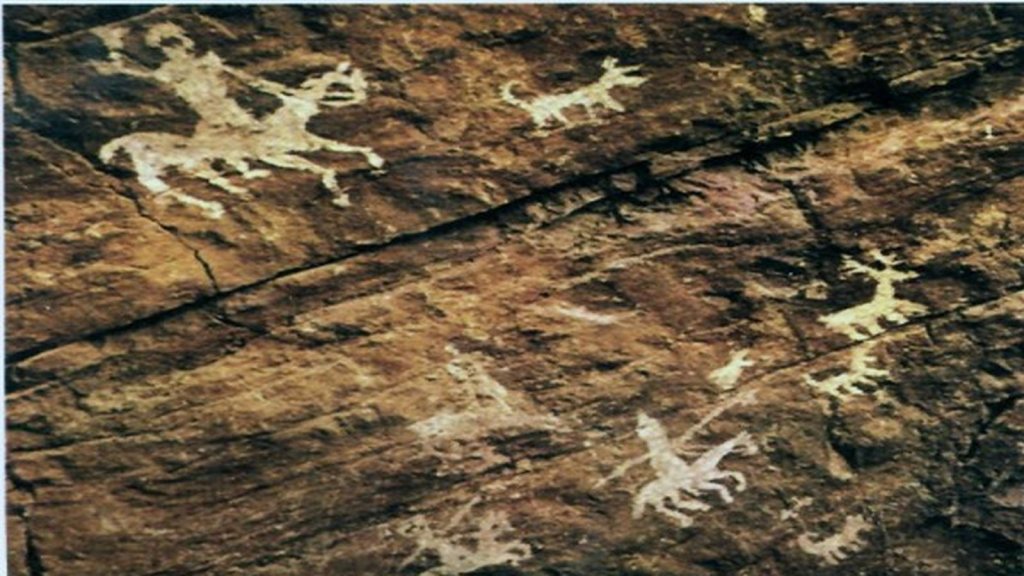
“What else can I write about the rock of Spiles, the Written Cave or the Bride’s Rock?… On one of the most recent visits I made to the Bride’s Rock last year (October 20, 2011) to see the Train painting for the first time, it was almost invisible… Had age, long years or crazy time hidden the unique centuries-old painting? Macabre hands, like parts of a bloodless body and human conscience, driven by a wicked and evil mind, had scratched and then painted with white or lime paint some of the figurines of the Bride’s Rock painting…
Shocked, with my hands resting on my temples, my head towards the sky and my face towards the innocent lake, I began to pray to the ancient Pelasgian-Illyrian gods, I begged them, I called them with all the power of my voice, I screamed… But neither they were nowhere to be seen…Where is Dia, the god of the Sun?! Where is Dia, the god of the sky?! Not even Dhemeta, the god of the earth, is answering! Are they all angry with us, humans, and gone forever?!
I prayed for a long, long time to the Pelasgian-Illyrian gods for the Bride Rock and the painting of the ancient Train… And… gone! My ears continue to ring from the voices of the sirens that give the alarm… (Oliver Topçiu http://www.devolli.net/piktura-prehistorike-e-spilese-se-trenit.html ))?
“Albanians speak one of the oldest and most beautiful languages on earth. Languages that have been friends and sisters of Albanian have been lost for thousands of years and are not spoken anywhere on earth. Albanian is closely related to ancient Greek, Latin, Sanskrit, the language of ancient India, Zend, the language of ancient Persia, Celtic, and Teutonic. These are called dead languages, and Albanian, our language, which is older than them, is alive and spoken today as in the time of the Pelasgians.”
– Sami Frasheri “Albania was, is and will be” Bucharest 1899.
This sentence annoyed me:
“A spear or ushta is a weapon made of thin wood, at the tip of which a sharp knife was placed.” a lack of clarity in historical perception. When a spear was tipped with a sharp metal blade and the spear of our ancestors is a time difference of millennia.
Monosyllabic Pelasgian
From the old Albanian language that we have, we are talking about the spear of the Pelasgian time when words were monosyllabic (one syllable). The spear was a hunting “weapon” but also a weapon of war from afar.
So, the Albanian language has preserved in itself many words, which in terms of meaning, method of construction and naming relate to very early periods of the use of words, which, in the initial phase of the development of the language, were words with one syllable.
The word Ushtë of the Albanian language, indicates a hand weapon of early man. Ushtë-a, an attack weapon of ancient times, with a long tail, and a sharp iron tip, which was held in the hand. Spear, spear, He pierced with a spear ( FGJSH ) The tip of the spear, originally could have been made of sharp stone, or of a hard wood, which served to attack wild animals in order to secure food.
Let’s know one thing: From the name spear-a,. came the name soldier, a person who holds a weapon, a spear. The union of two, three or more people with spears in hand, constituted the first group of hunters, who attacked wild animals together and who also shared the prey together.
Which language in Europe calls the soldier or the army with such an old name? So a group of people armed with spears also constituted the first units of that force, which would later be named an army and, which undoubtedly comes from the word spear. . The miracle of antiquity!
Historians explain:
“The army of the Great Lekë was primarily known for its long spears, made of a light but elastic type of wood, up to four meters long, which grew in the forests with rich vegetation of Illyria and Greece, a weapon with which the opponent was hit from a distance sufficient to paralyze him in the first match.” So, the spear remained a spear.
Looking through the dictionaries of the Albanian language, we find: From the word “soldier” are coined: ustë, eshtri, ushtroj. Ustë-a, an ancient offensive weapon, with a long shaft and a sharp iron tip, which was held in the hand. Spear, spear, He pierced it with a spear. (FGJSH, p 2098 Army, army- army, stone spear, cut the spear. Ibid., p. 2098 Prishtina, 1981
Eugenio Vaina De Pava, ( “Albania che Nasce”, Catania, 1914) wrote: “Here is the tragedy of a people that has given its best elements, soldiers, philosophers, statesmen, saints, to all its conquerors, Slavs and Latins, Greeks and Turks, and that finally calls its children, poor and mistreated, to educate them in its bosom; that tries to rebuild with difficulty a strong national consciousness. And this collective desire has had for a long time a single but powerful symptom: the preservation and and the unity of the national language.“ – or not?
The spear and the spear are not one.
“One of the constituent units of the army of the Etruscan king Tarquin Priscus was called HASTAT. Ancient authors explain that the members of the Etruscan army equipped themselves with weapons. From the weapons they carried, they took not only the name but also their social position. HASTAT is also pronounced HASHTAT, which brings to mind the Albanian word Heshta. (spear, spear, spear, are the first hand weapons made with stone tips and later from metal,) So on this side of the Adriatic “Ushta” was used and on that side “Heshta”
In the studies of local and foreign authors, no comprehensive attempt has been made to determine the antiquity of the cycle of songs of the warriors and through the examination of the weapons used by them. But the weapons used in our cycle of the warriors can be grouped as follows; a) Bladed weapons or cold weapons; and later also firearms and optical tools.
In bladed weapons we distinguish: close combat weapons, long-range combat weapons and personal protective equipment. Albanian warriors, in close combat, used weapons for striking such as: stick (synonyms: huni, shtaga, dajaku, çomanga, topurrja), wooden mace and later metal mace. (Issues of Albanian folklore, 3, Academy of Sciences, Tirana, 1987)
The Albanian language, the language of the gods!”
Reference


 Balkan Academia