
Written by Luigj Camaj. Translated by Petrit Latifi
The entire city of Shas is a very rich archaeological park with archaeological remains from different periods in which a large number of different objects have been identified, of which 15 churches have been clearly identified.
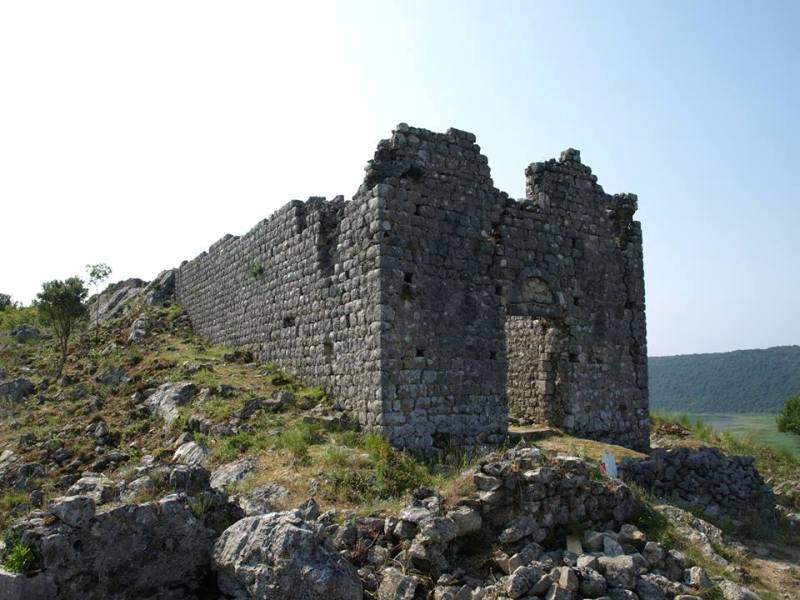
In the northeastern part of Ulcinj, on a meadow above Lake Shas, there is the medieval city of Shas. Now it is a ruin uninhabited by people. Every stone and every wall speaks with its mythical silence, wanting to keep the generations connected to these foundations, which were able to reach us today as a testament to the vitality and resistance with which it faced the hordes of barbarians who plundered, burned and razed it.
It is spoken of very little, nothing has been done except to cover it with oblivion. And yet Shas remains one of the most significant testimonies of Illyrian civilization. Although today only a few ruins try to keep us connected to this early Illyrian civilization, Shasi is so alive and so majestic in every fragment of its pride.
Every stone and every wall speaks with its mythical silence, wanting to keep generations connected to these foundations, which were able to reach until today as a testimony of the vitality and resistance with which it faced the hordes of barbarians who plundered, burned and razed it.
But Shasi, its inhabitants, a higher will has kept it alive, bringing it back more epic than before, even to the ruins of today, abandoned ruins, sidelined testimonies, historical truths deeply embedded in the memory of those who brought Shasi to life in action and in these stones that the sun shines on and the moss covers. Name: Albanian is called Shas, in Slavic Svac, in Latin Suacium.
It was a fortified medieval city. It is thought to have been created since the early period when Dioclea was also created. Shas is located on a rocky hill above Lake Shas at an altitude of between 60 and 70 meters above sea level, at the geographical coordinates: 41° 59′ 11″ °N and 19° 18′ 58″ ‘E.
The city was surrounded by walls and defensive towers. The main entrance was from the north, under which are traces of the suburb (the city surrounding the fortified city). Inside and outside the city fortifications there is a large number of medieval churches built on the foundations of much older churches. The second entrance (the remains of which are very well preserved, like those of the main entrance) is located on the side of the lake of the same name from which the city’s population is supplied with water.
The entire city of Shas is an archaeological park very rich in archaeological remains from different periods in which a large number of different objects have been identified, of which 15 churches have been clearly identified. Among others, Shas was destroyed and devastated by the Serbian emperor Stefan Nemanja. This is evidenced in his writings by Nemanja’s son Stefan the Crowned, who emphasizes that in addition to Shas, his father had also destroyed Drishti, Shkodra, Ulcinj and the famous city of Tivar (Antibarus).
With the arrival of the Turks, Shas was definitively destroyed and life in it died out. In the future, what remained of the archaeological wealth was looted from Shas, and this continues to this day. Dom Gjon Buzuku served as a priest in Shas, who in 1555 wrote the first Albanian book “Meshari”. Recent excavations in Shas are expected to yield discoveries of antiquity that will have historical value for the entire Mediterranean.
In the northeastern part of Ulcinj, on a meadow above Lake Shas, lies the medieval city of Shas. It is now an uninhabited ruin. As such, it is considered one of the most attractive “dead” cities on the Adriatic coast. According to the position of this castle, which was near Lake Shas in the fertile plain and on the Roman road Olcinium-Skoder, it has apparently been proven to be a ruin since the time of the Illyrians. Not far from the city, in the village of Shas, an ancient ovoid amphora was found that served as a burial ground, and a little further away in the locality of Gjeret, at Lake Zogajve, traces of a primitive Illyrian settlement were found, which proves that this area has been inhabited since early historical periods.
Shas is first mentioned in written documents in the 9th century as an episcopal city (Svacia Civitas). Around 1183, Stefan Nemanja conquered it and, together with other cities, annexed it to Rashka. The Mongols completely destroyed it in 1242, while Queen Helena of Anjou rebuilt it.
It was completely deserted when the Turks conquered it in 1571. According to Marin Bicci – 1610, Shas had 365 churches, which coincides with the number of days in a year, but today in these ruins only eight churches can be distinguished, of which two are the largest: the cathedral of the Church of St. John, built in the Gothic style, and the Franciscan Church of St. Mary, about 1300 years old.
All the churches in Shas were adorned with architectural decorations and frescoes, and in some even with traces of paint can be seen on the walls. The remaining parts of the fortress are located on the cliffs above Lake Shas, while the suburb continues to the west. The entrance to the city with an area of 15 hectares was made possible by two gates. The first archaeological research of the city of Shas was carried out in October and November 1985.
On this occasion, about fifty metal coins were found, of which one is gold, three are silver, and the rest are bronze. The three oldest coins are from the Byzantine period from the end of the 12th century to the middle of the 13th century.
From the time of the Nemanja government there are two pieces of money – Byzantine and Serbian; numerous coins from neighboring cities date back to the last quarter of the 14th century, while three coins are from Tivar, Kotor and an unknown city. The oldest discoveries from the city of Shas date back to the prehistoric period. The ancient period has not been confirmed in Shas.
Some Hellenic pottery fragments found in the eastern part of Shas indicate that it is possible that a Hellenic layer can be found in that part of it. The medieval city was formed in the early Byzantine period, and lasted continuously until the appearance of the Turks, respectively approximately until the conquest of Shkodra or even later.
The discoveries of vorbeis are quite rich, although not all eras are represented. Most of the household vessels have been found. The fragments of the 6th century are few, but it is certainly believed that they belong to the Illyrian plain from the time of Marvikia and Heraclius. Slavic vorbeis is represented in all layers from the 7th to the 11th century.
Almost all the household vorbeis of the early medieval century belongs to the Serbian cultural plane, but towards the end of Shas’s life the presence of imported vessels, probably of Venetian origin, is noticeable. The finds of jewelry are not only present as separate items in the graves, but also in layers. Byzantine jewelry includes glass pearl necklaces, simple earrings, rings, three coral stamps, and some beads.
During the excavation, many other iron objects were found, including parts of household equipment: (chains, wedges, nails, locks, etc.). In 1985, the Serbian Academy of Sciences hastily stopped the research when it was noticed that they were related to an ancient Albanian city. According to Prof. Aleksander Qilikov, 100 objects from the city of Shas are preserved in the ethnographic museum of Ulcinj.
In addition to Shas, in the Venetian period around Lake Skadar there were also the cities of Trishti, Danja and Sarda.

Albanian civilization is more located underground than above it. In the ethnic Albanian areas in Montenegro, and above all in the Ulcinj region, there are a large number of monuments of our heritage from our early history, where the ancient city of Shas, today an uninhabited city, is also located.
Shas is an ancient Illyrian settlement, which rises on the mountain of the same name. From here First, in the ancient period, the ancient connecting road between Ulcinj and Shkodra passed through it. Shasi is known in literature as: Suatio, Suaço, Savocci, Svaciao, Fshas etc. The base of the ancient city was built of large stones, while the surrounding wall was greatly damaged by the elements of time; this wall carries great architectural and artistic values. Even today, the two city gates stand there.
The Archbishopric of Tivar (over 900 years) was the main base of Catholicism in Northern Albania, but the bishopric of Shasi also played the same role for its area. In 1443, the bishop of Shasi was Palë Dushman.
If underwater research were done, even more of Shasi would be found, this unexplored heritage from our side has been hidden from the Slavs for centuries. There is also evidence that during the summer, when the water level of Lake Shas is low, parts of the walls of former residential houses can be seen.
Archaeological findings prove that the city of Shas, unknown until the 8th century, was actually affected by early Christianity in the Illyrian period. The Illyrianism of this culture is particularly evidenced by the typological similarity of the objects of the archaeological culture of Shas with the Illyrian-Arbër culture of Koman.
Shas was previously transformed into areas with fortified places, as shown by its position in the war between the Papacy and Byzantium for possession of this city during the Middle Ages. Research in the locality of old Shas attests to the existence of a prehistoric settlement as the basis on which the city of Shas was built after the discovery of the Koman culture, through which the most accurate dating of the sacred objects that have existed since the 6th-7th centuries was determined.
This ancient settlement, in addition to its strategic importance, also provided suitable conditions for life, given its location on Lake Shas and Buna, rich in fish, birds, wild animals and other special conditions for livestock and agriculture.
Referring to an unknown writer and his manuscript “Dulcigno secondo l’antica descrizione…”, it is said that “in this region there was a very old city called Shasi, where traces of 365 churches can be seen 15 miles from Ulcinj….’. It further writes that “near this city there are the lake, the cave, the water source and the mountain Lisinje, the Ledhet e Shasi and the gate where the Captain of Caesar died, fighting terribly against Pompeii where they are still standing today and miraculously a large pit, still not leveled…”
Medieval Shasi.
There is no doubt that medieval Shasi as a developed city has been immortalized in numismatics, because it minted its own coins, which bore the inscription Suacium, as well as the one that depicts the figure of Saint Paul the Baptist, as the protector of the city, as well as the tower and the castle with the magnificent pore of this city.
Montenegrin versions of this period state that Stefan Nemanja (13th century) destroyed Albanian churches and books of the time forcibly converted the remaining inhabitants to Orthodoxy, which is consistent with the oral tradition in Shas, where the current inhabitants of the village of Shas say “that all churches were originally Catholic”.
The first research by Yugoslav archeology, dating back to the 1980s, revealed a greater antiquity than was known. It was precisely the Illyrian heritage of the Shas culture that frightened the Belgrade archaeological school. In 1985, the Serbian Academy of Sciences hastily stopped the research when they noticed that they were dealing with an ancient Albanian city. This is the Illyrian city of 365 churches, which was first destroyed by the Slavs and then the truth of its ruins was also hidden from the Slavs.
It is believed that Shasi was named after the Illyrian martyr Saint Astius. The Latin form of Shasi is Suacia and is formed from the abbreviation of sanctus (saint) – Su and Astius. The combination Su+Astius forms Suastius and through the shift of the phoneme st → c, Suastius becomes Suacius, which in the feminine form is Suacia. In literature it is also encountered with other names, such as: Suatio, Suaço, Sovacci, Svacio, Scaç, Fshas, Saffazi etc.
- Basilio (1141? – 1150?)
- Pietro (1166.06 – ?)
- Dominio (1190? – 1199.09)
- G. (1200–?)
- ? Mark (ca. 1262)
- ? Peter (ca. 1284)
- Gregory (1303?–1307)
- Benedetto (1307.12.24 – 1317.07.08)
- Zaccaria, Dominican Order O.P.) (1318.07.13 – ?)
- Sergio (? – death 1345?)
- Paolo, Carmelite Order (O. Carm.) (1345–?)
- Pietro (1363?–?)
- Minor (? – 1403.09.13)
- Petrus Kirten (1404.02.27 – ?)
- Antonio da Firenze, Dominican Order (O.P.) (1418.08.12 – ?)
- Pietro (1420 – 1435.05.14), later Bishop of Ulcinj (Dulcigno, Montenegro) (1435.05.14 – death 1441?)
- Sergio (1439.05.18 – ?death ?1440)
- Paolo Dusso (1440.11.16 – 1445.12.22)
- Antonio da Fabriano, Friars Minor O.F.M.) (1446.07.18 – 1465.04.20)
- Francesco (? – death 1507?)
- Stefano (1507.02.07 – ?)
- Nicola (1517.04.08 – ?)
- Giovanni Rosa (1520.01.27 – 1524)
- Tommaso (1530.07.13 – ?)
Reference


 Balkan Academia