
Written by Petrit Latifi
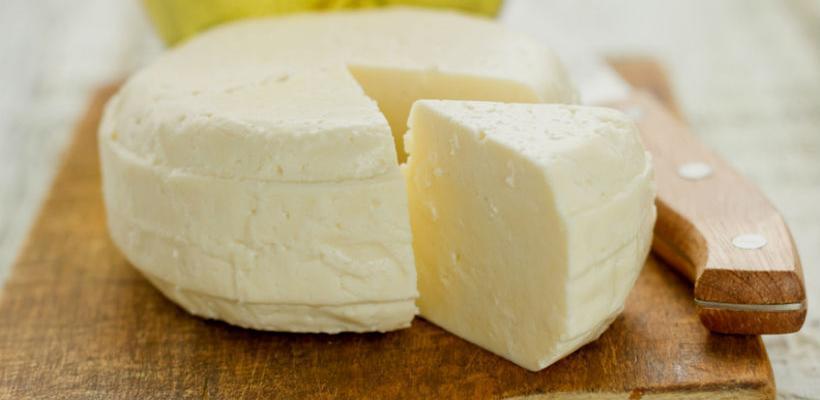
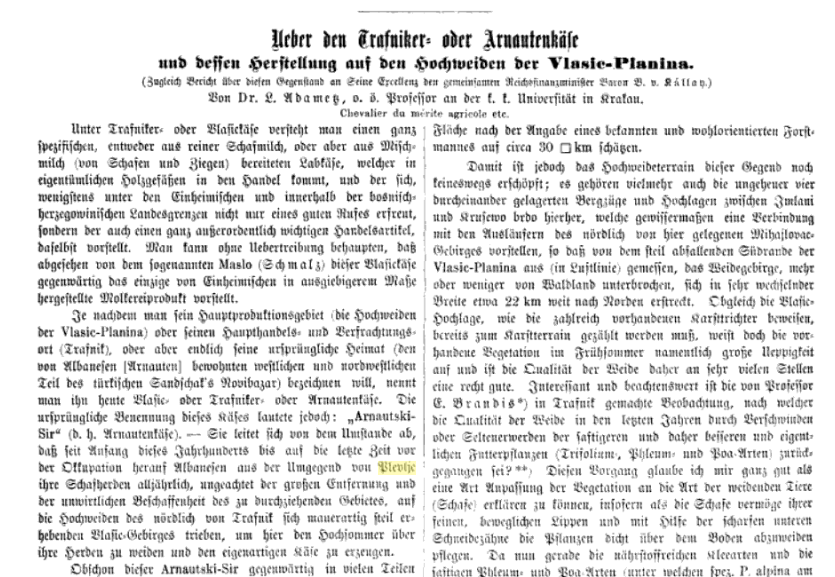
In an interesting German article written in 1892, published in the newspaper “Milchwirtschaftliches zentralblatt”, Volume 21, we find information about “Trafniker” or “Arnauten käse” (Albanian cheese) which Albanians of Plevlje made at the time. This cheese became very popular in Bosnia and Hercegovina. The document states the following:
“About the Trafniker or Arnauten cheese and its production on the high pastures of the Vlasic Planina.
At the same time a report on this subject to His Excellency the joint Reich Finance Minister Baron B. V. Kállay by Dr L Adamez, Professor at the Imperial and Royal University in Krakow. Chevalier du mérite agricole etc.
Chevalier du Trafniker or Vlasic cheese is understood to be a specific rennet cheese made either from pure sheep’s milk or from mixed milk from sheep and goats, which is sold in special wooden containers and which, at least among the locals and within the Bosnian-Herzegovinian borders, not only enjoys a good reputation but is also an extremely important trade item there. It can be said without exaggeration that, apart from the so-called Maslo Schmal z, this is currently the only dairy product produced on a large scale by the locals.
Depending on whether you want to describe its main production area as the high pastures of the Vlasic Planina or its main trading and shipping point Trafnik or finally its original homeland, the western and north-western part of the Turkish Sandjak Novibazar inhabited by Albanian Arnauts, it is today called Vlasic or Trafniker or Arnaut cheese.
The original name of this cheese was “Arnautski Sir” i.e. Arnaut cheese It derives from the fact that from the beginning of this century up until the recent time before the occupation, Albanians from the area around Plevlje drove their flocks of sheep every year, regardless of the great distance and the inhospitable nature of the area they had to travel through, to the high pastures of the Vlasic Mountains, which rise steeply like a wall to the north of Trafnik, to graze their flocks here in midsummer and to produce the unique cheese…
Although this Arnautski Sir is currently produced in many parts of Bosnia, particularly in the southern and western parts, the Vlasic must be seen as the main production area because nowhere else is the entire sheep farming so exclusively used for cheese production and because other closed pasture area of similar size for a purpose is available.
Without going into a description of the pasture conditions here, I would just like to mention that at the beginning of our century the Vlasic Planina was still covered with coniferous forest and that only gradually was such a large pasture area created through ever-increasing clearing with fire In fact, even today you can still find remains of old spruce stands on the higher ridges where the stony character of the soil does not promise adequate grass growth.
This actual home of Vlasic cheese is an undulating high area of the mighty central Bosnian Vlasic mountain range which, if you only restrict yourself to the actual mountain massif, covers an area of 21,000 hectares Of this, 6,500 hectares are privately owned as meadows and arable land, while the rest 14,500 hectares are forest and pasture land and are therefore state property.
The majority of this area is a property of a farm built between 1700 and 1780 m high plateau which has the shape of a triangle with the tip pointing to the NNE and which represents a single large pasture area. If one also considers, in addition to all the numerous ravines especially towards the east, the adjacent part of individual larger foothills of the Vlasic whose pasture area is also used in the same way and for the same purpose, one can see the more or less connected dairy farming purpose…”
The newspaper digitalized.
Link to article


 Balkan Academia