

Written by Petrit Latifi.
According to the collection of documents ZAL in the Serbian Archive, the name of Karadjordje’s grandfather on his father’s side was: Đin Marash Klimenta. Who were (they) the Klimenti: a Catholic Albanian tribe above Skadar, according to Latin and other sources.

In the COLLECTION of Andrija Luburić (in the following text ZAL) in the Serbian Archive, fund 1/107, the original text of the song “Vojvoda Jovan Mršić Klimenta Karadjordje’s grandfather and the Plav Turks” is preserved, by the author of a Catholic missionary, one of many who in the 17th and early 18th centuries missionized among the Klimenta tribe of the Catholic faith. In the same archival material, there is a commentary on the aforementioned song, from which we learn that the original name of Karadjordje’s grandfather on his paternal line was:
A part of the text of that commentary reads as follows:
“(…) This is a folk song of 186 stanzas, in which the heroism of Vojvoda Đin Marash Klimenta, Karadjordje’s grandfather, who was fated to kill Mujo Čaković, the greatest enemy of Christians in the vicinity of Plav.
In issue XXII of the “Bulletin of the Zemaljski Museum of Bosnia and Herzegovina” from 1910, the text “Contributions to the older history of Northern Albania” was published, pages 307-378, author: Nopča Dr. Franjo, Baron, in which on page 374 it says:
From old Bosnia, that is from the area around Gusinje, the Klimenti tribe also emerged, which 360 years ago was related to Rugovo, and that tribe settled longer in its homeland than the Kastrata tribe which, according to Hahn, settled from Kuči in 1640.”
Dr. Franjo Nopča refers to the work of the Austrian historian (Hahn: “Alboneische studien”, Vienna, 1858.)
“The Klimenta tribe, according to the document AS ZAL-1/107, was … settled in the mountains northeast of Hot and Kastrat. To the north, it borders with Kuči, to the east with Gusinje and Unzzai across the Trojan mountains, to the south with Schialla with the Disnikick and Galloyer mountains, to the west with the Hot and Kastrat mountains and the Prokletije mountain range, so called because their peaks are eternally covered with snow, and the side is bare, without greenery, and if you except the rare fir tree that appears here and there on the very top, offering a sad and desolate view…”
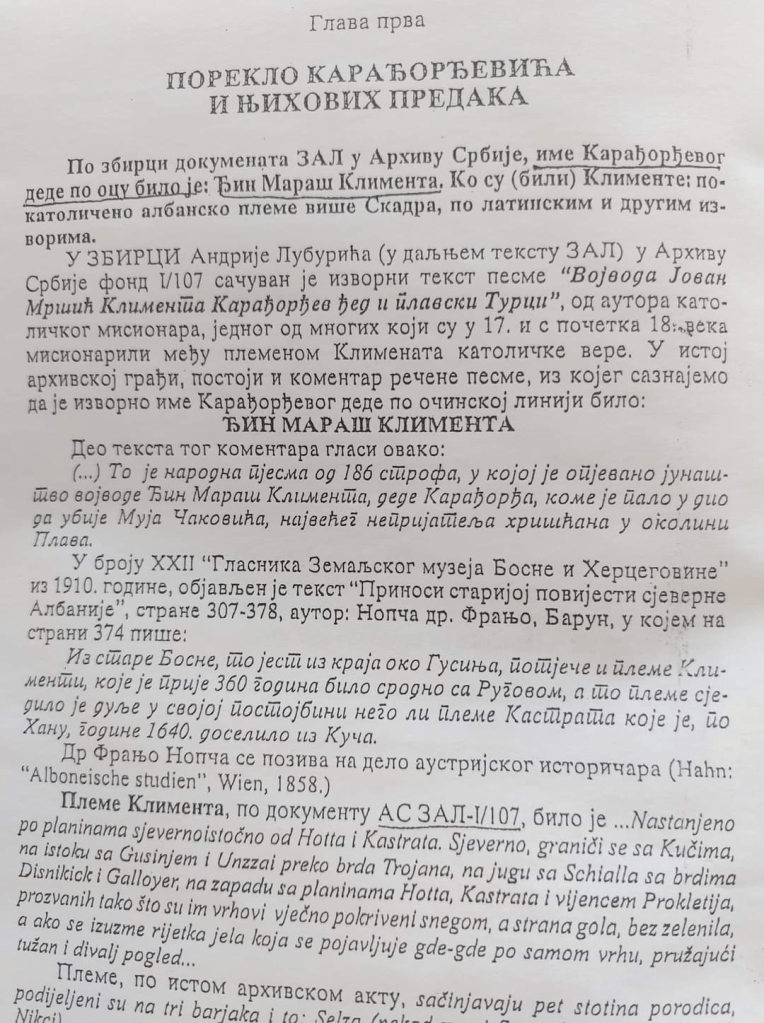
The tribe, according to the same archival document, consists of five hundred families, divided into three banners”.
Reference


 Balkan Academia