

Written by Petrit Latifi
Himë Ibishi was an Albanian fighter and patriot from Lybeniq. Hima fought alongside Bajram Curri, Ise Buletini, Azem Bejte, Hima was known to be brave and lived until the age of 118 years old (1870-1989)
Written by Prof. Besim Muhadri in New York.
“His and his comrades’ weapon only demanded unity and freedom
Himë (Ibish) Lybeniqi (Alimehaj) was born three decades before the end of the 19th century. The exact year of his birth is unknown. He himself said that he was born before the League of Prizren, but it was later confirmed that he was born in 1870 and died in the spring of 1989, in his birthplace in Lybeniq, a village between Deçan and Peja, on the edge of high mountains.
Shortly before his death, he said that he was over 114 years old. The elders said that he was even older. He was among the most famous brave men of these parts. He was known not only because he lived a long time, but also for his behavior as a man, brave and brave, who never forgot his name and the graves of his ancestors. This education was inherited from generation to generation, not only from the family, but also from his comrades who were enlightened and known to the Albanian people.
Himë Lybeniqi was a comrade-in-arms of Isa Boletini, Bajram Curri, Idriz Seferi, Hasan Hysen Budakova, Hasan Prishtina, Bajram Daklani, Azem and Shote Galica. He also knew Ismail Qemali, Luigj Gurakuqi, General Thomson, Prince Vidin, Fan Noli, Avni Rrustemi and many foreign and Albanian personalities of that time. He spent more than half of his life among friends and, as was customary in the tribe, in the difficult days of the wars of the enemies against the Komites, Kaçaks and brave men who fought for the homeland.
His weapon killed only enemies of this land. He participated in many battles and wars. In 1910 he was in the war against Xhavit Pasha in Carraleva. In 1912, together with tens of thousands of fighters, he liberated Ferizaj and Skopje and was among the first guards of the national flag in heroic Vlora in 1912.
His weapon and that of his comrades only demanded unity and freedom. War in Morina Pass. Where had he not fought? War against the Turks and the Albanians in Kodër i Qenit. In Qafë i Diellit. War against Cernagora. He did not say for himself that he had done this or that bravery for the homeland. He was very modest and realistic. He was wounded several times in the battles for the liberation of Kosovo and Albania, but survived, thanks to luck and the care of his comrades.
For many years he was close to Isa Boletin. From 1902 until he parted ways with him in Shkodra in 1916. After the murder of Isa Boletin in Podgorica in 1916, Hima stood by the distinguished fighter Azem Galica. He considered the murder of Beqir Vokshi a great loss for the Albanian people. After the death of Azem Galica, for a long time the old Yugoslavia was left struggling with life and its vicissitudes…
These are some of the data about Hima Lubeniqi, which the writer and actor, Nimon Muçaj gives us in his book “Rrëfimet e një kaçaku”, written in the form of a conversation and, more or less, documentary prose. Nimon had the good fortune to interview Hima in 1979, at a time when he had passed the hundredth year of his life, but who had a strong memory, but his notes taken from the interview remained unpublished until recently, which was very tragic, because some of them, as he says, were lost, but also burned by the Serbian crime machinery.
Nimon, hearing facts and arguments from the very mouth of the indomitable fighter for our national cause, Himë Lubeniqi, who died here 35 years ago, notes that emerge from Himë Lybeniqi’s stories can ruin the image we may have of some personalities of our national history, because he “must have known something, otherwise he would not have narrated such bitter and interesting things, at the same time”.
Our well-known writer and actor, Nimon Muçaj, shows that for thirty-six years in a row, he has reviewed these words of the old man from time to time, from which, as he says, he has “fixed” something and “destroyed” something, of course, even rewriting them from the beginning. He says that he has been working on the recordings, trying to rewrite the words as they were, “even though some of my recordings and notes were lost, stolen along with the entire computer and burned by the shredder in the terrible year of 1999…”
Forgetfulness – repetition of history
As Nimon Muçaj says in his book about Himë Lubeniq and his exploits, history tells us that the Serbs have burned us, killed us and cut us dozens of times over the centuries, while these evils that Serbia has done to us, unfortunately, we have “forgotten”. After the tragedy, we have sung or told stories about all those horrific events.
They have uprooted us from our lands since the Red Apple and we, after having “healed” the wounds of the Muhaxhirism, have “forgotten” them again. They have cut our land and our map with knives and iron, and the pieces of paper and flesh have drained our blood and soil.
Even before the League of Prizren, we Albanians were expelled from our lands, but we still sang about heroism and bravery. Even after the League of Prizren, they mutilated us. And again, as if we had “forgotten” and sung. In Kosovo In 1913, they killed us and we “forgot” again. The ordeal and massacre of Tivar is one of the most painful and bloody episodes. Unfortunately, history shows us that the Albanians there also helped the Shkije to exploit their own brothers. And we “forgot” again. They expelled us to Turkey and we, unfortunately, “forgot” again.
During the years of “autonomy ’74-’81” we were deceived by licking our bones and we “forgot” again the most important thing. The elders have advised us many times, telling us that the “Shkije” (serbs) cannot be trusted, but “we” did not want to believe this maxim. In 1998 and 1999, they burned our bones and the traces of our graves.
They killed our children, mothers, pregnant women, sisters, brothers, elders and expelled us from our lands. With our own eyes we have seen horrors and horrors. in Hima’s birthplace, in Lybeniq, on April 1, 1999. We also have many, many serious and painful events of our people. Are we forgetting again? With the greatest certainty that yes.
Isa Boletini together with 400 brave men was in Vlora on the day of the declaration of independence and the raising of the flag
The former “historians” of the Albanian People’s Army in Tirana and elsewhere, have denied the absence of Isa Boletini on the day of the flag on November 28, 1912. Why they have “fabricated” or falsified this detail, they know themselves. Hima Lybeniq, the protagonist of their events, therefore also of that great event, did not claim any position to say, that I was there and took the flag and shouted: “Long live Albania!”
No. He simply said that he had seen it with his own eyes, when Isa Boletini and 400 Kosovar men were there, when Ismail Qemali had climbed onto the balcony to unfurl our national flag. Some “kalemli” say that Isa is not seen in the photo with Ismail Qemali, is he?! Not everyone could have climbed onto the balcony, Hima asks and answers:
“Neither he, nor I, nor the researchers of history know whether they know or do not want to tell the truth, that that photo with the national flag and the signatures of Independence in Vlora, 1912, is not from that year. But a year later, with 1913…(?)”
Isuf Bardhoshi and Hazir Laha placed the national flag at the gate of the Beg’s house in Vlora
Nimon Muçaj in his book “Rrèfimet e një Kaçaku”, claims that in Luigj Gurakuqi’s notes it says:
“… that two Kosovar men unfurled a large flag and placed it at the gate of the Beg’s house in Vlora…” are completely accurate. If Luigj Gurakuqi does not tell them their names (because he did not know them), Himë Lybeniqi himself tells them their names. Those two men were Isuf Bardhoshi from Isniq and Hazir Laha from Belleja e Deçani.
So the notes of Luigj Gurakuqi’s words match the words of Himë Lybeniqi, when he said that:
“It was raining that day. The whole people were impatiently waiting for the decisions of the historic meeting and Ismail Qemali finally came out on the balcony with a small flag…”.
Hima could neither read nor write, so he did not read those notes of Luigj Gurakuqi, so that he would be influenced by that statement. He says this because he himself had been with them and was a protagonist, who was 42 years old at the time.
There is another version of the history of the raising of the flag, always based on the words of Himë Lybeniqi, a participant in that event. In this regard, Hima said:
“At the moment when the Flag was to be raised, Ismail Qemali addressed the brave men with these words: “Albanian brothers! Today the time has come for us to raise our flag with the double-headed Albanian and desecrate (remove) the Turkish flag once and for all. Is there a boy who rides and raises the Albanian flag?”
For a moment, a silence falls among the brave men, which is broken by Isa Boletini, who stands up and says:
“I will sacrifice myself for the flag!” Immediately after him, Isuf Bardhoshi of Isniq (Isa’s cousin) stands up and says:
“No, Baca Isa! I would raise the flag because if you were killed, you are a big piece, while I am a small piece!” (meaning you are important and i am not)
And he immediately climbs towards the place where the flag of the Young turks was placed. He broke his spear, profaned it on the ground and asked for someone to offer him the Albanian national flag. The flag was brought to him by Hazir Laha of Belle of Deçan.
To avoid the disputes that began to arise among the nobility about the issue of who raised the flag, Ismail Qemali said:
“We will call the one who raised the flag the unknown soldier.”
Even today in Vlora there is a monument to the Unknown Soldier, which should probably be the monument to Isuf Bardhoshi of Isniq of Deçan.
Himë Ibishi of Lubeniqi has been dead for 35 years, but his stories have remained. They have now been carefully recorded and written down by the writer and actor Nimon Muçaj, notes which he has put on paper and published. No matter how inaccurate someone may consider them, they were nevertheless told by the protagonist who himself had made and affected history.
And this is very important for history and for historians. Men like Himë Lybeniqi were numerous, but unfortunately, the darkness of the times and the injustices that were and are being done to the true warriors swallowed them up. Many of them left this world with the sorrow of not being able to touch the freedom of Kosovo and its unification with Albania, a cause for which they fought and gave everything they had and could…
In March 1981, when student demonstrations broke out in Kosovo demanding “Kosovo Republic”, while Serbia sent tanks to quell these demonstrations with blood, Himë Lybeniqi, on April 2 of that year, said:
“Remember that the teeth of the rabid dog are stuck in the flesh. Either they will leave their teeth in the flesh, or they will tear off a nice big piece…”
These were the words of a warrior and also an old man, worn out by battles, and his concerns that Serbia would not easily give up Kosovo without committing massacres and without also keeping a large part of Kosovo’s land, which is what it is still trying to do now, 25 years after the end of the war and 16 years after declaring independence.
Photo 1 by: Tahir Fetaj of Gurrat e Bardha in Strellc
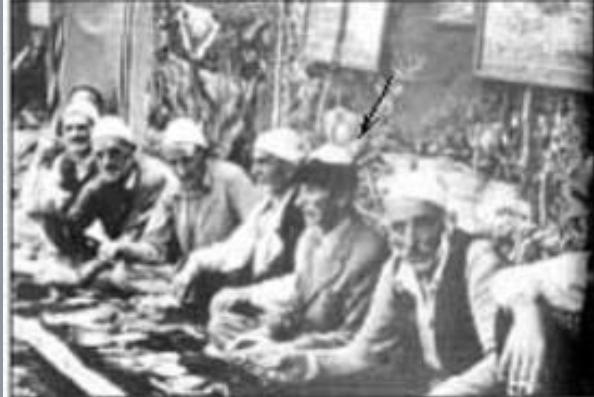
Photo 2: Himë Lybeniqi (marked with an arrow) among the men during a Dukagjini meeting.

Photo 3: Himë Lybeniqi on the left
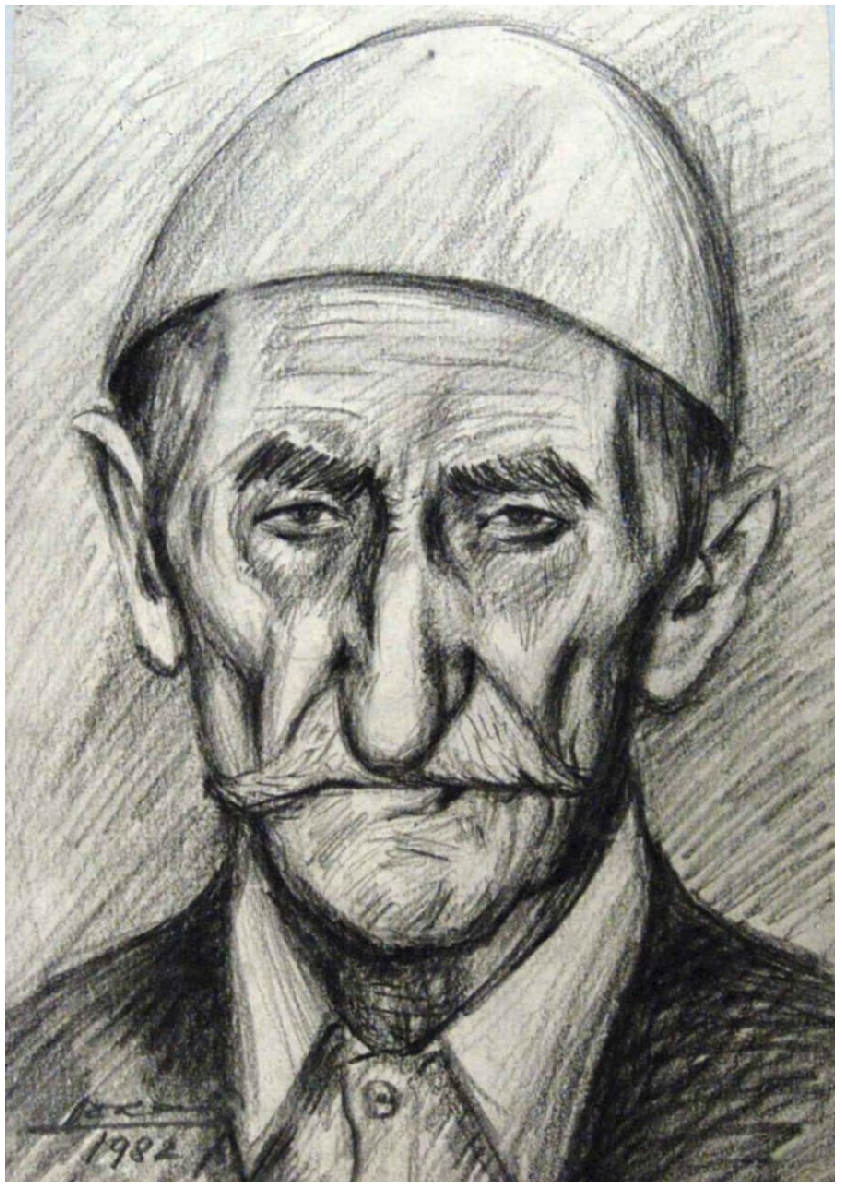
Portrait of Himë Ibishi by Sylejman Lokaj.
Folklore song written about Himë Ibishi
“në rrethatoren
fishektare
mbi një shekullore jetë,
sa otoman
e sa janturk (gjonturk),
pleh për tërfurk,
tevona me shkja
një jetë në bela!
Në të pame të vet
tri herë në vetpërshndoshje kreje
dhe vet për kryeshëndosh,
një unikalitet shqiptar
ala-mixha Himë,
miq e armiq
me sy
në sitë e shoshë
shoshiti
Po, pse?
Ai, vet mirë e diti!
Me njëqindekatërmbëdhjetë vjet,
katërmbëdhjetë, tha jam,
do nisim
shekullin e ri
për Vatan
me rriten e re tonë!
Veç njëherë në jetë
dy pika loti
në sytë e tij
mbi faqet motake!
Po, pse?!
I shikoi në sy,
memzi u përbi:
Për njatë Shkamb Mali,
njatë Burrë Selim Tali
që ma vranë k´ta shki!
Me atë shami t´zezë
rreth Plisi
ai Burrë Fisi,
shpirtin flakë ta dhezë,
i thonë Himë Lybeniqi,
Njeri i dyfeqeve,
tri herë
i gjallë midis t´vdekurve,
me nderë,
Legjendë e dy shekujve!”
References
Relatives and family notes and publications, thank you for these contributions.

 Balkan Academia