
Written by Petrit Latifi
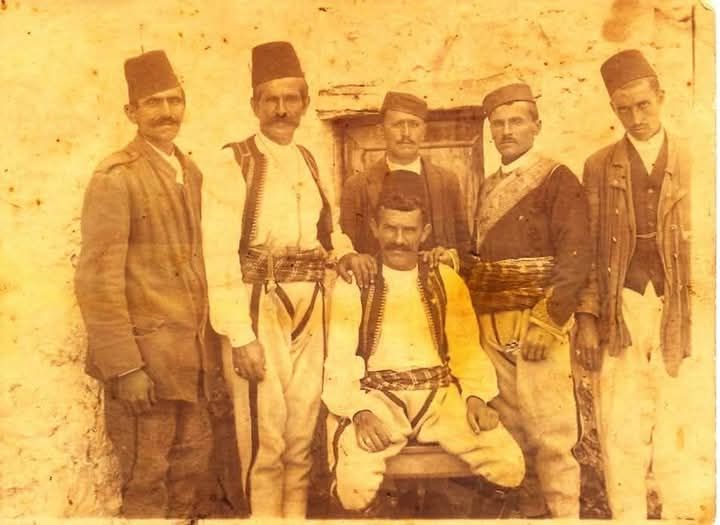
Albanian villagers of Pinçi (photo)
Pinculi (Binzhi) is mentioned in the 17th century
“… to the suffix anj, which then became aj: Lukaj, became Lukići, from Dedanj became Dedići. From Pinç, Pinçanj or Pinçaj became Pinčići. This village in the Latin document of 1614 is marked Pinculi and doubtfully translated Binzhi (?). We think that it should be officially marked Pinç-i or Pinçaj, while the resident: pinçanas pinçanase. With the form Pinçaj, this toponym is heard and pronounced in recent times also by the residents of….”1
Pinçi was part of the Sanxhak of Shkodër
“… The Riviera of Lake Scuttari … all subject to the Turks pay their taxes to the Turks. They are Christians and Turks together, the 4th part are Turks. The following municipalities are Chisagni, Scerochi, Craina à Rito Greco, Pinci, Brisca, Murichi, Sestana. There are 1500 Christians good at arms…”2
Albanian toponyms around Pinçi (Pinčići)
“… Pinčići and Rjeps in the Krajina on the slope of the Rumija mountain are located. About a mile north of Briska lies Shestani, which is not a single village and is surrounded by a series of settlements such as Dedanj, Bardanj, Gurza, Lukići (so-called Go ……)”3
Albanians from Pinçi arrived in Zadar in the 18th century
“…. For the first major migrations, 19 families arrived in Zadar, a total of 147 people. Later, the number increased to over 460 herds from 62 families. In addition to the area of today’s Arbanas, some are located in Zemunik – 7 families (Šestani, Pinčići, Prensi…). The archbishop fatherly took care of the defectors from Arban for two decades, until his death.”4
“[…] always Arban names, i.e. surnames: Paleka, Šestan, Pinčić, Prenda, etc. It is undeniable that such surnames, which are still in use among the Arbneš from Zadar, could serve as a facilitating circumstance for historians in determining their old place of origin. We come across the surname Šestani Šestanović much earlier, before…”5
Albanian Catholics of Pincichi
“There were also two churches dedicated to St. Peter and St. Nicholas. About 70 Catholic believers lived in the village. Then D. Marino visited Pincichi (Pinčići). The church there was called S. Nicola and had no furnishings. It did not even have a holy image above the altar. Nine Catholic families with about 50 believers lived in the village among Turks and schismatics. They were among the poorest in the diocese. D. Marino was finally in Scestani (Šestani). There (the place consisted of…”6
Pinci were of the Roman faith (Albanian Catholics)
“[…] all had fled with all their might towards Shkodra. The Krajina, Pinčići , Livari and Stojani, who were of the Roman faith, were waiting for us, as I had ordered them to be, and they joined us, and we occupied the middle of the front.. “7
Pinč may be of Albanian origin
“… Pinčići may be an Arbanasi name , or it may be a Brastveno name , after a certain Pinč . The village is located above Gornji Murići , from which it is separated by the Ordabec hill . To the east of the village is the Livrašnik hill , to the south Vrčok , and to the southeast Ashta ( Arbanasi …”8
Albanian toponyms in Pinçi9
Ara’ G’jatë – in Mushtana, at Ubla Kol’s.
Âshti – mountain to the east, towards Ljarja.
Baniri – above the village above Zbutë where it rises.
Bregu’j Pâlonj – from this hill you can see all of Pinçi.
Bregu’j Radolit – on the mountain, beyond Çog Pinçit.
Çog Pinçit – mountain above Pinçit.
Çogolina – the top of Rumië e Pinçit.
Djeri Kol’Niks under the village, in Gurina, at Patarica.
Dukiqet – working land in Sinjuer t’Pinçit.
Fusha Pinçit – working land, under Pâlonj e Pinçit.
Gropa’ Dredhzave – on the mountain, under Çogolinë.
Gropa’ Hithit – in Rumi, under Çogolinë.
Gropa’ Madhe – in Mushtana, here and Ubla Kol’s.
Gropa’ Murrizit – in Rumi t’Pinçit, from here you can see Tivar and the Adriatic Sea.
Gropa’ Plepit – in Mushtana, before reaching Ubla Kol’s.
Gropa’ Qershiz’s – near Rrug’s Ljares to Tivar.
Gropa’ Smajl Lik’s – on the road from Pinçit to Tivar.
Gropa’ Shkall’s – at Meja Shkall’s.
Gropa’ Than’s – on Rrugë t’Ljares, there you pass to Rumi.
Gropat e Simonit – in Rumi, before Grop’s Than’s.
Guri Birë – a stone with a hole, above Çog, near Radoli.
Gurina – stony ground (with pebbles, pebbles) under the village, Kol’ Nik’s property.
Gurra Shtog – a rock on the road from Pinç to Tivar.
Illcat – working land under Pâlonj i Pinçit.
Kodra Rrinxë – on the road to Ubla e Kol’s.
Kron’i Bushtërs – under Krue t’Shkall’s.
Kryqmashë – cross road to Prroni Lugut.
Ksollat e Marinve – in Markodol (4 ublat, 1 lere, cherries and mrizet).
Ksollat e Muratit Braconj – on the mountain at Pusi Bardhë, on the road to Mushtana.
Kshtenjat e Gjonit Gjek’s – property of the Miloshëves, at Zagnat e Lugut.
Kshtenja’ Marinve – near Kshtenjave t’Gjonit Gjek’s.
Lâma’ Agos – a lama in the village.
Lâma’ Barit – in Rumi, near Grop’s Hithit.
Lâminjt e Llakoçve – under Breg t’Pâlonjve.
Lera Pâlonjve – at Ubla e Pinçit.
Lerthe – above Gropë t’Than’s, a place of pits (lerth urth, hurth).
Lisi Krezman – on Mount Pushogorica.
Livrashniku - mountain near the village.
Lizalli – spring in Mikuliq të Vogël.
Lugu’j Pinçit – under the village.
Man’i Macit – above Lama t’Agos (Maci – father of Pjetër Vuçeta).
Markodoli – the surrounding area on the mountain (there are also 4 ubla and lera).
Meja’ Bizdenjve – in Rumi t’Pinçit, from there you can see the Sea.
Meja’ Çogut – above the village.
Meja’ Frashnit – on the road to Mushtana (to Ubla Kol’s).
Meja Gurit – under Dukiqet.
Meja’ Pushogoric’s – the top of Mount Pushogoricë.
Meja’ Shkall’s – where the roads to Tivar from Shestan, Pinç and Ljare join at Ubla Me Shkall’s.
Meja Vjesirit – above the village of Rjepc.
Meja Vizhënj’s – on the road to Kishe t’Pinçit, there are wild cherries there.
Milera – a place where there was a grove.
Mriz’i Kols – belonged to Kol’ Nik’s Pjetër Gjoni, on Rruga Ljares.
Mriz’i Mushtana – a hill in Mushtana, on Ubla Kol’s.
Mriz’i Vogël – on Rruga Ljares.
Pâlonj – (Palaj) the eastern part of Pinç.
Prroni Lugut – at Zagnat e Lugut, in Sinjuer, where there is arable land.
Prronjte mas Çogut – the streams behind Çogut Pinçit.
Pus’i Bardhë – a hole in the rock that holds rainwater, near Ubëls Kol’s.
Pushim’i Rjepcit – a resting place where three roads meet.
Rest at Dardha Canos – a resting place after Çog.
Pushogorica – a mountain above the Markodol hills.
Qafa’ Çogut – a mountain gorge.
Qafa’ Ljares – a gorge, a mountain pass between Livrashnik and Âsht.
Qafa’ Qershiz’s – a mountain pass at Mushtana.
Qafë Mushtan’s – a mountain pass before reaching Mushtana, at Rrethina Stjep’s Nik’s.
Qafë Konjoshk’s – a mountain pass before reaching Mushtana from Pinçit.
Qafë Shtogut – here were the Vuç Pinçi huts, on the road to Tivar near Mesë Shkall’s.
Qarratahi – at Meja Shkall’s.
Cherries – on the side of Rumija, cherries would have grown there.
Radoli – the plain, the area with huts for livestock.
Rumia Pinçit – part of the Rumi mountain range known to belong to Pinç.
Rrasa’e Kryp’s – on the mountain, near Radoli, there lay the cattle hut.
Rrasa me Kryq – a slate at the end of Prronjve mas Çog.
Rrinxa – at Ksollat e Marinve in Markodol.
Rruga Kish’s – the road leading to the church.
Rruga’e Ljares – the road leading to Ljare.
Sinjuer – working land under Pâlonj e Pinçit.
Shkalla’e Detit – on the mountain, on the border between Pinçi and Ljares, near Mushtana.
Shpishniku - mountain under the Church.
Than’s Path – between Grop’s Simonit and Grop’s Than’s.
Te Kregza – near Grop’s Qershiz’s.
Te Patarica – in the village.
Ubla Kol’s – on the mountain in Mushtana, opened by Kola’j Nik’s Pjetër Gjoni from Dobreci.
Ubla Kol’Tucit – in the village.
Ubla Lens Pinçanjore – in the village.
Ubla Marin’ve – at the Marin’s house.
Ubla Nryme e Malonjve – in the village.
Ubla Pren’s Malos – in the village.
Urdaborda – a mountainside.
Vjesir – a mountain above Rjepc.
Vorret e greva – there are graves of women who had made a lot of mistakes.
Zâna – a mountain between Rjepc and Shestan.
Zagnat e Lugut – working land at Prroni Lugut.
Zbutë – (a type of oak tree) above Pinç where the residents gathered for assembly.
References
- https://www.google.se/books/edition/Probleme_aktuale_t%C3%AB_kultur%C3%ABs_s%C3%AB_gjuh/3gvrAAAAMAAJ?hl=sv&gbpv=1&bsq=Pin%C4%8Di%C4%87i&dq=Pin%C4%8Di%C4%87i&printsec=frontcover ↩︎
- https://www.google.se/books/edition/Albania_sacra_Di%C3%B6zese_Alessio/O0FQSlrAw58C?hl=sv&gbpv=1&dq=Pinci+Montenegro&pg=PA77&printsec=frontcover ↩︎
- https://books.google.se/books?id=YyIbAAAAIAAJ&q=Pin%C4%8Di%C4%87i+Krajina&dq=Pin%C4%8Di%C4%87i+Krajina&hl=sv&newbks=1&newbks_redir=1&printsec=frontcover&sa=X&ved=2ahUKEwi75qjMrMGLAxU2CBAIHT-iAT0Q6AF6BAgHEAM ↩︎
- https://books.google.se/books?id=PJ_lAAAAMAAJ&q=Pin%C4%8Di%C4%87i&dq=Pin%C4%8Di%C4%87i&hl=sv&newbks=1&newbks_redir=1&printsec=frontcover&sa=X&ved=2ahUKEwjWq4WirMGLAxX8CRAIHQcnO2wQ6AF6BAgLEAM ↩︎
- https://www.google.se/books/edition/Djela/QW7s1DaF5l4C?hl=sv&gbpv=1&bsq=Pin%C4%8Di%C4%87i&dq=Pin%C4%8Di%C4%87i&printsec=frontcover ↩︎
- https://www.google.se/books/edition/S%C3%BCdosteuropa/tkBpAAAAMAAJ?hl=sv&gbpv=1&bsq=Pin%C4%8Di%C4%87i&dq=Pin%C4%8Di%C4%87i&printsec=frontcover ↩︎
- https://books.google.se/books?id=VfwyAAAAMAAJ&q=%D0%9F%D0%B8%D0%BD%D1%87%D0%B8%D1%9B%D0%B8&dq=%D0%9F%D0%B8%D0%BD%D1%87%D0%B8%D1%9B%D0%B8&hl=en&newbks=1&newbks_redir=1&printsec=frontcover&sa=X&ved=2ahUKEwi_9oa7sMGLAxW_FRAIHbNdD_04ChDoAXoECAkQAw ↩︎
- https://books.google.se/books?id=C50yAQAAMAAJ&q=%D0%9F%D0%B8%D0%BD%D1%87%D0%B8%D1%9B%D0%B8&dq=%D0%9F%D0%B8%D0%BD%D1%87%D0%B8%D1%9B%D0%B8&hl=en&newbks=1&newbks_redir=1&printsec=frontcover&sa=X&ved=2ahUKEwi2_8mtrMGLAxXdJxAIHU6kFN8Q6AF6BAgFEAM ↩︎
- Treguan: 1) Halili Muratit Mehmet Alisë Haxhisë-Braconj, pinçanjor, tash në Braticë, Ulqin, më 15.11.2008. 2) Mara (77 vjeçe), bija e Zefit Nik’s Gjonit prej Pinçit, e shoqja Gjonit Gjergjit Gjon Markoçit, prej Pinçit, tash në Braticë, Ulqin, më 24.1.2009. Simë Gjon Dobreci: Pinçi-Disa Toponime, BUZUKU 29, 2009:14 ↩︎


 Balkan Academia