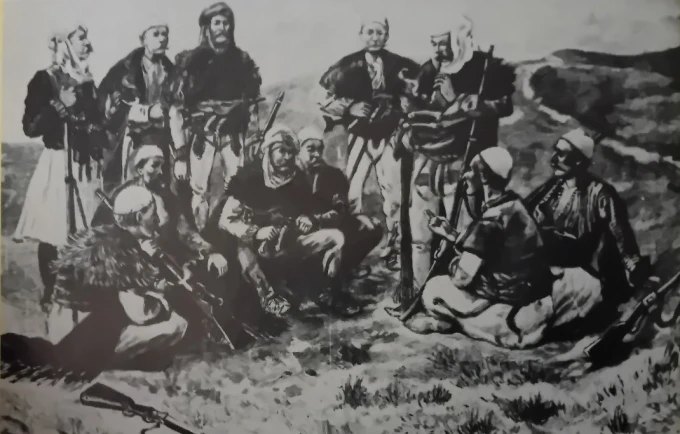

Edited and translated by Petrit Latifi. Written by Halim Purellku.
The preparations for the beginning of the Albanian uprising against the Ottomans had begun in the winter of 1911-1912. In this context, on 20 January 1912, in Dibra, a rally was organized in which the demand was made that the same rights that were recognized to the highlanders, with the agreement of Podgorica (2 August 1911), be recognized to the population of the province of Dibra.
The decisions of this assembly were also sent to the Albanian deputies in Istanbul for information. The uprising in Northern Albania broke out in mid-April 1912 and spread, or at least was felt, throughout Albania (Arnautlëku), or as the press of the time in Belgrade claimed, the uprising extended from the state border with Serbia in the north, and “to the southernmost borders” of Albania in the south, and from the shores of Lake Shkodra in the west, to the Vardar in the east.
Meanwhile, Hasan Ballanca, from Dibra, a prominent activist of the national movement, in his statement to the Bulgarian newspaper “Reç”, assessed that the current revolutionary/insurgent movement in Albania was not like the previous ones in terms of its level of organization and character.
Meanwhile, as early as March 1912, the Ottoman government took measures to prevent the uprising. For this purpose, she tasked Feti Pasha, commander of the VI Corps, and the governor of Manastir, to talk to several figures of Albanian public and political life, such as: Dervish Hima, Fehim Bey Zavalani, Abdyl Bey Ypi, Baba Hyseni of Melçan, to ask them that Albanians remain neutral in the political war between the Ottoman position and opposition, and to give up the idea of an uprising.
However, the uprising also spread to the vilayet of Manastir, respectively to the sandzak of Dibra. The organization of the insurgent groups and their rebellion in the Dibra region became apparent at the end of April 1912, when Basri Bey escaped to the mountains and gathered several hundred Albanian insurgents. In addition to Basri Bey, several influential leaders among the highlanders also rebelled, such as: Mersim Dema, Elez Isufi, Sejfedin Pustina, Shaqir Bey and Salih Bey Lacko. Meetings and consultations between them were held in Shupenza (Dibar).
Among the most prominent leaders of the uprising in the Dibar region was Mersim Dema, who with his squad (50 people) carried out very efficient activities in favor of the massification of the uprising. Meanwhile, by the end of April 1912, in Lower Dibra (Vogël), several insurgent groups were organized and operating by these leaders, each with a strength of 40-50 people.
The insurgents had their advisors and instructors in the city of Dibra: Sefedin Pustina, Shukri Bey, etc. The leaders of Dibra (a total of 39 people), by the end of April 1912, protested to the Ottoman government by means of a telegram against the practice of flagrant violation of the electoral process by the authorities in the Sanjak of Dibra. However, the Ottoman government, instead of stopping the practice of flagrant violation of the electoral process, sent a large expedition to the Sanjak of Dibra in pursuit of Basri Bey’s group.
The clashes between the army and the insurgents in the Dibra Highlands began in late April – early May 1912. Three clashes took place in the villages of Reç, Dardhë and Çidhën. The Belgrade newspaper “Politika” assessed the Dibra uprising as very serious, “more organized than ever before”. In the first ten days of May, the uprising in Dibra was taking on ever greater proportions.
Almost the entire Dibra Highlands was in revolt. This resulted in frequent, sometimes frontal, fighting between the insurgent forces and the Ottoman army during May 1912, and that between the villages of Dardhë and Reç, at the village of Topojan, at the village of Lis, at the river Lusi, etc. Thus, on May 4, 1912, the military forces clashed with the Elez Isufi platoon, where two Albanians were killed and 11 Ottoman soldiers were killed and wounded.
Meanwhile, around May 14, the Ottoman troops of the Second Battalion of the 49th Regiment in the war with the Albanian insurgents suffered heavy casualties; around 100 soldiers were killed. Meanwhile, around May 17, in the villages of Reç and Dardhë in the Dibra Highlands there was another attempt at frontal warfare between the Albanian platoons and the Ottoman troops. Mersim Dema came to the aid of the insurgents with 400 fighters and the villagers of the surrounding villages.
Before the onslaught of the insurgent forces, the Ottoman troops were forced to retreat. Soon after these clashes, Feti Pasha arrived in Debar from Manastir with an infantry regiment and a hill battery to demonstrate his strength. Feti Pasha declared that he had supposedly come to communicate to the leaders of the uprising the government’s response to the 10 written demands of Lower Debar and Mat, submitted to Haxhi Adil Bey. In this context, he invited the insurgents to disperse.
He went to their homes and ordered the army to stop pursuing the insurgents. Then, on May 23, 1912, Feti Pasha went to Homesh, the center of the uprising in the Debar Highlands. There he conveyed to the leaders of the uprising the decision of the Ottoman government that the Albanians of the Debar sanjak would be exempted from military service for several years and that new taxes would be abolished. Meanwhile, the leaders of the uprising, Basri Bey and Mersim Dema, through Shaqir Bey, were made very solid offers in terms of positions and money to stop the uprising, but the leaders of the uprising rejected these offers.
Also, at the end of May, a telegram from Istanbul arrived in Debar, confirming that the tax for the Albanian rebels had been canceled for three years, and that military service had also been canceled for three years, and that the possession of weapons had been legalized. Meanwhile, on May 26, 1912, the governor of Manastir declared that the rebels around Debar had been dispersed, in exchange for some concessions from the government. The Ottoman government’s efforts to quell the uprising in the Sanjak of Debar by peaceful means continued throughout the month.
June 1912. Immediately after the declaration of the governor of Manastir, on May 26, 1912, the Ottoman army was evacuated from the Debar Highlands in the first week of June, apparently this was the Albanians’ condition for entering into negotiations with the government. Meanwhile, in mid-June, a delegation consisting of Feti Pasha and Ejup Sabri Bey, secretary of the Young Turk Central Committee, arrived in Debar for negotiations with the insurgents, because “the entire Debar Highlands had fled to the mountains.”
Negotiations between the government and Albanian representatives for a temporary agreement took place in Debar. These negotiations resulted in the formal acceptance of the Ottoman delegation’s conditions and the Albanian representatives’ pledge that the insurgents would disperse to their homes. Consequently, by the end of June there were no clashes in Debar, but sources indicate that an agreement had not yet been reached between the insurgents and the authorities.
However, at the end of May 1912, the Ottoman government continued to concentrate additional military troops in Debar and Kicevo. However, the Albanian leaders of the Monastery vilayet also continued to strengthen ties with Upper Albania. Kral, the Austro-Hungarian consul in Salonika, informed his superiors that, with the efforts of several Albanian personalities – figures, in June 1912, progress had been made in reaching a mutual agreement between the provinces of Albania for a joint uprising. anti-Ottoman, but were still far from a “more secure and active” agreement, as it should have been.
However, an important element in the political developments in the Vilayet of Manastir during June 1912 was the anti-government revolt in the army (June 21-22, 1912), when a part of the military joined the rebels, and along with the deserted troops, many leaders of the respective areas in this Vilayet fled. Thus, with the troops deserted from the Dibra garrison, on June 22, 1912, 12 chiefs from the Dibra sandjak, who were staying in the Dibra Highlands, escaped with 80-100 men.
Meanwhile, in the first half of July, the Albanian uprising was gaining more and more momentum both in the North and in the South. At the beginning of July, fighting between the army and the Albanian insurgents in Dibra e Vogël, in Reka e Dibra, in Mat was frequent, but without any major importance. Anarchy continued to prevail in Dibra even from mid-July.
The insurgents cut the telegraph lines and interrupted all communication between Dibra and Struga, with Dibra e Poshtme and with Zhernanica. It was reported that about half of the army from the auxiliary command posts joined the insurgents. Meanwhile, in the second half of July, the number of insurgents in the Dibra Highlands, in Mat, etc. increased significantly.
To suppress the uprising in these regions, the government sent additional troops. However, by mid-July 1912, when in almost all of the “Upper Territories” of Albania, the “legal” Ottoman government was being replaced by the Albanian one, by the end of July, hostilities between the Albanian insurgent powers and the Ottoman forces ceased for a while.
On July 23, the new Ottoman government had issued a telegraphic order on the withdrawal of the army from Albania; a telegram with such content had also reached Manastir. After ordering the withdrawal of the army, the Ottoman government expected the Albanian rebels to return to their homes, thus ending the uprising. Meanwhile, on 12-25 July 1912, the Ottoman government ordered the cessation of all military operations against the Albanians.
References

 Balkan Academia