
Written by Petrit Latifi
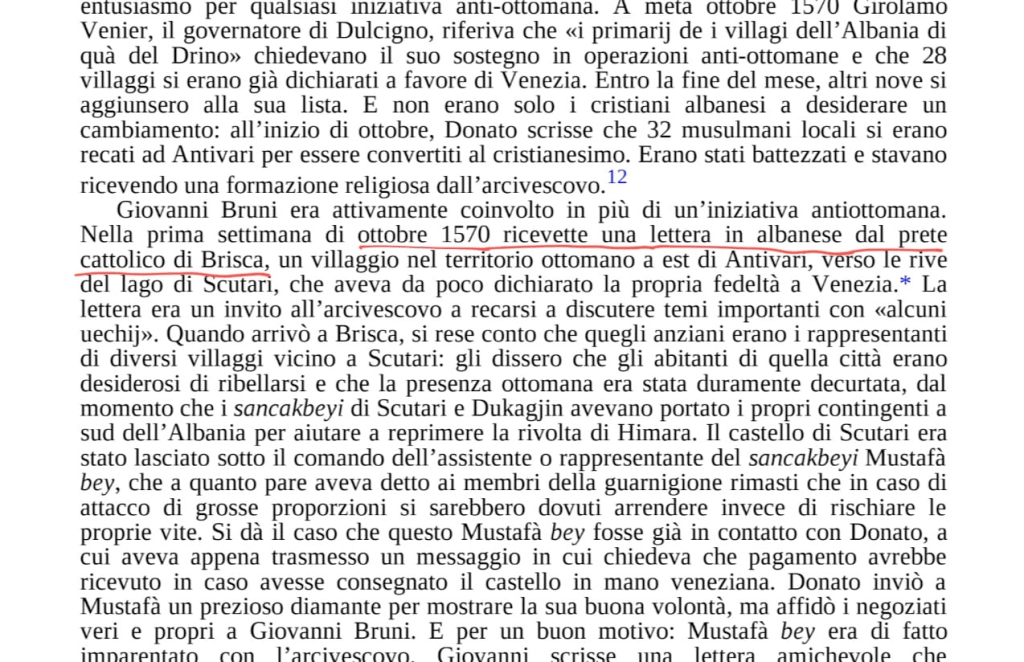
On October 6, 1570 (15 years after Meshar), the priest of Brisk sends the archbishop of Tivar a letter in Albanian, inviting the Archbishop of Tivar, Giovanni Bruni, to come to Brisk where the leaders of the villages of Krajë gathered, who were dissatisfied with Ottoman rule and expressed their loyalty to the Venetians in the event of an attack on the Shkodra Castle. Ulcinj and Tivar were still under Venetian administration and planned to conquer Shkodra since the Ottoman defense there had been weakened. This letter was later sent to Venice by Alessandro Donato, the Governor of Tivar. Bruni wrote a report on the visit to Brisk. The importance of this letter (which has not yet been published) lies in the fact that at that time Albanian was unofficially written between the local clergy and the authorities in Tivar and Ulcinj.
We can read the following:
“Giovanni Bruni was actively involved in more than one anti-Ottoman initiative. In the first week of October 1570 he received a letter in Albanian from the Catholic priest of Brisk, a village in Ottoman territory east of Antivar, towards the shores of Lake Skadar, who had recently declared his loyalty to Venice.
The letter was an invitation for the archbishop to go and discuss important matters with “some chieftains”. When he arrived in Brisk, he found that the elders were representatives of several villages near Shkodra: they told him that the inhabitants of that town were eager to rebel and that the Ottoman presence had been severely limited, since the Sanjakbey of Shkodra and Dukagjin had led their contingents south from Albania to help put down the Himara revolt. The castle of Shkodra had been left under the command of the adjutant or the representative of the sanjakbey, Mustafa bey, who apparently told the remaining members of the garrison that in the event of a major attack they should surrender and not risk their lives. …”


 Balkan Academia