
Written by Petrit Latifi
One of the clearest explanations given for the presence of Slavic-Orthodox names in Krajë, Mërkot, Shestan, Cërrnicë according to Puhala alongside Albanian ones and the argument through the analysis of patronymics, is that this population was of Arbërian origin in the 15th century in this region. We can read the following:
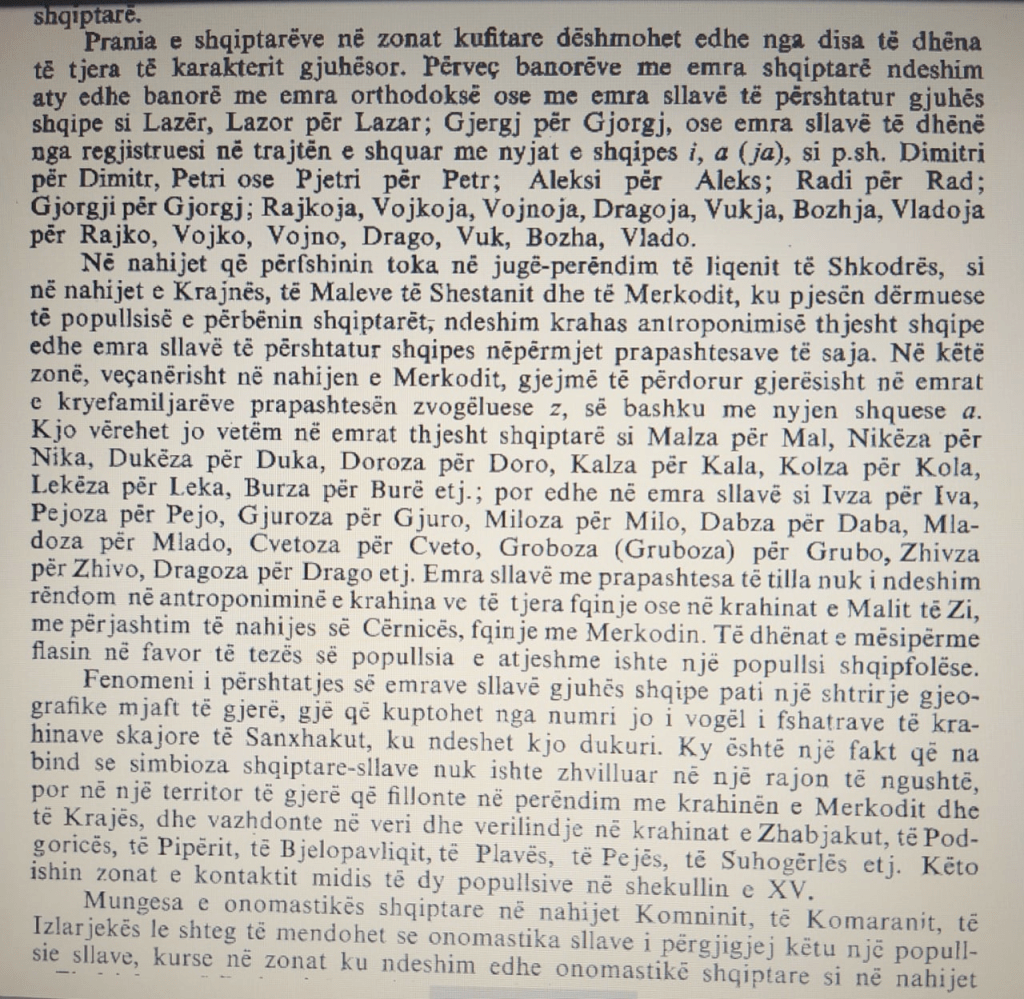
“The presence of Albanians in the border areas is also evidenced by some other linguistic data. In addition to residents with Albanian names, there are also residents with Orthodox names or Slavic names adapted to the Albanian language, such as Lazër, Lazor pēr Lazar; Gjergj for Gjorgj, or Slavic names given by the recorder in the prominent form with the Albanian nodes i, a (ja), such as Dimitri for Dimitr, Petri or Pjetri for Petr; Alex for Alex; Rad for Rad; George for George; Rajkoja, Vojkoja, Vojnoja, Dragoja, Vukja, Bozhja, Vladoja for Rajko, Vojko, Vojno, Drago, Vuk, Bozha, Vlado.
In the nahiyes that included lands in the south-west of Lake Shkodra, as in the nahiyes of Krajna, the Shestani Mountains and Merkodi, where the majority of the population was Albanians, we encounter, in addition to purely Albanian anthroponymy, Slavic names adapted to Albanian through their suffixes. In this area, especially in the Merkodi district, we find the diminutive suffix z, together with the suffix a, widely used in the names of family heads.
This is observed not only in purely Albanian names such as Malza for Mal, Nikëza for Nika, Dukeza for Duka, Doroza for Doro, Kalza for Kala, Kolza for Kola, Lekëza for Leka, Burza for Bure, etc.; but also in Slavic names like Ivza for Iva, Pejoza for Pejo, Gjuroza for Gjuro, Miloza for Milo, Dabza for Daba, Mla-doza for Mlado, Cvetoza for Cveto, Groboza (Gruboza) for Grubo, Zhivza for Zhivo, Dragoza for Drago, etc.
Slavic names with such suffixes are not usually found in the anthroponymy of other neighboring provinces or in the provinces of Montenegro, with the exception of the nahija of Cërnica, neighboring Merkodi. The above data speak in favor of the thesis that the population there was an Albanian-speaking population.
The phenomenon of the adaptation of Slavic names to the Albanian language had a fairly wide geographical scope, which is understood by the considerable number of villages in the peripheral regions of Sanxhak, where this phenomenon occurs. This is a fact that convinces us that the Albanian-Slavic symbiosis was not developed in a narrow region, but in a wide territory that started in the west with the province of Merkod and Kraja, and continued in the north and northeast in the provinces of Zhabjak, Podgorica, Pipir, Bjelopavliq, Plava, Peja, Suhogerla, etc. These were the areas of contact between the two populations in the 15th century.
The lack of Albanian onomastics in the districts of Komnin, Komaran, and Izlarjeka suggests that Slavic onomastics corresponded here to a Slavic people, while in the areas where we also encounter Albanian onomastics, such as in the districts…”


 Balkan Academia