
Exclusive by Prof. Dr. Lutfi ALIA. Translated by Petrit Latifi
Sunday, 14.02.2016, 04:49 PM
1272: After the fall of the Principality of Arbëresh (1255), on February 21, 1272, the Regum Albaniae appears on the stage of Arbëresh history, with King Charles I of Anjou (Carolus I, dei gratia rex Siciliae et Albaniae). King Charles I of Anjou mobilized many Albanians to serve in the army in Durrës and in the guard of the royal court in Naples. Of course, we are not dealing with the emigration of the inhabitants, but with the transfer of a group of Albanian soldiers, who did not return to their homeland, but took their families and settled definitively in Naples and other cities of the kingdom.
King Charles I, although he promised the Albanian nobles protection and self-government according to local laws, did not keep his word and to avoid revolts, he took hostage several nobles whom he exiled to Italy, some of them and imprisoned them. In 1278, a group of nobles were imprisoned in Terni, among them Duke Tanush Dukagjini (Dux Ginus Tanusius Albanensis), while in Antwerp, 5 nobles were imprisoned, among them Duke Tanush Skura of Kunavisa (Dux Tanusius Scura).
1385 – 1415: At the end of the 14th century, the Arbër population faced the first attacks of the Ottoman hordes, who after taking Morena, Kostur and Ohrid, occupied Berat and Lushnja.
On September 18, 1385, Balsha II with cavalry units attacked the Turks in Savër in Lushnja, but was defeated and Balsha II was killed. After this victory, the Turks took Kruja and then occupied other territories in the north of the Albanian lands. In these complicated situations, part of the population of the occupied territories, to escape the reprisals of the Turkish barbarians, emigrated to Italy. The first influx of Albanians were 60 families from Shkodra, Lezha, Durrës, Mati, which settled in Venice, Trieste and Istria.

The historian Pietro P. Rodotà in his work “Dell’origine, progresso e stato del rito greco in Italia; vol 3, Rome 1775” writes:
“… the Turkish attacks shocked the Albanians, some of whom, to escape the subjugation and punishment of the Ottomans, abandoned their lands and fled to Italy. Among the first refugees who landed on the Italian coasts in 1396 were 10 families from Krutë and Durrës, led by Miko Dragovik.
These families settled in the village of Peroi in Venice, in Trieste and in Istria, where they were distributed in the municipalities of Parenzo, Pola, Umago. A few years later, in the church of San Severo in Venice, Albanian families opened the school of devotion (Scuola di Devozione), which functioned until the end of 1443.”
In these years, emigration also began from the southern Arber lands.
Francesco Tajani writes: “… In the years 1399 – 1410, groups of Albanian families, led by the nobleman Gjergj Matranga (Giorgio Matranga), landed in Sicily and were placed in the service of the Aragonese king Martino il Giovane (1399-1409)”…..In 1413, after the fighting at Shkalla i Matit, Gjon Kastrioti’s army was defeated by the attacks of the Turkish hordes. Some groups of families, who escaped Turkish reprisals, fled to Sicily, Marche and Venice with the help of Venetian ships.
1444: The soldiers of Captain Demetrio Reres, who were sent by Skanderbeg to help Alfonso V of Aragon, settled permanently in Sicily and Calabria.
1461: The detachment of 2800 knights, who went to help King Ferrante I of Aragon of Naples, did not return to their country, but remained in Italy, scattered in several communes in Puglia.
In the summer of 1462, after the victory of the Albanian army against the allies of Count Orsini, in the battle near the city of Troia in the province of Foggia (Foxia), King Ferrante I consolidated his power and, to compensate for Skanderbeg’s contribution, donated the fiefs of San Giovanni Rotondo, Monte Sant Angelo, Terni, etc., which from that time have been the property of the Kastriots, where the Albanian knights and some members of the family of Gjergj Kastrioti settled.
1462– 1466: In these years, a wave of Albanian immigrants landed on the shores of Italy, where they began a new life.
Numerous Albanian families settled in Puglia and Molise, where they gave birth to the villages of Campomarino, Kasalnuovo, Kieuti, Ururi, Faxhiano, Kazalvekio di Pulia, Portokanone, San Paolo, Santa Croce di Maliano, Montinjano, Monteparano, San Giorgio, Rocaforcata, San Marzano, San Martino, Sternaria, Zollino, etc.
Of the 60 Albanian families that initially settled in the commune of Faxhiano in Puglia, in 1545 there were 190 families, while in 1560, the Arbëresh community had 500 families, which were exempt from the chimney tax. As a result of epidemic diseases, wars and internal migration, in 1669, only 123 Arbëresh families remained in Faxhiano. (Faggiano: “Primo casale albanese nel tarantino”; Taranto 1930).
Albanians in these new lands, especially where they settled as tribes and in groups families, preserved their traditions, Orthodox faith and language, and in many of these communes they still speak the language of their ancestors, Arberish. In 1866, during a visit to Rokaforzata, a historian met an elderly Arber woman who sang several songs in Albanian, one of which was the song of Saint Lazar, which he transcribed and published. I am presenting this song text below:
“O God, great God/For there is Lazarus/And God has found him/Vemmi Eklishi/He saw Lazarus/He called Lazarus and rose/And Lazarus rose up/in the pavi, in the favi/in the keshi Transcription in today’s Albanian:
O God, great God/Lazarus is dead/And you, God, are not found/We go to the Church/To see Lazarus/We call Lazarus, rise/And Lazarus rose to his knees/He did not see, did not speak, did not laugh.
1467: In this year the third wave of Albanian emigration broke out. Many tribes and family groups left the Arbër lands and emigrated to Italy. This migratory flow, mainly noble families and cousins of Skanderbeg, went to Sicily, where they joined the Albanian community, who had settled years earlier on the island. This large mass of refugees was divided into family groups and settled in the municipalities of Contessa Entellina, Mezzojuso and Palazzo Adriano.
To guarantee their livelihood in the new lands, most Albanians engaged in agricultural and livestock work, while some entered the service of the Catholic king’s militia, where they created stratiote units not only in Italy, but also in France, Bohemia, San Marino, etc.
At the end of 1467, among the Albanians who landed in Sicily, were the nobles Duke Pietro Emanuele Pravatà, Duke Zakaria Groppa, Duke Pietro Kuçia, Duke Pal Mànsi, whom King Ferrante I of Naples settled on his estates.
The noble families of Zakaria Groppa and Giorgio Mirespia (Gjergj Mirëspia) settled in Palazzo Adriano. Despot Cernojevic in Sant Angelo Muxaro, Count Elia Mullisi in Piana Albanese, while Captain Paolo Mansi joined his compatriots from Kunavia, who had settled years earlier in the fief of Mezzojuso.
The Italian people reserved a warm welcome for the numerous refugees who came from Albania, martyred by the Ottoman invaders. This hospitality expressed admiration for the heroism of this small people, who resisted the Ottoman invasions, but it was also gratitude for the great help that Skanderbeg gave to the Aragonese dynasty, just as it should not be underestimated and the fact that this hospitality was a political calculation of the kingdoms of Spain, Naples, France, etc., which had interests in taking these distinguished stratiotic warriors into their service.
1468: After the death of Gjergj Kastrioti, an exodus of around 300,000 Albanians took place, who abandoned their lands and settled in various provinces of Italy, France and Spain.
Initially, during the advance of the Ottoman army, the Albanian population ascended to the remote mountainous areas, but the reprisals and massacres of the Turks, a cruel genocide against the Albanians, forced the majority of the people to abandon the country and emigrate to the territories of the Kingdom of Aragon, the Duchy of Milan, Val D’Aosta, San Maurizio and the Republic of Venice.
Groups of men loaded with clothes on their backs, weeping women and children and exhausted old people, crammed tightly into the holds of Venetian, Neapolitan and Albanian ships, crossed the Adriatic Sea and landed on the Italian coast, where they found a friendly reception, but a large part of them would suffer a second ordeal.
Divided by tribes and family groups, the Albanian refugees were scattered in various municipalities in Puglia, Abruzzo, Calabria, Sicily, Tuscany, Molisse, Abruzzo, Basilicata, Calabria, Sicily, Campania, Lazio, Tuscany, Umbria, Lombardy, Venice, San Marino, etc.
Large groups of Albanian families, accompanied by priests and Franciscan monks of the minor order, settled in Trani, San Giovanni Rottondo and Monte Sant’Angelo, which were the fiefs of Gjergj Kastrioti – Skanderbeg, donated by King Ferrante I of Naples, while Skanderbeg’s son and grandson settled in the county of Galatina in Lecce (Fra Primaldo Coco: Gli albanesi nel Tarantino. Magazine “Roma e l’Oriente” 1919).
Part of this large migratory group settled in Puglia, Molise, Abruzzo, Venice.
In the Captaincy of the province of Foggia (Foxia), many villages were inhabited by Albanians, such as San Giacomo i Schiavoni, Peschiçi, Monte Sant’Angelo, Manfredonia, Castellucio i Sauri, while in Molise they settled in Campomarino, Portocanone, Ururi, Grottaminarda, Montecilfone, etc.
All these communes, in 1483, were inhabited only by Albanians, who spoke their own language, had Orthodox churches and were exempt from the chimney tax (fuoco).
In the village of Kazalvecchio (Old Huts) in the province of Fochia, the Arbëresh who arrived with the first emigration flights, by order of the Viceroy of Naples, were forced to abandon this residential center and settled in in Castelnuovo di Daunia.
In 1571, this Arbëresh community was granted autonomy. Three years later, Casalevecchio was rebuilt and repopulated by the Arbëresh and from 1574 it was called Casalevecchio of the Albanians.
Some of the Albanian families who settled in Kieuti, in several other municipalities in the Province of Foggia, the inhabitants speak the Albanian language even today.
According to Giustiniani, the emigration of Albanians intensified in the years 1468 – 1506.
The mass exodus are also reflected in old Arbëresh songs, where one of them says “Per tre sredn mile trima ictin, çaitin detin, se të tërren besën” (three hundred thousand brave, they flee and cross the sea, to keep the oath) (I.Mazziotti: Immigrazione albanesi in Calabria nel XV secolo e la colonia di San Demetrio. Edizione: Il Coscile Castrovillari, 2004).
The Albanians landed in a difficult period for the kingdom of Naples, which was shaken by internal wars and a severe economic crisis, which had led to the depopulation of several villages in the territories of Campania and Calabria. Some Albanian families settled precisely in these lands, but most were forced to settle in barren lands, in mountain gorges, in the depths of uninhabited hills and mountains, where they, with much effort and sacrifice, opened up new agricultural lands, bought livestock, built houses and formed new residential centers.

In addition to these difficulties, the Albanian community faced other difficulties, for example, they often conflicted with the local population, who, not understanding the language of the newcomers, often created misunderstandings, which ended in quarrels among themselves.
The Catholic clergy of the dioceses of these regions also contributed to the incitement of these conflicts, who, at the instigation of the bishops, did not accept the practice of the Orthodox rites of the Albanians and not only that, but the clergy of the diocese of Acerenza took inhuman and unchristian actions, forbidding them to perform burials with Orthodox religious ceremonies, and even began to exert pressure to rebaptize children according to the Latin rite. (R. Di Fasanello: D’amore di Ruffano, D. Baffa Trasci Amalfitani, Di Crucoli, Santa Sofia – Rapporti con la Città di Bisignano. Edizione MIT Cosenza 2009).
One of the problems of the Albanian community in Italy was the distribution of isolated families in the northern regions, such as Liguria, Lombardy, Padania, Emilia Romagna, Tuscany, etc., which over the years were assimilated, have forgotten the language of their ancestors, but many of them have preserved their surnames of origin, for example in Tuscany there are families with typical Albanian surnames: Makashi, Konxhiu, Shini, Pepi, Papa, Mansi, Vata, Vatima, Leti, Miraka, Alcani, Guxholli, Bardi (Bardhi), Bala, Skura, etc. etc.
It was different with the Albanians, who settled in the southern lands of Italy, where they settled in tribes and family groups in municipalities with a majority, or entirely inhabited by Albanians, thus strengthening the ties between them, organizing life according to the rules and norms of their countries of origin, opening Orthodox churches and preserving the language of their homeland, speaking and continuing to speak the Arber dialect.
1470 – 1477: A large wave of Albanian refugees was received by Geronimo Sansaverino, prince of Bisignano, who received them and settled them in his estates, which had been almost completely depopulated by the mass deaths caused by epidemics and famine, as a result of the drought in those years, which severely damaged agricultural and livestock production.
This emigration flow was supported by Irina Kastrioti, great-granddaughter of Skanderbeg, who was married to Prince Antonio Sanseverino, son of Prince Geronimo Sanseverino of Bisignano and was Duchess of San Pietro and Galatina. Duchess Irina Kastrioti, took the Albanians to the vast estates of the principality of Bisignano.
In the years 1467 – 1471, Albanian refugees settled on the banks of Coriliano in Calabria Citra, almost depopulated lands, while at the foot of the Scilla were founded San Demetrio, Macia, San Cosmo, Vakaricio, San Giorgio and near the river Krati – Spezzano Albanian.
In the summer of 1471, a large group of Albanian tribes founded San Demetrio Corone, in the province of Cosenza.

On November 3, 1471, the monk Paolo Greco asked the notary De Angelis to draft the acts of registration of the Albanians and the granting of land titles, which they would cultivate in the new village of San Demetrio Corone.
San Demetrio is one of the most important cultural centers of the Arbëresh community, which has preserved the Albanian language, the Orthodox rite, the costumes and docks of origin and patriotic traditions. In the municipality of San Demetrio is the “Italo-Albanian College of Sant’Adriano” (1732-1794), founded by Ferdinand IV of Bourbon, an important religious and cultural institution, considered a beacon of Albanian identity. In 1524, by order of King Charles V, a large group of Arvanite refugees, who came from Corone e Mores, were added to San Demetrio.
In the Macchia Albanese (Makia – Maqa) faction of San Demetrio, Jeronim De Rada was born, the most prominent figure a champion of Arber culture and patriotism, a writer and publicist of European proportions, the founder of modern Albanian literature.
In the hilly lands to the north-west of Bisigano, in 1471 Albanian refugees founded the municipality of San Sofia D’Epiro. From the 77 houses that existed in the year of foundation, in 1543 the inhabitants of the village of Pedilati joined, expanding by 96 houses. Albanians from the noble tribes of Mirako, Baffa-Trashi, Beçi, Bujari, etc. settled in this municipality.
1478 – 1479: During these two years, Kruja and Shkodra, the two centers of heroic anti-Turkish resistance, fell. The Ottoman army, after occupying these two cities, killed tens of thousands of innocent inhabitants and for this fact, Albanian histriography is still not being pronouced, to evidence the dimensions of this genocide of our people. Not only did they kill many people, but they took captive a considerable part of the inhabitants, who sent them as slaves to Turkey.
After occupying Kruja (1478), the Ottoman army massacred all the warriors and inhabitants who were in the castle of Kruja and very few of those who escaped reprisals, as well as a small part of the Milanese and Neapolitan soldiers, with great difficulty, reached Cape Rodoni, where they boarded Venetian ships and landed on the Italian coast.
Paolo Veronesi (1585): Captain Antonio Loredan, in the battles of 1479, for the liberation of Shkodra surrounded by the Turkish army. In 1479, Shkodra, the last bastion of resistance against the Ottoman hordes, also fell. On January 25, 1479, a Turkish-Venetian peace was signed in Istanbul, and the defenders of Shkodra gained the right to leave with their weapons and possessions. The 2,500 warriors and inhabitants, who escaped the massacres of the Ottoman army, boarded Venetian ships anchored on the Buna River and emigrated to Venice.
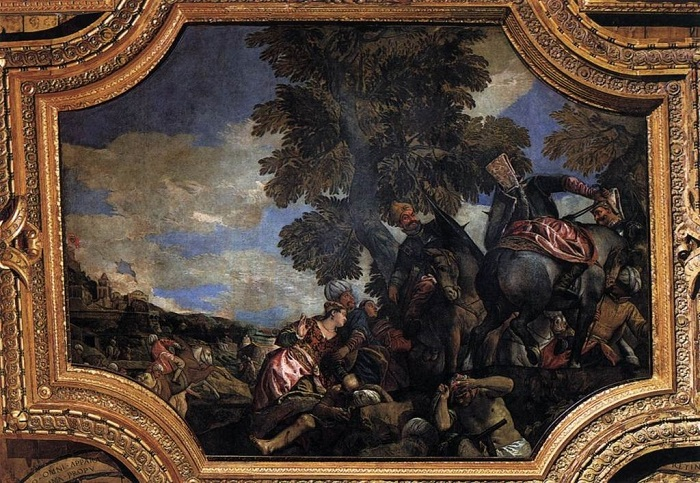
The heroic defense of Shkodra has been immortalized in a series of chronicles and literary works, among which Marin Barletti stands out with his work “The Siege of Shkodra”, the painter Vittorio Karpaçi, with the bas-relief “The Siege of Shkodra”, placed on the facade of the Saint Mary of the Albanese painting school, and Paolo Veronesi with the fresco “The Center of Shkodra”, located in the Hall of the Great Council of the Doge of Venice.
The people of Shkodra, in Venice, found a favorable environment to express their Albanian culture, which allowed them to integrate with dignity into the Italian and European Renaissance, among whom the humanists Gjon Gazulli, Pal Gazulli, Andrea Gazulli, Mikel Marullo, Marin Barletti, Nikolla Tomeo, Marin Biçikemi, Mikele Artisti, etc. stood out. This group of prominent Albanians included painters and sculptors Andrea Aleksi, Viktor Karpaçi, Mark Bazati, etc., known in the history of art as the creators of the Albanian school of painting.
1480: In 1480, Sultan Mehmet II – Fatih, ordered the attack against Rome. With 281 ships, Turkish soldiers landed in the Roka locality of Otranto. The Turkish hordes attacked with ferocity, killed, burned and destroyed everything they found in front of them. After a difficult resistance,
400 soldiers and residents of Roko took refuge in the castle of Otranto and refused to surrender to the Turkish pasha. After two weeks of fighting, Turkish artillery demolished the walls and occupied the castle and massacred all the captives. On August 28, 1480, the Turkish barbarians beheaded 813 Arbëreshë and Italian captives. The skeletons of the 813 martyrs are preserved in the cathedral of Otranto.
1481: Mass exodus, organized by Prince John Kastrioti, in collaboration with the Republic of Venice. Thousands of Albanians landed in Naples.
1482 – 1492: Albanian families from Chameria and Himara landed in Salento and Sicily.
Those who settled in Salento faced attacks and reprisals from the Turkish army, which attacked the coastal cities of Puglia. In these circumstances, some of the Albanians were forced to flee and go to Sicily. After a long and arduous journey, they arrived in the commune of Monreale where they were received by the bishop, Monsignor Nicolao Trullenchi, who gave the refugees the fiefs of Merco (Merko) and Daydingli on the outskirts of Palermo.
In the years 1482-1483 there was a fierce winter, so the Himariots and Chams, who had settled on the slopes of Mount Pizzuta (Picuta), were forced to descend to the valley and the plateaus, where they built their homes in the famous commune of Piana degli Albanesi.

The advance of the Turkish hordes continued unabated, conquering vast territories of Greece, among those many Arvanite settlements. In 1470 they conquered the island of Negroponte, in 1472 Vonizza, in 1479 the two fortresses of Zarnata and Maina, in 1479 Navarino and Lepanto. The fall of these cities was accompanied by massive emigrations of Arvanites and Greeks to Italy.
1503: After the failure of the general uprising of 1501–1503, led by
Gjergj II Kastrioti (nephew of Skanderbeg) and Count Progon Dukagjini, many Albanian families emigrated to Italy, while it is said that Gjergj II Kastrioti and his family went to Cyprus.
1500–1540: Arvanites and Greeks of Korona and Mod one, the two most important cities of the Morea,
frightened by the news of the violence and massacres that the Turks committed against the population of Zakynthos,
decided to hand over the city to Sultan Bayezid II, who on August 9, 1500, conquered it without a fight.
This decision to surrender to the Turks without a fight did not favor the inhabitants.
Faced with the constant pressures and persecutions of the Turkish army, many Arvanites and Greeks, led by the Arvanite captain Mark Militani, emigrated to Italy. The first groups of refugees settled in the municipality of Caggiano (Caggiano-Salerno).
In 1595, Arvanite families residing in Caggiano were exempted from the fire tax (Archivio di Stato di Napoli: Processo R. Cam. Nr 1251, vol 134).
After Corone and Modone, in the years 1533 – 1540 the Greek cities of Aegina, Malvasia, Naupalia and Patrassa in Morea fell one after another. The Turkish invaders continued with persecutions and massacres in these cities as well, so many Arvanite and Greek families asked the Pope and Emperor Charles V to help save them. According to Giustiniani’s accounts, during the years of Emperor Charles V’s reign, many Arvanite and Greek families flocked to Italy, including members of Byzantine royal families such as Lascari, Palaeologus, etc., who were lords of many fiefs in Morea, which were massively inhabited by Arvanites.
In 1533, with the intervention of Pope Clement VII and the Order of the Knights of St. John of Jerusalem, Emperor Charles V made 200 merchant ships available to help the evacuation of these inhabitants. The Viceroy of Naples, Pietro da Toledo, ordered Admiral Andrea Doria to transport Arvanite and Greek families to Naples.
Some of these refugees settled in Naples, but most went to the municipalities inhabited by Albanians, who had been established in these centers years earlier.
The Arvanites of Corone, led by the Arvanite captain Lazaro Mathes, founded the villages of Barile, San Costantino Albanese, San Paolo Albanese, Ginestra, Maschito (in the province of Potenza); Castroregio (Kastroreggio) and Farneta (in the province of Cosenza); Greci (Avellino), while another group went to the island of Giglio (Giglione) in Tuscany.
According to many historians, the purpose of accepting Albanian immigrants in the lands of the Kingdom of Naples was more inspired by the aim of recruiting men into the famous stratiotes, who distinguished themselves in the battles in Italy, France, Bohemia, Dalmatia, Spain, etc.
Along with the inhabitants, on the ships of Admiral Andrea Doria were the Orthodox Bishop of Corone His Grace Benedetti, the Bishop of Modone His Grace Gerasimo, the Bishop of Monemvasia His Grace Makario, as well as families of Albanian and Greek merchants and nobles.
Most of the Arvanite warriors from Corone and the Albanian women from Himara were mobilized in the guard of the court of the Kingdom of Naples, they were even paid a good salary and many of them were written in the “Golden Book of the Patricians”, among them the grandfather of Antonio Gramsci.
Albanian soldiers were allowed to carry weapons, even had the right to enter the prince’s apartment armed and were considered “the broken lances of the king of Spain”.
1552: Groups of Albanian families landed in Puglia and settled in the fiefdoms of Rignano, Lesina,
Guglionisi, Ischitella (Iskitella), Carpino (Karpino), Bari, Civitate, San Martino, Foggia
(Foxia), Vico Garganico, Larino, Apricena, Pescchici (Peskiçi), Monopoli, Manfredonia,
Ruvo, Cassano di Acquaviva (Kasano Akuaviva), Casamassima (Kazamassima), Toritto,
Bitetto, Gioia (Xhioia), Palo, Giovinazzo, Bisceglie, Molfetta, Andria, Barletta, Terlizzi and
Bitonto. (Palumbo Manfredi: I comuni Meridionali, Montecorvino Rovella: 1910. p. 340).
The historian Bernardino Biondelli, in his work “Colonie stranieri d’Italia” published in 1841, writes: “In residential centers such as Portocannone, Ururi, Chieuti; Campomarino, Santa Croce di Greci, Montelongo, Canore etc., the inhabitants spoke only the Albanian language (Albanian), and even in Church, liturgical rites and mass were held in the Albanian language.
1647 – 1664: Exodus of the Arvanites and Greeks from Maina.
1691 – 1750: Sporadic exodus of Albanians from Italy continued. In 1691, the bishop of
Palermo, Monsignor Ferdinando Bazan, settled dozens of Albanian refugee families in the fief of Santa Cristina (Cristina), while he sent 82 Albanians to Piana Albaneze (Hora Arbereshe). The Albanians worked the lands of the Bishopric of Palermo, as well as of the Duke of Gela (Xhela) and since the lands were far from the residential centers in the Piana Albaneze, the newly arrived inhabitants began to build their own houses around the places of work.
In the following years, with the arrival of many Arvanites from the Morea, this residential center was expanded and organized into an autonomous municipality known as Santa Cristina Gela.

1744: Himariote and Cham tribes arrive in Puglia and by order of King Alfonso III of Bourbon, they settled with residence in Villa Badesse – Abruzzo.
1774: Numerous groups of Albanian families landed in Brindisi di Mona tgna (Pesaro)-Bazilikata, while a group of families, with about 70 people, went to Viterbo, north of Rome.
During the 19th century, the landings of Albanians continued, mainly in groups of families, who were transported to Italy by Venetian and Albanian ships.
In continuation of these chronicles, I will tell the story of the first group of Albanian immigrants, who landed in Italy with the captain Demetrius Reres and about the influx of Albanian refugees in 1481, organized by Gjon Kastrioti, son of Gjergj Kastrioti – Skanderbeg.
Albanian Emigration in 1413 – 1444.
Ernesto Skirò (Schirò), in the study “Origine degli insediamenti albanesi in Italia-Origjina e sabatonjeve e albanezëve në Itali” – Palermo 2009, describes the emigration flows of Albanians, who initially settled in Sicily.
Around this book, on June 12, 2009, a “round table” was organized in Palermo, conceived and led by the Arbëreshë Dr. Romagnoli and Papas Vito Stassi. This activity took place, a few days after the feast of Pentecost, which is celebrated on May 31, which according to the Eastern liturgy, is the day of commemoration of the dead, but for the Arbëreshë, it also evokes two painful events, the defeat of the army of Prince John Kastrioti and the conquest of Constantinople by the Ottoman hordes.
The Arbëresh’s celebration of Pentecost on May 31 is also linked to a tragic event in 1413, when the army of John Kastrioti was defeated and many residents were massacred by the Turkish invaders. This event has remained indelible in the memory of the Arbëresh of Mezzojuso, who remember it with the expression: “It is beautiful to celebrate all the holidays, but the Saturday of the Scale (Scialla), may it never come!”
This cursed expression refers to Saturday, May 31, 1413, the day of Pentecost, when after fierce fighting in the city of the Scale of Mat, the army of John Kastrioti was defeated by the Turkish hordes, which marked the beginning of Ottoman domination in Mat. Part of the population of this region, who escaped Turkish reprisals, emigrated to Italy in 1413 and settled in the depopulated lands of Sicily.
The Saturday of Pentecost, for the Arbëresh, is the day that evokes this painful event related to the homeland, which they were forced to abandon and emigrate to Italian lands and their settlement in Sicily, mainly in the municipality of Mezzojuso and in several municipalities in Calabria.
The Arbëresh of Mezzojuso, for 603 years, on the Saturday of Pentecost, gather in the cathedral, where mass is held in memory of the martyrs in the battle of Shkalla, while at sunset, they climb to the top of the two hills Brigna (Brinja) and Dirrachion (Durrës) and with their faces turned to the east, they sing together the famous song “O e bùkura Morè”, a song of national pride, a song of longing and sadness, a song of suffering and overwhelming love for the homeland. In the Mezzojuso fresco of 1525, the two hills above the city preserve the Albanian names, the largest one is called Brinja and the other, lower one, is called Dirrachion – Durrës.
The first Albanian immigrants arrived and settled in Sicily in the years 1413 – 1440, while in the years 1444 – 1448, another group joined, consisting of three divisions of Albanian knights, commanded by Captain Demetrio Reres.
This emigration is related to two political circumstances of the time:
- firstly, it was dictated by the barbarian Turkish invasions, which after conquering the Albanian lands, committed massacres among the population, took captives who sent them to Turkey as slaves, while those who escaped the reprisals took the path of emigration towards the Italian coasts;
- secondly, it is related to internal conflicts in the kingdom of Naples, such as the revolt of the Calabrian barons, who rose up against Alfonso V of Aragon, king of Naples and Sicily. This rebellion, instigated by the Angevins, organized by the Marquis Antonio Centelles, who was also the viceroy of Calabria, had destabilized the situation in Calabria, but King Alfonso V was powerless to quell this revolt, so he asked for help from Gjergj Kastrioti. In 1444, Skanderbeg responded to the request of King Alfonso V, sending 200 knights, commanded by captain Demetrius Reres, with his two sons Gjergj and Vasil Reres, who together led the fighting and triumphed against the coalition of pro-Angevin Calabrian barons, instigated by the Marquis Antonio Centelles.
There is no information about the origin of Demetrio Reres and the Albanian knights. According to Venetian documents, his surname was Renes or Renessi and he was a captain of the Albanian army, distinguished in the resistance against the attacks of the Turkish army.
Johann Georg Hahn (1854), referring to the Italian historian Biondelli, writes that his name was Demetrius Reres Castriota, cousin of Gjergj Kastrioti – Skanderbeg, but this opinion has remained unconfirmed. (Johann Georg Hahn (1854). Geographisch-ethnographische Uebersicht. Sind die Albanesen Autochthonen? Alphabet.Historisches.Verlag von Friedrich Mauke).
The units of Albanian knights, commanded by Demetrio Reres, after landing in Sıcili, settled in the old Saracen castle of Bizyr (Bisiri), built on the top of a hill, above the small village of Mazzarese, on the right bank of the Mazzaro river, 10 km from the mouth of the river into the Mediterranean Sea.
Captain Demetrio, at the head of the Albanian knights, attacked and defeated one after another the Calabrian barons who had risen against the king. After these victories, the Albanian knights were charged with the task of maintaining public order but also of defending the western coast of Sicily, both from the attacks of the Ottoman fleet and from the occasional attacks of the Angevins.
Following these victories, Captain Demetrio Reres, at the head of the Albanian knights and the king’s troops, attacked the forces of the Marquis Antonio Centelles and in February 1445, defeated the coalition of the Calabrian barons and arrested the Marquis Centelles, whom he handed over to King Alfonso V.
After this victory, the Albanian knights remained for another two years in the castle of Bizyr (Bisiri) and, although they did not engage in combat, they performed important civil functions and in maintaining public order.
After this victory, the King of Naples confiscated the properties of the Marquis Antonio Centelles, which he donated to the Albanian soldiers and from 1445, many knights of Demetrio Rere were scattered in Cortona, Catanzaro and Belcastro, where they settled in the villages depopulated by the local inhabitants and after settling the agricultural lands and buying cattle, they began a new life in these lands.
The presence of the Albanian knights was positively evaluated and welcomed by the small feudal lords, who felt safe with the Albanian soldiers, since they themselves were not able to protect their properties from the attacks, robberies and destructions that created conflicts between the barons.
The contribution of the Albanians was decisive for the normalization of social, economic, agricultural and military life in the Calabrian region, so King Alfonso V of Aragon, in 1448, appointed Captain Demetrio Reres – governor of the Province of Calabria.
The contribution of Captain Demetrio Reres was appreciated by the nobles and the Calabrian people and in honor of his work, in the municipality of San Nicola Dell’Alto – Saint Nicholas the Upper in Crotone in Calabria, one of the main streets bears his name: Via Demetrio Reres.
In 1450, the military mission of the Albanian forces ended and part of the knights were transferred to the mountains beyond the Belice River, on the coast of southern Sicily, waiting to be repatriated, but they also changed their minds and stayed in Sicily and some others in southern Calabria.
The first settlements with Albanians in Sicily and Calabria are: Mezzojuso, Amato, Andali, Arietta, Vena e Zangarona and then Caraffa di Catanzaro (Karafa e Katanxaro), Carfizzi (Karfici), Pallagorio San Nicola e Sperme and Gizzeria.
In 1450, some Albanian knights of the captain Reres, settled in the municipality of Contessa Entellina (also called Kundas – Kudhësi), while another group went to Taormina.
In the years 1461 – 1503, with other massive exodus, the Arbëresh settled in other municipalities: Santa Cristina Gela, Palazzo Adriano, Piana degli Albanesi, Bronte, Biancavilla, San Giuseppe di Mastellaro, Sant’Angelo e San Michele (Sicily), Vena, Belvedere, Marcedusa, Zagarise etc. in Calabria. In addition to these first, there are currently 35 municipalities inhabited mainly by Arbëresh, where the Albanian language is still spoken in the Arbëresh dialect today. (Raffaele Patitucci D’Alfiera Patitario: Casati Albanesi in Calabria e Sicilia. Rivista Storica Calabrese: N. S. Nr. 4; X-XI: 1989 – 1999)
According to the historian I. Mazziotti, the geographical extension of the Albanian settlements, from Karfici, to San Pellegrino and San Nikola Dell’Alto, from Marcedusa, Andali and Zangarona and the descent in an arc shape to Gizzeria near the Tyrrhenian coast, makes one think that these residential centers were populated by Albanians, according to a strategic plan of Demetrio Reres, to put the terrain under military control, to monitor the attitude of the barons and thus, to suppress any form of revolt.
The noble family of Demetrio Rere settled in the municipality of Mezzojuso, in a beautiful fief next to a water source, on the other side of the Salto abyss, near the Norman church of Saint Mary of the Most Merciful. On this beautiful meadow, Demetrio built houses for his family and his sons.
The Albanian knights, who settled in the territories of Sicily and Calabria, with the financial resources they had earned for the services they performed for King Alfonso V, in the following years, bought houses and livestock, dedicating themselves primarily to livestock, since the territories donated by the king were rich in pastures among the forests, similar to those of the villages of origin.
Most of the Albanian knights took their own families, while others created families with local girls. Most were dedicated to livestock, but when necessary, they took up arms to protect the properties and lands of the municipality. (Robert Elsie – 19 March 2010. Historical Dictionary of Albania. Scarecrow Press. p. 17. ISBN 978-0-8108-7380-3. Retrieved 10 June 2013). In fact, the knights of Demetrio Rere are the second group of Albanians settled in the lands of Sicily and Calabria, and the royal administration even provided these new residents with a regular authorization, called “Licenti populandi” (residence permit), accompanied by a notary’s act, which legislated the right of ownership of the lands, so for 600 years, the Arbëresh have been owners of the lands where they live.
Demetrio’s sons, Gjergji and Vasil Rere, distinguished themselves as soldiers and continued to hold the command of the cavalry, even recruiting many Albanians and creating stratiot units, which, as Paolo Petta writes, in later years were increased and served in other regions of Italy (Venice, Milan, Florence, etc.) and in France, Spain, Flanders, Bohemia, Dalamacia, San Marino, etc. (Dott. Paolo Petta: Stradioti – soldati albanesi in Italia durante secoli XV – XVIII).
A part of the Albanian knights went to the service of other kingdoms and Italian nobles, organized in stratiot units, distinguished in battles like captain Gjon Manesi (1495).
Demetrio Reres and especially his sons, made a great contribution to the creation of the Albanian stratiot units, which were distinguished as brave warriors in the years 1450 – 1750. The Albanian stratiots went to war singing their war anthem: “Nu la sèmo de Albania/Strattioti palikari/kie in kavallo, in terra, in mari/non stimemo la Turchia – we are from Albania/strioti heroes with fame/on horses, on land and at sea/we are not afraid of Turkey”.
In the medieval chronicles it is said that the Albanians were not dissolute soldiers, nor poor, on the contrary they were brave knights, regular and obedient to their commanders.
In 1628, the stratiot Buzikio Renesi, the feudatory of Rocaforzata and San Martino, stands out, who went to Milan in the service of King Philip III. Along with the nobleman Buziki Rennesi, there were also stratiotët from the Arbëresh commune of Faxhiano, among whom were Dimiter Balza, Giorgio Fadati, Pietro and Giorgio Sgura, Kola Renesi, Pietro Pidao, Giovanni Traggina, Demetri Krescia, Demetri Gimata, Giorgio Quedikano, etc. Many Arbëresh families in Faxhiano still preserve the spears, swords, daggers and armor of these prominent stratiotët in Arbëresh history.
My friend, writer, poet and publicist Luan Rama, in the article “Da Vinci, the Albanian stratiotët and the French king François I”, shows that the great Leonardo Da Vinci admired the Albanian stratiotët and often organized elaborate spectacles in commemoration of the Battle of Marignano near Amboise. In these spectacles, alongside the king, princes, dukes, ambassadors, there were also the Albanian stratiotes, those who, led by Mërkur Bua Shpata, on the morning of September 15, 1515, won the battle of Marignano.
Leonardo da Vinci knew the stratiotes from battles sometimes against the French and sometimes for them: he knew them from King Charles VIII, who, together with Constantine Aranit, went down to Bari, to begin the crusade against the Turks with the Albanians; he knew them in the service of King Louis XII and finally with the new King, François I.
Leonardo had seen the stratiotes at the court of Cesare Borgia, where the stratiote leader stood out; he had known them when they captured Ludovico Sforza (Il Moro) in Milan, whom they escorted to imprison him in a castle in France, he also knew Mërkur Bua Shpatë, or “Dominus Mercurio” as the Venetians called him, as the commander of the stratiots who fought in Italy.
Next to the king stood Bokali with the stratiot heroes Buziki, Gjon Manesi, Frata, Reposhi and many others, in fact, Bokali stood next to the king, as he was his aide and with him, there was also a line of stratiots, ready to protect the French king.
The Albanian stratiots, at the time of King Louis II, formed the French light cavalry, called by French historians of the art of war “chevalerie albanoise – Albanian cavalry”.
In those years, another captain, Gjergj II Kastrioti, who with 400 Albanian soldiers from Morea, Durrës and Shkodra, had served the previous king Charles VIII.
In the years 1739 – 1745, the Arbëresh stratiot Gjergj Korafa was one of the prominent commanders of the “Real Macedone” regiment of King Charles III of Bourbon. Captain Korafa distinguished himself in the fighting against the Austrians at the Battle of Veletri in 1744. The last commander of the royal regiment was General Dhimiter Leka from Dhermi, to whom Jeronim De Rada dedicated the famous poem Milosao (Paolo Petta: Stradiotti, soldati albanesi in Italia. 2000 Ediz. Argo, Lecce).
The Reres family, in addition to their military and administrative contributions, was also integrated into Italian social and spiritual life, in particular the monk Andrea Reres, great-grandson of Demetrius, who founded the Basilian Monastery of Mezzojuso, stands out.
The monk Andrea Reres, son of Teodoro Reres and Agnese Reres, died in Mezzojuso in 1609. His life and ecclesiastical activity are linked to the monastery of Mezzojuso, of the order of San Basilio Magno. (1579) (Pietro di Marco – 2007). In a memorial about Mezzojuso, the Arbëresh Nikolla Filia writes that the Albanians, at the initiative of the monk Andrea Reres, in 1601 requested the establishment of a monastery of the Orthodox rite, near the church of Saint Mary in Mezzojuso.
This fact is confirmed by the Arbëresh Nikolla Keta, who indicates that this act was signed by the Arbëresh notary Luka Kuçia (Luca Cuccia) on January 12, 1601, which documents that the Basilian monastery of Mezzojuso was founded by Andrea Reres. (N. Chetta, Tesoro di Notizie su de’ Macedoni. Contessa Entellina 2002, p. 454).
N. Filia and N. Keta show that on April 13, 1609, the monk Andrea Reres had deposited his will with the notary Antonio Glaviano in Palazzo Adriano, where he emphasized that the monks in this monastery should only be Albanians and Greeks (arvanitas), skilled in the practice of Orthodox rites.
After the death of the monk Andrea Reres, for the establishment of the Orthodox monastery in Mezzojuso, his mother Agnes Reres – the universal heir of the will and the Arbëresh commissioners Nicolò Matranga di Paolo (Piana degli Albanesi), Paolo Reres (the brother of Andreas), Gregorio Droserò (Palazzo Adriano), were committed to the establishment of the Orthodox rite monastery in Mezzojuso.
C. Granà, in his chronicles, emphasizes the nobility, moral qualities and patriotism of the monk Andrea Reres, the originator of the foundation of the Basilian monastery in Mezzojusso (Archivio Parrocchiale San Nicolò di Mezzojusso, vol. II, Documenti Manoscitti, p. 22). (Onofrio Buccola, La Colonia Greco – Albanese di Mezzojusso. Origine, vicende e progresso, Palermo 1909, p. 42).
A decision of Pope Paul V was delivered to the bishop of Palermo, Cardinal Giannettino Doria (1608 – 1643), who in 1617 consecrated the opening of the monastery of San Basilio in Mezzojusso.
In honor of the work of the Arbëresh monk Andrea Reres, one of the main streets of the municipality of Mezzojusso bears the name: Via Andrea Reres.
The Mezzojuso Monastery has contributed not only to the spiritual life of the Arbëresh, but has made a great contribution to the awakening of national feelings, to the opening of schools in the Albanian language and the preservation of the Christian faith among the inhabitants of the Albanian Province of Himara.
Several Sicilian Arbëresh monks of the Basilian order, who had been ordained and had served in the Mezzojuso Monastery, in the 17th – 18th centuries went as missionaries to Himara, among whom were distinguished: Bishop Neofito Rodinò, Bishop Simeone Lascaris, the monks Onofrio Costantini and Giuseppe De Camillis, Bishop Arcadio Stanila, Don Nilo Catalano, Don Filoteo Zassi, Don Callinico Granà, while the Arbëresh Don Basilio Matranga and Don Giuseppe Schirò were from Piana degli Albanesi. (N. Borgia: I Monaci basiliani d’Italia in Albania, Appunti di Storia Missionaria, Secoli XVII-XVII, Roma 1942).
The Monastery of Mezzojuso is also notable for its library, rich in books, documents and old manuscripts, so it was a cultural institution, where the monks tirelessly gave knowledge and culture to the Arbëresh community of Sicily. In the archives of the Monastery and the parish of Saint Nicholas, there are interesting documents, among them an ancient manuscript in two volumes entitled: “Memoria per il Monastero di San Basilio di Mezzojuso”. One of these volumes was transcribed by Carmelo Filia-Spata, an Arbëresh monk from Mezzojuso.
The memorial begins with a brief commentary on the will of Andrea Rere and continues with religious, social and cultural facts and events in the monastery. This documented information continues until October 16, 1706, the day when the Arbëresh Don Nunzio Schirò died. Many other documents and manuscripts are also important, arranged in separate volumes and archived in the monastery library by the Arber monk Kalliniko Granà.
The Mezzojuso Monastery, after a 200-year flourishing period, went through a period of decadence, and with the laws of 1866-67, its religious function was abolished, the building was abandoned, and the monks left. During World War I, the monastery building was converted into a barracks and prison for prisoners of the Austro-Hungarian army, and in the winter months, soldiers and prisoners burned some of the old and valuable books and manuscripts to keep warm.
In the years after the war, the Brotherhood of Saint Mary of All Mercies, based on the will of Andrea Rere, reconstructed the monastery. In 1920, the Confraternity decided that the Andrea Reres Foundation would be transformed into the “Andrea Reres Institute”, with the objective of educating and culturally training the Arbëresh youth of the Orthodox rite. This mission was entrusted to the Basilian Fathers of the Monastery of Grottaferrata. The renovated building also has a new library, where some of the ancient books that were saved from burning, theft and destruction are stored.
Thus, the history of the Reres family in Italy began as a military mission, contributed to the political and administrative life of Calabria and Sicily and continues to be present and felt contributed worthily to the spiritual and cultural life of the Arbëresh population.
The Exodus of 1481, organized by Prince Gjon Kastrioti, son of Gjergj Kastrioti.
Prince Gjon Kastrioti, son of Skanderbeg, after mobilizing many compatriots in Calabria and Sicily, landed in heroic Himara, where he organized a nationwide uprising to liberate the homeland from the invaders. During 1481, fierce fighting took place, but the insurgent forces could not break the large Turkish army, so Prince Gjon Kastrioti was forced to return to Italy, accompanied by his comrades and many Albanian families.
Since the coasts of the Ionian and Adriatic Seas were patrolled by the ships of the Turkish fleet, it was impossible to sail towards the coasts of Puglia, so the prince organized the inhabitants from Himara, Parga, Vlora, Myzeqeja, Durrës, Mati, Lezha, Shkodra, Ulcinj, most sailing by boats and ships and the others traveling through the mountain roads, to gather in Old Tivar, where the Venetian galleys would await them.
As is understood, this was a massive exodus organized by Gjon Kastrioti and other Albanian princes, in agreement with the Doge of the Republic of Venice, who promised to send ships for the transfer of the Albanians to Italy.
The story of this exodus is reflected in a document written in 1650 by the Albanian Agostino Toçi, a resident of San Cosmo Albanese, and published in Florence in 1860 by Jeronim De Rada and Nicolo Jeno, as a supplement to the work “Rapsodie di un poema Albanese”.
According to Prof. Domenico Casiano, this memorial is an important historical document because it contains true and dramatic news from 1481, about the journey of Albanian families to the Italian coast.
Groups of Albanian tribes, led by Prince Gjon Kastrioti and captains Col. Mark Shini, Elia Mullisi and Mark De Mathia (Mark Mati), set off on a long voyage and after a few days arrived at the port of Pristan in Old Tivar, where according to the agreement they were supposed to wait for the Venetian ships, but there they were faced with a sad surprise: there was no ship in the port. The Venetians, fearing that the Turks would revolt over their involvement in this exodus, avoided the port of Old Tivar and anchored their ships further north, in the port of Pastrovic.
The great mass of Albanians were not discouraged by this treachery. Tired and exhausted from the long journey, before starting the march to Pastrovic, they decided to take a short break, so they settled in the city fortress and in the few houses of Old Tivar. The commander of the Turkish garrison, Jusuf Pasha, informed of this massive flight of Albanians, pursued them with cavalry units and managed to surround them in the castle of Old Tivar.
To escape the siege, the armed men and women, after killing the guards, threw themselves against the Turks, who, surprised by the bold attack of the Albanians, on a night with heavy rainstorms, were routed and were unable to organize themselves to face the situation.
After breaking the siege, the great mass of emigrants traveled during that night in bad weather and rainstorms, but another obstacle arose before them. The river that descended from the Perasto mountains, and that passed through the plateau between Tivar and Pastrovic, had a large flow of water and in this part there were no bridges to cross to the other side. The leaders and the people, who were marching in this massive escape, decided not to turn back, so as not to fall prisoner to the Turkish army, which was in pursuit with cavalry units, so they unanimously decided to cross the river.
Holding hands, with children in their arms, they all crossed the river together, but some of them, especially the elderly, exhausted from this long journey, were drowned by the waves of the raging river. Most of them got to the other side of the river, so wet and exhausted from fatigue, they continued their journey and as soon as they reached the port of Pristan, they boarded the ships and set sail for Palermo.
They followed this sailing itinerary because Ferrante I, the king of Naples and Sicily, had promised Prince John Kastrioti to settle these immigrants in the communes inhabited by Albanians who had emigrated in previous years and who had settled in Sicily.
After this hopeful and trying voyage, the mass of immigrants faced another bitter surprise. King Ferrante I of Aragon, frightened by a retaliatory attack by the Ottoman army, ordered the viceroy not to allow the landing of the Albanians in Palermo and other Sicilian ports. This dishonorable decision, which also expressed ingratitude for the help that the Albanians had given him in the defense of his throne, revolted John Kastrioti and the other Albanian leaders, who decided to continue sailing towards Salerno, with the idea of landing there and continuing the journey on foot to Naples. But again they were faced with a surprise that revolted the Albanian refugees.
The viceroy had ordered not to allow the Albanians to land in Salerno.
In these circumstances, John Kastrioti and the Albanian leaders decided to sail towards Naples and, disregarding the orders of the viceroy, landed in the port of Naples, where they were received with love and honor by large crowds of Neapolitans, who accompanied them to the fortress of Castel Nuovo. In this difficult conflict situation, Prince John Kastrioti, accompanied by some of his officers, went to the Vatican, where he met Pope Sixtus IV, to whom he told about the suffering of his compatriots, about the obstacles that the king of Naples had created for them and asked for his intervention for the settlement of the Albanians, who had left their homeland, to escape reprisals and to preserve the Christian religion.
When the Pope learned of the ordeal of these people, he was outraged and immediately wrote letters to King Ferrante of Naples, the King of Spain and the King of France, asking them to intervene immediately for the settlement of the Albanian refugees, led by Prince John Kastrioti, who were to be settled in the lands around Castel Nuovo, which were the property of the Kastrioti.
This disagreement between King Ferrante and Prince John Kastrioti caused many Albanian families to disperse and settle in the vicinity of Naples and in Sicily, where there were several ancient settlements with Albanians.
King Ferrante was not satisfied with these obstacles, but asked the King of Spain for help, who in response to Ferrante sent military forces to forcibly remove the Albanians from Naples.
Faced with these pressures, most of the Albanian refugees gathered in Avellino and Ariano, where they resisted with weapons the Spanish and Neapolitan army, which was crushed by the Albanian force. After these fierce efforts, the Albanians retreated to Trebisaccia, where they were joined by other Albanian forces, coming from Calabria.
The persecution of the Albanian refugees was not limited to this, as King Ferrante, with his army, went to Corigliano behind the Albanians, closing their routes to the south, putting the Albanian fighters in the grip of a siege.
Prince John Kastrioti, with his forces, found himself surrounded by the Neapolitan and Spanish armies, asked for a ceasefire and the establishment of peace, as Pope Sixtus IV had ordered.
In the negotiations between the two parties, it was decided that Prince John Kastrioti would settle in the territory of San Pietro Galatina, while the other families were distributed in several municipalities of the kingdom, and were even given modest financial support to cover the costs of settling in the new lands.
Thus ended the adventure of this great influx of Albanian refugees of 1481.
Distribution of the Arbëresh and some data from the church registers for the Arbëresh and Italo-Arbëresh families.
The Arbëresh have been the largest ethno-linguistic minority in the population of Italy for 6 centuries. Although there are no complete and accurate records of the Albanians who have populated the Italian regions, in fact there is also data that points to a greater presence of the Arbëresh.
According to the data of the ISTAT of the Republic of Italy, in the 2015 census, there are 120,000 Italian citizens with Arbëresh nationality, but I must remind readers that there are many others, especially those of Italian-Arbëresh families, who, although registered with Italian nationality, only the surname proves that they are Arbëresh. To argue this fact, I present the official Italian ISTAT data, which communicate that there are 4429 families with the surname Albanian (Albanese), which in many cases the members of these families, result in Italian citizenship and nationality.
The surname Albanian began to be used in the medieval centuries. The newly arrived inhabitants were not registered, most families did not enjoy the right to “fire” (Fuoco), thus they were differentiated from the local inhabitants, who called them “coloro albanesi – those Albanians” and then registered them with this new surname when they had to pay taxes to the nobles for whom they worked, in notarial acts of legalization of ownership of land, houses and other means of livelihood, during marriages in churches, in registrations of births and baptisms in churches, and in the registration of children in schools.
The surname Albanese was used not only to indicate the origin of the new families that were increasing, but to differentiate it from the rest of the population and in particular, to distinguish this population of the Orthodox rite from the rest of the local Catholics.
The use of the surname Albanian was practiced mainly by the Catholic Church, which initially refused to baptize children born to Orthodox parents, so over the years, for tax payments, in schools or in military service, these were registered with the name of their homeland of origin, which the Arbëresh accepted with great pride.
Reference

