

By Blerim Latifi. Translated by Petrit Latifi
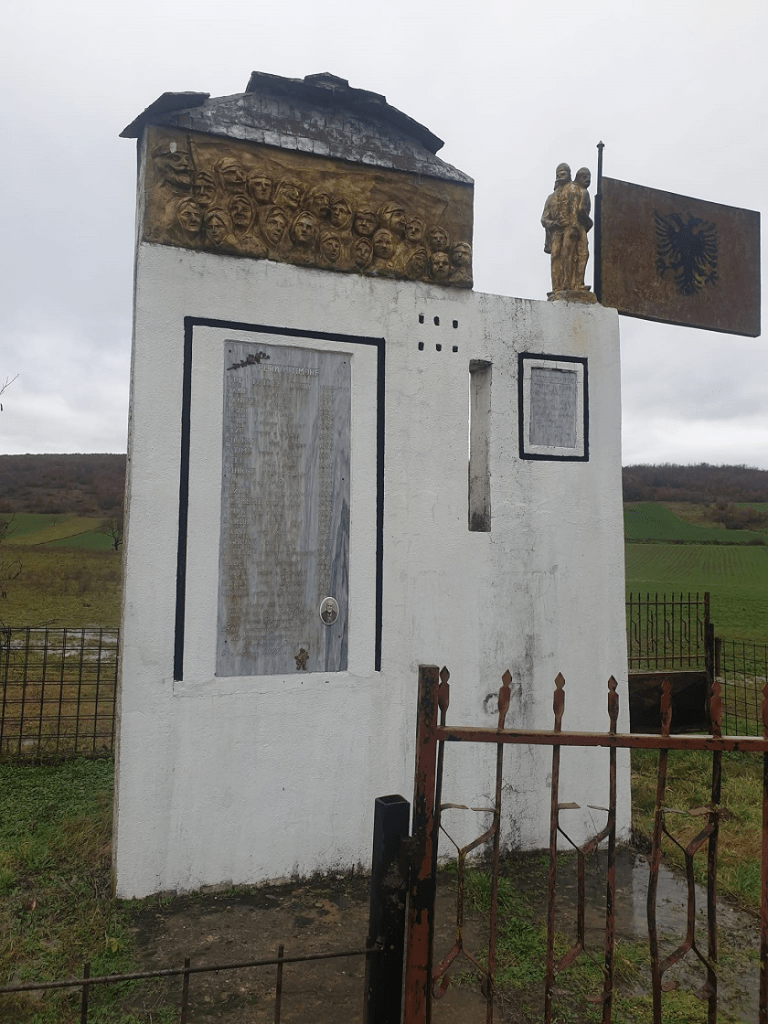
I was passing through the villages of Klina today. When I entered the main road of Gjurgjevik, from afar I saw a monument erected by the roadside. I said to myself: it must be of a martyr of the last war. When we approached it, I told my brother to stop the car. I wanted to see up close in whose memory that monument had been erected. It did not turn out to be what I thought.
The monument commemorated an event that occurred 80 years before the KLA war. In that place, in the late autumn of 1918, the Serbian army had executed 22 members of the family of Isuf Dushi. No one was spared, from the 85-year-old man to the three-year-old babies. The inscription on the plaque indicated that the remains of the massacred were buried in that place.
Although it was raining, I could not leave without reading their names on the plaque. I stood in silence in front of it for a few minutes. Along with the gloomy winter view of the surrounding nature, my sadness for that tragic place was further heightened by another fact that came to mind at that moment: how many such crimes have occurred in all corners of Kosovo since 1912, and the memory of them has now almost disappeared. Forgetting crimes, as someone has said, is a silent forgiveness of criminals.
I touched the cold plaque as a sign of respect for that family cruelly exterminated by the Serbian invaders and got in the car. We set off uphill to reach Rrasat e Gllarevës. Not far from the place where the Dushi family was massacred, in the yard of a school, there was another plaque. It bore the portrait of Ymer Berisha, an Albanian nationalist born in this village in 1912. I asked my brother if he had heard that name before. No, he told me curtly.
Ymer Berisha was probably the most educated man in Kosovo at that time. After completing his studies in history and geography in Florence, Italy, he continued his studies in philology at the Sorbonne in Paris. With the outbreak of World War II, he returned to Albania to become involved in nationalist groups. For a time, he taught at the “Sami Frashëri” high school in Pristina. Perhaps this high school, in its entire history, has never had a more qualified teacher than Ymer Berisha.
He was among the few Albanian intellectuals of that time who thought about an anti-fascist front based on ties with the Western allies. Alone in his vision, he was certain of failure, but he refused to give up. When the communists took power, the Sorbonne student remained in the mountains in an attempt to organize an anti-communist resistance, until he fell into an ambush organized by the OZNA and its Albanian-speaking mercenaries. It would be the end of the 20th century for his political vision to become a reality.
Reference


 Balkan Academia