
By Gjekë Gjonaj. Translated by Petrit Latifi.
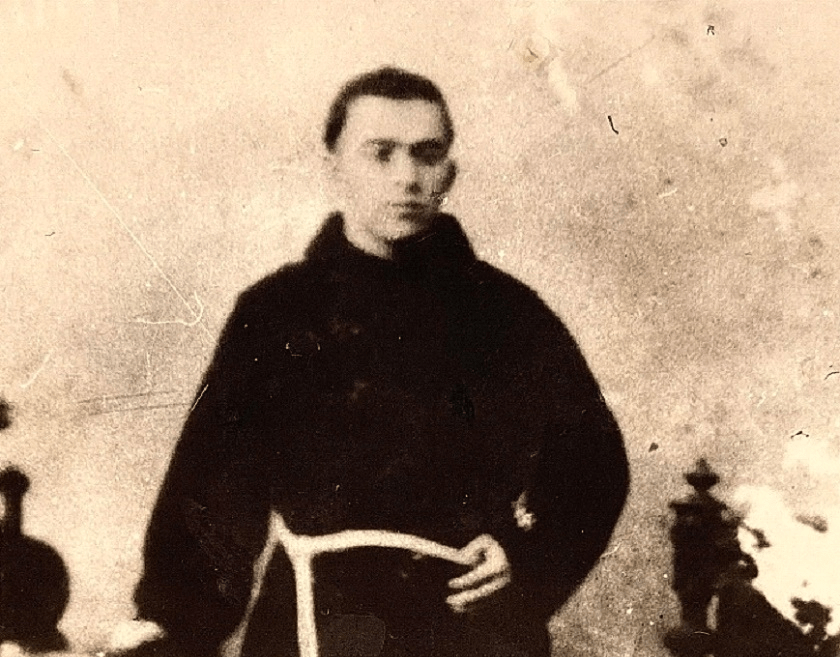
FATHER ANDREA GJEKAJ, THE TRIESHJAN CLERGYMAN WHO SACRIFICED HIS LIFE FOR CHRIST HELPING THE PEOPLE
Many Albanian Christian and Muslim clergymen were persecuted, tortured, shot and died, although innocent, in prisons in different historical periods. They did not have the grace of God, that after many years of ordeal they could escape the bullets of foreign invaders and the red ones during the communist regime in Albania, who sentenced priests to death, thinking that together with them they would eradicate the Gospel from the culture of an entire people and would also condemn the Creator, but as Dom Simon Jubani said, “God is not condemned to death”, “There is only one God in the world, and this God has no beginning and will never have an end”.
These colossuses of the nation and Christianity did not manage to enjoy freedom of religion. To see the liberated churches. These men dressed in the priest’s robe “lived to show” that indeed their blood, the suffering of innocent children, the tears of mothers and the sacrifices of our fathers have not gone in vain, but have been accepted by God as the most beautiful gift that the Albanian people have ever made to the Creator of the universe. This blood, these sufferings, tears and sacrifices became a cornerstone for true democracy that over the days – as Dom Simoni said – was transformed into democracy.
He came into this life as a gift from God the Father
Father Lul Vuksani Gjurashaj with the ecclesiastical name Father Andrea Gjekaj, was the son of the well-known family from the house of Mal Vuksani from the village of Nimarash in Triesh – Malësi e Madhe. For this Franciscan priest we do not have an official document that proves the exact date of birth.
But, it is believed that he came into this life as a gift from our heavenly Father around 1874, from his father Vuksan and mother Mirja, from a family with inherited national values, which since the time of the Ottoman Empire had proven their religious and national belonging, who preserved the ancient Albanian customs and traditions from generation to generation.
He heard the call of God and became a priest
Patriotism, a sound family upbringing (even with daily rosaries in hand) and even from the area where he lived with an ancient tradition encouraged the young Luli to hear the voice of God, his call to the priesthood, to become a priest. And so it happened! His stance was extremely courageous and quite prophetic: “for the sake of God, I am Catholic, as were our fathers.”
As far as is known, he completed the secondary school for priests in Zadar, Croatia, which he always had good memories of for general knowledge, education and sincere spirituality. Thanks to these virtues that he possessed, he will be able to continue his further education at the Faculty of Philology and Theology in Rome – Italy, which he successfully completes, in the place where many priests already known from the Albanian world had studied for centuries.
Returning to his homeland is a joy for the Trieshi people
He proved that he was and remains a patriot by returning to his homeland at the beginning of the 20th century, even though in Italy he had the opportunity for a safer and more prosperous life. At least in terms of the earthly, financial and material side. As a young priest with high academic preparation and extraordinary European culture, he began the missionary task of conveying the word of God to the Albanian Catholic believers.
His return to Trieshi, a small border town under Montenegrin rule, near the present-day border with the mother country – Albania, economically poor and with low education, was in itself a great joy for the entire local population. Because he was the most knowledgeable man that Triesh had and one of the most cultured people that Malësia had at that time.
Therefore, the people of Triesh needed his wonderful religious advice and sermons, in the implementation of Christian virtues, religion, hope and love, charity, hard work during the day, and fasting at night.
His arrival in Trieshi, as the first priest of this part of Malësia e Madhe, also sounded strongly to awaken the hearts and minds of the local population through religious sermons, for the preservation of the religious and national side, the preservation of the language, tradition, culture and Albanianism, with all the connotations that are included in this name.
Thus the young friar became beloved and a valued and respected man in Triesch and the surrounding area, so much so that the good reputation of the Triesch people and their fame spread and grew day by day. He was a true Christian by life and example, a disciple of Christ.
The local population, with great attention and interest, attended his masses and admired their brother, who was knowledgeable about the great cultural and spiritual values. Father Andrea, in order to convey and increase patriotism among the Triesch people at the beginning of the twentieth century, founded the “Flag” Society in Triesch, the first chairman of which was which was chosen by Prëlë Lucë Hasi.
This patriotic man, together with other patriotic Trieste parishioners, raised the Albanian flag in the village of Nikmarash, in 1906, thus preceding the raising of the flag in Deçiq, in 1911.
Religious service in Ljare in Krajës and Salç in Ulqin
The church documents of the Church of Ljare, which were discovered by Father Mirash Marinaj, parish priest of the present-day parish of Tuzi, show and prove that Father Andrea served for a long time, for eight years (1904-1912) in the parish of Ljare in Krajë and other parishes of the Archdiocese of Tivar. In these 115-year-old documents written by Father Andrea himself, new interesting facts from his life were revealed, and even the last four months of his life in the Church of St. Peter (built in 1865) in the village of Salç are revealed. of Ulqin.
Of particular interest is a letter that sheds light on many events and other still unknown data about the reasons for his departure from this parish and his departure as a priest to Shkodra. In these registers it appears that he had said the last mass of his life in Ljare. In the register of Father Andreu, among other things, it is seen that in 1910 he baptized Father Zef-Leonard Tagaj, the friar of Traboini of Hoti, who was barbarically killed by Serbo-Montenegrin soldiers on February 19, 1945, in Lugje e Thella, on the border of Hoti and Gruda.
The Murder in Shkodra, a Great Loss for the Catholic Church and the Albanian Nation
Based on the documentation we have and the chronicles of the time, Father Andre was innocently killed by Turkish soldiers in Shkodra in 1912, in the mission of a priest, not a warrior, when he was 38 years old. The only weapon he had in his hand was the Cross with which he stood with his unwavering will and his courageous decision together with his believers on the battlefield to liberate Shkodra from the Turks.
He did not intend to fight with weapons, but in case of death to give the sacraments to the believers. According to the Obituary of the Albanian Franciscan Province, he was killed on October 8, 1912, while according to Father Donat Kurti and Father Marjan Prelaj he died on November 22, 1912. He was killed somewhere in the Kolajve Mountains or in Kukël.
The murder of Father Andreu as a chaplain, spiritual leader of his faithful who wanted to be close to God until their last breath, was a great loss for the Catholic Church, but also for the Albanian lands, also because of his age. He was at the age of maturity, when a person gives of himself.
The tragic fall of this true and devout Franciscan was truly a deep sorrow and pain, but this is life and each of us must accept it. The news of the murder of their priest was received by the faithful of Tries, Ljare and Salç, with whom they were spiritually connected, with tears in their eyes and pain in their hearts. Their memory of the venerable priest Father Andreu will remain unforgettable. (Continued)
Reference

 Balkan Academia