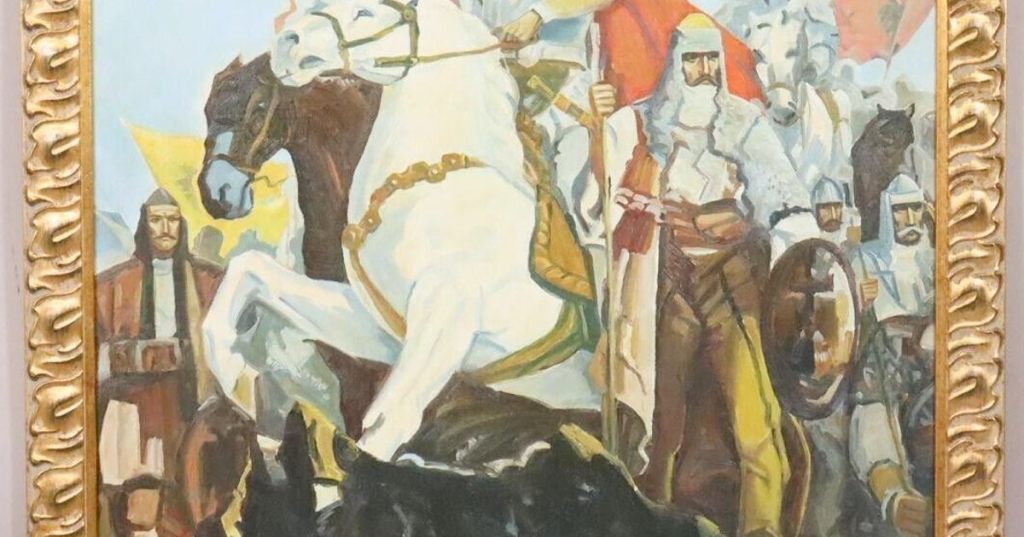

By José M . Floristán. Translated by Petrit Latifi
The following study was authored by Jose M. Floristan on Academia.edu and was translated by yours truly. Link to source.
In a short article devoted to the Albanian stradiotes who served the Republic of Venice in the late Middle Ages, F. Babinger (1964: 103) expressed the wish that his study would serve as preliminary work for the writing of a comprehensive history of stradiotes in Western Europe, including biographies of its most important figures. More than half a century later, this task remains to be done, although our information has grown thanks to the news provided by the partial studies of Valentini, Hassiotis, Kolyvá, Plumidis, Petta, Patapiou, Bugh, Korre, Gramaticopolo, Pappas and Birtachas¹.
My aim is to follow in their footsteps, offering new data on Albanian stradiotes who served the Spanish Austrias. The news I give is taken from their memorials, service records, letters of recommendation, consultations of the Council of State and royal decisions, documentation kept in the General Archives of Simancas, National Historical Archive of Madrid and State Archive of Naples. In a first installment (Floristán 2019) I presented the news that I was able to gather about the life and services of various members of the Bua, Crescia and Renesi clans. In this one I offer those of three others, the Alambresi, Basta and Capuzzimadi.
As is known, these surnames designate more clans than true families, so their bearers did not necessarily have blood ties with each other. In other cases, however, we can establish kinship relationships. The various States that the estradiotes served (Venice, France, the Empire, England, the Spanish Monarchy) tended to favour the family transmission of military posts by transferring salaries or granting pensions to the widow and orphans of deceased estradiotes².
In this way, true family dynasties of soldiers were created with a historical condottiere at the head. It is not always easy to follow the dynastic lines of these lineages and reconstruct the biography of their most prominent members, precisely because of the mobility that characterized these soldiers of fortune. In the case of the stradiotes in the service of the Austrians, the difficulty increases due to the dispersion of the sources (archives from Spain, Naples, Palermo, Milan, Brussels, Vienna).
I am aware that I do not exhaust the information on each stradiote included in this study. I have only intended to add the data preserved in the Spanish archives to those already known from other sources, thus adding a few more tiles to the extensive mosaic of the history of the stradiotes in the armies of Western Europe in the 15th and 16th centuries.
Alambresi
The surname Alambresi is barely documented in the primary sources and the most conspicuous studies on estradiotes (Sanudo, Philippe de Commynes, Jovio, Hassiotis, Petta, etc.). Sathas mentions two individuals of this surname under the forms “Calambressi” and “Calabressa”, coinciding with another that appears in a document from Simancas from 1536 (cf. infra)³.
At present, there is the town of Allambres in the province of Berat. The first testimony that I know of this surname in the documentation of Simancas is in a consultation of the Council of State, from the year 1536, on the requests formulated by coronets settled in Naples, in which five Alambresi are mentioned: Nica, Deda, Lhomo, Joan and Georgios. The surname appears under the variants Alambres and Alambresa, which are easy to explain. More problematic is the variant Galambrosa / Calambrosa assigned to Georgio. It is said that in payment for his services, Filiberto de Chalon, prince of
Orange, viceroy of Naples (1528-1530), had granted this Georgio the manor of “Calambresa” and other properties, which he asked for confirmation for himself and his successors that year. He had no luck, judging by the note in the margin of the document: “His Majesty does not confirm these things now.” In any case, the consultation says that all the Alambresi were from Coron and that they had served in this place and in the conquest of Tunis (1535), services for which they asked for a reward Of Deda Alambresi it is said that he had lost a brother in Coron and his horse in Tunis, and that he was wounded.
We know that Nico Alambrese had already died in 15537. On November 15 of that year, Pedro Pacheco, Cardinal Archbishop of Jaén and Viceroy of Naples, transferred the 20 ducats of his annual provision to Petrinella Pascale, daughter of Teodoro Pascale de Corón³.
- ALAMBRESI, Andrés
A native of the Kingdom of Naples and descendant of the coronets who emigrated in 1534 on the ships of Andrea Doria, he was the son of Captain Giorgio Alambresi (perhaps the aforementioned Georgio, cf. above) and nephew of Lucas Alambresi, who served the Emperor. Andrew served 32 continuous years in Flanders as a soldier, light knight, entertainer, second lieutenant and lieutenant, in the companies of Teodoro Crescia and his son Jorge, and almost five years as captain of lances.
He took part in the battles of Tirlemont (Tienen, Flemish Brabant), in Friesland, in the siege of Mons de Hainaut (1572), in the Valenciennes faction (1576), in the siege and capture of Haarlem (December 1572-July 1573), in the battle of Mook (April 15, 1574), in the relief of Roermond (1572), in the battle of Gembloux (January 31, 1578), in the relief of Zutphen (1586), where he was wounded in the right hand, and in the reliefs of Paris (1590) and Rouen (1592).
After a brief stay in Italy, in 1593 he returned to Flanders with his company of horse in the army of the field master Agustín Mejía¹º. The Albanian captains Lazaro Mates and Nicolas Renesi¹¹ also went with Mejía, with their respective companies. He was in the conquest of Le Catelet, south of Cambrai, perhaps with George (II) Basta (cf. infra), and was imprisoned in the square with three horse banners together with other forces (1595). He also participated in the enterprise of La Fère (1596), a place which he retained with three hundred cavalry to prevent him from going over to the enemy.
Finally, he took part in the conquest of Amiens (1597)12. On 30 March 1594 the king gave him a letter of recommendation to Archduke Albert13. Years later, in recognition of his services and the death of three of his brothers in royal service, he asked for a monthly salary in Naples of eighty crowns, the same amount he had received in Flanders as a captain, in order to be able to support his family and feed his orphaned nephews. The Council suggested to the king a pay of 25-30 crowns per month, which was finally fixed at the higher amount¹4.
2.- ALAMBRESI, Constantino
He was one of the principals of Coron. He lost all his property when he left the city and went to Naples with Andrea Doria’s fleet. He settled in Maschito (Basilicata). By order of the viceroy Pedro de Toledo on June 26, 1541, he was granted 25 ducats of annual provision for his entire life. By another order of Juan de Manrique in June 1558, he was given another ten additional ones that had become vacant due to the death of Greek coronets, up to a total of 3515.
According to information provided by his son Juan (q.v.) in a memorial, we know that he reached 60 (or 65) annual shields of provision. He served for more than forty years and was present at the events of Lepanto (1571), Navarino (1572) and Tunis (1573). He was still alive in 157816.
3.- ALAMBRESI, Juan
He was the son of Constantino Alambresi (q.v.). After the latter’s death he was left poor in a foreign land. He served thirty years in the light cavalry, twenty in Flanders and ten in Naples. According to information from the Count of Lemos, viceroy of Naples (1610-16), one of his brothers was killed in Flanders and he was taken prisoner. He then returned to Naples on leave from Archduke Albert of Austria, governor of the Netherlands (1598-1621).
In the memorial he presented in 1615 he asked for a salary in the light cavalry or a grant, whichever the king deemed appropriate¹7. Lemos proposed that he be assigned the sixty annual crowns that his father Constantine had had as a salary18.
4.- ALAMBRESI, Pedro [Alambrese, Pedro]
Albanian, a “Greek” (i.e. Orthodox) priest, son of Captain Giorgio Alambresi who served in many expeditions in the time of the Emperor, and cousin of André Alambresi (q.v.) 19. He was on the naval expedition of Lepanto (1571) and his sons continued their service in the cavalry of Sicily. In 1606 he asked for help to support himself in Naples, as he was old and poor 20. In the margin of the document, as a resolution of the Council, we read that he was given a letter of recommendation to the viceroy.
Basta family
The Albanian Basta lineage was one of the most distinguished, some of whose members rose to the rank of nobility in return for their military services. The surname has been linked to the toponym Basti mentioned in 1510 by Giovanni Musachi in his Memoria de li descendenti de nostra casa Musachi²¹.
This double value of the name as a gentile and a toponym would explain the hesitations offered by the sources regarding the form of the surname of Giovanni Basta (cf. below): perhaps it was in fact the toponym Bastia (Σαγιάδα), the small town in Epirus close to the Greek-Albanian border.
Rodotà (1758-63: III, 52) mentions the Basta clan among the families established in S. Pietro in Galatina when King Ferrante I appointed Scanderbeg lord of the town (1461). It is more certainly attested at the beginning of the 16th century. A Pietro Basta fought in Italy in the service of the King of France, who knighted him. He then went to the King of Venice and died defending Brescia. On 25 October 1511 the Venetian Senate declared him a knight.
He granted him and his companions a monthly salary in time of war and a persecution in time of par, to keep them in the service of the Republic. After his death the Senate ordered that his brothers Andrea, Lazaro and Alessio be paid a provision of ten ducats for the three of them in the chamber of Candia four times a year. The Bartas formed a feudal dynasty in the Kingdom of Naples with possessions in the area around Taranto (S. Martino, Roccaforzata, Faggiano and Monteparano).
Sathas assigned them Greek origin and Babinger, Albanian. The documents of Simancas leave no doubt as to this last origin. The family reached its peak under George (II), general of the imperial cavalry in Transylvania during the Long War between Turkey and the Empire (1603-1606). Finally, there is a Dimitri Basta de Nivicê who arrived in Naples in 1608 with Gi Clossi de Lakové with a letter from Jeremias, bishop of Chimarra and Delviso, dated May 1 of that year.
- Basta, Andrés
In 1591 he asked the Council of Italy for a reward for his services. 11 Cornejo gave him a letter of recommendation for the viceroy. Shortly afterwards he requested that the court write to the viceroy ordering him to obtain information about his services as a preliminary step to request a reward, but of Conjassen rejected his previous decision to give him a letter of recommendation. Finally of Conasjo granted him the requested letter in which the viceroy was ordered to report on his services.
2.- Bass, Demetrio (1) [Dimitrio)
Born, apparently, in Albania, he took refuge in Apulia fleeing the Ottoman advance. He was the commander of the Roccaforzata chadadela, and the settlement of an Albanian population in this town is documented from the end of the 15th century, although it is possible that it dates back to a few decades earlier. In 1519 the emperor granted this house to Lazaro Mates along with other privileges. Demetrio served in the Spanish army in
Flanders and Plamento. He had at least two known children, Nicolla and Jorge (11) (qq.x). In 1567 he had 35 years of service. At that time he was captain of a horse company with which his sons served. He had a life annuity of two hundred ducats in Naples and asked that it be extended during the life of one of his sons, without specifying which. The Council approved the extension, but only for half the amount that Demetrio received. The king accepted the proposal.
3- BASTA, Demetrio (11) [Densitrio, Dimitrio, Dimitri]
Bra nephew of General George Basta and Captain Nicolls Basta The Emperor names his grandfather Demetrius (1) (4x) captain of a hundred stradivarius in Naples. His father continued the service in Flanders for thirty years, as ensigns and lieutenant of lands, until he returned to Italy with the Regency of Alexander Farnese and a letter of recommendation in which he asked that he be rewarded for his services.
His grandmother, his father and his uncles died in the service of the crown, and also a brother in the war of Hungary (1593-1606). Demetrius himself served 20 years in the cavalry, in the kingdom of Naples and outside it. He distinguished himself in a special way in 1607, in a confrontation in which he killed a Turk, although at the cost of the loss of his horse.
He subsequently joined Hernando Patiño’s company of mounted arquebusiers in the Parsons War, where he distinguished himself in an encounter with the enemy army that took place in Vercelli. In payment for his services and those of his ancestors, on January 22, 1620, he requested a salary in Naples to continue his services.
On April 13, the Council of State sent a letter to the king asking the viceroy for information and his opinion on the reward that could be given to him. The response did not satisfy Demetrio because he believed that he had presented sufficient documents proving his services and those of his ancestors.
For this reason, on May 7, he insisted on requesting a salary for the viceroy or in the galleys, or, failing that, for a double position as a man-at-arms. The Council’s response, dated July 28, was no different from the previous one: a letter of recommendation was given in which the viceroy was asked for information on his merits.
5- Blata, Jogda (11)
He was born in 1550 (1544) at Roccaforzata. Crassus (1686: 17-18) mentions another version of his birth, in Monferrato to a noblewoman of Lesandria when his father was serving with his company on the Plamonte. He was the son of Demetrius (1) and younger brother of Nicalls (qq). Crassus (i) states that he studied at Asti until he was 14. He then went with his father to Flanders.
There he served during the governments of the Duke of Alba (1567-73), Luis de Requesens (1573-76), Juan de Austria (1576-78), Alexandre Farnese (1578-92) and Archduke Albert (1596-98). He went through all the ranks of the military: soldier, afférez, lagarteniente, captain, general commissioner of the cavalry, war counselor, condatiere of the army of Flanders and governor of the cavalry who went to France.
He began his service in the units of his father and his brother, first as an arquebusier on horseback, then as a lancer. He soon earned the favor of the governors Juan de Austria and Alejandro Farnese. In 1588 he prepared to cross to England with the Grand Armada, but he never embarked. He was at the siege of Headen (Brabants) in 1589 and a year later at the of In 1590 he went with Alexander Farnese to France to fight against Henry of Bourbon in the League.
In August of that year he fought at Meaux in command of 1,500 light horse and in the following months on various fronts. In 1592 he was appointed general commissioner of the cavalry of the army in the Lower Palais and as such was in the relief of Rouen. There he fell ill and retired to Brussels to recover. After the death of Farnese in December
In 1592, he returned to the army of France. In 1594, Emperor Rudolf II asked his uncle Philip II to commission supplies for the war in Hungary. After some time in Vina, in 1596 he was back in Flanders. The interim governor, Count of Fuentes, sent him with eight hundred light horses to relieve the town of La Fère in Picardy, besieged by Henry IV. Basta hunted down the enemy from Le Catelet, a town situated somewhat further north.”
Finally, Archduke Alberts of Austria, the new governor of the Netherlands, sent him in 1597 to finally fight the Duomo war. In 1598, Rudolf Illo sent him to Transylvania as general of the imperial cavalry to fight against Sigismund Bathory and his troops. Basta defeated him on August 3, 1601 with the help of Mihai Viteazul, “Michael the Brave”, lord of Wallachia.
Shortly afterwards, however, he ordered the latter to be killed, considering him a dangerous enemy, with the excuse that he had made a secret alliance with the Turks. Basta took control of Transylvania, making enemies of the Hungarians and Romanians, and held it intermittently between 1601 and 1604. His government was characterized by terror, looting and pillage, for a process of Germanization and by the elimination of a good number of the population. part of the population.
This provoked the uprising of Stefan Bocksal, Bathory’s former advisor. Despite the Emperor’s support for Basta, Bocksai defeated him on 14 and 24 November 1604 and took control of Trailvania, forcing Bathory into exile. The fame of Basta’s military articles and of the Viteazulino revolt made the Greeks of the Epirus-Thessalis provinces propose them as heads and examples respectively for the uprising they were organizing.
After his retirement, Basta wrote at least two treatises on military tactics: carpo generale de governo della cavalleria (1606) il governo dala cavalieria ingglera (Verwis 1612), a past work. He died in 1607 (June 1612). His descendants, already Germanized, continued to serve the Habsburgs in Vienna. Romanian and Hungarian historiographies give a negative image of Basta as a perfidious and violent man, driven by the
By anodius, to the chagrin of the Hingiros, on June 5, 1599, the Council of State proposed to the king to give Basta five hundred crowns of pension in Italy, a request that the king accepted. It seems that Basta was given three hundred crowns of pension.” On May 10, 1600 Secretary Aristogul communicated the decision to the Duke of Lerma so that he could give the order to draft the corresponding dispatch.”
- Basta, Juan [Basta, of the Bascia, of the Bastia, of Bastia, of the Bastia, of the Bastida]
It is likely that her surname was actually a toponym (cf. sapro). Her father Jones accommodated in his house in Bastia (Σαγιάδα, Epirus) the spies who travelled to Constantinople on behalf of the King of Spain and brought them news from Turkey. After 15 years of service, in 1576 she was discovered by the Turks, who impaled her, confiscated her property and took prisoner her sons, Demetrius and Nicholas, and a daughter named Maria, aged 10-15 years.
John was not in Bastia at the time, so he was able to escape. At the beginning of 1577 she went to Constantinople and stayed at the house of Aurelius de Santa Cruz, one of the heads of the spy network created by John Maria Renzo in the city. At the end of February of that year, Martin de Acuña, a Spanish knight, arrived in Istanbul on an anti-Tarctic offensive mission that led to the negotiation of the truce of arms between Spain and Turkey signed by Giovanni Marglario in February 1570.
Acuña arrived with ten men and Santa Cruz left him in charge of Basta. At the end of his stay, on March 25, 1577, Acala signed a letter to him in which he attested to the loyalty and dignity with which he had served him. In it he says that Basta would have had much to worry about if he had denounced him to the Turks, but that he had not done so and that now he wanted to go to Spain to serve.
Not long after, Basta crossed from Turkey to Italy. Some time later, when Santa Cruz arrived in Naples in July 1577 to negotiate some matters on behalf of the couples of Constantinople, he met Basta in Otranto. On July 22 of that year, he signed a certificate for him in which he stated his services. In it he says that Basta knows Turkey well, that he is a person of consideration, that he masters the Greek, Albanian and Turkish languages and that he can travel anywhere and provide great services. He therefore asks for a reward for him, so that he can live with dignity and
Years later we find Basta in Milan. On 10 January 1517 he was given a mere salary of 15 crowns. Shortly afterwards the Duke of Terranova, Governor General of Milan (1503-92), ordered the deployment of five thousand infantry for the defence of the territories of the Dacha of Savoy and placed them under the command of Pierre Malvezzi. He appointed Basta general of the troops with a salary of twenty crowns a month and the honours and privileges inherent to the post.
After the mission was completed, on 12 November 1589 Malvezzi issued him a certificate of his services in which he praised his skill, fidelity and diligence. Juan de la Cueva, field master of the Spanish infantry in Piarnonte and Lombardy, issued him a similar certificate on 28 November of that year. Five years later, on 20 May 1595, Basta fought under the command of Juan Fernández de Velasco, the new governor of Milan (1592-95, 1600), under the castle of Vezzo, where his horse was killed.
On 5 June I was at the meeting in Fontaine-Française where Alonso de
Idiáquez, captain general of the State of Milan, was taken prisoner. Basta fought bravely and took a French knight prisoner. We know all this information from the two reports made to him by George Crescia, captain of a company of Albanian lances and governor of the king’s light cavalry in Burgundy, and Nicolla Renesi of the Council of War of the master of the Albanian cavalry in Lorraine, dated August 20, 1595.
Basta was in charge of a company of Albanians in Milan by order of the Constable of Castile. From September 20 and December 12, 1599, there are two cortices of Borso Acerbo and Bernabellarbo in which he was a consort for some time and they certify that he served with Basta.
On September 11, 1603, when Juan lasta had been in service for 20 years, the Count of Fuentes, Governor General of Milan (1600-1610) granted him a three-year increase in his monthly salary of fifteen to a total of eighteen. Adla has counted Prancisco Od, General Inspector of the State of Milan, in two certificates that have been preserved in his file, dated January 15, 1604 and June 5, 1606″,
- Basta, Nicolás [Nicolao Basti]
He was the firstborn son of Demetrius (1) and brothers of George (II) (94). He was a cavalry officer and fought with his brother in Flanders with the troops of Alexander Farnese. He was with his company of horses at the siege of Bom in 1588 under the command of George Crescia. In 1995 he participated in the conquest of Cansbral. In 1596 he was commissioned to confront with his three hundred cavalry and some companies of infantry the raids that Maurice of Nassan made in Brabant, and in 1597 he was ordered to winter in Turnhout to control the region.
Some soldiers of his company participated in the mutinies of Lier (1588-99) and Morentals (1599-1600) In 1601 he had been in service for forty years, lastly as general tonionio of the cavalry of Flanders. 11 June 10, 1599 the king granted him by way of State three hundred ducats of rose in Italian 1601 granted him two hundred mala, payable from 1 February.
On 19 July of that year the secretary Prada communicated the decision to the Constable of Castile, president of the Supreme Council of Italy, so that he could be granted the ID. Nicolás presented a memorial that is not dated, but probably dates from the same year, in which he asked that he be credited with the payment of the total of quinimtas given in a safe place where he could collect them. Coco (1921: 64, 69-70, doc. a) mentions a Nicolás Rasta
Baron of the house of San Martino who bought the house of Monteparano from Guglielmo Antoglietta. It is said that he died on 30 August 1609 and that his son Francesco succeeded him in the barony. It is likely that he is the same Nicola Llasta as in the previous reports, but I have no source that links them.
- Basta, Peter
He belonged to an illustrious family of Albanian stradivarius settled in Italy with more than one hundred years of service to Korea. Quials was the grandson of Pietro Basta who died in Brescia serving the Venetians (cf. above). By 1592 he had served thirty years in Naples and Lombardy, and the rest in Flanders, as a soldier, second lieutenant and cavalry lieutenant.
He was in the most notable battles and received various war wounds. In 1591, tired, sick and crippled in the feet, he was discharged by Alessandro Parmesio and travelled to the court of Spain to ask for a salary in Naples or in the province of Otranto, where he had his house and where there were numerous opportunities for service in the face of Turkish landings.
With the memorial I presented a letter of recommendation from Parnesio which certified his service and ancestors. The Council of Italy refused to give him a salary because it was not within its jurisdiction. The Council of State, for its part, proposed paying him up to twelve encades a month in Naples. The king accepted the request and ordered the viceroy to pay him that amount in exchange for having him at his service or wherever he was most needed.
Finally, the amount was set at ten scado. Through the Council of Italy, Pedro Basta requested a shipment of a thousand barrels of wine to negotiate with. The Council granted him five hundred, on the condition that he pay the customs duties and that the retainer not be left destitute. The king then communicated this to the viceroy.
9-Basta, Theodore
Born in Naples, Romania (Nauplia), he served for more than twenty years in Italy, Flanders and other places. He was one of the 300 light horses that, with the Duke of Gravis as captain, commanded Don Juan of Austria in the Kingdom of Naples to guard the basket against Turks and bandits. When he was returning to Naples with four other soldiers, he was attacked by bandits who shot him in the chest with a shotgun, resulting in his death.
He was forced to remain ill for four years, bedridden, and was permanently listed. In the hospital he lost all the papers in which his services and the salary he received were recorded. Later he seems to have been held captive by the Turks, at least as is stated in the request he made in 1602 for a license to ask for aid from the kingdom to ransom his sisters.
He also asked for something to support himself. Both requests were rejected. He was, however, granted a one-time aid of twenty ducats, which the king ordered to be paid from the income from the wine trade, but without affecting the rights that corresponded to the king. By way of State he asked for a permanent position in the castle of S. Salvador in Messina, as he was no longer fit for service. On June 15, 1602, the Council proposed to the king to give him fifty ducats one-time, which the king accepted.
Capuzzimadi (Kapucimadhi) (Kpucmadhi)
The Capuzzimadi clan, probably originally from Nauplia, is linked to the villa of San Marzano di San Giuseppe in Allain Salentina. We have well documented the marriage of this villa, Demetrius (1), Caesar and Demetrius (1), in the 16th century and first decade of the 17th century. In addition to the clan records included in the study, we know that a Pietro Capezzinadi was part of the company of the Duke of Urbino in the year of Lepants.
We also know of a Melica Capuzzimadi from Roccaforzata, married to Andrea Mancia and mother of a Pietro Capuлтай (perhaps of an earlier age), who was Caesar’s son, therefore sister of Demetrius (1). The notarial documents mentioned by Tomal-Pinca (1982:11) also make her the sister of a Jorge Capuzzimadi, although I am unable to identify him with either of the two of this family whose biography she reconstructs.
These documents mention other Capuzzimadi that I do not know how to include in the family history: the brothers Conti and Guillermo Capuzzimadi from Roccaforzata (ibid, p. 10), Scander, who acted as notary in various commercial transactions (ibid, p. 18-19), Giovanni (ibid, p. 19) and Fruscina (ibid., p. 21).
In 1602 he was topped by the rank of lieutenant and had served 15 years in Flanders in the cavalry and infantry with fifteen crowns of pay, and in other places he lost two brothers and a nephew in the service of the crown. He himself received two headbutts and lost his sight, as a result of which he was discharged. That year, old and sick, he asked for the fifteen crowns of pay from our mercy in Naples. The king requested information from the viceroy, in addition to his opinion and that of the Collateral Council.
2- CAPUZZIMADI, Aníbal [Capaciomad]
He was the son of Captain Jorge (7) Capuzzimadi. In the year of Lepanto he was a soldier in the company of the Duke of Urbino in Naples. In 1579 he claimed the six hundred ducats of salary that were owed from the service of his father, in consideration of the need that his mother and two brothers were going through, from which it can be deduced that Jorge had died. The king ordered the viceroy to make inquiries and pay the debt as soon as possible. In 1599 the children of Jorge (II) Capuzzimadi claimed debts, so, if it is a question of the family, the claim lasted a long time.
3-Capuzzimadi, Antonio Comino Capuçamadi Comi
Captain albanis, served in the light cavalry of Flanders. He was nephew of Caesar Capurimadi (qv). In recognition of his services and the merits of his uncle, the king granted him a privilege of twelve crowns to the mu with the Light cavalry of Milan and ordered the governor general to pay them to him, in addition to his ordinary place, while he resided there and served in said cavalry. Although the document does not bear a date, from another letter from the king to the Constable of Castile we know that it was from May 1592 (cf. Capuzzimadi, César).
4- CAPUZZIMADE, César [Capucimadi, Capapimadi, Capapamadi]
Bra son of Captain Demetrio (1) Capurzimadi (q.x), to whom Charles V sold ca. 1535 the feado of San Marzano, which Caesar inherited in 1557 when his father died. He married Sibilla Rolla of Lecce. The names of both They appear in several notarial deeds of sale from the years 1562 and 1563. In 1566 his aunt Melica, widow of André Mascia and resident in Roccaforzata, returned to him in the sums of her son Pietro part of the property she had received as a dowry when she married.
In 1570-71 Cesare asked for remuneration for his services. Information was requested from the viceroy, who sent it in a letter dated 30 November 1571 with the opinion of the Council of the Sumaria. However, the viceroy forgot to give his own opinion, so a decision could not be taken. The king asked for his opinion in a letter dated 20 July 1572. The viceroy took some time to reply, so Cesare urged that his request be resolved.
The king wrote again to the viceroy asking for his opinion on what could be done with him. From the testimony given by Antonio Pirico, a Greek priest from Brindisi, in March 1575 during the pastoral visit of the Greeks of that diocese, we know that Caesar was acting as lay vicar of Bishop Timothy of Grevená (Teßev, Macedonia), to whose jurisdiction the Greek clergy of Apulia were subject. At that time, however, he was absent from the land.
Caesar served in Flanders, Plasencia and Savoy as a soldier and captain of an Albanian company of light cavalry. In 1591, Philip II decided to send him to Milan when he was free from the service he was providing to the Duke of Lorraine in his ship against Henry IV of France and granted him a salary of 40 escudos a month. Adelo praised the Duke of Terranova with a letter dated 12 August.
With a later letter he ordered him to lodge him with his compattia and pay him like the other companies, even though his services were not needed at the moment. Addendum, “if in the future it was necessary to make levies of soldiers, he would be appointed for the task,” With letters dated August 1591 and May 1592 Philip II appointed Casar and his nephew Antonio Comino (43) to their respective destinations.
Mini and his nephew, however, delayed taking possession of the castle for reasons unknown to me, so the king ordered the Constable of Castile, the new governor of Milan, that if they appeared within a year from the date of the new letter, he would execute the decrees. In 1593 Caesar asked for a shipment of wine barrels from the kingdom of Naples to keep the
He died in Venice, according to a memorial by his son Demetrius (II). From news published by Lamansky we know that the Council of Ten of Venice condemned him on February 19, 1595 to be executed and that his body should be buried in secret. It also ordered that his will and a letter in which he cleared his conscience be sent to his nephew Antonio Comine, as Caesar had requested. The rest of the documentation of the trial, in which he confessed his guilt, was to remain in his file, which was sent to the State inquisitors.
- CAPUZZIMADI, Demetrio (1)
Bra was born in Nauplia, and it seems that his family had settled in San Pietro Vernotico and Squinzano (Apulia) at the beginning of the 15th century. On 24 April 1530, Charles Vernocchio asked the Prince of Orange, viceroy of Naples, to sell fiefs and crown property to raise 40,000 dacats of gold. His lieutenant and successor in the viceroyalty (1530-1532), Cardinal Pompeo Colonna, sold the fief of San Marzano to Demetrius on 27 July of that year for 700 dacats, together with the title of bartin.
Demetrius also acquired, in another case from the clergy of Taranto in emphytousis, the neighbouring fief of Rizzi (November). The modern town of San Marzano was born from the union of the two. By a privilege dated 5 February 1536 at Castelnuovo in Naples the Emperor confirmed the sale, and three years later, on 11 August 1539, he granted Demetrius and the inhabitants of the town an exemption from the tax on fiscal duties and from the ordinary and extraordinary salt and campfire duties in payment for the services rendered with his company of light horses in all the wars in Italy, especially in the last invasion of the Fracs and their allies.
A consultation of the Cornelius of State on requests for the coronets of the year 1536 include a news about him. We know from the pot that Orange had granted him 200 ducats of annual income on the burgonet and feudal hierws of Bartolomeo de Pranza, of Barletta. By mistake, in the document of concession the norbes Carlo de Franca was written instead of Bartoloné, so the privilege was not made effective and Dermetrio Taso had to ask the king for confirmation of the grant.
I do not know why his name appears in a document of Coenness. It is possible that he had participated with the troops of Deria in the conquest of the square, if it is true, as I page, that his presence in Italy is prior Demetrio served the emperor as captain of horses and master of field for forty years.
At an undetermined date he was denounced by the Chapter of Taranto for having failed to pay the emphyteusis of Rizzi and was condemned by the Caria of Naples in 1554. He appealed the sentence and when it became final, he refused to comply with it, alleging that the letters of execution should be in the name of his son Caesar, who had succeeded him in the baronage.
The curia accepted the allegation and proceeded against the son in 1567. Demetrius died in Civitella del Tronto (Abruzzo), perhaps in the defence of this place during the siege (24 April-16 May 1557) to which it was subjected by the Duke of Guise, appointed by Henry II of France as an ally of Pope Paul IV in the war against his expaticles. If the news is true, Demetrius’ allegation must have been earlier
6-CAPUZZINADI, Dermetrio (11) [Dimitri Capuzomadi, Capuzimadi, Capucinadi]
Captain Albands, Baron of San Marzano since 1505, was the son of Demetrius (1) and son of Clear (94%). In 1573 he went with a company of Albanian horses, under the orders of the Marquis of Trevic Flanders and served in the battles of northern France. In recognition of the services of his father and grandfather, in 1603 he asked for a grant. Information was requested from the viceroy who sent it with a letter dated September 19 of that year.
In it, however, the viceroy did not specify what Capuzzimadi’s claim was or the services he had provided after having been granted the thirty crowns that he had as salary, so the king ordered the viceroy to investigate it, consult with the Collateral Council and inform him of everything, Demetrius
He again insisted on his request a year later. He presented a memorial in which he stated that his father, for the services he had rendered to the crown, had left the Casal de San Marzano indebted in the thousands of ducats, the interest on which he had paid. For this reason he requested a salary so that he could live and dedicate himself to royal service. Once again the king asked the viceroy for information.
The situation was repeated in the following years. In October 1607 the king ordered the viceroy, as in the letter of December 1603, to send information on Demetrio’s services and his opinion and that of the Collateral Council. Finally, on 23 February 1608 the viceroy sent the information requested. In his letter, he confirmed that the services of his father and grandfather had been relevant and proposed assigning him an income of three hundred ducats per year in Naples.
The Council stressed the convenience of keeping his farsilia in the service of the king and proposed to give Demetrius a salary of twenty-five crowns a month with an obligation to serve in the cavalry, instead of the income of three hundred dacados armsales suggested by the viceroy and his Collateral Council. The king approved the proposal. In 1611 his pay was reduced by 30%, like other salaried employees of the treasury. Years later, on October 11, 1620, the king ordered Cardinal Zapata, viceroy of Naples (1620-1622), to restore all the money that had been deducted from his salary.
7-Capuzzimadi, Jorge (1)
He was a captain of the Estradiotes and served in the wars of Talla 11. On April 19, 1529, the emperor assigned him a payment of 200 ducats per year, which was confirmed with another privilege issued by the viceroyalty of Pedro de Toledo. With this amount he appears in various balance sheets and income and expenditure reports of the viceroyalty of Pedro de Toledo (1532-53): in the years 1535-36 and 1536-37, However, it seemed that payments were delayed.
In a consultation of the Council of State on the crowns of Naples in 1536, it was read that he had only collected 50 ducats of the grant, for which he asked for a full payment. He was given a letter of payment so that he could collect the debt. A year later, in a report from September 1537, Bartolomeo Camerario, lieutenant of the Royal Chamber of the Sumaria of Naples, said that the ordinary provision had not to be paid that year to Capuzzimadi or to three other captains (Dionisio Critipele, Miguel Ralis and Juan Mates] because they were employed in the kingdom or in Lombardy and the provision was paid only in case of vacancy.
In later documents from 1541 and 1550 the names of the other three captains appear, but not that of George, perhaps because he had already died. Jovio mentions in his Historiarun Giorgie Cappuzimadi that, fighting in Plamonte with Charles’s army, he was taken prisoner by the French.
Offended because the emperor did not ransom him, he went into the service of France. Captured again by the imperials, he was beheaded in the first months of 1537. The dates of our documents and of Jovio barely leave room to fit in the sequence of events. the facts, but it seems likely that it is the same person. Petta (1996: 113) claims not to know what relationship Jorge de Jovica Demetrio had (1). Given the dates, it is possible that they were brothers, but no known document, as far as I know, confirms this.
–Capuzzimadi, Jorge (11)
By profession, he died in the war serving the Spanish crown. His sons and heirs asked in 1599 for the payment of the part of his salary that was owed to them. By then they had received 507 ducats of Neapolitan currency, a little more than four hundred ducats. In the years prior to 1599, King Philip had ordered that they be paid despite it being an old debt.
However, after his death on 13 September 1598, they had been faced with difficulties in collecting it, arguing that the royal order had to be renewed. For this reason, they asked the new monarch to order the payments to be made to them. The Council proposed to Philip III to give them a letter of satisfaction. Given the delay in issuing the document, the heirs of George III, they again asked for renewal, which was granted. Finally the king ordered the viceroy to immediately pay the debt from any funds available, ordinary or extraordinary.
Reference


 Balkan Academia