

Written by Petrit Latifi
According to the book “Tutin o okolina”, written by Ejup Mušović, Petar Vlahović, there was a disctinct Catholic Albanian heritage of Peshter and Tutin. The region was inhabited by Kuci and Kelmendi. The Kelmendi women were described as “Amazon” women, according to Zmajevic in 1701. On pages 30-40 we read:
“According to the census from 1721, missionaries listed households and household members in Pešter villages, but only Catholic ones”:
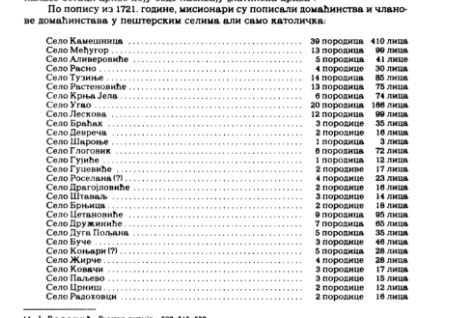
Translation:
“Village Kamenishija …………. 39 families 410 people
Village Melnugor …………… 13 families 99 people
Village Aliveroviche ………… 4 families 41 people
Village Rasko ……………… 4 families 41 people
Village Tuanje ……………… 3 families 103 people
Village Risteleno ………….. 13 families 92 people
Village Krna Jela ………….. 10 families 74 people
Village Uto ……………….. 8 families 186 people
Village Leskova ……………. 6 families 196 people
Village Branjak ……………. 8 families 165 people
Village Golozhnik ………….. 2 families 74 people
Village Guvine …………….. 3 families 36 people
Village Degrene ……………. 2 families 30 people
Village Logovik ……………. 3 families 30 people
Village Guvishe …………… 2 families 17 people
Village Dragojovche (?) ……… 2 families 17 people
Village Brtanik ……………. 2 families 18 people
Village Cvetanich ………….. 4 families 16 people
Village Roselane (?) ……….. 2 families 28 people
Village Tuga Poljana ……….. 5 families 35 people
Village Konche …………….. 7 families 28 people
Village Zhure ……………… 5 families 26 people
Village Rakozhin …………… 2 families 16 people”
“Amazon women among the Kelmendi”
“Referring to sources from 1708, Jovan Radonić writes: “It is truly a miracle, adds Zmajević, that the Klimentes, even though they are eternally hungry, do not ask for anything other than gunpowder and lead.” In one description of the Klimente women, he writes: “The Arnaut women like the new Amazons deftly and skilfully handle weapons”.
The Kelmendis of Peshter
“It is likely that they gave the Clements great difficulties in the war from 1683 to 1699, and that they decided on a definitive showdown with them. The then Vizier of Skadar, Hudaverdi Mahmudbegović, organized a campaign against Klimen and besieged them in the area of Epaja near Skadar and kept them besieged for six months. When the besieged Kliments ran out of food, especially salt, which caused livestock to die, they surrendered to the Skadar pasture. Huda verdi Mahmudbegović ordered internment in far away. Pester, completely unknown to Klimenta.
According to the sources referred to by Jovan Radonić in the Roman Curia section, 251 Klimentian families settled in Pešter in 1700, while Jovan Tomić states that there were 270 families.
It is quite certain that all the Klimentes, whom the Turks sent from Epaia, did not move to Pešter, but that they stayed in certain places, on that arduous and long journey, and that they stayed to live where they had the opportunity to do so. He states that many stayed in the Plav-Gusin area, in Rugova and Rožaje. Thus, in 1705 there were 251 families in Peštera, and in 1707 there were 274. Zmajević reports that all Klimentes who moved to Peštera were like persons.
Pešter was uninhabited at the time of Klimenata’s immigration, because its population, as we mentioned, was evicted at the end of the 17th century. The Turks did not benefit from Pešteri being so empty and uninhabited, so their effort to settle it is understandable. On the other hand, Pešter, due to its inaccessibility and climatic conditions, was very suitable for the settlement of the restless Klimenati because there was a greater possibility of keeping them under control.
Having come to Pešter as members of the Catholic confession, the Clements brought their customs, beliefs, way of life, and they settled in Pešter, an area not only distant but completely different from their former homeland. It took a long time for them to get used to a new way of life. They kept their temper, their rebellious nature, their desire to preserve the disobedience of the Klimentas in Peštera, and they almost constantly clashed with the Turks because of this.
Due to the difficult adaptation to new living conditions, and pressured by constant nostalgia for their homeland, many Klimentes tried to return to their homeland. Some succeeded, so in 1707, 147 families (1,362 members), with many herds of sheep and cattle, moved from Pešteri. In front of that long column were 400 men and 300 armed women, while old men and children chased the herds. On the way, they broke several Turkish ambushes that tried to prevent their return, and they returned. Another group of 50 families returned from Pešteri in 1711 under the influence of Archbishop Zmajević in order to save them from violent Turkish persecution.”
The Kuci of Peshter
“In the 18th, and then in the 18th century, the territory of Tutina was settled in large numbers by the Selik Kuča, so that there is a considerable number of their descendants, Serbs and Muslims. Papal missionaries from 1721 mention “Kuče na Peštera”. The Kuchi were brought here from Montenegro as Orthodox, but they, like Malisor, were also Islamized. Most took a new surname, and many kept the surname Kuch (Leskova, Biševo).
All Kuchis, as stated in well-preserved traditions, immigrated from Montenegro, brought their customs, beliefs and traditions. Those who received Islam, accepting the new faith, lost very little of their earlier characteristics, which they proudly emphasize. Many Islamized Kuchis achieved great reputation and joined the Agan and Beg orders, such as the Hazmagići from Tutin, the Ganići from Rožaj and others. In some villages, the Islamized Kuchis represented compact units and did not allow others to settle there. Such was the case with the villages: Đerekare, Oraše, Orlje, Biševo. Where they were in the village with the Kliments, they lived in separate villages, not messing with each other. Such is the case with Rozaje and Žabren.”
Reference


 Balkan Academia