
Written by Petrit Latifi
The Mojan mountain, situated between Zlorječica and Kuckaja at the Lim river, used to be inhabited by Albanian malesori tribes, according to a Serbian publication from 1927 in Belgrad. There were also Albanian tribes around the region of Komovo, according to Dr. Petar Stojanovic. In the book “Posebna Izdanja. Editions Speciales Issues 12-14”, page 72 we can read:
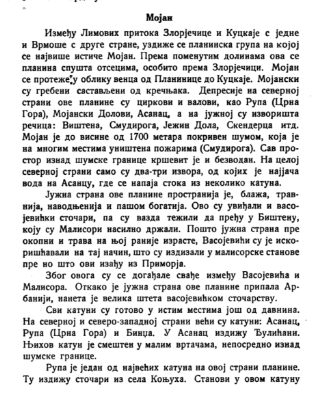
Albanian malesori tribes of Mojan, according to Milojević. Page 72:
“Between Lim’s tributaries Zlorječica and Kuckaja on the one hand and Vrmoša on the other, rises a mountain group on which Mojan stands out the most. Towards the mentioned valleys, this mountain descends in sections, especially towards Zlorječica. Mojan stretches in the form of a wreath from Planinica to Kuckaja. The Mojan ridges are composed of limestone.
Depressions on the northern side of this mountain are cirques and waves, such as Rupa (Montenegro), Mojanski Dolovi, Asanac, and on the southern side are the sources of rivers: Vistena, Smudiroga, Ježin Dola, Skenderca, etc. Mojan is covered by forest up to a height of 1700 meters, which was destroyed by fires in many places (Smudiroga). All the space above the forest border is rugged and waterless. There are only two or three springs on the entire northern side, the strongest of which is the water at Asanac, where cattle are fed from several katuns.
The southern side of this mountain is wider, milder, grassier, more irrigated and richer in pasture. Vasojević herders also saw this, so they always tried to move to Bishtena, which the Malisors held by force. Since the southern side is dug up earlier and the grass grows on it earlier, the Vasojevićs cleared it in that way, which they built into the Malisor apartments before they left the Primorje. Because of this, there were quarrels between Vasojević and Malisor. Ever since the southern side of this mountain belonged to Arbania (Albania) great damage was done to Vasojević livestock.“
Bishtena is an Albanian word meaning “tail” which shows that the Mojan (Moyan) mountain in Andrijevica used to have Albanian toponyms.
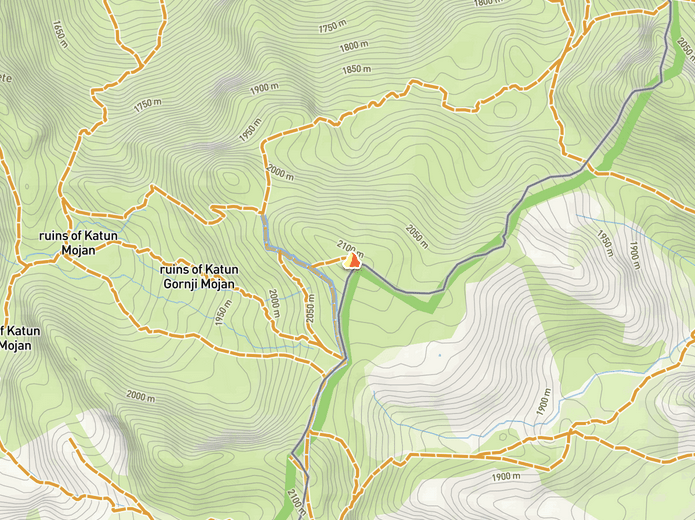
Around the mountain, Albanian toponyms like “Katun” can be seen.
Albanian tribes of Komovo (Koma) according to Dr. Petar Stojanović. On page 20-21 we read:
“The struggle for pastures, and thus for the unhindered seasonal movement of herders, in the conditions of fraternal and tribal organization of society, is in the background of many key events in the history of Montenegro. It is a struggle for the sources of survival, and at the same time a struggle to crush the resistant strength of the opponent. Whichever brotherhood and tribe has more pastures is more independent and has a better chance of survival.
In a natural autarchic economy, needs are low, there is little trade, needs are mostly met by own production. In that struggle, some tribes succumbed, while others stood out as tribes with a particularly expansive power. Bratonožići were left without tribal katuns, they were stolen from them by other tribes. The houses are in the area of rich pastures, which are under attack from other Montenegrin and Albanian tribes.
They pushed out the Hotes, Pipers, Kliments, Gusinjes, so they had so many pastures that they leased part of them to the neighboring Montenegrin and Malisor tribes. Rich pastures made up for the scarcity of arable land and enabled seasonal livestock grazing from winter pastures in the countryside and lower mountains to summer pastures in Žižovo and Komovi.
The large pastures in this region are the center of gravity and the home of four hill tribes (Kuča, Vasojevića, Bratonožića and Pipera). The continuous, seasonal movement of livestock of these tribes on communal pastures is the basis of their clan-tribal social structure. 14 Collective pastures are a cohesive force among tribes, the basis of their firm organization and mutual solidarity. The battle for grazing is fierce.
The Kuči, Vasojevići, Klimenti and Gusinjani fight over Komovo, so blood and milk are often spilled together on them, and the borders of the communal pastures are marked by graves. Kuči, Drekalovići suppressed the Arbanas from Koma and only they have the right to use it. Looting and destroying the livestock and property of opponents is one of the forms of that struggle, which disorganizes and makes seasonal grazing impossible. The struggle between the border Turks and Montenegrins over grazing closely affects the seasonal movement of livestock. Means are not chosen in that struggle.”
References
https://www.google.se/books/edition/Posebna_Izdanja_Editions_Speciales/37c6AQAAIAAJ?hl=en&gbpv=0
https://istorijskizapisi.me/wp-content/uploads/2021/10/STOJANOVIC-Sezonska-kretanja-stocara.pdf


 Balkan Academia