

Authored by Fahri Xharra. Translated by Petrit Latifi.
Where did the Serbian Cyrillic alphabet come from?
The Serbs are also latecomers when it comes to literacy. Without going into their self-deceiving and falsifying writings and publications, let us show that their script, called Vuk’s Cyrillic (Вукова ћирилица), is a variant of the Russian Cyrillic script developed by the Serbian linguist (of Albanian origin) Vuk Karadžiqi in the first half of the 19th century, which has 30 letters.
Until the end of the 18th century, the Serbs wrote in an archaic Slavonic script, which was known only to the church class, and little understood by their own people (славеносербски, архаични језик свештенства и виших слојева, теско разумлјив очином народу.) It was written in Serbian Cyrillic, which did not contain all the letters of the Serbian language.
Vuk Stefanović Karadžić created the Serbian alphabet in 1818. From the Russian alphabet, he removed those letters that did not find expression in the Serbian language: и, ю, й, ъ, ь, щ, я and introduced 6 other letters (also borrowed): ћ, ђ, љ, њ, ј and џ, taking the letter j from Latin and the letter џ from the Romanian Cyrillic (ecclesiastical) script.
So their claims that Cyrillic was created by Cyril and Methodius fall flat because when Cyril wrote the “Glagolic” script, the Serbs were a conglomerate of impoverished immigrants in the service of Byzantium.
Who were Cyril and Methodius?
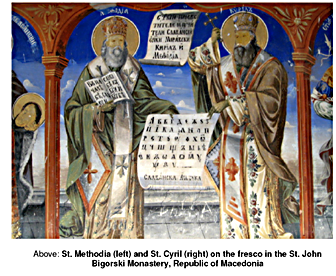
They are said to have been Greeks from Thessaloniki (Cyril and Methodius), but as is usual in literature and history, what was Byzantine was necessarily Greek, which is not true. They are said to have “spread” literacy among the illiterate Slavs in the Principality of Moravia (Cyril was born in 827 or 828, and Methodius in 815 or 820) [1] brothers from Thessaloniki, who spread literacy and Christianity among the illiterate Slavs in the Great Moravian Principality and Pannonia. With their work, they helped to advance the cultural progress of the Slavs, which is why they are remembered as “Slavic apostles”. They created the Glagolitic alphabet, the first script of the Slavs.
So the Glagolitic alphabet was made for the Moravian Slavs. They were still pagans and the goal of spreading Orthodoxy was to bring them literacy. Cyril spoke many languages, including Arabic and Hebrew. According to what is written in the “Žitiju Ćirilovom” and “Žitiju Metodijevom”, the Moravian prince Rastislav (842 – 871) requested that Byzantium send missionaries to preach the faith to his people in order to turn them away from paganism; and in a language that is understandable to the people. So Cyril and Methodius got involved and made the “Glagolic” alphabet for that Slavic part. Let me remind you, century 9; the Serbs were still torn between their paganism and Orthodoxy.
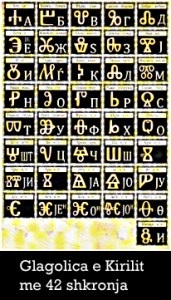
Glagolith and Chryllic with 42 letters
Glagolitic had 42 letters, why? Today and then only the Czech language has 41 letters (The Czech alphabet consists of 41 letters. Russian alphabet consists of 33 letters. Bulgarian number of letters to 30. Slovak It includes all 26 letters Serbian It includes all 30letters Croatian alphabet consists of 30 letters. It is interesting to note that only the Croats preserved the Glagolitic from the 12th century. liturgical script.
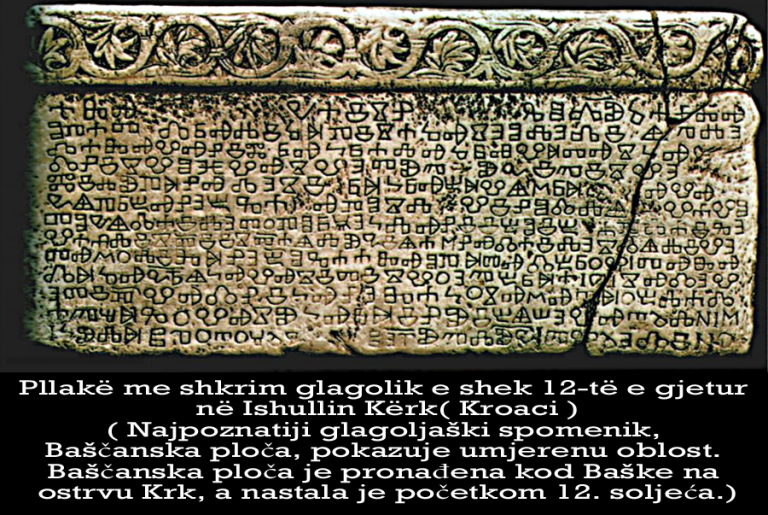
12th century Glagolitic plaque found on the island of Krk (Croatia)
But where did Cyril get the “idea” for the so-called Glagolitic letters? Good studies have been done in this field (by Albanian historians, nothing)

Illyrian alphabet “Alpha[betum] Illyricum Divi Hieronymi”
In the Middle Ages, “Glagolic” was known as the script of St. Jerome (342–429), which was propagated by the Croats. Until the 18th century, the Croats proclaimed that the Glagolitic script, which they also used in Dalmatia, was the Holy Scripture, owing their existence to the famous church father St. Jerome.

The Illyrian alphabet of Saint Jerome
But without further ado, the writing of Saint Jerome and that of Cyril were of Pelasgian-Phrygian origin.
(There’s many theories on the appearance of the Glagolic script, from the presumed Pelasgo-Phrygian origin, Linear A-B/Etruscan scripts, ‘Syriac’ hypothesis, through that of the renowned doctor and scholar St. Jerome (lat. Hyeronimus) of the 4-5th century, to the authentic narrative of the two learned brothers from Macedonia, SS. Cyril & Methodius and the modern claims of the national-politicized 20th century scholars. )
References
“Handbook of Old Church Slavonic” by R. Auty, 1977.”Hrvatsko-Glagoljska Knjiga o Esteri” by Vesna Badurina-Stipčević.”Origin And Development Of Writing” by Petar Hr. Ilievski,
Authored by Fahri Xharra. Translation by Petrit Latifi.


 Balkan Academia