
Written by Petrit Latifi
On page 64 in the book “Српски етнографски зборник Volume 39 by Српска академија наука и уметности, published in 1926, we can read:
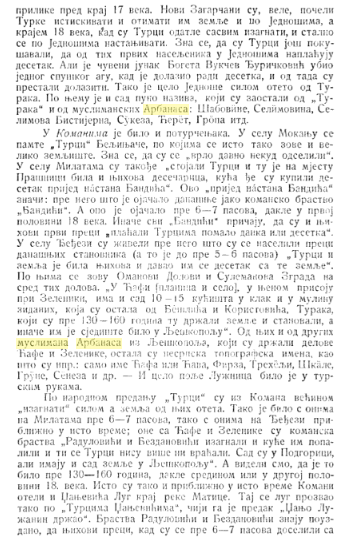
Translation:
“In the Ćafa mountain and the village in its vicinity near Zelenika, there are still 10-15 houses built in a klak and in a mulina that remain from Beslić and Koristović Turks who held lands and lived there 130-160 years ago, and their headquarters were in Lješkopolje. From them and other Muslim Albanians from Lješkopolje who held parts of Kafa and Zelenika, non-Serbian topographic names remained, such as the name Ćafa or Ćava, Firza, Trehëlji, Škale, Grüne, Seneza, etc.
And the entire Lužnica field was in Turkish hands. According to folk tradition, the Turks were mostly expelled from Koman by force and their land was taken from them. That was the case with those on Milate 6-7 years ago, and with those on Đeđeza at about the same time. Those from Ćafa and Zelenika were expelled by the Koman brothers, the Radulovićs and Bezdanovićs, and their houses were burned down, and those Turks never returned.
They are now in Podgorica, but they still have lands in Lješkopolje. And we have seen that It was 130-160 years ago, so in the middle or second half of the 18th century. At about the same time, the Komani also took away the Džanjević meadow near the Matica River. That meadow was named after the Turks Džanjević, whose ancestor Džanjo Lužanin held it. The Radulovići and Bezdanovići know for sure that when their ancestors moved from Brastva 6-7 centuries ago”.
Albanians of Tinjsko Pole and the Albanian “Bin”
.”.. of Tinjsko Polje, right to the south of the town of Cetinje. The name of this hill is obviously derived from the male personal name Bin, which is still in use today among the Arbanas (at least the northern ones). Therefore, it is certainly named after someone from the Arban (or Vlach) and Styra people, who lived on that hill and grazed cattle.”
Albanians of Kučki and “Brinja” or Brinje”
“… of Kučki Arbanas and in the villages where they used to be, he recorded six topographical names, in which the names Brinja or Brinje appear and the Serbs there translated them to me with the words: (strana, stenoviti bok and stena). According to everything, it is clear that the word brinje and its similar forms have long since become terms for various types of elevations and that many topographical names have also become from them.”
Those personal names are certainly not of Slavic origin, but were received from the older population, from the Vlachs and from Arbanas (Arbanas also has the masculine personal name Prend and Premto and the feminine Prende)”), so they took the Serbian form and became home to our people. Prentin Do is therefore certainly named after a non-
Albanian toponyms in Jednoše: Shabovina, Selimovina, Selimova, Bistern, Sukeza, Ceret, Grop and around Komani
“But the famous hero of Boget, Vukčev Đuričković, killed an aga from Spuz, when he was coming for ten, and since then they stopped coming. Thus, the whole of Jednoše was taken by force from Turks. There are still many names after him, which have been left behind from “Turk” and from the Muslim Arbanas: Shabovina, Selimovina, Selimova Bistijern, Sŭkeza, Ćerët, Grop, etc. There were also Turks in Komani. In the village of Mokanje, the “Turks” of Beljinjace are remembered, after whom the village is also called.”
Albanians of Šišëk (Štek or Shishek)
“… On the west side of Ržani Dol is a do with the name Šišëk. There is no word in our language from which this name could be derived, nor are there, as far as I know, such topographical names in our nation. However, among the Arbanas, topographical names from their word Štek (“Durchgang, Eingang; Weg; Haarscheitel”)”
Albanians of Dol (Sava Kapa)
“Jablan later informed me that he found out from the owner himself of that Arbanas Dol (Sava Kapa), that there are still four houses in the same dol and that the old people said that they were left over from the former Arbanas, who in earlier times, just like the Serbs from Zećani (and with them, as their neighbors), came with their herds to these parts for the summer.”
The Albanian Ujkov Kabao (Ukë Kaba)
“Next comes the head Ujkov Kabao, in whose name the word ka-bao definitely has the meaning attributed to it by Rovinski: it means the shape of a visage, which resembles an overturned kabao). The adjective Ujkov will be a memory of some Arbanas with a personal name from arb. words cík (wolf)”
Albanians Međa Arbanaška and Đinovo Brdo (Meda and Gjinovi) of Crnojević
“Međa Arbanaška and Đinovo Brdo, both mentioned in the charters of Crnojević, and the names Arbanaški Do on the land of the Cetinje Monastery and another Arbanaški Do in Vreli testify to the Arbanas. The rise of Arbanas to the regions of the Cetinje tribe must have stopped early, because there are no memories of them in folklore.”
Albanian toponyms Štëk and Šaljeza
“Some of those names (Štëk and Šaljeza), as we have seen, are explained by words that are spoken today in the Arba-Nash language. But there is no information about the activities of Arbanas in Tsuce. That’s why, and for the reasons we mentioned…”
Albanian names Brinda and Gurdic
“Some of those names (Brina and Gurdić) are explained by the power of words, which the present day Arban language has, and one could think that they were left over from Arbanas. But it is hard to believe that Arban shepherds (except in individual exceptions) regularly came here with their flocks. In the people of this tribe..”
Mani?
“… says in the Dictionary of the Zagreb Academy³), or perhaps from Mani-slav, which Maretić proves to be of Slavic origin). But it could also have been received from the Vlachs, because it is known that the Thracians still had the name Manius and that the Arbanas still have the name Mani³) and that the Dalmatian Romans had the name…”
Gropez, Shura and Grop of Bjelosi
“In any case, the names of Gropez and Grop remained with our people from the Vlachs, as is the case here in Bjeloši, and in some places probably also from Arbanas. Shura is the name for the parties under the Željidruga visa. I have not found such a topographical name anywhere else in the Southern …”
Lek or Leka in the region of Gorjni Ljek in Gorjni Orahovac in Boka
“…. that the do was named after an ancient Vlach or Arbanas, who had that name and who probably lived in that valley. Even today, Ljëk or Lek (and Leka, from Aleksandar) is a very common name among Arbanas. In a similar way, the names of the arable land Ljek and Gornji Ljek in the village of Gornji Orahovac in Boka will also become. On the other hand, we don’t have such topographical names here…”
Lisupi and Sroi and Katun
“… to be called Lišupi.) and later the Sroi could receive that name from them, as they received many others. The word katun (Katunari and others of the same origin) is mentioned very early and very often in our old monuments. 3) In addition, we see it among Arbanas and Romanians and then also among Bulgarians and Greeks, all in the same or similar meaning to ours.) So it is a general word of all Balkan peoples, and it seems to me most likely Miklošić’s opinion, yes…”
The Albanian name Murak or Mura and Mig
“… it read Murak or similar. That personal name, or at least its basis, is certainly not of Serbian origin. Among the Dalmatian Romani, we know of a larger number of personal names and surnames from the base mur, among them Murca¹), and among the Arbanas there is also the personal name Mura²); in addition, there are many topographical names based on Mig- and Mura-3) in Romanic countries. Hence the name Mura…”
The Limë tribe of Krajina
“… which is nevertheless very suitable for human life. It should be added that among all the Montenegrin tribes, the Limjans are the most prominent in the southeast and that for centuries they were in the immediate neighborhood of the Turks and Arbanas (Muslim and Catholic) in Montenegrin Krajina.”
Lek of Ćeklići
In addition to these data on the settlement of non-Serb brastas around Ćeklići, we consider it worth mentioning that there is also one in the village of Dragomi-dolo with the name Ljëk, as we have shown before, perhaps a memory of some Vlach or Arbanas, that is, a Vlach or Arban family, which was once among the Serbs settled down.”
Albanian names
“Cuce, tribal name: 585, 589, 715.
Cuce, last name: 588,
Cuce, brotherhood in Boka: 674, 714, 719, 720.
Cuci, male name in Arbanas:
Cucin, professor in Senta: 674, 714.
Cuce Velje, part of the Pula tribal area”
Albanians of Ceklin tribe
“The Ceklin tribe also includes the town of Rijeka, where 88 families from various Montenegrin tribes live (18 Gornjaci and 7 Donjaci), and in addition, a considerable number of temporarily settled Catholics and Muslims from Shkodër.”
Reference


 Balkan Academia