

Written by Petrit Latifi
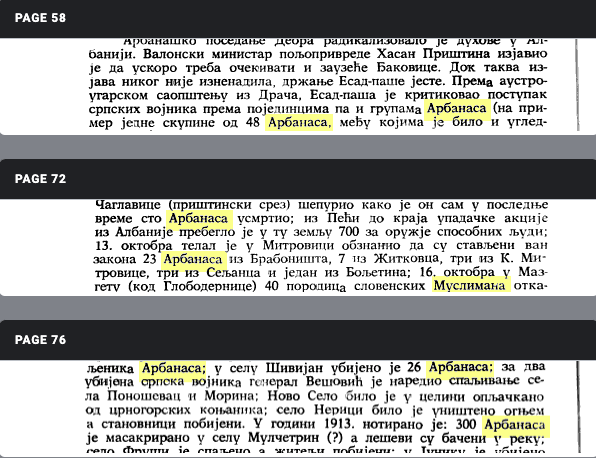
“In 1913 it was noted: 300 Arbanas were massacred in the village of Mulcetrin (?) and the corpses were thrown into the river.
Crimes and massacres were carried out there not by Serbian soldiers but by irregular gangs, which was necessary for the Serbian government to deny the news that the European press reported about the misdeeds of Serbian troops. Complete peace reigned in the Malesia of Gjakova at that time, and those who fled deeper into Albania declared that they did not intend to return to their homeland until Serbia opened the market in Gjakova.
A total of 57 villages were affected. In 32 of them, it was possible to determine how many inhabitants were massacred. There were 229 of them. Residents of the village … Blaca, every last one was killed. In the villages of Vojnik and Labej they were raped and then burned. The damage caused to Debra amounted to one million Turkish lira (23 million francs). Of those 37 settlements…
Lenika Arbanas; 26 Arbanas were killed in the village of Shivijan; for the two killed Serbian soldiers, General Vešović ordered the burning of the villages of Ponoševac and Morin; Novo Selo was completely plundered by the Montenegrin horsemen; the village of Nerici was destroyed by fire and the inhabitants were killed.
A Serb from Čaglavice (Pristina section) boasted that he himself had recently killed a hundred Arbanas; from Pejë until the end of the raiding operation, 700 people capable of arms fled to that country from Albania
The village of Fruši was burned down, the inhabitants were killed and Niki was killed. 51 people were killed in the Zvečan district by mid-January 1914, and 57 horses and two oxen were stolen in four municipalities of the Mitrovica region, eight houses and 16 stables were burned. The bloody craft of the old forge was, of course, more developed in the then state mecha than deeper in the interior. In the first half of January, an emissary of the Serbian border command, by the way…”
Reference


 Balkan Academia