

Written by Petrit Latifi
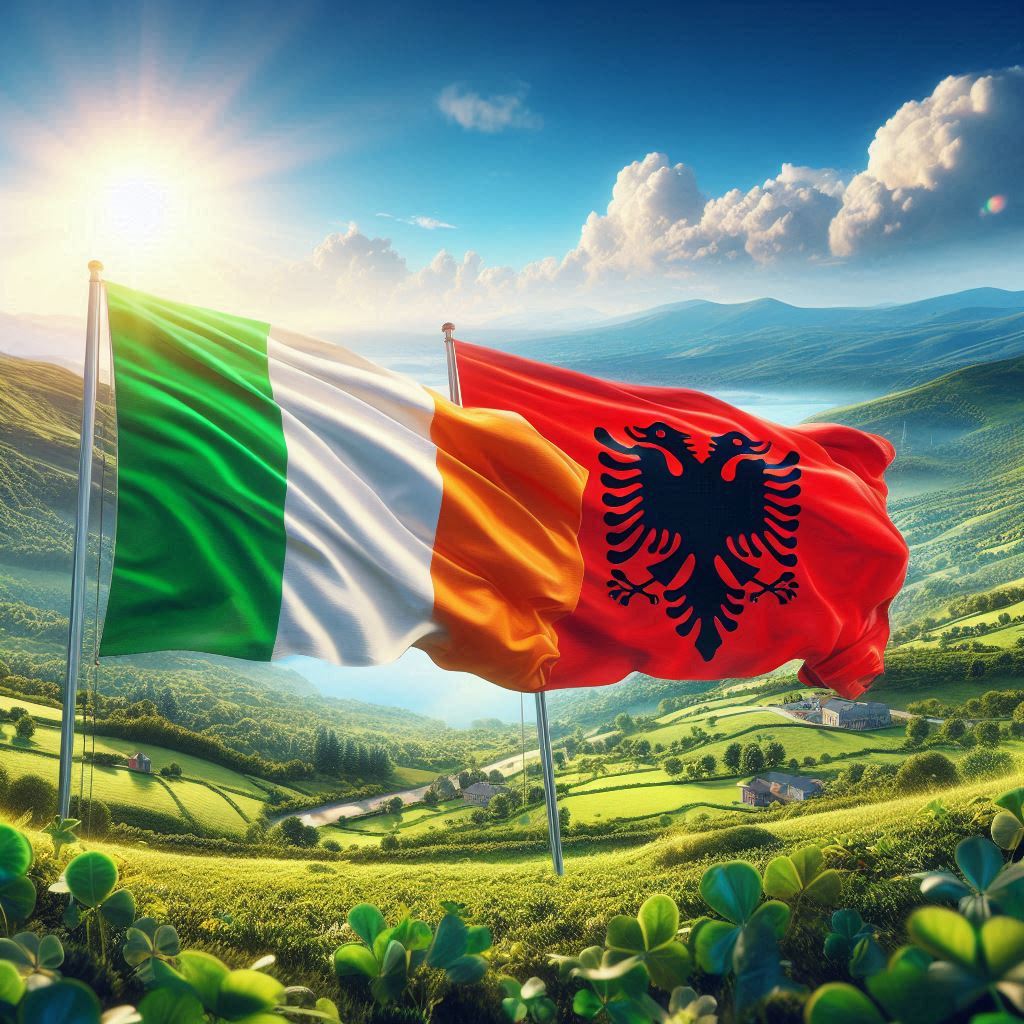
Today is St. Patricks day and I would like to write of the similarities between the Albanians and Irish both suffering centuries of oppressive rule. The Irish have their Celtic heritage and the Albanians have their Dardanian and Illyrian heritage. Both suffered under colonialism. The Irish under the British and the Albanians under the Ottomans and Slavs.
There are quite a few striking similarities between the Irish and Albanians in terms of their historical suffering under oppression. Both peoples have endured centuries of foreign rule, resistance struggles, cultural suppression, and the impact of diaspora due to political and economic hardships. Here are some key parallels:
1. Centuries of Foreign Rule
- Albanians: The Ottoman Empire ruled over Albania for nearly 500 years (late 15th century to 1912). During this period, Albanians experienced heavy taxation, forced conversions to Islam, and attempts to suppress their national identity. The Serbs then occupied Dardania (Kosovo) and oppressed and killed Albanians for decades. Serbia had begun expelling and killing Albanians since 1878.
- Irish: Ireland was under English and later British rule for over 800 years, facing land confiscations, penal laws that discriminated against Catholics, and attempts to erase Irish identity and language.
2. Cultural and Linguistic Suppression
- Albanians: Under Ottoman rule, Albanian language and education were restricted. The Ottomans prevented Albanians from having their own schools in their native language, forcing many to adopt Turkish, Greek, or Slavic languages. Even after independence, communist Albania severely controlled cultural expression. The same happened during the Kingdom of Yugoslavia and Socialist Yugoslavia in the 1950s.
- Irish: The British authorities attempted to suppress the Irish language through policies like the Penal Laws and the National School System, which discouraged the use of Irish. English became dominant, and Irish Gaelic was nearly eradicated as a spoken language in many parts of the country.
3. Resistance and Rebellion
- Albanians: Albanians engaged in multiple revolts against the Ottomans, culminating in the League of Prizren (1878) and the eventual declaration of independence in 1912. Later, they resisted Italian and Nazi occupation during World War II and endured decades of brutal communist rule under Enver Hoxha. Albanians had to fight both Ottomans, Montenegrins, Serbs and Greeks who all invaded Albanian lands.
- Irish: The Irish continuously resisted British rule through uprisings like the 1798 Rebellion, the Easter Rising of 1916, and the War of Independence (1919-1921), which led to the establishment of the Irish Free State in 1922. Northern Ireland, however, remained under British rule, leading to further conflict (The Troubles, 1960s–1998).

4. Forced Emigration and Diaspora
- Albanians: Due to oppression, economic hardship, and conflict (Ottoman rule, communist isolation, Kosovo War, and 1997 economic collapse), millions of Albanians emigrated to Italy, Greece, Switzerland, Germany, the U.S., and other countries.
- Irish: The Irish faced mass emigration, particularly during the Great Famine (1845-1852) and later due to economic hardship and political turmoil. Millions of Irish people emigrated to the U.S., Canada, Australia, and the UK.
5. Clan and Family-Oriented Societies
- Both the Irish and Albanians historically maintained strong clan-based societies.
- Albanians have the Kanun (a traditional set of laws governing social behavior, honor, and family ties).
- Irish had Brehon Law, which similarly emphasized kinship, honor, and social obligations.
- Both cultures have long histories of blood feuds and a deep-rooted sense of loyalty to family and community.
- Albanians have the Kanun (a traditional set of laws governing social behavior, honor, and family ties).
6. Religious Persecution and Division
- Albanians: Under Ottoman rule, many Albanians were pressured or forced to convert to Islam, creating religious divisions (Muslims, Catholics, and Orthodox Christians). Later, under Enver Hoxha’s communist regime, Albania became the first officially atheist state in the world, persecuting all religions. When Serbia occupied Albanian lands, they were expelled and killed and the Albanian language was forbidden. Some Albanians were Catholic, just like the Irish.
- Irish: The Irish, predominantly Catholic, faced severe discrimination under British Protestant rule, particularly through laws that limited Catholic land ownership, education, and political participation. The religious divide later contributed to the Northern Ireland conflict.
7. Periods of Isolation and Hardship
- Albanians: During the communist period (1945-1991), Albania was completely isolated under Enver Hoxha’s dictatorship, suffering extreme poverty, political repression, and a closed-off economy.
- Irish: Ireland experienced economic stagnation and relative isolation from Europe for much of the 20th century, only seeing significant development after joining the EU in 1973.
8. Strong National Identity and Pride
- Despite oppression, both the Irish and Albanians have maintained a strong sense of national pride, identity, and cultural resilience.
- Their folklore, music, and oral traditions played a significant role in keeping their heritage alive.
- Both have heroic national figures, such as Gjergj Kastrioti (Skanderbeg) for Albanians and Michael Collins for the Irish, who symbolize resistance and national struggle.
9. Post-Oppression Struggles
- Both nations have faced challenges even after gaining independence.
- Albania struggled with dictatorship, economic collapse, and migration. Kosovo, an Albanian-majority region, fought for independence from Serbia in the 1990s.
- Ireland experienced a civil war (1922-1923) over the Anglo-Irish Treaty and later The Troubles in Northern Ireland (1960s-1998), leading to decades of political violence.
Conclusion
Both the Irish and Albanians have endured long histories of foreign domination, cultural suppression, rebellion, forced emigration, and deep-rooted clan-based traditions. Their shared experiences of struggle and resilience have shaped their strong national identities. Despite hardships, both have preserved their cultures and languages through generations of resistance and perseverance.
- Albania struggled with dictatorship, economic collapse, and migration. Kosovo, an Albanian-majority region, fought for independence from Serbia in the 1990s.

 Balkan Academia