
Authored by Qazim Namani, Doctor in Archeology and Cultural Heritage. Translated by Petrit Latifi.
Neither the Serbian nation nor the ethnic group existed in the Middle Ages! Serbia was created as a political entity in the 19th century by assimilating the Albanian and Vlach populations.
Today’s Serbs have never had a state or an ethnic identity before the 19th century – Servia, a name for a region in service, not an ethnic name. During the 19th century, according to Pan-Slavic projects in the central part of the peninsula centered in Smederevo, a political group of Orthodox Christians who called themselves Serbs was first created, who had strong support from Russia and the Patriarchate of Istanbul.
From this political platform, by assimilating the Albanian and Vlach populations of the Orthodox faith and to the detriment of Albanian lands, the Serbian nation and political state were formed. Below we offer some scientific arguments about the name Servia:

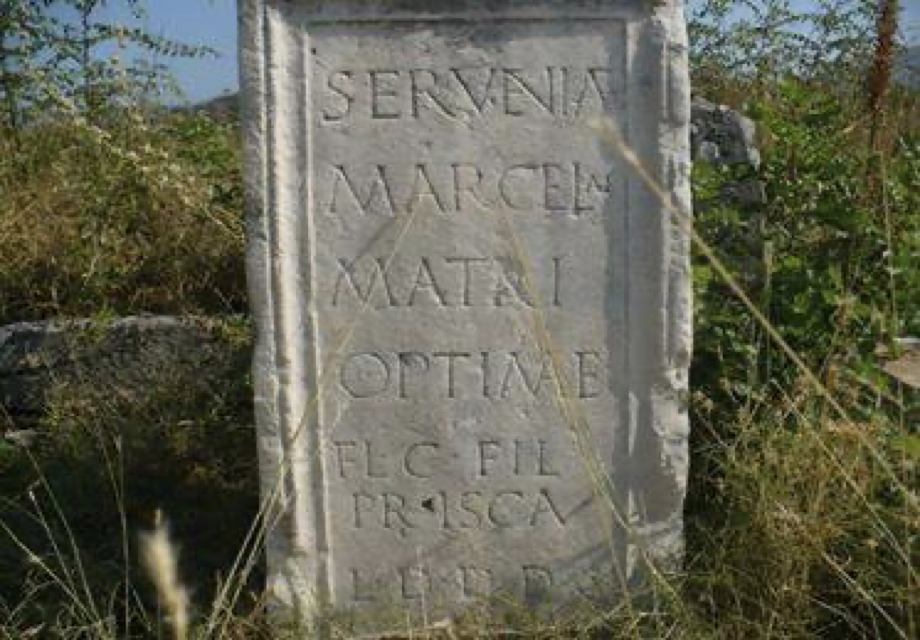
Photo 1. The discovered find is located in the archaeological site of the old city of Doklea, near the road leading to Podgorica
The name Servnia is an old Romanesque name that means servant, we also find this in an inscription carved on stones, where the Roman historian and jurist Priscus dedicates it to the homeland when he says: SERVNIA MARCELAT MATRI OPTIMAE FLC.FIL PRISCA = IN OPTIMAL MILITARY SERVICE FOR THE HOMELAND, FAITHFUL SON.
This find was discovered in the old city of the Illyrian-Roman period Doklea near today’s Podgorica in Montenegro. From this inscription “Serveniae”, which I think is in Latin and means service (Servant-Serv). I think the writing belongs to the early period of the Roman occupation, in the first or second century of the new era, and has nothing to do with today’s Serbs.
This tablet with an inscription in Latin discovered in Doclea, is today preserved as a find of very high archaeological value

Photos 2 and 3. The name “Serveniae” discovered on a commemorative tablet in the town of Doclea near Podgorica
The meaning of this name is also explained by the Bulgarian academic Ivan Duridanov, who claims that Servus is an old Balkan Roman name, from this name came the names Sarban, Serban, Serbu, and in the feminine gender Serba. The medieval name Serviu, Serva, and from RUM Serb (farmer).
The Latin word “Servi” which means, bowed, submissive, served to serve the slave-owning society of that time. Even in the official Byzantine language, “Serv” is a word that means “slave” “tzerboulianous” means those who wear poor clothes. Servants are called the lowest social category because they were slaves (servants) of the Byzantine Empire.
Servants are called all those who were slaves of the Byzantine Empire, so as you can see Servant means slave, servant, slave, serf. Their name itself shows that they are not a national ethnicity, but a low social category even throughout the medieval period.
We can also find the meaning of the word Servi in many dictionaries published in different languages of the world. In the old Latin-Albanian dictionary, written in 1635 by Frank Bardhi, we note that the word Feruaqë can also be read as Serva, translated into Albanian it means Servant, Feruire-Servire with servants, Feruitus-Servitus servant, Feruitum-Servtum Servant.
Also in the Latin-Albanian dictionary, by the authors Henrik Lacaj and Filip Fishta, the word Serva, has the meaning of slave, slave, Servio I am a slave, I am in slavery, Servitium, slavery, slavery, Servitus, slavery, submission, obedience. In the dictionary of foreign words and expressions, written by Mikel Ndreca, we find the meaning of the word Servil (lat. Servilis), which refers to slaves without character who bow down like a slave, Servis-servit, Servitut (Service, submission, slavery).
In the French-Albanian dictionary, published by Murat Bejta, we find the word Servante to mean servant, servant, Servitude (slavery, slavery), Serf-Serve (slave of a slave, state of a slave, peasant slave, slave of the land). In the French-Albanian dictionary published by Vedat Kokona, we find the word Servage to mean peasant slave, slavery. In the English-Albanian dictionary by Stuart E. Mann, we find the word Serve with the meaning serve, Servility which means humility itself, excessive servant, Servitude with the meaning slave, slavery.
Also in the English-Albanian dictionary written by Ramazan Hysa the word Servant means servant, servant, Serve, serve, work. In the Serbo-Croatian-Albanian dictionary we find the word Servilan (Servilni) with the meaning slave, from slave, low, dallkauk, Servilnost, Servilitet , dallkauk, Servis, to serve.
From the data on the meaning of the word Servi, we can affirm that in the 18th and 19th centuries, a political group of Orthodox people was created with this name in the region previously called Servi, who were in the service of Russian pan-Slavic projects and politics.
From these sources we understand that the name “Servia” itself shows that we are not dealing with a civic ethnicity that is separated by language and culture from another ethnicity, but it is a territory, where the population, accepting foreign rule, remains a low social category in the service of the ruler.
During the 15th century, a similar region was created in the territories of Upper Mysia when Gergj Branku betrayed all the leaders of the Christian uprising against the Ottoman Empire, betraying Hunyadi as well, and agreed to become a vassal of the Ottomans and live in Smederevo.
It is known that until these territories fell under the Ottoman occupation, they were under the rule of the Byzantine Empire, but at some stages of time they were occasionally owned by local princes. In the Middle Ages, during the 13th-15th centuries, the region of Novi Pazar, including some of the Arbër territories in the region of present-day Kosovo, was called Rasi.
The region populated by the Arbër population in the sandjak of Niš was not included within the territory of Rasi. Prof. Vojislav Nikcevic, at the international symposium on the topic “Bosniakism and Sandzak”, held in Novi Pazar, in 1995, speaking about the name Serbian, pointed out that after Profirogenti, the word Serbian in the Romani language means slave, Serbian means dependent person, so this name until recently had a social and not ethnic meaning.
In this symposium, among other things, Nikcevic also explains the etymology of the name Rasha-Rasa-Rashka, which according to him derives from the Albanian word skram- rasë guri.
Analyzing the data mentioned above, I think that the ethnicity of the Nemanjids should be sought among other indigenous peoples of the Peninsula and not among the Slavs for two reasons: At the beginning of his career, Nemanja was not Orthodox under the Byzantine Church, but of the Catholic faith, and secondly, the name Neman, Niman, Numan, Naman is an ancient biblical name that we often find among ancient Mediterranean peoples such as: the Arbëror, Jews, Greeks, Bosnians, Germans, Italians, etc.
In this specific case, how does it make logical sense to think that we are dealing with a medieval state, a medieval Serbian kingdom, or a Serbian Orthodox Church when the Slavs did not carry a tradition of Christianity, but were unorganized and pagan until this period of time.
King Constantine Porphyrogenitus in his work “De Administrando Imperio” around the year 950, regarding the origin of the name Serv writes:
“Servët is a word in the Byzantine language that means slaves, and in the Byzantine language usually the word “Serbula” means slave shoes, and the word “Serboulianous” means those who wear cheap, peasant clothes.”
In a similar way, Archbishop Guilelmo Tirski (1139-1186) described them, in his document called “Monumenta Montenegrina” he wrote: “all these people originate from a region, condemned to cut marble and dig ores, and from this comes the word slavery – “Servitutis”. It is understood that we are dealing with the name of the region and not an ethnicity.
In the 17th century, Pjetër Bogdani in his writings expresses his interest in educating the poor Arbëror and Servite people, for whom he says that for the most part they speak the Albanian language. Some historians have also written about the name Serb during the formation of nations in Europe during the 19th century.
The Czech historian Josef Holecek (1853 – 1929) writes that:
“The name Serb has no connection with the Serbian ethnicity, which formed the present-day Serbian ethnicity by uniting the Orthodox of the Balkans”.
So, the name Serb was a special name only for the Orthodox and not for defining an ethnicity.
Holecek, a researcher of the issue of the South and North Slavs, when talking about the Montenegrins, writes that these are “some of the denials of today’s Montenegrins that they are Serbian and that “Serbian” was only an Orthodox term.”
The Russian diplomat Aleksandar Giljferding who stayed in the Balkans wrote that:
“Until the middle of the 19th century, all nations that had the Orthodox religion were called Serbs.”
Lubomir Nenadovic writes that:
“Vuk Karadžić in 1834 forced Njegoš to invent a Serbian ethnicity including all Orthodox Christians living in the central Balkans.”
From what can be seen above, Serbia as a state and nation is a Pan-Slavic project that was realized in 1878, assimilating the Orthodox Christians of the north and adopting the medieval Christian tradition, art and culture of this region.
In the territory of western Macedonia in present-day Greece, one of the main cities in the regional unit of Kozani is called Servia. In Greece, there is a region called “Servia”, whose name derives from the Latin verb servi, which means dependent place (supervised by the king). This is one of the most historical places in that region, with a 6th-century Byzantine fortress rebuilt during the time of Justinian. As can be seen, even before the arrival of the Slavs in the Illyrian Peninsula, there was a name for a region of a castle called Servia.

Fig 4 and 5, Region, Servia in present-day Greece

Fig 6 and 7: Servia Castle in western Macedonia of present-day Greece
The numerous sources of foreign travel writers who visited the central regions of the Illyrian Peninsula, where medieval maps of Servia after the conquest by the Ottoman Empire are found, testified that the majority of the inhabitants who populated these o regions were the Arbërorët (Arnautët) and the Vlachs, this is evidenced in many publications and maps of researchers from several European countries.

Fig. 8. Map of 1885, made according to the literature of the Eastern Pan-Slavic bloc in which the name Servi is clearly visible; Fig. 9. Map made in 1861, made according to the literature of the Western bloc, in which it is noticeable that these regions were known by the researchers of that time as the Albanian region – Illyrian.
The Illyrian Peninsula occupies an important geographical and geostrategic position as a Mediterranean area between three continents. Many land and sea routes have passed through these regions that connected these three continents since ancient historical periods.
Being a region of particular importance, many intercontinental and local wars have been fought in these lands to maintain the military and political superiority of the most powerful world empires, therefore in this region historically different interests and cultures have been intertwined, continuously maintaining it as an area of intercultural borders and geostrategic conflicts.
The geographical extension between the four seas in the most important historical periods was also an ethnocultural and religious division where numerous civilizations were confronted. Historical sources prove that on the western and central side of this peninsula lived the Illyrian tribes and it was precisely these cultures of civilizations that created the boundaries of interests in the Illyrian lands, forcing the indigenous Illyrian population to embrace different cultures and beliefs.
This situation created numerous conflicts and wars to create nations and political states to the detriment of the language, culture and identity of the indigenous Illyrian population. These political states created on the Dardano-Illyrian culture, during the last three centuries that relied on projects and political platforms to assimilate the autochthonous Illyrian-Dardan population by changing their native language, religion, through the creation of myths, falsification of history, appropriation of cult objects, torture and mass murder, burning and colonization of settlements and the displacement of this population to other continents.
Due to the numerous pressures, the Albanian lands were divided into several states, the Albanian people remained divided into territories, in religion and in constant pressures to assimilate and merge into other cultures. In such circumstances of political developments, the Albanian people undoubtedly remained among the most damaged peoples on the European continent.
During the 19th century, according to Pan-Slavic projects in the central part of the peninsula centered in Smederevo, a political group of Orthodox who called themselves Serbs was first created, and had strong support from Russia and the Patriarchate of Istanbul. From this political platform, by assimilating the Arbër and Vlach population of the Orthodox faith and to the detriment of the Albanian lands, the Serbian nation and political state were formed.
Since the core of this political state was founded in the region previously called Servia, a region that had accepted vassalage and had been in the service of the sultan since the 15th century, this new state was unjustly called Serbia. In the first half of the 19th century, the political and autonomous region called Servia did not include the Albanian territories in present-day Kosovo, Novi Pazar and the Sandžak of Niš.
The inclusion of most of the Sandžak of Niš in the new Serbian political state was achieved during the Eastern Crisis of 1877/78, while present-day Kosovo after World War I.

Fig. 10. Map of 1830, Roman Province of Dardania, part of Mysia and; Fig. 11. Map of 1865, Roman Province of Dardania, part of Mysia.
These territories, including the most famous medieval cities such as Artana, Niš, Skopje, Prizren, New Bazaar until the second half of the 19th century, were known by Western scholars as territories of Illyria, Dardania or even Mysia.
The idea that Artana (Novobrdo) was a Serbian cultural center, just because it lies in the central territory of the Illyrian Peninsula, is contrary to the historical reality of the time and the history of Novobrdo itself. This contradicts the logic of understanding the historical circumstances of that time because the city of Artana was formed as a city that had flourished long before the 14th-15th century, so it was an important economic center continuously subordinated since late antiquity was in the service of Constantinople and after the Ottoman conquest it was put in the service of this empire.
As is known, after the Ottoman conquest all the mines of Artana and other mines of the region, together with all the properties, and the local population were put in the service of the Ottoman Empire. In this period, not completely subordinated, but with obligations to pay a certain annual tax, there were only a few villages deep in the mountains of today’s Albania, which divided the Albanian territories in the middle.
The Ottoman chronicler Evliya Çelebi, during his travels through the Albanian territories in the middle of the 17th century, left some interesting data res about the Albanian settlements and population in Kosovo. When Çlebiu describes the flow of the Gnalab (Lab) River, he says that it flowed from Albania (Albania), and through the city of Mitrovica it flowed into the Morava River (see fig.12).

Fig.12. About the Llap River, Çelebiu writes that in the Ottoman documents in the original it is called Gnalab (see fig.13).

Fig. 13
About the structure of the population of the city of Vushtrri, Çelebiu writes that they did not know how to speak Slavic languages, but they spoke Albanian and Turkish (See fig. 14).

Fig.14
About the flow of the Lim River, Evlija Çelebiu writes that it flowed from Albania, from the city of Plav, passed the town of Rudo and joined the Drin River near Višegrad (see fig.15).

Fig.15
From the description of Evlija Çelebi we note that in the region of the Llap River, the cities of Artana, Vushtrri, Mitrovica, Plav, even during the 17th century, the autochthonous Arbëro population lived and these areas were known as the Albanian territory (Albani).
Regarding the spread of Albanians in the central part of Serbia, we find written sources for Kralevo in the book by Tatomir Vukanović “Naselja u Serbiji”, which writes that Kralevo in 1784 had 11 Serbian houses and 89 Turkish and Albanian houses. At this time, the number of inhabitants in Kralevo was 664, of which 592 were Turks and Albanians, while about 72 Serbs. Knowing that in this period there was no Turkish population living in the cities of the Balkans, we can affirm that the vast majority of the inhabitants of Kralevo were Albanians (see fig.16).

Fig.16
A Serbian missionary, Mita Rakić, who also visited these areas after the war of 1877/1878, writes in his book “Iz Nove Serbije” that Kušumli was a nest of Albanians, that ethnically pure Albanians lived and ruled in Kušumli (see fig.17).

Fig.17
He also claims that on the right side of Toplica up to “Petrovo Gora” and in Llap only ethnically pure Albanians lived (see fig.18).

Fig.18
Mita Rakić, when visiting the Albanian areas of Toplica during 1880-1881, writes that he could not find a companion to visit these settlements, because the Serbian soldiers did not know them, while of the Albanians who were the only ones who knew the settlements and roads of these areas, there was not a single one left in these parts (see fig.19).

Fig.19
From the data provided above, we understand that throughout the Middle Ages in the region of Toplica and the entire Sandzak of Niš until the wars of the Eastern Crisis of 1879, the autochthonous Albanian population lived.
Jefo Dedjer (1880-1918) in his book “Stara Serbija Geografska i Etnografska Slika”, among other things, writes that the name “Old Serbia” as a geographical name began to be mentioned in the 19th century. As a new geographical name since the 19th century, which begins to cover such an area, there is no Old Serbia. There was a long discussion about determining how far the
border of Old Serbia extended.
In the end, the prevailing opinion, supported by Jovan Cvijici, was that Old Serbia should call those old areas to the south and southeast of the city of Skopje.
In these regions, the population recorded at the end of the 19th century and during the 20th century, as a Slavic population, are the Orthodox Albanians and Vlachs who were assimilated by the influences of the Serbian Orthodox Church and the political programs that were applied especially after the expulsion in 1896 of the Albanian and Vlach clergy from the Orthodox churches in the Albanian territories and their replacement with Serbian and Russian clergy.
Jagosh Gjillas writes that during the 19th century the Patriarchate of Istanbul enjoyed great privileges in the Ottoman Empire. In the Albanian territories, the center of this propaganda had become the Metropolis of Prizren, therefore, through the monks and the Vlach population, they kept the churches in Prizren, Ferizaj, Lipjan and other cities of the northern Albanian territories under supervision. The Serbian Orthodox churches in these regions from 1830 to 1896 were in the hands of the Greeks and the liturgy in them was held in the Greek language (see fig.20).

Fig 20
As can be seen in this case, for the Albanian territories of the north, we are dealing with a misunderstanding of the name that appeared on some medieval maps of Servia in Serbia, because the data of the time prove that an Albanian population lived in these regions. Many of these maps with this name were made in the 19th century, even during the influence of Pan-Slavic projects and Slavic historiography.
From these data, we understand that the Serbs should be sought for their ethnic formation parallel to the beginnings of the falsification of the Balkan historiography under the influence of Russian Pan-Slavism, and of Serbian literature that begins with the dictionary of Vuk Karadžić in the 19th century.
From the field data, even in the present-day territory of Kosovo, it is clearly observed that the present-day Serbian population that had lived in these parts during the 19th centuries was an Albanian Christian population, which was assimilated at the end of this century and in the first decades of the 20th century.
In conclusion, we can say that world historiography, and in particular Albanian historiography, should not support the idea of the formation of in the Serbian Kingdom and the Serbian Orthodox Church in the 13th-14th centuries, when it is known that the 19th century is considered the century of the formation of nations in Europe.

Fig. 21. Map of 1844, on the spread of Albanians in the northern and western parts of the peninsula, where it is noted that the Serbian region that had gained autonomy from the Ottoman Empire, extended north of Novi Pazar and Kruševci.
Reference
Footnotes
1 Ivan Duridanov, KAM, Etymology of the Old Names of Places, Investigations of the
Dimiter Decev, Sofia, 1958, p. 164
2 Ibid., p. 164
3 Frank Bardhi; “Latin-Albanian Dictionary 1635”, Editorial Office, Rilindja, Prishtina, 1983, p. 232
4 Henrik Lacaj & Filip Fishta; “Latin-Albanian Dictionary”, Editorial Office, Rilindja, Prishtina, 1980, p. 481
5 Mikel Ndreca; “Dictionary of Foreign Words and Expressions”, Editorial Office, Rilindja, Prishtina, 1986, p. 631
6 Murat Bejta; “French-Albanian Dictionary”, Publishers of Textbooks and Teaching Aids of the Autonomous Socialist Province of Kosovo, Prishtina, 1986, pp. 543, 544
7 Vedat Kokona; “French-Albanian Dictionary”, Rilindja, 1990, pp. 1005
8 Stuart E. Mann; “English-Albanian Dictionary”, Rilindja, Prishtina 1957, pp. 337
9 Ramazan Hysa; “English-Albanian Dictionary”, Tirana, 2000, pp. 694
10 Albanological Institute of Prishtina; “Serbo-Croatian-Albanian Dictionary, Prishtina 1974, p. 777
11 International Symposium on the topic “Bosniakization and Sandzak” held in Novi Pazar on March 1 and 2,
1996, The article was published by the newspaper “Bujku” on March 4, 1996, Prishtina.
12https://www.scribd.com/…/Constantine-VII-Porphyrogenitus-De-Administrando-Impe…:
https://books.google.com › History › Ancient › Rome
13https://bogbosnaibosnjastvo.webs.com/znacenjerijecisrbin.htm;ttp://srpskaistorija.livejournal.com/3260.html
14Gaspër Gjini, Ipeškvia Shkup-Prizren sekretve šečevje, Zagreb 1992, page 181
15www.academia.edu/…/Odnosi_čeških_zemalja_s_Crnom_Gorom_R…, Jozef Holecek; “Serbska narodna.”
epic”, Prag, 1909
16 http://montenegrina.net/pages/pages1/is … o_u_cg.htm.
17https://en.wikipedia.org/wiki/Servia,_Greece
18 http://www.kastra.eu/castleen.php? castro=servia
19 Evlija Celebija; “Putopis II”, Sarajevo 1957, p. 24
20 Ibid., p. 24
21 Ibid., p. 25
22 Ibid., p. 10
23 Tatomir Vukanovic; “Naselja u Srbiju u doba prvogo srpskog ustanka 1804-1813”, Vranja, 1975, p. 113
24 Mita Rakic; “ From New Serbia”, Leskovac, 1987, p. 16
25 Ibid., p. 17
26 Ibid., p. 27
27Jefto Dedijer; “Stara Serbia Geografska i Etnografska Slika”, Belgrade, 1912, p. 3
28 Ibid., p. 3
29Jagosh Gjilas;” Serbian Schools in Kosovo from 1856 to 1912”, Prishtina 1969, p. 303

