

Authored by Petrit Latifi
THE FIRST SCHOOLS AND DOCUMENTS IN THE ALBANIAN LANGUAGE
(Compiled by N. Gjema)
| Year | Event |
|---|---|
| 1258 | An Albanian school was opened in Ulcinj |
| 1278 | An Albanian school was opened in Durrës |
| 1332 | Guliem Adaes states that Albanians had their own books. |
| 1345 | An Albanian school was opened in Shkodër |
| 1349 | An Albanian school was opened in Tivar |
| 1367 | An Albanian school was opened in Pult |
| 1380 | University of Durrës – Universitas Studiorum Dyrrhachium, the first university in the Balkans |
| 1395 | The second Albanian school was opened in Shkodër |
| 1396 | An Albanian school was opened in Drisht |
| 1462 | “Formula e pagëzimit” – The first dated document we know today in the Albanian language |
| 1496 | The Dictionary of Arnold Ritter von Harff, among the first Albanian language documents |
| 1515 | The chronicle of Ruhi Çelebi, also mentioning Albanian writings. |
| 1555 | “Meshari” by Gjon Buzuku |
| 1584 | An Albanian school was opened in Stubëll, Gjilan |
| 1588 | An Albanian school was opened in Prizren |
| 1632 | An Albanian school was opened in Kurbin |
| 1638 | An Albanian school was opened in Shkodër by the Franciscan Fathers |
| 1639 | An Albanian school was opened in Blinisht |
| 1639 | An Albanian school was opened in Zadrimë |
| 1697 | An Albanian school was opened in Janjevë, Prishtina (upon request by Andrea Bogdani) |
| 1698 | An Albanian school was opened in Shkodër, in the Kamsi family by Father Filip Shkodra |
| 1857 | An Albanian school was opened in Shkodër, girls’ school |
| 1885 | An Albanian school was opened in Prizren, girls’ school |
| 1889 | An Albanian school was opened in Prizren, boys’ school |
| 1861 | An Albanian school was opened in Shkodër, elementary public school by the Franciscans |
| 1867 | An Albanian school was opened in Shkodër, the first secular school where arithmetic was taught in Albanian by Dom Zef Ashta |
| 1879 | An Albanian school was opened in Shkodër, girls’ school by the Stigmatine Sisters |
| 1887 | An Albanian school was opened in Korçë, a secular school |
| 1888 | An Albanian school was opened in Pogradec, and so on… |
According to the currently accepted knowledge, from the opening of the first Albanian school in 1258 until today (2024), 766 years have passed.
Other Schools
| Year | Event |
|---|---|
| 1904 | An Albanian school was opened in Corfu, Greece |
| 1906 | An Albanian school was opened in Shubraka near Cairo (Egypt) |
| 1907 | An Albanian school was opened in Natick, Boston, USA |
| 1908 | An Albanian school was opened in Istanbul, Turkey |
| 1909 | An Albanian school was opened in Catania (Italy) |
| 1913 | An Albanian school was opened in Jamestown, Boston, USA |
| 1916 | An Albanian school was opened in Constanța, Romania |
| 1919 | An Albanian school was opened in Philadelphia and Worcester – Mass (USA) |

The first Albanian school was opened in 1258 in Ulcinj.
The Albanian school has a long tradition. From the research so far that has been found and published by scholars of the Albanian language, Albanian school and the history of Albanians, it is confirmed that Albanian schools have a history of at least 8 centuries and from the data so far, they were opened mainly by Catholic priests of the Franciscan rite and mainly in coastal Albania between Kotor and Durrës.
These schools were opened several centuries before the “Formula of Baptism” (1462, the first Albanian document that we know so far) and the publication of the first Albanian book that we know so far, the “Meshari” of Gjon Buzuku in 1555. Therefore, various testimonies such as that of the monk Brocard that the Albanians have their books in Latin script must be accurate and it remains for future scholars to research in this field.
It is even believed that Albanian may have been written several centuries earlier (and that there were schools before that of Ulcinj) in biblical script in the South and Southeast of Albanian lands, which coincides with the Byzantine period and the Church of the East, to which Church a large part of Albanians belonged.
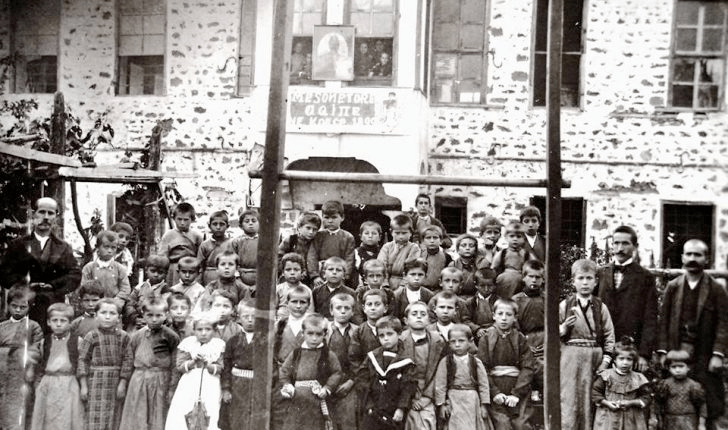
From the data of research so far by Albanian scholars, we have this chronology for the existence of Albanian schools:
– Albanian school in Ulcinj (1258)
– School in Durrës (1278), two schools;
– Albanian school in Shkodër (1345 and 1395);
– Albanian school in Tivar (1349), Pult (1367),
– Albanian school in Drisht (1396).
– In 1584, an Albanian school was founded by Catholic clergy in Stubllë (near Gjilan – a village in the Karadak Mountains) known as the College of Saint Luke in Kosovo.
– In 1632 – The Albanian school in Kurbin was opened by Monsignor Gjon Kolesi.
– In 1638 – The Franciscan Fathers opened a school in Shkodër and in Pllanë.
– In 1639 – The Friars of Troshan opened schools in Blinisht and Zadrimë.
Archbishop Pjetër Mazreku from Prizren in his reports (written in 1632-1633) emphasizes the role of the school and the need for Albanian education.
In 1664, the Albanian school was opened in Janjevë, near Prishtina, at the request of Andrea Bogdani and with Pjetër Mazreku as the first teacher.
In 1698 – Father Filip Shkodra opened a school in the Kamsi family, in Shkoder.
– In 1885 in Prizren, we find an Albanian primary school for girls.
– 1858 – Kushë Micja opened a school for Shkoder girls.
– In 1861 the Franciscans opened a public primary school in Shkoder.
– In 1874 a school was opened in Shiroka, where the Albanian language and arithmetic were taught by Dom Zef Ashta and some consider it to be the first secular school.

In 1879 in Shkoder, the Stigmatine Sisters opened a primary school for girls.
The first Albanian school in Korça opened on March 7, 1887 with teacher Pandeli Sotiri is the first secular school in Albanian lands, but which was a continuation of an earlier tradition of over 600 years, but without right, sometimes out of ignorance and sometimes out of certain Pan-Slavic interests, this tradition of over 800 years that we know of the existence of the Albanian school within the Albanian space has been silenced.
This has cost the Albanians since in anti-Albanian literature and propaganda, Albanians have been presented as people and as a people without cultural traditions and not infrequently as a wandering people, or even as Ottoman remnants and a conglomerate of peoples and cultures.
Therefore, at least on March 7, when we mark Albanian Teachers’ Day, it is good and necessary for teachers and representatives of institutions that mark this important day to show that even before March 7, 1987, the Albanian school had a tradition of over 600 years before this school was opened.


Reference

 Balkan Academia