

Authored by Petrit Latifi. Taken from Historia Krajes.
ANDRE ZMAJEVIC’S REPORT FROM HIS FIRST VISIT TO KRAJE. 1672
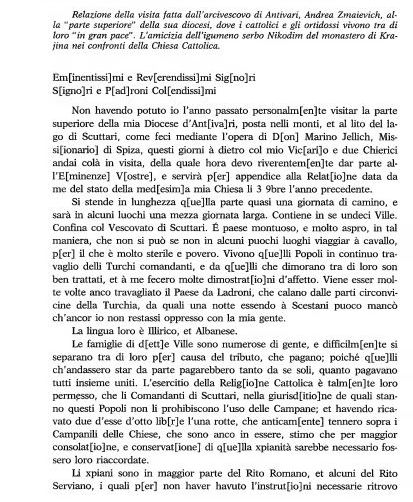
This report, dated November 27, 1672, is of the first visit of the Archbishop of Antivar, Andre Zmajevic, to the “upper part” of his diocese (in Krajë), where according to him Catholics and Orthodox lived among themselves “in great peace”. The friendship of the Orthodox Abbot Nikodim of the Church of Krajë towards the Catholic Church is emphasized.

Freely translated text:
“Last year, I was unable to personally visit the upper part of my Diocese of Antivar, situated in the mountains and on the shores of Lake Skadar, as I did with the work of Don Marino Jellich, missionary of Spiç, these days afterwards with the Vicars and two clerics I went on a visit, of which I must now respectfully give a part to Your Excellencies and which will serve as an appendix to the Report given by me on the state of my Church on the 3rd of October of last year.
This part extends in length for nearly a day’s journey, and in some places will be half a day’s breadth. It contains eleven villages (note: Western Kraj with Shestan). It borders on the Bishopric of Skadar. It is a mountainous country, and very rugged, so much so that it can only be traveled on horseback in a few places, and is therefore very sterile and poor.
Those peoples live in constant suffering from the Turkish commanders and are well treated by those who live among them and have made many demonstrations of love towards me. The country is also often troubled by thieves, who come from the outskirts of Turkey, from whom one night, being in Shestan, it was almost impossible for me and my people to remain oppressed.
Their language is Illyrian and Albanian.
The families of the villages in question are numerous in number and are difficult to separate from each other on account of the taxes they pay; since those who would stay aside would pay alone as much as all paid together. The exercise of the Catholic religion is permitted to them so long as the commanders of Shkodra, in whose jurisdiction these Peoples are, do not forbid them to use the Bells; and having received two of them of eight pounds each broken, which in ancient times were kept on the bell towers of churches, which still exist, I consider that for the greater comfort and preservation of that space it would be necessary that they should be reunited.
The greater part of the spaces are of the Roman rite and some of the Serbian rite, who, for want of the necessary instructions, are found materially schismatic. They frequent our Church and live in great peace and tranquility with us. They have for their principal Parish Priest Father Nikodem, Abbot of the Monastery of Kraje, a person very devoted to the Holy See and beloved by all the Ministers of that Holy Congregation, as well as of my Archbishopric, and of the Bishopric of Shkodra.
I found some of our men who have two wives, who have a contract with the first according to our rite and with the second according to the Serbian rite; In order that they may refrain from this, I have made angry rebukes, and against those incorrigible men who have made similar disturbances to terrify others, I have published excommunications with a prohibition, so that until a total change should be seen in them, they shall not be permitted to enter the churches. Which unless it happens in those parts which are among the infidels no other remedy can be applied to eradicate this abuse.
The churches are of stone, and most of them vaulted; and although they are very ancient, they have been preserved in their being, with the exception of that of Shestan, which has been severely damaged by earthquakes, needing no other compensation than to cover and repair the floor and doors.
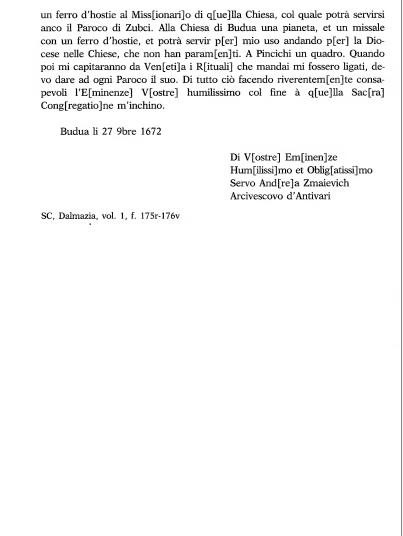
The parish priest guards his children, and the Most Holy Sacrament for the strength of the place and the lack of which is not found in those mountains cannot preserve it. I have not found any other sacred furnishings than those which I noted in my previous report. The same Churches do not possess any buildings, and the Parish has no other help than a few pounds of fodder for the house and to support themselves they must plow and harrow like the other lay people in the country.
The eleven villages, for which at least three Parish Priests would not be enough to be far from each other, the Parish Priest Don Luca Brisca, priest, who serves those peoples with great pleasure and is very diligent in the care of souls and practical having been raised by Monsignor Bonaldi, my Predecessor.
And I have found this Priest to be one of the best and most fruitful servants that this Diocese of mine has. He teaches literacy to one of his nephews, who when he comes of age will be a good subject for the College of Fermo and in time will be able to serve as an assistant in the same care. I also recommended that he try to find a way to foster someone from Shestan, a very needy place, more than half a day away from you.


 Balkan Academia