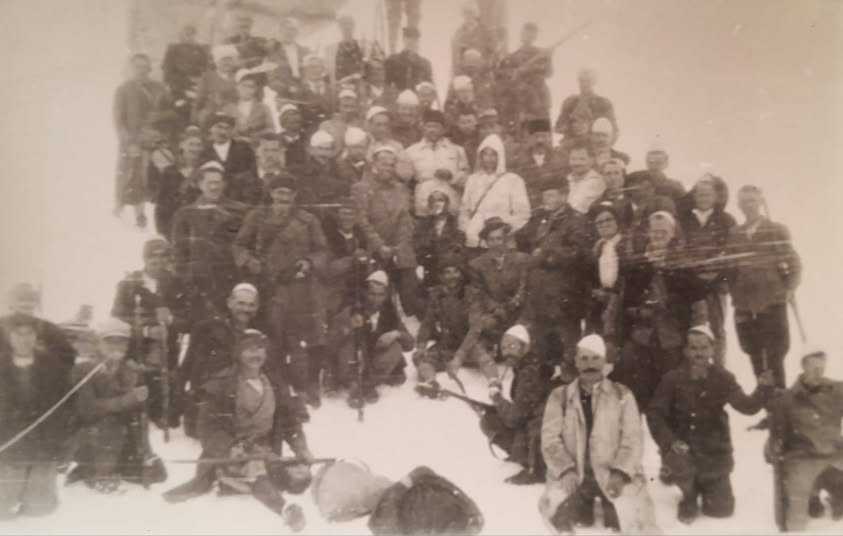

Written by Dodë Progni. Translated by Petrit Latifi
“Kreziu Movement” is the name of the Nationalist Antifascist Movement, in Kosovo, Albania and Serbia, in the 1940s – 1944, at the head of which were the brothers from Gukova, Gani, Said and Hasan Kryeziu. The strategic goal of the Albanians, the organization of the Anti-Fascist Movement in Kosovo, is the liberation of Albania from the Nazis, its separation from Serbia and its unification with our state, Albania.
And the end of this trial was known, because as Peter Kemp has stated, “For the communist rulers of Albania, collaboration with the British was a much greater crime than collaboration with the Germans.” In these extremely difficult circumstances, faced with the low provocations of the communist forces, the brave and wise commander, Gani Kryeziu, did not fall into their trap of making armed resistance, which would have meant a fratricidal war, but dispersed his forces, ordering those who wished to continue the war together with the communist partisan forces, while the others could return to their homes.
Gani, with his brother, Hasan Kryeziu, and 22 of his bravest and most loyal comrades, settled in the towers of Sulejman Kryeziu in Gjakova, after their towers had been burned by the Germans. This marked the destruction of the ‘Kryeziu Movement’, the only effective non-communist resistance against the Germans in Northern Albania.
The Hereçit massacre of Decani
On the evening of December 28, 1944, twenty-six Albanians, sworn to loyalty and unarmed, after being taken from the towers of Sulejman Kryeziu, and sent to the hills of Herezi, (Deçan municipality), were confronted by hundreds of heavily armed Serbs. There were 22 comrades of Gani Kryeziu and 4 of his sympathizers, friends and supporters, who were killed and massacred in an inhumane manner.
This painful event, although not made public for over 45 years of communist rule, neither in Albania nor in Kosovo, entered and remained in people’s memory as a barbaric execution of the ugliest of the Slavic-communist type.
It is impossible to describe, much less imagine, the tragic scenes of that December evening that the Hereçi hill experienced. The stories of Malë Shyti from Berisha and Zenel Ademi from Gashi, who were saved alive by fate from that guillotine, have been passed down from mouth to mouth, to this day. They are extremely painful, horrifying and sad for anyone who hears them. The anti-Albanian hatred and the level of cruelty of the Slavic-communist executioners, during this unprecedented massacre, exceeded the proportions of rabid beasts.
After the executioners had stripped the arrested of their clothes and subjected them to the torture of the low temperature of that December evening, which had dropped to about -15 degrees C, they began to beat them with picks and shovels. Breaking hands, legs, and piercing with bayonets was the pleasure of these executioners, eager to see as many wounds and blood on the bodies of Albanians as possible.
A horrific scene, a real massacre, that continued for about two hours. After two hours of fighting, the Slavic beasts had defeated the Albanian people. On the frozen, bloody ground of Hereçi Hill, the following were left dead:
Selim Malë Dula from Paci i Bytyçit, Brahim Musli Demaliaj from Vladi, Shaban Sadik Saraçini from Berisha, Shpend Zeqir Prëndgjoni, with his son, Sali Shpend Prëndgjoni, from Zherka, Ukë Arif Prëndgjoni and Imer Halil Prëndgjoni, from Zherka, Metë Rexhë Saraçini, Col Isuf Koka, Sadri Dash Gjonpapaj from Berisha, Sali Shpend Mujaj from Paci, Musë Avdyl Neza from Leniqi, Musë Zenel Ahmetaj, Ali Miftar Zhuta from Kepeneku, Rame Osmani, Shpend Halili, Mehmet Musa from Gashi, Zmajl Sadik Koka from Berisha, Rexhë Mehmeti from Paci, Mehmet Ali Mehmetaj from Vladi, Zenel Miftar Zhuta from Shaban Ali Bajrami from Kepeneku.
These men were outstanding fighters, the pride of the Kryeziu forces, distinguished in the battles against the Nazis, and not victims who were sacrificed for their own narrow interests, or those of the Kryeziu, nor adventurers and mercenaries sold for money, as they were described by communist propaganda, during 45 years. These were martyred for Kosovo and a free, democratic Albania, for the unification of ethnic Albanian lands.
Their standing by Gani Kryeziu in those difficult moments, when he was targeted by the Slavic-communists, to be annihilated, was an act of courage and bravery, which stemmed from the common nationalist and democratic ideal of these fighters with their commander, as well as from the high virtue of Albanian loyalty and manliness, which characterized these highlanders.
After the execution, their bodies, massacred in an unprecedented manner, were dragged by the executioners and thrown one on top of the other, into a pit that had been dug by the villagers for another purpose, creating perhaps the first mass grave of Albanians executed by the Serbo-Slavic communists, after the Second World War in Kosovo.
Unfortunately, the bloody Serbo-Slavic hand would not stop here, with Hereçi. It would continue with the creation of dozens of other mass graves, where it buried thousands of Albanians. With this criminal act, the Yugoslav communist leadership took the first step in their strategy of violence and terror, against the Albanian people of Kosovo.
After the Hereçi massacre, it carried out other massacres, such as the suppression of Shaban Polluzha and his forces, the elimination of any Albanian who displayed nationalist views, to reach the massacre of Tivar, 1946, where the Slavic Serbs, annihilated over 4,700 young Albanian boys, to continue with the massacre of Recak, without interruption until the liberation of Kosovo, in June 1999.
Gani Kryeziu
On the morning of the day that the Hereçi massacre was to be carried out, the OZN forces had summoned Gani Kryeziu to the Gjakova District Council, supposedly to consult, but treacherously, they had handcuffed him, accusing him in a completely absurd way as: “collaborators with the Germans and the quisling government of Tirana, – opponent and enemy of the National Liberation War.”
After they held him for about a year under torture of the investigation, on October 27, 1945, in Belgrade, they held a formal, typically communist trial, with false accusations and manipulated witnesses, sentenced him to 5 years in prison, and locked him in the cells of the Sremsko Mitrovica prison, from which he never came out alive.
His death in prison, completely unexpected, in 1951, at the age of 51, when he had completed his sentence and was awaiting release, was learned from a telegram that the Sremsko-Mitrovicë Prosecutor’s Office sent to his family in Gjakova, but the cause of death, which was highly suspicious, was never revealed and never learned!
The Hereç massacre, the physical elimination of Gani Kryeziu and his closest comrades, were indeed carried out outside the borders of Albania, with the direct perpetrators being the Yugoslav side, but this in no way exempts the Albanian side from responsibility. This criminal act was not only a desire, but also an agreement of both parties.
Enver Hoxha himself has affirmed this in his book: “The Anglo-American Danger to Albania”. When he tells of his alleged quarrel with the Yugoslavs, Veilimir Stoinić and Nijaz Dizdarevic, regarding the position towards the Blackheads, in 1944, he claims to have told them: “The interest of both our parties and our common war, requires that these enemies be severely punished…! Such people deserve a bullet in the forehead”. “Our National Liberation Army,” he says, “caught these bandits (speaking of the Blackheads, D.P.) and sentenced them to death”.
The fundamental reason for this strict stance that Enver Hoxha held towards the Blackheads is clearly and accurately explained by Peter Kemp when he says:
“For the communist leaders of Albania, collaboration with the British was a much greater crime than collaboration with the Germans.”
In fact, the Blackheads had not only collaborated with the British, but had also gained their sympathy and support. They had received high praise from the British as patriots, as anti-fascist fighters and as democrats with a Western political orientation. For their participation in the Anti-Fascist War and the pro-Western democratic ideals they aspired to, they had become known, even in the highest circles of Anglo-American politics.
Enver Hoxha, who had decided to make Albania communist, to link it closely with the ‘Red East’, and to sever all ties with the capitalist West, put the Blackheads at the top of the list to eliminate them politically and physically. As pro-Western and anti-communist, they would be a serious obstacle to his future power.
After failing in his efforts to bring the Blackheads into his “collar”, through a government position, and to eliminate them later, as he did with several other nationalists, Enver Hoxha, in collaboration with the Yugoslavs, elaborated a plan for the urgent elimination of the Blackheads, accusing them of: “war criminals and collaborators of fascism”.
The execution was undertaken by the Yugoslav side, not only because they were Yugoslav citizens, as Enver Hoxha says, but because they were very interested in their quick and safe execution. The existence of the Kryezinje was considered extremely dangerous by the Serbs and Slavs.
They were seen as a potential danger and as a burning “gas” that could at any moment spread the flame of an anti-Slav nationalist uprising in the explosive Kosovo of that time, so they could not trust their execution to anyone else. On the other hand, Enver Hoxha at that time was neither capable nor courageous enough to openly conflict with the British on the issue of the Kryezinje.
The British, as we have mentioned above, had expressed sympathy for their positioning on the side of the Anti-Fascist Front more than once during the War. In fact, they had supported them throughout the entire period of the War. Ultimately, for Enver Hoxha, it was important that the elimination of the Kryeziu Movement was certain.
The liquidation of the Kryeziu Movement and the Kryeziu themselves is one of the typical examples of cooperation between the Albanian and Yugoslav communist leaderships for the elimination, in Kosovo and Albania, of anti-communist nationalists, Western-oriented intellectuals and influential people among the people, who had thought and strived for an ethnic, free and democratic Albania.
When we talk about the authorship of the Yugoslav and Albanian communist leaderships in the elimination of the Kryeziu and their anti-fascist movement, the negative role played by the communist leaders of Kosovo in the realization of this criminal and anti-national act cannot be overlooked. When it came to opposing the Kryeziu brothers and their anti-fascist movement, they were always ready to serve with great zeal, both the Albanian and the Yugoslav communist leadership.
Former members of the Kosmet headquarters and the Provincial Committee of the Yugoslav Communist Party for Kosovo such as: Xhavit Nimani, Mehmet Hoxha, Fadil Hoxha, Ymer Pula, Ali Shukria, etc., who, just as during the War, and after it, when they had occupied important leadership positions in the communist party and state in Kosovo and Yugoslavia, never stopped fighting against the Kryeziu brothers and their family.
As mentioned above, during the years of the War, the rivalry between the Kosovar communist leaders and the Kryeziu brothers was fierce and continuous. But in 1944, when the victory of the anti-fascist coalition over Nazi Germany seemed close and certain, the Kosmet headquarters and the Kosovar communist leaders greatly hardened their stance against the Kryezinje.
This happened because the Kryezinje were well-known, respected figures, and with unquestionable authority in Kosovo. As active participants in the Anti-Fascist War, they had won the sympathy and support of the Anglo-American allies.
Meanwhile, with their clear positioning on the side of Albanian nationalism and irredentism, which aspired to the creation of ethnic Albania, and with the open and determined anti-Slavic and anti-communist stance, which they had maintained during the years of the War, they had won broad support, throughout the population of Kosovo. For these reasons, the communist leaders of Kosovo, contenders for leadership positions in post-war Kosovo, did everything possible to eliminate the Kryezinje, who were their long-standing political, ideological and class rivals and opponents. To achieve this goal, they collaborated closely with the leaders.


 Balkan Academia