
Authored by Dr. Qazim Namani. Translated by Petrit Latifi.
The Albanian pashas and their mercenary soldiers, with their Muslimism, managed to become owners of timars and occupy high positions in the Ottoman Empire.
The feudal class belonged to the Ottoman nationality. In the Albanian territories, a part of the population, but also the raja, were of Albanian ethnicity. The Albanian feudal class, sometimes put itself in the service of the Ottoman Empire, suppressing every uprising of its own people, and sometimes opposed the processes in the Ottoman administration.
Among the Albanians, there was also a clan and tribal aristocracy, where the bajraktars in the villages were considered agallars, while in the cities the beylers were the heads of the clans and craftsmen. Since the Ottoman conquest, the Albanian population had been in a state of war with the Ottoman authorities.
The Islamization that the Albanians accepted did not match the official Islamization. At this time, the Albanians were a population with a large clan, tribal and religious mixture. This political and social division of the Albanian population, in the mountainous regions, had a tribal character, which differed from the division into cities and fields that had a feudal character where the pashalars ruled.
After the Ottoman conquest, the Orthodox Albanians of the south, but also a part in the north, were under the influence of the Patriarchate of Istanbul. From the thirties of the 19th century, the Albanians of the south were under the influence of the new Greek state, and the newly established Greek Orthodox Church. In the northern regions, the Albanians were under the influence of Italy, Austria, and from the thirties of the 19th century, also of Serbia and Montenegro.
At the time when the Ottoman Empire was engaged in frontal wars with Russia from the end of the 18th century and the beginning of the 19th century, liberation movements had begun among the peoples of the peninsula, to free themselves from the Ottoman Empire.
The Pasha of Ioannina, Ali Pasha Tepelena and Mustafa Pasha from Shkodra, who were known as the most powerful pashas, and governed semi-autonomously, failed to unite their forces among themselves, but against the Ottoman Empire, they acted independently with their actions, weakening it considerably.
The Ottoman Empire, in these circumstances, began military and administrative reforms, to create an absolute monarchy, which would be supported by a modern and disciplined army. To achieve its objectives in the Albanian lands, the Ottoman Empire began the war to extinguish the Albanian pashas, and the liquidation of the Albanian nobles.
Albanians in the late 18th and early 19th centuries waged wars among themselves, sometimes against the sultan and sometimes for the protection of the Ottoman Empire, and many of them were mobilized in the war against Russia, in Asia Minor and in northern Africa.
During this period, reforms and the process of forming national states had begun in European countries, and the strengthening of absolute bourgeois monarchies had begun, in accordance with the technological development of the bourgeoisie of these countries.
With the reforms that the Ottoman Empire began, it destroyed the traditional Albanian nobility, which lost its role in the feudal society, created over centuries in the Albanian lands.
Mustafa Pasha Busatliu, at this time, ruled to expand, extending his authority in addition to Shkodra, also over Dukagjin, Elbasan, Dibër, Ohrid and Targovishte (Rozaje).
Thus, at the time of the anti-reform movements, Mustafa Pasha appointed Hasan Hoti (an officer in charge of his order) in Peshteri and Bihor. The ajans of Rozhaja went to seek help from Abdul Rezak Pasha of Peja, against the peace of Hasan Hoti’s rebellious infantry.
The rebels were against the Pasha of the New Market, who was an ardent supporter of the Sultan. The rebels were led by Jusuf Bala from Balien in Peshteri, Sali Ugla from Ugla above Peshteri, and Deli Ibrahim. The first two were Islamized Kelmendi, and the third was the son of Adem Pasha of the New Market.
Osman Pasha, after receiving help from Pristina, Peja, Gjakova and Prizren, crushed the Peshteri uprising, set them on fire and chased them out of those regions. Jusuf Bala fled to Bosnia, Deli Ibrahim went to Vidin via Kraljevo, while Sali Ugla disappeared in an unknown direction.
Osman Pasha in November 1822, registered a new army in the Senica field. There he waited for another delegate from the Grand Vizier to arrive, and together they went to the village of Rasna, which had become the center of the insurgents.
Rasna was a mountain village above Peshterë inhabited by Kelmend Albanians, and the Ottomans called the inhabitants of this village Arnauts. Deli Ibrahim, who had previously fled to Vidin from Osman Pasha, had returned and hidden in Rasno. After he had captured Dervish Pasha, he fled and hid in Rasna.
The Sultan’s envoy from Novi Varoš, who at that time had set fire to several Arnaut houses, also took part in the suppression of the Albanian revolt in Rasna. In those conflicts, the leader of Sjenica, Sulejman Beg Cavic, was killed, and Zenel Aga Cesovic, Ahmed Salakovic and Adem Dzankovic disappeared without a trace.
In the In the first half of the 19th century, when Sultan Mahmud II (1808-1839) began reforms in the army and administration in 1826, uprisings broke out throughout the Ottoman Empire.
With the reforms to centralize power, the Ottomans intended to take local power away from the peoples enslaved by the Ottoman Empire.
At the end of November 1826, two high-ranking imperial officials arrived in Novi Pazar, and a letter was immediately sent to Sjenica to prepare, as they would arrive there together with Osman Pasha of New Pazar, and perhaps Jashar Pasha from Pristina would also come with them. High-ranking imperial officials came to investigate the situation in these parts, bringing with them two imperial decrees, for Osman Pasha and Jusuf Aga, who were honored for their cooperation, correctness and loyalty to the Sultan.
The imperial officials also brought letters to the cities: Shkodra, Skopje, Prizren, Gjakova, Pristina and Pazar i Ri. With those letters, Sultan Mahmud II called on the pashas and citizens to oppose the rebel insurgents, and at the end of the letter cursed them for inaction.
The first action in response to the Sultan’s letter was taken by Jashar Pasha in Pristina, who stopped two hundred cargoes of Bosnian merchants in Pristina, coming from Constantinople towards Bosnia.
An exception from all the pashas was made by Duke Vasojevic Lakic of Montenegro, who with 250 of his sons, helped Mustafa Pasha Busatli against the Sultan.
The Serbs in all aspects listened to Prince Miloš Obrenović, who closely followed these developments, and advised them to remain calm, and in these circumstances to be wise. The reasons why the majority of the Muslim and Albanian population were against the Sultan are deeper than those that can be addressed in this paper. Being undefined in these events was very difficult, they definitely had to be defined on one side.
Among the main reasons that the lower classes of the Albanian population easily accepted invitations to rise in rebellion against the Sultan were the heavy tax burdens that had been imposed on the local population since the beginning of the 19th century, when the Ottoman Empire had begun frontal wars with Russia. This heavy tax burden hit Christians and Muslims hard.
The popular revolt against the Ottoman Empire had increased due to anarchy, weak governance, lack of implementation of legality, corruption, bureaucracy, and now even when reforms had begun in the army, which affected the broad masses, and for this reason the broad classes of the people constituted the majority in the rebellion against the Sultan.
At that time, news spread through Novi Pazar that Sultan Mahmud II had granted Prince Miloš Obrenović the territory of the New Bazaar region, along the road to Hendek. Hendek is a small hill in the center of New Bazaar. With news and propaganda, the Serbs and the Sultan’s collaborators managed to divide the population.
As this news spread, in early February 1827, about 600 Bosnian soldiers arrived in New Bazaar. Up to this time, this was the first arrival of the Bosnian army in New Bazaar after the Ottoman occupation. They had come to contact the Albanians who had come from Shkodra, and the Albanian Muslims of New Bazaar, who were preparing to launch an uprising against the Sultan.
The arrival of the Bosnian army in Pazar i Ni, and the preparation of Mustafa Pasha of Shkodra, for the march with the rebels towards the king’s city against the sultan, and the imperial army, caused great uncertainty among the other Albanian pashas. Most of the pashas of Kosovo, even Jashar Pasha in Prishtina, who until then was the Sultan’s hope, now also chose to fight against the Sultan. The exception was Abdul Rezak Pasha of Peja, who was the owner of the bakeries, and who had supporters Gani from Rozaje, some Kelmendas from Rozaje and Peshteri, Hadrovici from Bihor and Dupljaka from Korita, who remained loyal to the Sultan.
The Grand Vizier asked the imperial command that in the spring of 1828, 25,000 troops should be gathered in the territory of the Bosnian Pasha, and sent to the Ottoman-Russian battlefield on the Danube River. Upon his return to Pazar e Ni, Osman Pasha summoned the Serbian princes and ordered them to collect food for the imperial army, which amount of food had to be purchased partly in his area, in order to go to the battlefield against the Russian army.
The Muslim and Albanian population was also on alert, as it was under pressure from the large and numerous engagements. The Albanian population was in a very difficult position, because it was not united but divided into two large groups, for and against the sultan.
So in early 1828, the Pasha of Shkodra sent 8,000 soldiers to Rozaje, led by Hasan Hoti. Mustafa Pasha of Shkodra sent Hasan Hoti to Peshter , to connect Peshter with himself, and to gather troops there. Hasan Hoti built a tower in the Dry Stream – today Suvo Dol. The construction of this tower was not well received in Peshter and Bihor, which they even opposed.
He had open conflicts with the Ganic people from Rožaja, and the Hadrovi?s from Bihor. Hasan Hoti displaced the Hadrovi?s from the village of Vrbica. The cemetery in the Dry Stream-Suvo Dol is formed by the numerous victims that Hasan Hoti killed.
When Aslan Pasha of Peja, who was appointed Vizier of Shkodra, instead of going to Shkodra he entered Peja, according to a report dated April 5, 1829, Abdul Rezak Pasha fled from Peja with 300-400 supporters. Aslan Pasha then set fire to several ovens, which held the supporters of the sultan and Abdyl Rezak Pasha.
From all these unrest and uprisings in the Albanian lands, the Sultan’s attempts to gather a large army from the Albanian lands for the battlefield against Russia failed.
In the Albanian lands, Mustafa Pasha from Shkodra was against the reforms, who sought to reach an agreement with the feudal lords of Bosnia. Mustafa Pasha sought to connect, also with the Serbian prince Miloš Obrenović, and through him with Russia. The friendship between Mustafa Pasha Bushatliu, and the Serbian prince Miloš Obrenović, was created during the Russian-Ottoman wars of 1828/29.
Mustafa Pasha hoped from Prince Miloš for financial assistance, shelter in case of danger to his life, and through him he hoped for the support of Russia. In the negotiations that they held, Prince Miloš counted on the help of Mustafa Pasha to expand the territories of his pashalik. Mustafa Pasha had promised the expansion of the Serbian prince’s territories, as well as good relations with the Bosnians. When the Albanian uprisings began, Prince Milosh sent his informant to Shkodra to learn about the preparations for the uprisings.
On January 18, 1831, Mustafa Pasha sent Atanas Ikonomovic, known as Captain Armashi, to Kragujevac, who informed Prince Milosh of the reasons that Mustafa Pasha had decided to rise up against the Grand Vizier, and therefore sought his help. At this time, Albanian spahis ruled in Krušec and the city of Niš, who supported Mustafa Pasha Bushatli.
In addition to these neighboring feudal lords, Mustafa Pasha also hoped a lot for the help he would receive from Russia. Mustafa Pasha sought help from the Russians through Milosh Obrenovic. The Russians, through Milosh, promised aid to Mustafa Pasha, but asked him not to respond to the sultan’s invitation to enter the war against Russia. When the sultan asked Mustafa Pasha to participate with his army on the front against the Russian army, Mustafa Pasha replied to the sultan that his army was unprepared, lacking weapons and clothing.
The Albanian uprising, and the war for the liberation of Albanian lands, led by Mustafa Pasha, also mobilized the Albanian feudal lords in Kosovo. In order to reach an agreement for an uprising against the reforms in the Ottoman Empire, a gathering of Albanian pashas was held in Pristina. Representatives of the pashas of Bosnia and Albania participated in this meeting. The feudal lords of Kosovo did not want to talk to Abdyl Rezak Pasha from Peja, who at that time had accepted the reforms of Sultan Mahmud II.
Serbian Prince Miloš Obrenović followed these developments closely, and very carefully through his informants, but did not interfere directly with them. He occasionally provided assistance to the Bosniaks with food and advice, and sometimes provided food to the Sultan’s army, depending on the situation.
Mustafa Pasha asked Prince Miloš for help, but he did not want to reveal Prince Miloš to the Sultan, who had authority over the Sultan, for the liquidation of Karađorđe Petrović’s group, so Mustafa Pasha asked for help secretly.
Prince Miloš kept Mustafa Pasha in his promises, but for every event and agreement with Mustafa Pasha he consulted with the Russian king.
The Russian government advised Prince Miloš to maintain friendly relations with Ottomans, in order to begin to implement the reforms of Hatisherif, which suited Russian policy in the Balkan Peninsula. The Russians advised and urged Prince Miloshi to maintain the following positions: Prince Miloshi’s submission to the Ottoman Empire and maintaining friendship with Mustafa Pasha from Shkodra.
By developing this policy, the Russians fully understood the development of events in the Albanian lands. Prince Miloshi, according to Russian advice, offered a small part of the aid that Mustafa Pasha had requested, but always promised and kept him dependent on him, with the promise that he would later give him the rest of the aid.
Mustafa Pasha, through Prince Miloshi, demanded that during the Russian-Ottoman negotiations, the Russians also demand full autonomy for the Albanian people. When the Russian-Ottoman war began, Reshid Mehmed Pasha made called Mustafa Pasha of Shkodra to go to the front. Mustafa Pasha had been appointed commander of Vidin in this battle. Mustafa Pasha was late and when he arrived at the front the war had already ended.
The Sultan, Reshid Mehmed Pasha, had given full powers to govern Rumelia. After the end of the Russo-Ottoman war in 1829, at the Russo-Ottoman peace conference held, the Russians did not mention the rights of the Albanians at all, and the autonomy for the Albanian people, which Mustafa Pasha had previously submitted as a request to the Russians through Prince Milosh.
From the policies that Prince Milosh was developing towards Mustafa Pasha, he understood it late and was very disappointed. Mustafa Pasha, angry with his 20,000 soldiers, set off towards Niš, to take control of Sofia, and intended to march towards the king’s city.
When Mustafa Pasha entered the city of Niš with his army, he was well received by the city’s population. He gave a speech to the population and his army, and made several decisions:
He assured that no one would touch the palace in the city.
He invited all citizens to raise money to support the uprising.
He promised the citizens that he would only confiscate the property of the Ottoman rulers.
He advised the citizens not to touch European offices and post offices.
He asked that foreigners traveling along the old road to the king’s city not be touched.
General Dimić informed Mustafa Pasha that he would be attacked if he marched with his army towards the king’s city. The Russian General Gezman received orders from the Russian Empire to stop the march of Mustafa Pasha’s army towards the king’s city.
On October 4, the Russian army attacked the Albanian army in the vicinity of Arnaut Kalesh, and defeated it, causing great losses in people. Under these circumstances, Mustafa Pasha returned to the city of Shkodra. After returning to Shkodra, Mustafa Pasha began to mobilize his ranks after the defeat he suffered against the Russian army.
After the end of the Russo-Ottoman war, which ended in 1829 with the peace reached in Edirne, where according to the agreement reached, in this meeting Greece gained independence.
The Sublime Porte had sent Reshid Mehmed Pasha to suppress the uprisings in the southern Albanian territories. In 1830, the Grand Vizier began his offensive in the Albanian lands. The Tosks and Ghegs who were dependent on Reshid Mehmed Pasha, informed him that they would join him as soon as he arrived in Ohrid. Reshid Mehmed Pasha made himself the pashas of Ohrid, Dibra, Elbasan, Kavaja and Tirana. After acquiring the pashas of these cities, he did not march north with his army, but notified Mustafa Pasha of Shkodra to leave Dukagjin, because the sultan had entrusted him with power over that territory as well.
Rashid Mehmed Pasha, as soon as he arrived in the city of Manastir, had requested that all the ajans, beylers and agallars, of the most famous families of the southern Albanian territories, appear before him in a meeting. He had planned to kill all the guests, in order to more easily subjugate the southern Albanians.
He received the guests who came at first with good manners, promising them that everything would go well. On August 26, 1830, Reshid Mehmed Pasha had prepared his military parade, and in a few minutes he treacherously killed 500 invited ayans and beylers who had come to the meeting. After their murder, he ordered the beylers of Ioannina, who had not come, to be killed and a neighborhood of the city in Ioannina to be burned. The rest of the Albanian feudal lords, who had escaped these massacres, were forced to abandon their homelands.
Reshid Mehmed Pasha, after subduing the Albanians of the south, began to prepare to attack the Albanian rebels in the north, who were under the leadership of Mustafa Pasha of Shkodra.
Abdul Rezak Pasha and Veli Beg Mahmud attended the meeting held in Manastir by the Grand Vizier Reshid Mehmed Pasha, to suppress the uprisings and implement reforms. At this meeting it was said that all those who are against the reforms are against the Ottoman Empire. At this meeting, a decision was made to act against Mustafa Pasha of Shkodra, the feudal lords of Kosovo, the ayans and other Albanian leaders who did not support the reforms.
After Reshid Mehmed Pasha achieved his goal, in order to humiliate Mustafa Pasha, he sent Mustafa Pasha’s enemy to Dibër as the government viceroy. At this time, Mustafa Pasha had called for an uprising against the reforms that had begun in the Ottoman Empire.
Ago Huseyin Pasha was appointed commander of the sultan’s regular army, with whom Mustafa Pasha had corresponded regarding his dissatisfaction with the announced reforms. Ago Huseyin Pasha made efforts to calm Mustafa Pasha and convince him to accept the reforms.
Mustafa Pasha had informed Ago Huseyin Pasha of the attacks and humiliations that Reshid Mehmed Pasha had inflicted on him. For opposing the reforms by the sultan, Mustafa Pasha was declared sentenced to death by a firman, while the sanjak of Shkodra. The sultan gave it to the prime minister Reshid Mehmed Pasha. These actions of the sultan pushed the pashas and beylers of Bosnia and the north in general to cooperate with Mustafa Pasha of Shkodra.
Mustafa Pasha with 15,000 of his soldiers, had set off towards Ohrid, Elbasan and removed Abdyl Rezak Pasha, whom Reshit Pasha had appointed to the sanjak of Dukagjin. In these circumstances, Mustafa Pasha’s supporters had gathered in Pristina and dispersed, before the regular forces of the Ottoman army arrived.
Later, when Mustafa Pasha with 10,000 soldiers, went towards Prilep, but the pashas from the north who had joined in Pristina, did not follow him even though they had promised. Mustafa Pasha was very disappointed that the other pashas from the north did not come.
Mustafa Pasha and his army had planned that before the war between his forces and Reshid Mehmet Pasha began, Reshid Pasha would first be killed. For this purpose, an assassin had been sent to the city of Manastir. The assassin, while looking for Reshid Pasha, saw a man writing in a decorated tent, and thinking it was Reshid Pasha, killed him.
The next day Reshid Mehmed Pasha mobilized his army to fight against Mustafa Pasha’s army. After five hours of fighting near Prilep, Mustafa Pasha’s forces were defeated, leaving 2,000 soldiers killed. Mustafa Pasha with difficulty managed to return to Shkodra through Kaçanik.
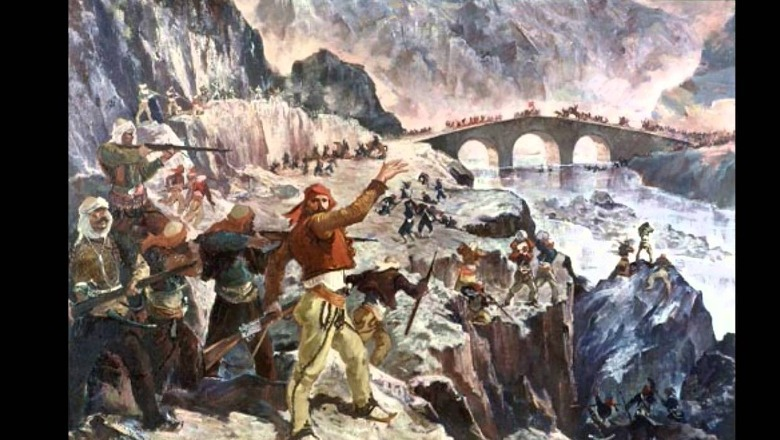
The Albanians of the north who mobilized under the leadership of Mustafa Pasha, threw off their religious beliefs and instead wore the Plis and the saddle as the national symbol of the Albanians for headwear. As can be seen, Ottomans, in addition to denying the Albanians their language, also prevented the Albanians from wearing the national dress. The feudal lords and some of the ajans of Kosovo were not on Mustafa Pasha’s side. The feudal lords of Prizren supported Mustafa Pasha, while those of Peja were against him.
On March 19, 1831, Mustafa Pasha Bushatliu arrived in Prizren, and was preparing for a major battle against the Sultan’s army. From the losses they had against the Russian army, and the bitter experience during the battles in Peshter of the New Market under the leadership of Hasan Hoti, the Albanians told the Shkodran vizier Mustafa Pasha Bushatliu: “We will not be anywhere without you, and we cannot go far with you.” The Albanians in the area of Gjakova and Peja, all refused to join his army, except for Sefedin Pasha from Gjakova.
On March 27, the Albanian pashas entered Skopje, where the plan of military actions was drawn up. With Mustafa Pasha were: the Pasha of Prizren, Skopje, Vranje, Leskoc, Prishtina, Elbasan, the Anan of Tetovo, and many other Albanian leaders. Sefedin Pasha of Gjakova with several thousand soldiers, was sent to help Ali Bey, who had besieged Sofia, where Qor Mustafa Pasha was imprisoned. The siege of Sofia lasted 40 days and was finally conquered.
Hysen Hoti with his soldiers, on April 4, 1831, was sent to Veles, while Mustafa Pasha himself with 3500 of his soldiers went to Prilep, and on April 9, he was in Babun Han. The Albanian army of Mustafa Pasha was poorly armed compared to the Sultan’s army. In this battle, the Sultan had sent 1500 Orthodox Albanians from the regular army, which he had gathered from the Albanians of the south.
Reshid Mehmed Pasha had arrived in Manastir at that time. At the Babun’s Inn, Reshid Mehmed Pasha began his attacks, he first attacked the unit of Hivzi Pasha of Skopje. Hivzi Pasha instead of defending his positions, which were very important, he began to flee and abandoned the battle. With his action, Hivzi Pasha demoralized the other units of the Albanian army.
On April 21, 1831, when Mustafa Pasha was in Prilep, and in a fierce conflict against the Grand Vizier Reshid Mehmed Pasha, he suffered a heavy defeat in the battle that took place between Prilep and Veles. In this battle, Mustafa Pasha did not have any help from his Bosnian allies.
Miloš Obrenović, in order to keep his collaboration with Mustafa Bushatli of Shkodra secret, had at the same time sent one of his trusted informants to Reshid Mehmed Pasha (Grand Vizier). Mahmud Pasha of Niš in February 1831 had asked for money from Prince Miloš. Prince Miloš had also given aid to Mahmud Pasha of Niš, and had sent Dimitrije Tiriqi there as his informant.
This suited Prince Miloš, since he was very interested in having his own man in Niš. Prince Miloš chose to send Dimitrije Tiriqi to Niš, since he had been born in Niš, was educated in the West and knew the Ottoman language well. Tiriqi was sent to Niš through the consul of Belgrade with the excuse that he wanted to return and live with his family.
In fact, Tiriqi had sent money to Mahmud Pasha, who had been given to him by Prince Milosh, on condition that he accept him as his agent. Tiriqi in Niš was very well received by Mahmud Pasha.
To receive the financial aid in Niš from Tiriqi, to whom Prince Milosh had sent him, Mustafa Pasha sent Anton Juban there, but he traveled from Niš to Leskoc and due to uncertainty returned to the city of Niš. It was said that the money fell into the hands of Ottoman officials in the city of Niš.
The Albanian uprising under the leadership of Mustafa Pasha, undoubtedly aimed to have an all-popular character, to free themselves from the Ottoman Empire, and although this uprising did not achieve its goal, it awakened the national idea of our renascentists.
During the uprising, although the Albanians were divided into three religious faiths, the Albanian people were seen to be trying to unite as an ethnic formation, based on language, culture, tradition and the glorious wars that Gjergj Kastrioti had waged against the Ottoman army. This is also evidenced by the French traveler Ami Bue, who traveled through Albanian lands in the late 1930s and left these notes about the Albanians of those years.
Albanians still remember their leaders, Skënder Bey, Ali Pasha Tepelena, and others under whose leadership they fought against the Ottoman occupation. The Albanians of the mountainous regions, who lived without guards and without taxes, could not have any sense of respect for the Ottoman authorities. The Ottoman authorities treated the Albanians with the same bad and submissive policy as they treated the Bosniaks, writes Ami Bue.
During the implementation of the reforms, the Greek and Serbian people had the support of the great European powers, but also of Russia. The Albanian people, with the overwhelming majority of the Muslim faith, had not managed to create their own intellectual class in European countries during this period.
The Arbëresh of Italy were an exception, but in those years they had just begun to take the first steps in education and science. The Arbëresh of Italy, educated in the spirit of European Romanism, in the 19th century, managed to gain knowledge of the Albanian language and culture. Jeronim De Rada in the forties of the 19th century, and several other Arbëresh, wrote about the rights of the Albanians, about their autochthonousness in the region, and initiated the thesis that the Albanians are descendants of the old Pelasgians.
As can be seen, this current of the Albanian intellectual class that developed outside the ethnic lands was revived in the 19th century, at a later time than among other European peoples. The Albanian intellectual elite, which was formed in the Ottoman Empire, Syria and Egypt, had the concepts and ideologies of Asian states, therefore they served the sultan more than their homeland.
During the 18th century, from all the communities living in present-day Greece, an intellectual class of the Phanariots was created, which had created cultural, intellectual and political ties in many European countries. This intellectual class, formed in the spirit of the European Enlightenment, therefore enjoyed the support of European countries. This cultural spirit also included Voskopoja in the vicinity of Korça.
In this place, until the 18th century, the oriental Islamic culture had not managed to influence the cultural life of the inhabitants of this area. In the absence of the development of education and Albanian culture in the Albanian language, in other Albanian territories, Greek culture influenced this place. Although the Greek language began to be used in schools, the intellectual movement and concept was outside the influence of the Patriarchate of Istanbul.
Intellectual and cultural activity in Voskopoja was supported by the Patriarchate of Ohrid, which at that time was in opposition to the Patriarchate of Istanbul. In 1720, Voskopoja was equipped with a printing press, while in 1744, a high school was opened in Voskopoja, with an educational program of high schools of the most advanced countries in Europe.
In 1767, the Patriarchate of Istanbul suppressed the Patriarchate of Ohrid. In 1767, during the Russian-Ottoman war, the Voskopoja residents showed sympathy for Russia, and supported the Himariyots who had risen in rebellion. Seeing their activity, the Ottoman P. authorized the derebeks (rulers who controlled two or more villages) to attack and burn Voskopoja.
With the beginning of the bourgeois Revolution in France, interest in cultural heritage and classical style increased in European countries. Based on the studies of Winkelman and Romanticism, old buildings in ancient Greece were seen as a symbol of democracy, and thus immediately after the formation of the Greek kingdom, the anastylosis began for the conservation of many temples, and objects that had become support for the formation of the new Greek state.
Likewise, the Slavic peoples, at the end of the 18th century and the beginning of the 19th century, had managed to form the intellectual class in European countries. A small part of the Albanians, who were educated, or had served r in the Austrian army, at the beginning of the 19th century, they joined the Slavic movement, in the fight against the Ottoman occupation. This addition served the Serbian movement very well, and who later became Serbs, and fighting the Ottoman occupation alongside the Serbs, fought against the defenseless Albanian population.
At the beginning of the 19th century, in the city of Paris, the Polish political and cultural movement was formed, under the leadership of the Czech Pan-Slavist František A. Zach (1807-1892). Ilia Grašanin, the project of Nacertanja, was entrusted to the Czech Pan-Slavist František A. Zach from Moravia, which at that time was part of the Austrian Empire. Zach represented the organization of Polish emigrants, founded by Prince Adam Czartorysky.
Unlike the intellectual movements, previously formed among the Orthodox population in present-day Greece, and which, at the beginning of the 19th century, also began to form among the Slavic population of the region, both of which came up with national projects, the Albanian population was still suffering from the long phase of uprisings against the Sultan, and bloodshed for the Sultan’s interests.
The Greek and Serbian national movements also enjoyed the support of international diplomatic factors, before whom the Sultan was forced to grant privileges to these peoples. The Albanians had not yet managed to present a project for an independent Albanian state to international factors. In these circumstances, the Albanian uprisings were understood by foreigners as the last efforts of the Albanian feudal lords to preserve their narrow interests, which did not allow themselves to be subject to centralist supervision by the Sultan.
The involvement of the broad masses in these uprisings was seen by foreigners as a popular revolt against taxes, and mobilization as a nizam in the sultan’s army. As can be seen from foreigners, the Albanians were seen as an unorganized people, without religious and national unity, who for narrow interests, for positions and property were subject to the sultan, and were capable of killing each other.
In the Albanian territories, the feudal system was strengthened, which was led by the Albanian feudal lords themselves, this system had not made it possible for the development of the Albanian intellectual class, but often for personal interests they fought among themselves, sometimes serving the sultan, and sometimes fighting against him. In the Albanian cities, crafts and trade were developed, but there was no powerful capitalist bourgeoisie like in European countries.
The Albanian citizenry, always remaining in the service of the pashas and the sultan, was small in number, weak, and unable to lead any insurrectionary movement to liberate themselves from the Ottoman Empire. On the other hand, the mass participation of the population in the uprising alongside the Albanian ayans and pashas was great, because they hoped for their freedom from taxes and forced mobilization in the imperial army.
It must be admitted that the broad Albanian popular masses were very tired of the taxes that the Albanian ayans and pashas took from them. Another characteristic of these uprisings was that the uprising was carried out by the vast majority of the Albanian Muslim population, due to their flight during the forced mobilization in the sultan’s army. This proves that with these reforms the Ottoman Empire violated the elementary rights of culture and identity of the Albanian people, regardless of their religious affiliation.
Reshid Mehmed Pasha’s victory had a very bad effect on other Albanian cities. Under the influence of Mahmud Bey, the son of Sahit Pasha and Qerim Bey in the city of Niš, the inhabitants of Niš were encouraged, on April 27, 1831, to remove the 600 Albanian sejmen, who were supporters of the Albanian uprising in the city of Niš.
In these circumstances, the supporters of the sultan imprisoned Abdyk Efendi, removed Mahmud Pasha from Niš, and demanded Nizam soldiers for the vizier of Vidin and Belgrade. On May 6, 1831, Reshid Mehmed Pasha took the news to Mahmud Bey in Niš, and appointed him pasha in the city of Niš.
The Grand Vizier expected to take the city of Niš in mid-May. In these circumstances, the Pasha of Leskoc abandoned the Albanian uprising and joined the Grand Vizier. In these circumstances, Prince Miloš ordered the pursuit of Albanians wherever they were found in the region. It is known that in those years, Albanians lived in Belgrade, Kralevë, Kragujevac, Aleksicë, Cyprus and many other places.
Miloš wanted to put pressure on the Albanians in order to remove them from his pasha. To achieve this goal, he had also received support from the sultan, because both sides wanted peace to be maintained in the region and the rebellious Albanians to be pursued. Albanians wherever they were found were attacked, beaten and killed, without anyone being held responsible for their lives.
The news of the loss of the Pasha of Shkodra caused new complications because many pashas of Kosovo and the rebels abandoned him. The supporters of Mustafa Pasha of Shkodra, including Jashar Pasha, returned in Pristina. He took refuge in Vushtrri for a while. A letter from the Vizier Reshid Mehmed Pasha, sent to Jashar Pasha, reached him in Vushtrri.
The Vizier had written to him that he would be pardoned if he returned to Pristina, and if he began to collect food for the Ottoman army, which was about to enter Pristina. Jashar Pasha accepted the Vizier’s request without hesitation, and thus rejoined the Sultan’s supporters. Jashar Pasha was joined by Ejup Pasha Ferhatagic, so that the two of them prepared the terrain and food for the Sultan’s army, which was coming from Skopje towards Pristina.
In these circumstances, Mustafa Pasha of Shkodra remained passive even when there was an invitation to unite with the Albanians of the south. Mustafa Pasha’s passive attitude was used by the Sublime Porte for an expedition against Shkodra.
The Sublime Porte issued a firman demanding that the feudal lords of Shkodra implement the recommendations for the implementation of the reforms. The Pasha of Shkodra organized a gathering in Shkodra in which it was decided: That the Albanians would rise again in armed uprising if the Sublime Porte began to forcefully implement the reforms.
At this meeting, the Albanians demanded several conditions:
The same treatment of Albanians as Bosniaks in the Ottoman P.
The internal administration to be in the Albanian language.
The Albanian national dress to be recognized as a national symbol.
That the Ottoman P. recognize the Albanians all the privileges and independence of the Albanian tribes.
At the same time, Mustafa Pasha was in difficulty, because the army of the Grand Vizier, Mehmed Reshid Pasha, was supported by the Pasha of Prizren, the Pasha of Gjakova and Jashar Pasha of Prishtina. The help that Mustafa Pasha of Shkodra asked for from the Bosniaks did not come, and after the defeat he had suffered earlier, great unrest was caused in Mustafa Pasha’s army. This forced him to close himself, with thousands of his closest supporters, in the castle of Shkodra, and from there he made an attempt to make the last resistance.
With the demolition of the chimneys, and the Janissary system in 1826, the Ottomans began throughout the country to make administrative changes, change of cadres and continued to gather regular soldiers. Reshid Mehmed Pasha was relieved of his duty as Vali of Rumelia, and was appointed Sadriazam (Prime Minister), in his place the former Prime Minister Selim Pasha was appointed.
In these changes, the sanjak of Janina and Vlora were given to the son of Emin Pasha. Selim Pasha, as governor of Rumelia, sent Latif Efendi as myteselim (sub-governor) to Ioannina. These changes created disagreements between Reshid Pasha and Selim Pasha, and the country’s leadership was divided into two opposing groups. Reshid Mehmed Pasha’s supporters gathered under the leadership of Deli Koka and surrounded Ioannina.
Ago Husejn Pasha from Edirne was sent to Skopje, while Reshid Mehmed Pasha left for Shkodra. When Mustafa Pasha received this news, he sent 400 of his Muslim soldiers towards Manastir to take horses from the Christian population there. These horsemen left for Tirana, the Tirana nobility welcomed them, but told them that they did not want to go against the army of Prime Minister Reshid Pasha.
The rebels continued their way to the city of Elbasan, but when they arrived, they received news that the regular Ottoman army had entered the city. In these circumstances, many untruths were spread. Mustafa Pasha received news that Reshid Mehmed Pasha would land in Ulcinj with his ships and soldiers.
Reshid Mehmed Pasha did not go to Ulcinj but headed towards Shkodra with his army. When Reshid Pasha’s army reached Lezha, it encountered Mustafa Pasha’s supporters, where bloody fighting took place.
After Reshid Pasha crushed the rebels in Lezha, he entered Shkodra and forced the inhabitants of Shkodra to surround the Castle, and his army approached very close to where Mustafa Pasha and his supporters were sheltering. The Ottoman army began to fire cannons at the walls of the castle. The resistance continued for three months, but due to the difficult situation, Mustafa Pasha surrendered to the general of the Sultan’s guard, Ahmed Fevzi Pasha. After the end of this siege, the forces that had come from Anatolia withdrew to Shkodra.
Mustafa Pasha was sent to Istanbul and placed in a special guest house. When the sultan realized that Mustafa Pasha had been lied to by the pashas of Kosovo, he revoked the decision he had made to execute him. Later, Mustafa Pasha served in various positions in the Ottoman government, and for a time he was even governor.
After a short time, Mustafa Pasha, with his eldest son who had a high civil rank, were admitted to the sultan. The sultan gifted Mustafa Pasha with property and other valuables and a watch decorated with diamonds. He died in 1861 while on religious duty near the tomb of Muhammad in Medina (Arabia).
Ali Hifzi Pasha, governor of Skopje, Mahmut Pasha, prefect of Prizren, Sejfedin Pasha from Gjakova, Haki Pasha, the prefect of Dibra, Shashivar zade Ismajl Pasha, Asllan Pasha, Jashar Pasha zade Bahtijar Pasha, Abdyrrahman Pasha, the elder brother of Hifzi Pasha, Hysen Pasha from Vranje, the Albanian beylers Karafil Bey, Xhelil and Vesel Aga who had helped the sultan’s government and received swords and decorations decorated with diamonds from the sultan as a reward.
During these uprisings, the great tragedy for the Albanian population of Kosovo also occurred when Mehmet Reshid Pasha, from Skopje, entered Kosovo, and with him was a large number of Albanian soldiers, gathered as a nizam, and several Albanian pashas who were against the uprisings. This army of the Grand Vizier encountered the Albanian and Bosnian insurgents in central Kosovo, in the vicinity of Lipian.
Mehmed Reshid Pasha’s entry into Kosovo had the effect of further dividing the Albanians. On the other hand, Albanian and Bosnian insurgents waged war against Albanians, killing and burning many Albanian villages. In these circumstances, some of the pashas of Kosovo sided with Mehmed Reshid Pasha.
The army of Hysen Gradashqeviqi also managed to win over Jashar Pasha Gjinolli of Pristina, who left Pristina and took refuge in the village of Mramuer. The army of Mehmed Reshid Pasha consisted of the Albanian low guard from the Prizren region, led by Haxhi Ahmet Pasha, and was stationed in the village of Sazli near Ferizaj.
The Albanian and Bosnian insurgents decided to attack Ahmet Pasha and capture him alive. The army of Hysejn Gradashqeviqi headed towards Sazli, where the headquarters of the Grand Vizier was located. The Albanians who had been mobilized as a violent nizam, sided with the insurgents. Those who deserted began to be prosecuted by the army of Mehmed Reshid Pasha, in order to prevent the Albanian soldiers who were turning against him.
In the village of Sazli, a bloody battle took place, where Haxhi Ibrahim Pasha from Prizren lost his life, while the Grand Vizier Mehmed Reshid Pasha, Ivzi Pasha from Skopje, Abdyl Rezak Pasha from Peja and Mehmet Begu, who was the leader of the regular cavalry unit, were wounded.
In this battle, 2000 Nizams, 7 cannons, several tents, and the Grand Vizier’s kitchen with all the equipment were captured. After the defeat, the Grand Vizier and the other wounded pashas, along with Ibrahim Pasha, were taken dead to the city of Skopje.
This war had a great impact and the uprising spread to Skopje, Vrajë, Leskoc and other Albanian territories, which began to support the Albanian-Bosnian uprising against the reforms in the Ottoman Empire.
Gradashkevich and his army continued to pursue the Albanians, who were against the uprising, even in the areas of Ana Morava, where only a quiet victory was achieved by Sylejman Rogoçica near Kamenica against his attacks. Seeing the atrocities of the Bosnian army against the insurgents, Derall Pasha of Tetovo, who had previously been for the Albanian uprising, under the leadership of Mustafa Pasha of Shkodra, also came out. During the expeditions against the army of the Grand Vizier, the Bosnian insurgents completely burned the village of Smirë near Viti.
The Bosnian army under the leadership of Hysejn Gradashkevich, on June 11, 1832 from the Kosovo Plain, crossed into the Dukagjini Plain, in the cities of Peja and Gjakova. The cities were only with small units of the regular army, because the garrisons of the cities had gone to Albania, and were focused around the fortress of Shkodër, where Mustafa Pasha was imprisoned.
Abdyl Rezak Pasha from Peja, stayed for a while in Skopje, and monitored the situation in Kosovo, where he had a large number of his supporters to return. Asllan Pasha turned to Hysejn Gradashkevich for help, he replied from Mitrovica and Drenica. Gradashkevich left for Peja and took up positions near Peja. Many Albanians from Dukagjini were supporters of Abdyl Rezak Pasha, and were against the Albanian and Bosnian uprising. With the arrival of the Bosniaks in Peja, the Albanians who were against the Bosnian insurgents were locked in one of the mosques in the Peja neighborhood. Gradashkevich began firing cannons in the direction of the mosque.
An Albanian who had taken refuge in the Peja Mosque, afraid of not being noticed from the minaret, decided to jump from the minaret, because otherwise he could not go down. After jumping from the minaret, he remained alive.
When he noticed a Bosnian insurgent, he went towards him and took out his scimitar, and cut off his head. According to popular tradition, when Gradashkevich noticed this, he killed the Bosnian insurgent with his scimitar, it is said that he did this because it was not necessary to take the life of the Albanian, who remained alive after jumping from the minaret of the mosque, and there was an old song about this that the Albanians sang.
Due to the victory of the Bosnian and Albanian uprising against the Grand Vizier, Mehmed Reshid Pasha, near Lipjan, Vasa Popovic was also very happy, and immediately responded to the prince. cit Miloš Obranović.
An agent of Miloš Obrenović from Novi Pazar, sending news to Vaso Popović in Kralevo, about the victory of the Bosniaks, added that the Grand Vizier, Mehmed Reshid Pasha, blamed Mahmud Pasha Rotula of Prizren for his losses.
After the formation of the Greek kingdom, and the granting of autonomy to Serbia, the Albanian uprisings against the Ottoman Empire did not cease. The uprisings that continued 10 years later, under the leadership of Dervish Cara, began to take on a religious and fratricidal character.
The Christian population in the city of Shkodra had managed to convince the Grand Vizier to separate them from the Muslims of the city. The Christians had elected the koxhobashi (head elder for the Christian population) and twelve elders, whom the Grand Vizier had recognized. Christians were free to mobilize for war, but were obliged to pay an annual tax of 40,000 piastres to the sultan.
Austria also began to take an interest in the Christian population in Shkodra, where they were informed about their rights and freedoms through the Catholic clergy.
Conclusion
From all that was said above, we can affirm that the main causes of the failure of these uprisings during these years are: the lack of unity of the Albanian pashas, the loyalty of many pashas who sometimes opposed and sometimes helped the sultan, the lack of diplomacy, the lack of support from European countries, the expansion and poorly planned military actions, the dominance of the clan and tribal character of the uprising.
The rivalry of the Albanian pashas, who often fought among themselves, had not enabled the creation of an Albanian intellectual class to present the Albanian ideal in European countries.Their flag-waving had created leaders with unbridled lust, and drunk on raping their own people!
To learn from the historical mistakes of this period, it is of great importance how the failures of the Albanian movements of the 19th century were treated, to gain independence from the Ottoman Empire.
For the Albanian uprisings to be successful, I think they had to rely on two important factors, which for the fate of a people, are closely linked to each other. The internal organization of the population, the unity and strengthening of the ideal and the national project, which constitute the axis of a liberation movement.
Foreign political diplomacy, and finding the appropriate moment to start with an armed uprising, based on the degree of preparation, the level of national consciousness, the ability to reason before internal and international factors, the evidence of military and political ability, as well as the ability of the leadership to self-govern the state.
So, as can be seen in the circumstances of the beginning of the reforms in the Ottoman Empire, to fight against the regular Ottoman army, the Albanian feudal lords were not sufficiently prepared with food and military equipment, they had not created unity among themselves, and above all they lacked a strategy of action and the support of European states.
After the announcement of the reforms in the army, even though the Ottoman Empire had been involved in riots in Istanbul, and anarchy had been created throughout its territory, I think that Mustafa Pasha, with the military potential he had, and his preparation, should not have marched towards Istanbul, to lose the morale of his army, to be defeated by the Russian army with great losses.
Mustafa Pasha should not have trusted Prince MIllosh Obrenovic and Russia so much, but he should not have gone out of Albanian lands with his soldiers, to give up the siege of Sofia, and to do more to strengthen unity with the other Albanian pashas.
In these circumstances, the Albanian population was always in rebellion, but their rebellion did not take on a completely popular and national character. The Albanian pashas, uncoordinated among themselves and undisciplined, failed to organize a nationwide movement to be freed from the Ottoman Empire.
During the reforms he undertook, the Ottoman Empire transformed the obedient Albanian nobles and agallars into simple administrative officials, while those who opposed him he liquidated and sent to the regions of Asia Minor.
In these circumstances, the Albanian pashas did not have the opportunity to develop any broad national project, to rise in a nationwide movement, to form an independent Albanian state, as the other peoples of the peninsula did. Mustafa Pasha of Shkodra, although he had submitted requests to the sultan to respect the Albanian language, tradition and national dress, these requests had not been made by the other pashas.
Some Albanian pashalars, to protect their interests, often served the sultan, for some privilege, post or semi-autonomous government, in their region where they ruled. Albanian uprisings took place at different times and places, therefore rising sometimes at one end of the Albanian territories, sometimes at the other end.
Ottoman Empire suppressed these uprisings with Albanians, pushing them to kill each other, and in this way he managed to suppress them without creating the possibility for the uprisings to take on a nationwide character.
During the Albanian uprisings, the different religious affiliations also played a major role, and the possibility of general unification between the Albanian Christian and Muslim populations was not created. As was seen a few years later, these uprisings under the influence of the Bektashis often took on an anti-Christian character until the beginning of the national renaissance.
Ottomans had used the Albanians in the wars he waged from Asia Minor, North Africa to Europe, against Austria and other European states, while on the other hand, against the Albanian uprisings, he used his most distinguished soldiers with origins from the East and with Albanian, Greek and Slavic origins from the territories of Rumelia.
Albanian uprisings were often led by feudal lords, ayans and religious leaders, so this leadership was not able to give the uprising a national ideology, to unite Albanians regardless of religion and region against the Ottoman Empire.
The leaders of the Albanian uprisings, supported by religious clerics, bannermen and tribal leaders, did not have the intellectual class to seek help and support from powerful European states, so their requests were often addressed to Mehmed Ali Pasha in Egypt.
These leaders, who were not sufficiently educated, did not understand the foreign influences on Albanian lands, so during the last three centuries, they created secret connections with the Greeks and Serbs, who in this period were guided by Russian influence and policies, and who were also supported by European states.
From the secret talks with the Greeks, Serbs and Bosniaks at this time, the Albanians did not benefit from any help, but these connections became an obstacle to any possible cooperation with Austria and other European countries.
The Albanian uprisings, although they were carried out to protect the rights of the Albanian population, opposing oppression and violent mobilization to fight for the interests of the Ottoman Empire, did not have any success.
This movement in the eyes of the European peoples was not seen as a national movement but more as a clan and religious movement that had rebelled against the reforms and the new order in the Ottoman Empire.
The uprisings took place at a time when the Ottoman Empire had begun reforms, with the help and proposal of powerful European countries, therefore the war that Mustafa Pasha was waging against Reshid Mehmed Pasha, the Europeans saw this uprising as an internal rivalry between these two powerful viziers. This was one of the reasons that Westerners supported Mehmed Reshid Pasha who supported the reforms and was supported by the sultan himself.
The Albanian uprising during the years 1826-1832, although it expanded and was the largest uprising against the Ottoman Empire in the region, died down without yielding any results in gaining the freedoms and civil rights of the Albanian population in the region.
Viewed in terms of the historical circumstances of the time, we can say that these armed movements and uprisings against the Ottoman Empire in some form had the character of national liberation, but were delayed in time and uncoordinated, which did not take on national proportions, due to the deep centuries-old divisions of the Albanian pashas, religious divisions and narrow interests of tribal and regional clans.
Literature used
T. P. Vukanov?: Albanian Uprising 1826-1832., Vranjski glasnik, Vranje, 1969.
Bedrush Shehu: Albanian Issues in the Early 1930s, Prishtina Albanological Institute, Prishtina, 1990.
Sylejman Kylçe: Albania in Ottoman History, Tirana, 2004.
Alekdandar Matkovski: Dervish Tsar’s Uprising, Skopje, 1985.
Sadullah Brestovci:, Albanian-Serbian-Montenegrin Relations, (1830-1878).
History of the Albanian People I: Tirana, 2002
History of the Albanian People II: Tirana, 2002
Noel Malcolm: Kosovo a Short History, Prishtina, 1988
Danilo Vulovi? in the book Knjaževa kanalasi, knjiga prva, Nahija požeška 1815-1839, Belgrade 1953.
Ejup Mušovi?, Novopazarski pesnik Sulejman Tabakovi?, Mostovi, br. 19., Pljevlja 1973.
Jovan N. Tomi?, O Arnautima u Staroj Srbiji i Sandžaku, Belgrade, 1913
Aleksandër Meksi: Restoration of architectural monuments, Tirana, 2004
Ami Bue: Albania, in European Turkey, Tirana, 2011


 Balkan Academia