
Taken from Narod.hr. Translated by Petrit Latifi
It was not only Croats who were targeted by the Chetniks and the Serbian army, but also all the peoples who lived in the territory that these pathological minds imagined as Greater Serbia. Because of this, throughout the 20th century, in addition to Croats, other peoples were systematically and intentionally killed and persecuted: Albanians, Montenegrins, Bosniaks, Muslims, Germans and others…
The Albanians in Kosovo were a special target of Great Serbian violence and chauvinism throughout the 20th century, from the Serbian occupation of Kosovo and Macedonia in 1912 to the end of the war in Kosovo in 1999.
After the severance of all ties with Serbia, Kosovo, and especially Pristina, is being rapidly rebuilt and is today becoming an increasingly modern European city compared to the miserable status it had in Serbia.

On this day, January 30, 1990, Serbian authorities, still in Yugoslavia, brought tanks onto the streets of Kosovo’s cities. At the same time, fighter jets flew over Pristina to suppress protests by Kosovo Albanians. 27 Albanians were killed and more than 100 people were injured.
How did the Serbian slaughter of Albanians begin, which lasted an entire century?
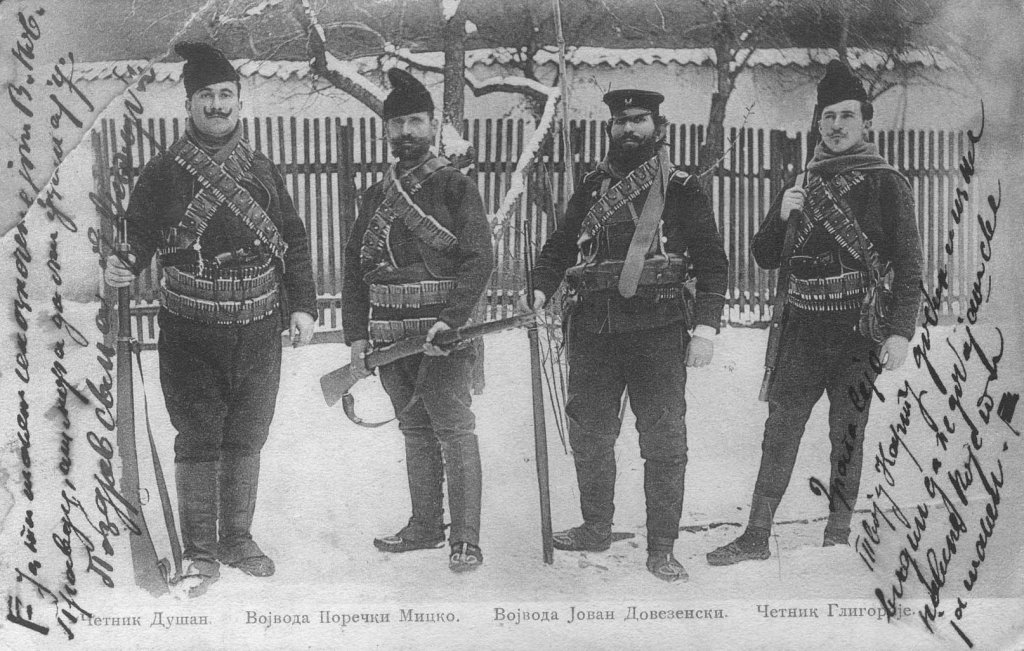
The Chetniks were the right-hand man (“elta units”) of the Serbian army in the Balkan Wars of 1912 and 1913, just as they were the right-hand man of the JNA in the Homeland War when they were the first butchers in Vukovar, a bloody feast for which the “red carpet” was prepared for them by Tito’s anti-fascist and criminal JNA, the alleged defender of Yugoslavia and the fictional “brotherhood and unity”. It was the Chetniks who committed the greatest mass crimes in all the Serbian wars of the 20th century, although the official Serbian army also burned, raped, killed, and ethnically cleansed large areas in its campaigns…
Regarding the occupation of Kosovo by Serbia at the beginning of the 20th century, the well-known journalist and founder of the Social Democratic Party of Serbia, Dimitrije Tucović, wrote in 1913 that “these days, a year has passed since the systematic extermination of the Albanian population in all the areas occupied by the Serbian army. In this year, a lot of human blood was shed in the ravines and fields of Balkan banditry.
What marks the Balkan wars as the most barbaric and bloodthirsty wars of the Dark Middle Ages, these are not streams of blood from one side and the other of dead armed men, but rather a river of blood of the murdered civilian population, innocent children, women, old people, all peaceful people whose only fault is that they prayed to God differently, spoke a different language, and that they naively waited on their hearths for the wild invasions of the Serbian army…
Tucović cannot forget the impression left on him by the reddening of the sky from burning Albanian villages, both in Kosovo and in Albania, whose north was occupied by the Serbian army (and the south by Greece) in the desire for this Balkan country to gain access to the sea. The fires of the burning Albanian villages were the only signal to the Serbian army until they reached the penetration of the Albanian territory.
The Albanian population, which was not killed, which could flee, was pushed by the army in front of them. With the fall of the Kumans, the whole world of the Albanian population, pushed by the Serbian army, gathered in Skopje, and most of them died while seeking refuge there. Tucović watched as a drunken Serbian soldier was amused by throwing the Albanians headlong at the Demir Gate, into the waves of the Vardar River.
” Just at night was the time that was always chosen for the execution of the worst crimes. People were taken from their beds and prisons to be slaughtered. “Peace” and “order” reign everywhere. Albanians disappear somewhere every night. And the hyenas would strangle them in a more humane way than the Serbs do , “ Tucović wrote.
Under strong international pressure, Balkan neighbors Serbia and Greece were forced to withdraw from the territory of the internationally recognized state of Albania in mid-1913. The newly formed Principality of Albania encompassed only about half of the Albanian ethnic territory, while a large number of Albanians found themselves within neighboring states.
These events greatly contributed to the escalation of the Serbian-Albanian conflict.
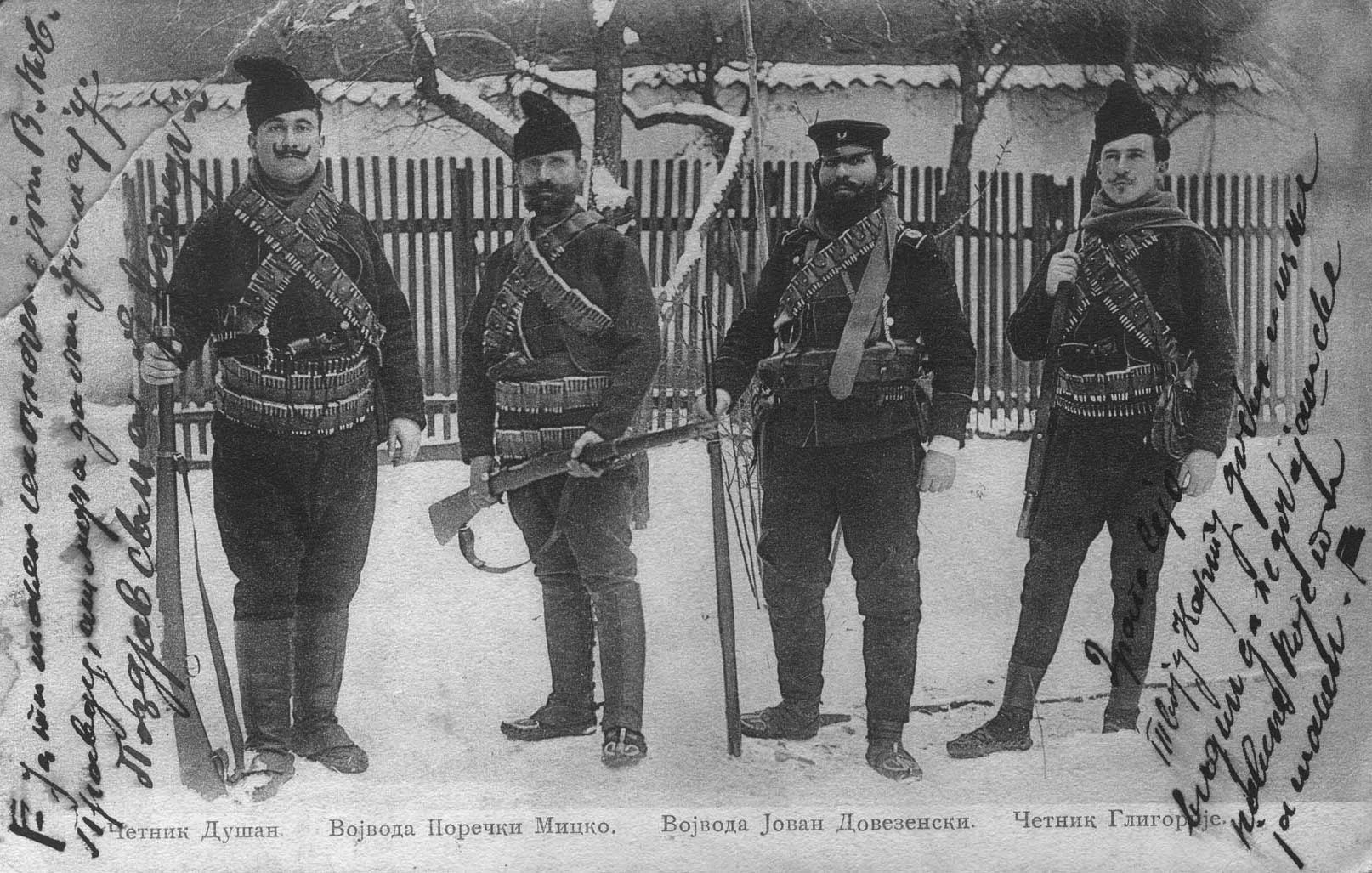
Chetniks in the First Balkan War – Bloody orgies against Albanians in Skopje and Kumanovo
Kosovo – colonization, terror and violence of Belgrade
After the occupation of Kosovo in the Balkan Wars, it was annexed to Serbia together with another occupied country by Serbia – Macedonia. At that time, a very small number of Serbs lived in these countries, both in Kosovo and Macedonia.
Nevertheless, Serbia, together with Kosovo and Macedonia, as a newly occupied territory, entered the First World War with 81% more territory than before the Balkan Wars, and came out of it even “richer” for the new territories: Bačka, Banat, Srijem and Baranja, now in the north. Of course, Montenegro, whose statehood was systematically destroyed, was occupied in 1918 and thus imperially expanded into the newly created Yugoslavia.
The terror against the Albanians, similarly to the Croats, began immediately after the establishment of Yugoslavia. Serbia allowed the establishment of private schools, but the language had to be Turkish. Serbia also carried out a systematic colonization of Serbs in Kosovo, placing them in key positions in the province.
The Albanian national identity was strongly advocated by the Albanian Catholic clergy and the Catholic Church, among whom there were many Croats, due to the low cultural level of the Albanians at that time. In Serbia and Kosovo, Croats lived in large numbers, not Slovenes, and yet the head of the Belgrade Archdiocese was almost always a Slovene, not a Croat. So even today, the Archbishop of Belgrade is a Slovenian, Stanislav Hočevar. It is very interesting to think about why this is so…
A large number of Croats also lived in Kosovo, at that time more than 10,000 people. Because of this, the Serbian regime carried out persecutions, but also the killing of Catholic priests such as the Franciscan Konstantin Shtjefen Gjeqovi (Tjefen Đečovi), a native of Janjevo, parish priest in Zjum near Prizren. Contrary to the policy of the hodja and mufti, in 1930 three Catholic priests sent a petition to the League of Nations in Geneva with the aim of protecting the rights of Albanians, regardless of their religion, but they became victims of Serbia’s colonial policy.
One of the Croats from Kosovo, Fr. Alojzije Palić, is currently in the process of being canonized as a Blessed, and he was killed by the Serbian army in 1913 as part of the terrible crimes they carried out against the Albanian and non-Serb population at the time.
Changing the ethnic structure of Kosovo by settling Serbs
In order to change the ethnic structure of Kosovo, the Serbian government carried out ruthless colonization and brought the Serbian population to Kosovo from other parts of Yugoslavia: Lika, Banovina, Kordun, etc. This also began the seizure of land from the Albanian population. On the political level, the Serbian government also cooperated with the Islamic element.
Counting on the lack of Albanian national consciousness in the Islamized part of the Albanian population, it allowed the work of the political party Džemije (Unity), founded in Skopje in 1919, whose goal was to protect the interests of Albanian Muslims. This party cooperated with Serbian political parties, for example with the radicals – centralists and democrats-unitarists.
In this political game, Belgrade found people from Albanian ranks through whom it implemented anti-Albanian policy (it did the same in Croatia, with pro-Jewish and pro-Yugoslav Croats, who still “pull the strings” of their own or family heritage today).
The Albanian population did not benefit from the reform because Serbs and Montenegrins were settled on the land taken from the landowners. Their colonization was accompanied by the systematic Serbization of the administration and education. Systematic repression led to new uprisings by the Albanian population.
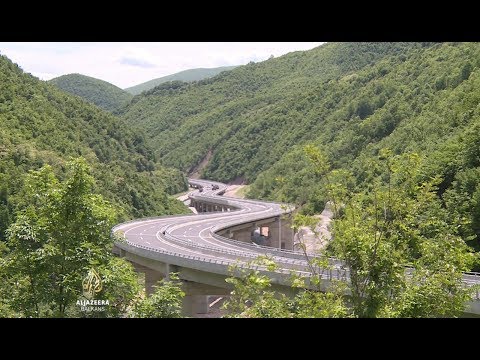
Independent Kosovo is being built – the newly built Pristina-Skopje highway
The creation of banovinas on the territory of Yugoslavia was aimed at crushing nationally dissatisfied groups, especially Croats and Albanians. In this sense, the assignment of the territory of Kosovo to the Vardar, Moravian and Zeta banovinas should be understood. The aim of this division was to reduce the Albanian population in these areas to the position of national minorities.
The genocide project of the Minister of the Government of Yugoslavia, dr. Vasa Čubrilović on solving the issue of Albanians by forcibly emigrating to Turkey. In 1937, Vaso Čubrilović made a genocidal plan “Emigration of Albanians” in Yugoslavia (Stevan Moljević had the same plan for Croats and Muslims under the name Homogenous Serbia, made in 1941). With this genocidal and criminal plan, the genocide against the Albanians of Kosovo was planned in detail (Vasa Čubrilović, Expulsion of the Albanians, memorandum for Stojadinović’s government from 1937).
World War II ended the state terror against Albanians in Kosovo carried out by Yugoslavia, specifically Belgrade and its Greater Serbs. During World War II, for the first time in history, the majority of the Albanian people found themselves in a unified national state, although it was a creation under the influence of fascist Italy.
The majority of the Albanian population welcomed the changes brought about by World War II, as the Serbian state terror had ended. Until the German withdrawal in November 1944, there was no liberated territory in Kosovo for Serbia, as most Kosovars were in favor of cooperating with the Germans, who were a guarantee that they would not have to be subjugated to Serbia again. Fighting with local forces that sided with the Germans lasted until March 1945.
Tito’s Yugoslavia and Kosovo – Greater Serbian terror and killings again
With the establishment of communist Yugoslavia, in 1945, Kosovo received limited autonomy within the Republic of Serbia (as the Autonomous Province of Kosovo and Metohija; since 1963, the Autonomous Province (AP) of Kosovo and Metohija).
The historical strain in Serbian-Albanian relations, the national and ideological split, and the revolutionary actions of the communist government made political stabilization difficult. The political supremacy of Serbs and Montenegrins was maintained, despite their smaller numerical representation. After the deterioration of relations between Yugoslavia and Albania (since 1948), state repression was intensified in Kosovo. For example, in 1956, a large number of Kosovo Albanians were convicted in a rigged political-judicial trial in Prizren.
The similarity of the situation in Kosovo with Croatia is not accidental; these two peoples were a thorn in the side of the Greater Serbs for their complete dominance in the “Serbian lands”, as the pathological minds at the head of the Greater Serbia project called them.
There were state repressions and trials of Kosovo Albanians (in 1964, among those convicted was Adem Demaçi, who became one of the more famous Albanian political prisoners).
In 1968, Kosovo received greater autonomy as part of Serbia, so it was renamed Socialist AP Kosovo. Towards the end of November 1968, protests by Albanians were held in Pristina demanding the status of a republic for Kosovo. Since the beginning of the 1970s, the number of Albanian communist cadres in administrative and other positions has been increasing. services, which weakens the Serbian political supremacy, which is also threatened by demographic changes, which gradually reduced the share of Serbs and Montenegrins in the Kosovo population.
Demonstrations in Kosovo drowned in blood (1981)

The disintegration of Yugoslavia is considered to have begun a little less than a year after the death of Josip Broz Tito, in the spring of 1981, when the Kosovo Albanians demanded the status of a republic for Kosovo. During the mass demonstrations, which will be stopped by the declaration of a state of emergency and the JNA’s appearance on the streets of Pristina, nine demonstrators were killed, and 250 will be seriously injured.
In response to the emergence of so-called “Albanian nationalism”, there is a rise in Serbian nationalism and Chetnikism, which calls for the alleged protection of “endangered Serbs” in Kosovo, following the pattern we saw in Croatia when this phrase was used to prepare the ground for war and the destruction of the Croatian people.
The old Byzantine school, the same methodology, which was carried out with the same intolerance and systematic persistence, imbued with hatred, against Albanians and Croats in Yugoslavia.
The battle cry of these calls would become the alleged rape (the victim, as well as the investigators, spoke of both self-harm and rape) of the Kosovo Serb Đorđe Martinović by Albanians in 1985. All of this resembled the alleged ‘Ustasha’ attack on the Serb Miroslav Mlinar in Benkovac in 1990, which was the cause of the armed rebellion of the Serbs in Dalmatia, as well as the prelude to the war in that region, and the destruction of the Croatian people in Dalmatia.
The newly built Catholic Cathedral of Mother Teresa in the center of Pristina

Cathedral Tower:

SANU and KOS are starting to create Greater Serbia
Less than a month after this event (May 25, 1985), SANU began working on its famous memorandum on the Serbian situation in Yugoslavia, which actually called for the creation of a Greater Serbia with a border along the Virovitica-Karlovac-Karlobag line.
Of course, all this work was synchronized and organized by KOS, the JNA’s counter-intelligence service that worked to create initial positions for war and attacks on Croats, Albanians and others who would oppose the creation of a Greater Serbia in the event of the breakup of Yugoslavia.
On September 24, 1986, the main points of the controversial SANU memorandum were published in Večernje novosti, in which the authors, among other things, wrote the following about the situation in Kosovo:
“But the biggest problem is that the Serbian people do not have a state like all the other nations have. It is true that the first article of the Constitution of the SR of Serbia contains the provision that Serbia is a state, but the question inevitably arises of what kind of state it is that declares itself non-jurisdictional on its own territory and that does not have the means available to restore order in one part of its territory, to ensure the personal and property security of its citizens, to stand in the way of the genocide in Kosovo and stop the resettlement of Serbs from centuries-old hearths.”
The President of Serbia, Ivan Stambolić, declared immediately after its publication that the memorandum was a “deadly war manifesto for the Serbian commissars”, but his protest went unreacted. The next twelve months pass in the rise of Serbian nationalism and the struggle for power, which ends with the dismissal of Stambolic, who clearly condemned the memorandum and Milošević’s speech in Kosovo (“Nobody is allowed to beat you”). He was defeated by Milošević at the vote of the League of Communists of Serbia, who became the new leader of the Serbian Communist Party. Stambolić was later killed by the Milošević regime.
The situation in Kosovo is constantly on the brink of armed conflict, Belgrade carries out terror, repression, arrests and killing of demonstrators.
War in Kosovo
The war in Kosovo, after the war in Croatia and Bosnia and Herzegovina, comes as the last in a series of wars that began with the collapse of the SFRY, and which were initiated by Serbia with the aim of occupying other countries and creating Greater Serbia. In 1989, Slobodan Milošević gave an inciting speech at Gazimestan, in front of the entire public and the JNA, which took to the streets of Kosovo, during the celebration of the 600th anniversary of the Battle of Kosovo, and told the Kosovo Serbs: ‘ We are again facing battles and in battles. They are not armed, although such have not yet been ruled out.’
Ten years later, the war in Kosovo ended as the last war in which Serbia was involved and marked the end of Milosevic’s rule in Serbia. Therefore, it is often mentioned that ‘ everything started in Kosovo, everything ended in Kosovo’.
Modern and Europeanized Pristina after leaving Serbia:

Crimes of the Serbian army against Albanians – entire families were killed
There are countless crimes committed by the Serbian army in the 20th century against the peoples they wanted to exterminate or subjugate.
The crimes committed by the Serbian army in the wars they launched in 1991, with their attack on Croatia, are countless.
As for Kosovo, it was violence that was just a continuation of the Balkan Wars. Over a million Albanians were driven from their homes, in ethnic violence unlike anything Europe has ever seen.
On March 7, 1998, Serbian forces invaded the village of Prekaze and killed the leader and founder of the Kosovo Liberation Army (KLA), Adem Jašari (33). They also killed 56 members of his large family. Among those killed were 18 women and ten children. Only Besarta Jašari (10) survived .
The Serbian police in Kosovo, of course with the wholehearted support of the Yugoslav Army, carried out mass persecutions of the Albanian and other Muslim population of Kosovo during 1998 and the following year.
Albanian residents were given a short time to leave their homes after the verbal order to evict. They could take only the most necessary things.
Their Serbian neighbors, as well as gangs of criminals from Serbia itself, also participated in attacks on villages, murders, rapes, looting and burning of houses and apartments.
On May 25, 1998, in the village of Lybeniq, Serbian police killed eight members of the Albanian Hamzaj family … They were executed in front of their house, which was then set on fire.
By July 1998, the Kosovo Liberation Army (KLA) guerrilla forces had grown to several thousand members and established control over about 40 percent of the province’s rural areas, including several strategic locations. In mid-June, the Serbian authorities no longer controlled the main road connecting Pristina and Peć, as well as the northern road between Kosovska Mitrovica and Peć.
The KLA called these areas “liberated territory”. However, apart from the military component, the organization gained an increasingly strong political dimension, which clearly emphasized the desire for the creation of an independent Kosovo state – for independence.
Having completely lost patience with Milosevic’s aggressive policy, the international community decides to intervene militarily in order to prevent further escalation of the conflict. NATO officials have threatened military intervention if the Serbian army does not withdraw from Kosovo and allow the deployment of peacekeeping forces.
Milošević refuses, which ultimately leads to NATO bombing of Serbia. The Serbian ‘leader’ is soon forced to withdraw from Kosovo… and the rest is history.
Kosovo is today a young state in the process of development and progress, and its army is a guarantee to it, as it is to Croatia, that Serbia will never set foot on its soil again.
Reference


 Balkan Academia