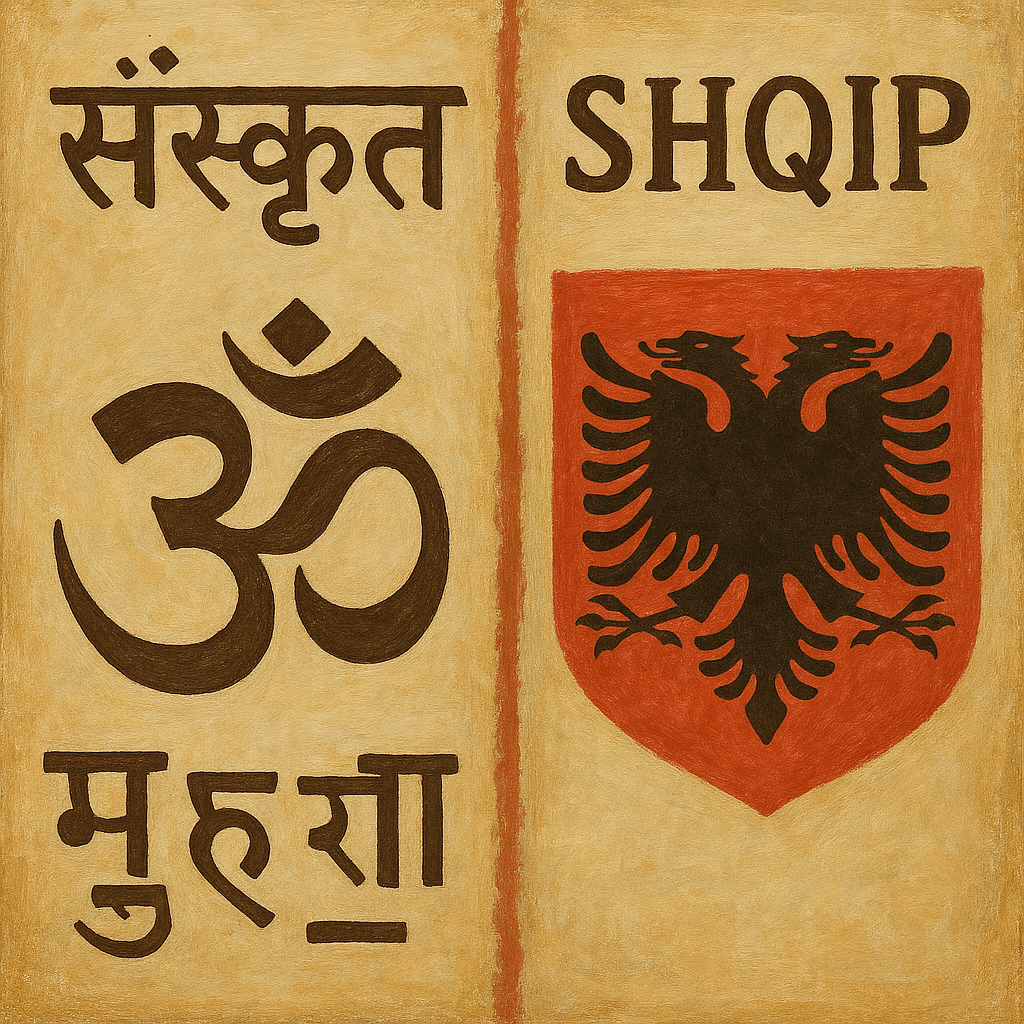

Authored by Përparim Kabo. Original book by Petro Zheji. Translated by Petrit Latifi

Petro Zheji, author of “Sanskrit and Albanian” and “The Messianic role of Albanian”.
Every afternoon he would sit in the scientific hall of the National Library with a pen and ink and work on white paper. The mission had taken root in the mother’s womb, – as Petro himself says. He would argue that, what is the Albanian language? How old is it? Where are its roots? How paradoxical is it in its idiomatic expressions? And consequently, how modern and inexhaustible is Albanian?
Some looked at it with surprise, some with pity, some called it a lost mission and some pseudo called it “mad”, that it was engaged in a useless work, because according to them, these things about Albanian had been said by others and that the Albanian issue had been resolved. It was an Indo-European language, it was known in which group it was identified and how old it was, and how much and how it resembled and where it differed from other languages.
It was the time when Professor Çabej at the University of Prishtina was holding a long series of lectures on “Introduction to the History of the Albanian Language” and “Introduction to Indo-European Studies”. Sanskrit was also accepted by him as a primordial language, because the Indian language of the Vedas was the only one documented as the oldest written language.
As such, it was taken as the beginning of other languages considered Indo-European, but which had derived from it. But did anyone have the scientific courage to study the Sanskrit language? To read and interpret it, its words, its lexical wall, and to make comparisons with old Albanian, looking at the similarities and differences? None other than Petro Zheji in his two-volume study “Albania and Sanskrit”.
The work is a monument of scientific and academic thought, between the dialogues of history and philology, philosophy and mathematics, logographic calligraphy and symbolism, cosmogony and cosmology, religion and transcendental interpretations, of mathematical symbolism and modern and natural science. As such, it surpasses all previous studies that treat language as a disciplined grammatical matter and as a comparative historical etymology, where the argument remains only that related to the construction of the word and sentence, and not the construction of thought, which is the soul, foundation and immaterial root of the word.
This is the distinction that Petro Zheji makes. He studies the ideological essence of the word and language, and then the material expressive shell. Like an archaeologist, he finds the semantic motif of words, and not simply the structure of the form with prefix, theme and suffix, as has been done by many respected linguists. Professor Çabeji has stated that Indo-European languages know the end in derivatives but not the beginnings.
I quote the professor: “In Indo-European languages, we must be clear that we only have ending points, the specific Indo-European languages, whether these are documented in writing or from centuries before the new era, they are always a result, not a starting point.
The starting point there is always in question.” (Eqerem Çabej, “Introduction to Indo-European Studies”, page 54, “Çabej” publishing house) With formal logic, this means that it is not known, or that I do not dare to say what comes before them, but I do not say that we do not have to look for anything else, because there is the beginning, it is the base and everything flows from them. Petro Zheji, on the contrary, researches there, to what is considered the first known, to Sanskrit, and jumps beyond it, bringing a deep and fundamental study when reasoning in the equation of Albanian and Sanskrit.
No one, neither before him, nor in his time, nor currently, has dared or dares to delve into this work so deep, so challenging and so scientific. Outside Albania there have been and are such researchers. Professor Çabeji mentions a number of researchers who, after geographical discoveries and travels to India, noticed similarities between Hindi and their languages in many words.
He mentions since Filippo Sassetti in 1500, the Jesuits Bonaventura, Paolino de Bartolomeo, Bethelemy, Coeurdoux, the German philosopher Leibniz who noticed that there are some analogies, affinities between German, Persian, Latin and Greek. “But especially the Englishman Colebrooke, in the last part of the 18th century, we can say that he is the founder of Sanskrit philology,” – this is how Professor Çabej concludes his presentation.
Even the comparisons of Albanian as an Indo-European language, the distinguished linguist realized by making comparisons with Latin, Greek, Thracian, Celtic, Slavic, Baltic languages, Armenian, sometimes even with Sanskrit, etc. But he did not have the courage to travel to the source, Sanskrit. What the scientist Eqerem Çabej did not do, the genius Petro Zheji did.
Linguists, I am talking about their serious generations, have dealt long and deeply with the linguistic aspect of thought materialized in the word, analyzing its construction, and here the main focus is identification, affiliation and features, based on linguistic comparisons, highlighting similarities grudges, differences and unique features. They have also been extensively involved in historical etymology, where the essential development of the lexicon takes place, from old and very old words, to the newest lexicon.
They have diligently underlined the developments of words, which in a way, although they have evolved, have preserved in their essence that motivating particle since genesis. In his lectures held in the 1970s, Professor Eqerem Çabeji stressed the need to study the philosophical aspect of language as thought, but that this remained simply a preamble. It should be clear: it is not a question of analyzing philosophical thought expressed by language, but we must enter into language as thought and what are the epistemological principles of the creation of thought, since the mythological cosmogonic genesis as the first expression of worldview.
More simply, if it is right and scientific to carry out the examination of historical etymology, why is it not equally necessary and with scientific obligations, to follow step by step how thought has evolved historically as the content of language and how in this development this semantic essence has motivated the material form of existence and expression, as well as the spoken and written language.
Precisely this fundamental study in the lands of the Pelasgians-Illyrians-Arbërorians and Albanians, was carried out by the worker of thought and the courageous scientist, the challenging innovator Petro Zheji. With his work “Albania and Sanskrit” Petro Zheji has succeeded, even though the circles of linguists have either not studied his work, or have not understood it, or do not dare to overthrow their taboos, or worse yet, are burdened with a jealousy, which only spoils the work in the “great magic” of science.
Petro Zheji takes over 1000 words of the Sanskrit language and compares them with Albanian and French, but also with other languages. He finds similarities between the first two, but also an absolute difference with the French language, because the words are completely different.
This Albanian-Sanskrit similarity (concordance) is not in form, but in the basic forming units, in glosses. That is, in the smallest meaningful units, beyond which any further division would no longer have value, because the meaningful boundary would be crossed and we could end up with the letter as a primordial sound, so we would no longer be in the word. And Petro Zheji discovered the self-sufficiency of Albanian as a word meaning and as a system even in monosyllabic words, which motivate an abundant lexicon in other languages.
This is otherwise known as the phenomenon of isoglossism between languages. Other researchers have long used this study methodology. Petro Zheji goes to the heart of the report, daring and trying out a scientific equation, which was first Sanskrit and later Albanian, or the opposite, Albanian earlier. Without rushing into preliminary statements, let’s follow some comparisons that Petro Zheji’s study generously offers.
Sanskrit – Albanian – French
1-çladh çlidh relëchër
çlodh (release, release, relax)
2-dâru dru boi (wood)
Here we see the comparison, but for the sake of the place not in order and impossible for all the words. Anyone who is seriously interested should study the work and not rush, to their own detriment, manifesting exemplary ignorance, to say, “eh, these things have not been proven”.
11-gini-(guru) guri pierre, montagne
(stone, mountain)
20-krimi krimbi ver, larve (worm, larva)
32-Lap llap causer, bavarder (me llap)
83-ghatita gatitë produit, effectué par, fait de…
100-as-asit âsh, âsht être (qenë)
Ishte, washit
Another exploration by researcher Petro Zheji is related to compound words, or composites as they are also called. If we take compound words of the Sanskrit language and divide them into their constituent parts, in a formal logic it should happen that the parts have meaning and can be explained within the lexicon of this language. But if it happens that the compound word is decomposed into parts and the latter within itself can be motivated in a meaningful way by comparing them with words of Albanian and not of the Sanskrit language, what does such a reality mean?!
The similarity is acceptable, but the dependence and derivation are such that it provokes the question of which is the first language, Albanian or as J. de Rada called it, our Albanian Lingua primeva, key language. Petro Zheji, like other serious researchers in the field of language (outside Albania, of course), uses extralinguistic instruments in his studies, so his research is modern and as such he dissects the anatomy of language. Let’s take a compound word of the Sanskrit language – a composite, and see how Petro Zheji decomposes it into its semantic components.
In Sanskrit, upa-rati = French, mort (Albanian: dead).
In Albanian, there is no correlative word similar to it. “However,” Petro Zheji reasons, “this simple Sanskrit word is decomposed through Albanian into these elementary, meaningful units u-pa-rat, or more precisely, u ba rat.”
u-diateza of the past participle in Albanian (e.g. u çova, u dogja etc.)
pa-verb Albanian ba (baj, ban, banë etc.)
rat-participle of the Albanian verb with ra (French, tomber, German fallen)
After this anatomical decomposition, Petro Zheji summarizes the operation by drawing the conclusion: “None of these elements u,ba,rat exists in a free state in the system of the Sanskrit language… it is not able to motivate, within its linguistic system, without leaving it, its word u pa-rati, therefore it is not able to tell us why this word expresses the notion of death.” (Petro Zheji, book “Albania and Sanskrit”, pages 18-19, publishing house “Rrënjët”).
To discover why a word expresses in the semantic aspect a state, phenomenon, occurrence, function, relationship, report, experience, thing, object, imagination or notion, etc., this means to explain how thought was materialized in the semantic instrument with phonemes called language. This aspect is the philosophy of language as thought and is related to its conception in the transition from thinking to expressing.
This limit, both dialogical and enigmatic (e.g. why was this word chosen for this notion and not another, e.g. day for day and not another and so on), through logical digression, from the formed to go to its semantic elements, is the way back to go to the starting point, accepting that the reasoning for building meaningful communication with thought as a feature of only humans, could only come from the first simplest semantic elements.
And if linguists unanimously agree that Sanskrit is the oldest language, then by proving to them that, “the Albanian language system includes that of the Sanskrit language, and therefore, is more ancient than it”. Whoever is afraid of this reasoning either lacks the courage that science requires, or is for shallowness, or will vegetate on everything that has been said since the time of Hanni and Meyer, – because it is known that found prefabricated structures are the best shelter for those or those who never created anything themselves, – let them be silent!
Professor Çabeji had more than once put forward the need for language to be researched as a social phenomenon. As such, it is related to philosophy, ethnogenesis, historical give-and-take, mythology, myth, geography and geopolitics, conquests, ritual, open and closed life, pastoral speech, civic life, orality, the creation of standards, influences within the broader group and subgroups, culture and subcultural layers, religion, primitive artisan activity, industrial activity, and in our times, technology, globalization and multiculturalism.
Only in this perspective does language acquire plural dimensions and not remain just a philological instrument of communication. Language as such cannot derive its functions from grammar, syntax, phonetics, morphology and orthography alone. And finally, language cannot be understood, explained and argued in its omnipotence, neither by linguists alone, and moreover not only by narrow linguistic studies.
Its meaning comes from the thought it carries. It is constructed as thought and expressed as language. It is reasoned and then expressed. It is constructed as a logical argument and then presented in words. The act of thinking and the words used is the “magic” of the human mind. It is the greatest creation in all time.
This creative act continues without end. Terms as linguistic notions with special semantic value, are not solid, random and prefabricated products. All the words of prehistory, of the initial time of twilight, have been part of the wall of the lexicon that explained the creation of the universe, in a naive, mythological and religious way.
The merit of the true researcher is that that lexicon, those mythical words, that some call “the language of the gods”, some “living fossils”, that is, the oldest words, the first stones of the language of that people who built reason through cosmogonic mythology, whether they come to our days unchanged or with deviations in standardized derivatives within the same language, or in other languages as borrowed with overlays of new times, are taken, the superimposed stratification is removed and they go to the bottom, in order to study the initial, basic linguistic material, without which the spontaneous worldview and forms of consciousness could not be built, but neither could it be researched in our times, to identify the founding languages or language, as well as those that have derived from them, or that have acquired the lexicon from those primordial languages.
Petro Zheji is of these research waters. He takes and analyzes the first form of cosmogonic knowledge, which speaks of the creation of the world. The question is simple: Is the creation of the world according to Christian Judaism accepted, as is the sin of Adam and Eve, and is this whole story described? The answer is: Yes! We will not go into the facts here as to whether this explanation is credible or not, whether it is scientific or yes no.
We need to analyze how this entire cosmogonic event was expressed, through written words or oral narration, so simply what is the cosmology used? What place does Albanian have in this history? Does it have interpretative power? Or more directly: Was our language born in that prehistoric time? If so, what is its role? It is understood that, in these circumstances, it is not enough to be just a linguist to give the answers. Petro Zheji is a philosopher, philologist, mathematician, expert in higher mathematics, physics and modern ones such as quantum physics, which surpassed the principle of causality, he is a deep expert in Christianity, Orthodoxy, Islam, both in their liturgical and ecumenical aspects.
He is a connoisseur of symbolism, the semantics of calligraphy, and as such, the multifaceted researcher Petro Zheji is able to transfer the explanation of the history of Albanian and its interpretative capabilities to this multidimensional studio, carrying out the study that no one else, neither before, nor currently, but apparently not in the future, will be able to accomplish.
Let us take a closer look at what is known by Christian Judaism as the birth of the material world, due to the disobedience of Adam and Eve to God. Or as it is also known, “original sin” (Italian: peccato originale). The act is a separation from God and the creation of the material world. As the philosopher Paracelsus wrote that “Die SEPARATIO is taller Geburt Anfang” – Separation is the cause of every birth”.
This act was also a sin, therefore, – underlines Petro Zheji, dirije-dnyrë, is separation from God. The Latin word is derivative, which is motivated by the Albanian “bër DAR”. According to the Judeo-Christian myth, the rebellious angels led by Lucifer, rebel against God, as a separation from him, which made Lucifer also a Demon. This is thanks to Albanian is d a m u n, i.e.: separated. Only Albanian finds in its lexicon the literal words of this act, because separation is fëlë (it is understood that separation is fëlë, I divided it into fëlë) as well as the word fill-filloj, i.e. separation from God as a beginning.
“The fact that other languages are not able to explain their own words, proves that they are built using recipes and borrowed, or even stolen, material”, – concludes Petro Zheji. We are required to be careful; there is an essential difference between the above reasoning and the work of other linguists.
The latter, with the linguistic interpretation of words from other languages, accepting a priori their meaning and existence, do not ask when and under what circumstances that word was created, and how they served in the worldview starting from the older mythological and religious one. They a priori accept as the original word what is better known than it comes complete.
This kind of archaeology is shallow. But let us continue the reasoning on the ontological cosmogony and how it is expressed through language. The act of creation is in one word bër Dar, made by division. In old Albanian, as reflected in the Albanian-Greek dictionary of Kostandin Kristoforidhi, Petro Zheji argues, we find the word bdaj=bëj (Italian-fare). Albanian is more cosmogonic, bëj bijemënë. English is done=bërë which is Albanian danë = division.
Italian is fato. And also, Petro Zheji underlines, Albanian is pronounced “bërë”, Sanskrit is bharâ. In general, all linguists are concerned with the morphological analysis of the word, according to the formational structure, with the structure of the form. At the beginning, the root of the word is determined, and by adding the suffix, the subject is created, by adding the ending, the noun is created. This is an analysis of form and not a philosophical contemplation of the thought that materializes in every word.
Professor Çabej had left the path open when he wrote that, “Yes, the roots themselves can often be decomposed, and they themselves can be analyzed further.” This is the analysis that Petro Zheji was able to carry out, not by breaking down the roots of primordial words into letters, because such a thing would not make sense, but by breaking down the semantic content, as not simply a grammatical root, but as an existential starting point of the word in the service of the level of consciousness and worldview, when the initial words, mostly monosyllabic, were created as the stones of the lexical wall and as semantic sign systems of mythology and the monotheistic religious worldview later.
He is the first to speak and reason about the philosophy and logic of language since its formation. Language in its beginnings cannot be evaluated with today’s modern mentality and with the linguistic system created in the times of modernity. Why in explaining the findings of prehistoric material archeology do we not use modern technology to explain the production of that time, but what was actually used at that time; while in language, some linguists are mistakenly required to apply the rules of today’s or modern language in the general sense of the word in interpreting archaic language.
Lack of coordination leads them to get stuck in layers shallow linguistic material. It should be kept in mind that the journey of languages to their standardization is very, very long, like a marathon, some cut it short, enter the middle of the race and say “I am a marathon runner”, when they are half-way through.
And in reason, mythical thinking must be distinguished from the conceptual scientific mentality that we use. “We are dealing,” Petro Zheji underlines, “with two different codes, one essential (primitive mentality, mythical thought), and the other formal (modern mentality, conceptual thought), which differ from each other because:
1) The first operates through symbols, the second through concepts
2) The first is at a deeper level than the second
3) The first has within it (contains the second)
In his fundamental studies, the researcher Petro Zheji, addressed in his life’s work, entitled “The Book of Aphorisms”, analyzing the language of paradox as an expression of the most advanced thought since Antiquity, through complex reasoning from mythological and cosmological, mathematical and especially referring to the reversal that quantum physics brought in the explanation of coexistence without cause-effect conditioning, as well as focusing on what happens in paradoxical logic, where diametrically opposed things meet at one point; all these phenomena, therefore, Zheji reveals the aforementioned in the esotericism of the Albanian word and in the combinations of expressions such as aphorisms.
It is that miracle of thought and expression that Albanian has built and preserved over the centuries with a primitivism that brings our language to us as a universal treasure to our days. Let us present some of these analyses. To understand the philosophy of language, we will have to take into consideration the symbolic algorithm of language that comes from early prehistoric times and the logical algorithm that is related to language that was formalized with the birth of science and conceptual systems.
Considering Albanian as one of the languages that has built the symbolic algorithm alongside other languages, means recognizing an early attribute of it since its creation. Neglecting this essential feature means misbehaving with the fundamental element of our identity as Albanians. “The Book of Aphorisms” is the most complete and exhaustive study that can be built to our days on these characteristics of Albanian.
The author explains how reasoning on the symbolic algorithm is also transformed into a symbolic, figurative and mathematical equation, moving from word to sign and vice versa, from sign to word, but by combining words, the paradoxical combination of language is built, which in mathematical terms builds the algebraic equation. Interesting are the homonymous pairs of words (i.e. a word with two meanings); e.g., the word “fshij”, which has the meaning of cleaning on the surface, but also erase, remove, remove, hide.
But let’s go further, combine them in a paradoxical formulation; “what is hidden is only hidden (hidden)”. The primitive language in an expressive asceticism has built this paradoxical logic, which today has been brought back into use by both modern science and philosophical thought, which has moved away from the simple Aristotelian logic where x=x and never x=-x, while modern thought on a scientific and experimental path arrived at the point where the language predicted it, that x can be e = even with –x, equal as different, or as a meeting of completely distant opposites, or even further, of a word that with its ambiguity indicates two completely opposite ends.
Here is an example: The word of our wonderful Albanian “përpara”. Përpara in the past tense, the word comes, “a long time ago this event happened” (identification in the past). But we say in another case that, “we have a long time ahead until that day arrives” (identification in the future).
Two diametrically opposed ends that, based on the infinity of time, can extend to minus infinity and plus infinity. Petro Zheji, with an unparalleled richness, brings together the esoteric fertility of the Albanian lexicon (esotericism is the multiplicity of meanings of a word) and the inexhaustibility of Albanian aphorisms, which in linguistic terms are short sentences, in logical terms are rational paradoxes in essence and with inconsistencies in appearance, and in thought are like philosophical equations that can be transcribed into mathematical equations (the connection of philosophy with mathematics is known as the highest level of abstraction).
Languages with a high level of esotericism are capable of constructing logical paradoxes and having a logical-philosophical attraction in expression. Our Geg dialect has preserved this way of expression more, so the sentences of the northern highlanders often surprise you with the simplicity of form and the more than unambiguous depth of essence. To quench your curiosity, let us mention one of the words that Petro Zheji explains.
The word “voice” – voice. How many meanings does this word have? In addition to voice, it means something I am following, a plant or a tree takes root, a tradition takes root, a hoe takes root, a fight, a fight between two parties or two people etc… Let’s imagine that we combine this word with some of its meanings into an expression, without creating any misuse or cacophony, but by constructing an expression that, as an equation, does not show you the multiple values of x, but you will have to find them by implying the essence or multiplicity of the expression.
“Even from a single symbolic formula or equation we can extract information that affects both philosophy, theology and physics, by establishing between them a clear isomorphism relationship, or expressed in a more concrete and understandable language, a correspondence, a parallelism or otherwise and a metaphorical connection.” (Petro Zheji, “Book of Aphorisms”, page 150, publishing house “Mediaprint”)
Here is an example in the multitude of those that researcher Zheji brings. “Everything that is measured is matter”. In the scientific aspect, physics proves that the material is measurable, which does not happen with the immaterial (or as we say, the ideal). An ambiguous word is bisemic.
Let’s look at the word mat, matet, matter. In Sanskrit, the word is “matra” and has two meanings: both mat and matter. In Albanian, we have matje and matter. Here is how an aphorism is both a language of paradox, a symbolic equation, and a formulation that kept hidden what science would prove in the future.
The “Book of Aphorisms” by researcher Petro Zheji has argued that, the closer we approach the study of language at the time of the creation of the world, the clearer things become, the meaning of the universe and communication. The tool is language, even though it is mystical and mythological; as such, it formulated in the conditions of the lack of science symbols and their combinations in symbolic equations of reasoning that are simple in appearance, but profound in the messages they transmitted.
It was the language that served for the transition from the naive transcendental logic to the paradoxical aphoristic one of man who created cosmology as a worldview and cosmology as its logical vocabulary, with words and expressions. Aphorism, this feature of Albanian, is also a symbolic plural or symbolic spectrum; disemia (a word with two meanings), trisemia (with three meanings) and so on.
The double or multiple meaning of Albanian words is an argument for its antiquity. These features help us to enter the philosophy of language as thought, and from here to understand that language as thought is found as philosophy, as mythology, as theology, as human sciences, as exact sciences, as art, as symbolism, and therefore as the most universal means of interdisciplinary knowledge. Petro Zheji proves also with Albanian, that language before it became a scientific concept, was linguistic symbolism and predicted and foretold that the world is an infinity, it is endless.


 Balkan Academia