
Written by Academic Prof Dr Hakif Bajrami. Translation by Petrit Latifi. Pristina, 18.12.2023

Academic Prof Dr Hakif Bajrami
The national liberation council of Kosovo for the spread of the anti-fascist war and the conspiracies against
On December 18, 1943, the circles of the Nazi-fascist government were seized by axiosa, because they had realized that the illegal action to organize the National Liberation Council of Kosovo had begun. In fact, on this date, the war activists on December 18 had completed the task of selecting candidates for the Bujan Assembly, which was supposed to begin on December 31, 1943. In this regard, the Yugoslavs would not stop the fight against the decisions of the Kosovo National Liberation Council for half a century. Here is the history of this event, which is a guiding foundation for where Kosovo should be aligned in its future.
After this historical event, anti-fascism in Kosovo among Albanians will take on a visible popular alignment, which influenced some intellectuals who had remained neutral, due to the fact that they did not want to be in the “dance” in the war with Serbia.
They weighed their position with the historical argument, therefore, without any hesitation, they warned of the risk of a possibility that the Albanian cadres-leaders would be betrayed: “if they cooperate with the predatory Slavs” and divided into four political camps.
Therefore, anti-fascism in Kosovo cannot be explained otherwise, only as a political alignment for national unity, because the Albanian people either had to unite with Albania, or the establishment of the Republic of Kosovo. Outside of these conditions, there was no disposition for anti-fascist war.
And these two possibilities, Albanian popular anti-fascism did not have the power to realize, without a genuine national policy, whether of the Albanian Communist Party, the National Front, Legality, Albanian National Democracy, the Albanian People’s League or the Second League of Prizren.
The truth is, Albanian anti-fascism at the end of 1944 and the beginning of 1945 was with a wide inclusion, due to the fact that the patriotic vocabulary was not lacking in any group. But the commitment to a real joint fight against fascism was lacking with the exception of the AKP, and this argument must be stated publicly. On the other hand, the AKP will be fought cunningly especially by the PKJ and by quisling policies of all colors.
But also by groups that collaborated with Nazism, such as Serbian organizations such as: ZBOR, Chetniks of all colors, then the Balli, Legality and up to the Second League of Prizren. In these circumstances, with all the old and new means, the anti-fascist forces (think in Kosovo, they created 9 Partisan brigades, which then turned into the 52nd Division with 56,000 fighters, where 96% were Albanians.
This force will become the saviors of Kosovo, based on the decisions of Churchill, Roosevelt, Stalin at the Tehran Conference, as early as October 1943. But, despite everything, the Albanian people did not gain what they dreamed of in action, namely what was promised in Bujan, they did not achieve national unification, because in continuity the Slavic Avnoists prepared dozens of political and military traps for them.
But the idea that turned into hope, especially after June 18, 1944, will never die. Based on the arguments, a significant part of the Albanian people has called the Tito regime the following: ‘the most savage fascism’, than Hitler’s.
- THE IMPORTANCE OF THE KOSOVO NATIONAL CENTER FOR THE SPREAD OF ANTI-FASCISM AMONG THE ALBANIANS
-ALL ADVANTAGES AND CONSPIRACIES
There is no power or government in the world that for two centuries in a row (XIX and XX) would have compiled 37 programs like Serbia to EXTERMINATE a neighboring people (Albanians). Therefore, calling the Albanians in 1941 to the anti-fascist war together with the Serbs and Montenegrins, when comparing the recent past, would be like inviting the Jews to fight for Hitler in 1945.
But, the National Liberation Conference of Bujan, with its resolute decisions, gave the Albanians HOPE that they must fight Nazi-fascism and through that war they will unite with Coastal Albania. Unfortunately, in 1945, all hope of the Albanians was dashed. Read the study and you will understand the reality.
But not only the PKJ but also the Royal Government of Yugoslavia in London, subsidized by Britain, and the consulting Government of Milan Nedić (1941-1944), when it came to Continental Albania (Kosovo and other parts occupied by Yugoslavia) were of one mind. All three camps breathed Slavic because the Chetniks from 21 XI 1944 were AMANSTED by the AVNOJ Presidency, and at the same time the PKJ became the INCUBATOR of all Chetnik units, of which 76% were converted into “partisans”.
This truth is argued with documents that have been known, especially in the Yugoslav and London Archives since 1976. The truth is, the most powerful Albanian anti-fascist achievement in 1941 was the founding of the Albanian Communist Party on 8 November 1941, a party that led the anti-fascist war to victory. According to secret Comintern documents, the establishment of the AKP was foreseen with the head of this institution being:
THREE candidates were needed. The first was KOÇO TASHKO (Student in Moscow), a verified anti-fascist with high education and solid revolutionary knowledge. The second was ZEF MALA, who was proposed by Palmiro Tolati (Italian CP). THE THIRD was ENVER HOXHA, who was sympathized with by the French communists in the highest circles of the Comintern.
The epilogue is known and in no element can it be said because there is no evidence, that the election of ENVER, the leader of the CPSH, was “influenced” by the Yugoslav communists (Miladvin Popovici and Dushan Mugosha, two illiterate people). This second one was totally illiterate, but cunning like Machiavelli.
Regarding this establishment of a COMINTERNIST political party, Kosovo won the most, because the Albanian state would still be established, if conservative, even pro-Nazi policies, also won. But, historically, the “communist awakening in Kosovo” and the victory of the PKJ in Yugoslavia, despite the numerous wounds and endless injustices, is still in favor of the history that the PKJ has won on the YUGOSLAV FRONT, because if the Chetnik Movement and the Royal Yugoslav Government in London had won, there would be no Albanians in Kosovo today, because the Yugoslav-Turkish Convention of 1938 was in force, for the relocation of Albanians to Anatolia (in the MYSH Vilayet).
Even worse, the power of the Karadjordjevic Dynasty would not allow any Albanian SCHOOL, would not allow Albanian administration in the occupied territories. Meanwhile, other oppressions against Albanians, but it is said that they have not changed the position of Albanians, not even after 1945, when Titoism triumphed, and Kosovo remained a modern Serbian colony.
In this regard, a campaign has recently been observed that: “Enver Hoxha gave Kosovo to Tito, because of the possibility that Yugoslavia would discipline its nationalism”. This claim, after much research, turns out to be a fabricated LIE. And, if such a Bazaar existed, especially Pera Damjanović, who is the publisher of 50 volumes – documents about Tito, would publish it.
Not only this, but also Vladimir Dedier, Tito’s biographer, would certainly quote it in his four volumes. In this regard, I have researched the documents of the PKJ-LKJ in Belgrade, even the military ones, but nowhere does such a document exist. The truth is, V. Churchill personally in Italy “forgave” Kosovo to Yugoslavia, claiming that: “I have an agreement with Yugoslavia for the exploitation of Trepça. I do not even have a contract with Albania”. The result is known.
Above all, it should be noted that the Albanians protected: A) Jews; They did not persecute in any way the surrendered Italian soldiers after September 1943; They protected by all means 30 American officers and soldiers who escaped from a crashed plane in the South of Albania in late 1943 and early 1944. So the Albanians are above all LOYAL and freedom-loving.
The anti-fascist national liberation war in Kosovo, according to documents, began on July 30, 1941, when the Trepça miners organized the demolition of the cable car that carried the ore from the Trepça mine to the foundry in Zveqan.1. (1. See: Qeta e Minatorëve , Mitrovica 1981, p. 22; H. Bajrami, Aksioni i 30 juli 1941 na teleferik za žeša iz želja iz želja iz žejteje šeša iz njera in Stan Treg in Zveçan, Prishtina 1980, p. 6).
Anti-fascism in Kosovo will be proven with considerable slowness and difficulty, because the Yugoslav occupier had exercised state, political and ecclesiastical terror against Albanians since 1918 until 1941.2. (2.H. Bajrami, German Documents for Albanian History 1939-1944, Book No. 2, Prishtina 2018; “From the Diary of a Serbian Officer”, p. 4-22; Unistiti Jugoslaviju, Belgrade 1975, p. 18; Albanian anti-fascism was manifested on April 24, 1941 when in the village of Prapashticë (east of Prishtina) there was a war between Albanians and a German battalion.
18 German soldiers were killed in the war, a fact that has no parallel in any part of that bed of injustice. Another fact is that from May 3 to 5, 1941, the Germans bombed three Albanian villages in Gallap; On that occasion, they deported over 2,300 Albanian civilians to Vrajë and Niš, women, children, men and women, but this event has never been accepted by Yugoslav communist historiography, because it was considered that for this action: “he did not order the PKJ”3. (3. Belgrade Military Archive; Zbornik, German doc., Book 1, For the incident of April 24, 1941).
In May 1941 in Peja, the Consultation of the PKJ Provincial Committee for Kosovo and the Dukagjin Plain will be held. There, they will examine the possibilities for Albanian and Montenegrin anti-fascists to fight together with a guarantee that at no cost they will allow the colonial position of the Albanians to be repeated as it was in the Yugoslav Kingdom.4. (4. Dr. Ali Hadri, Consultations of the PKJ Provincial Committee for Kosovo, in “Kosovo” no. 1 in detail; Consultation of May 1941 in the Kosovo Archive, Fund: K. K. LKJ, year 1941).
In the summer of 1941, the first anti-fascist actions in the cities, mainly by communists, were seen, which had a symbolic character. As a result of this orientation, on 2On November 8, 1941, Albanian national manifestations will be held in several cities of Kosovo, which in various forms will display an anti-fascism under the guise of celebrating the declaration of Albanian independence, a date that reminded Albanians of their national duties in every time and situation, even in the context of the Nazi occupation, which had to be fought, like any other occupier.5. (5.Fadil Hoxha, How and with what motto did we celebrate on November 28, 1941 in several cities of Kosovo).
In February 1942, the Consultation of the Provincial Committee of the Communist Party of Yugoslavia for Kosovo will be held, which was the continuation of the Consultation of December 1941. At the Consultation of February 1942, the main political and strategic-war speech will be given by Emin Duraku.
In this advice, Emin Duraku will quote the PKJ’s line with the Resolution at the last Congress held in Dresden in 1928. There, among other things, it is stated textually: Quoting Emin Duraku – “The Party (PKJ) declares solidarity with the Albanian people enslaved under the Kingdom of the Socialist Federal Republic of Yugoslavia and calls on the working class to fight for the liberation of Kosovo and its unification with Albania.
First of all, this task belongs to the working class in Yugoslavia and especially in Serbia”.6. (6. Emin Duraku’s report in AVIIB. K 1141 complete; Emin Duraku’s report incomplete in the Kosovo Archive, PKJ Fund for Kosmet 1942; Pavle Joviqeviqi intentionally falsified Emin Duraku’s speech in 1948.
It was for this speech that Emini was ambushed in Lipjan. He died in the Prizren hospital, seriously wounded.5. (5. Fadil Hoxha, Kujtime izrađe Hasan Zherka in 1957; “Fourth Congress of the KPJ”, Dresden 1928, published as a complete material in “Istoriski Arhiv KPJ, III, Belgrade 1949.).
With all this, anti-fascism in Kosovo was continuously marking structural and political turns. Thus, on October 20, 1942, as a result of political and military activity, the Krahibor Committee of the PKJ for KOSOVO on its own initiative will establish The Temporary Main Headquarters of the National Liberation Army and the Partisan Regiments of Kosovo and the Dukagjin Plain.
Fadil Hoxha will be appointed Commander of the Headquarters. Understandably, this headquarters was established after several military actions carried out by the Partisan Regiment “Zenel Hajdini”, and several small detachments operating mainly in the southeastern part of Kosovo.7. (7. Fadil Hoxha, Declaration in 1974 given to Hakif Bajram in Prishtina in 1973; Zbornik, volume I, book 19, doc, Temporary Headquarters..).
From the time of the establishment of the Provisional Main Headquarters of the UNC and AP of Kosovo until April 15, 1943, anti-fascism will take on strict political and military dimensions, because the following will be established: the “Bjarm Curri” partisan detachment; the “Emin Duraku” partisan detachment and the “Shar partisan detachment”.
These detachments will be further strengthened on the occasion of the establishment of the Main Headquarters of the UNC and AP of Kosovo and the Dukagjini Plain, with Fadil Hoxha as commander. This fact will also be forced to accept the instructor of the CPY CC S. V. Tempo. Subsequently, from this time until the November Council (4-6 XI 1943 in Shar) of the CPY Provincial Committee for Kosovo, the establishment of ILLEGAL NC councils will begin in many areas of Kosovo.8 (8. Ibid.).
At the November 1943 Council, it was decided to establish the National Liberation Council of Kosovo, as a legislative assembly; the decision was made that Kosovo and the Dukagjini Plain, and not Metohija, would appear in the documents, as well as some other decisions of strategic and political importance for anti-fascism, which needed to be popularized, which is the initiative for the establishment of the Anti-Fascist National Liberation Council of Kosovo and the Dukagjini Plain.
Encouraged by an anti-fascist spirit, with which Italy had capitulated (September 7, 1943), on November 3-6, 1943, the Council of the CPY for Kosovo also issued an additional proposal that Fadil Hoxha develop anti-fascist activity in the Kosovo Plain, by electing delegates for the NLC. Meanwhile, Ismet Shaqiri, together with Xhavit Nimani, were tasked with developing activities in the Dukagjin Plain, by electing delegates for the National Council.
In record time, the most devoted anti-fascists (delegates) from all parts of Kosovo will be elected. Of the 62 delegates elected for the National Council, due to difficult political circumstances, 49 delegates from all parts of Kosovo participated in the Assembly. There were representatives of Albanians, Serbs and Montenegrins.
The conference was held in BUJAN, on December 31, 1943 and January 1 and 2, 1944. The political and national culmination that aligned the majority of the Albanian people towards POPULAR, POLITICAL and military ANTI-FASCISM was the stance on the Resolution, an alignment that became the GOAL of the entire nation in national anti-fascist political activity.
The text of that document is: “Kosovo and the Dukagjin Plain are a region inhabited in the majority by the Albanian people, who, as always and today, want to unite with Albania. Therefore, we feel it our duty to show the right path that the Albanian people must follow in order to realize their aspirations….” .9. (9. Dr Ali Hadri, Consultations of the Provincial Committee 1941-1944, “Kosova”, no. 1, 1972; Hakif Bajrami, Kosovo from Bujan to Kaçanik, Prishtina 1997, doc. as phototype on the cover; Kosovo People’s Council 1943-1953, Prishtina 1954, document no. 1.)
The decisions of the KNC Conference had to be popularized, because in Kosovo anti-fascism was becoming mass and institutionalized. Therefore, on January 12, 1944, Fadil Hoxha sent a copy of the documents in Albanian to Enver Hoxha, for APPROVAL. The decisions of the Bujan Conference were APPROVED by the KNP without any objections.
On the same day (January 12, 1944), Fadil Hoxha will send a copy of the documents of the KNC Conference from Buajni to J.B. Tito in Serbian, for the M.’s NOTIFICATION. After a political analysis, M. Gjillasi on March 28, 1944, on behalf of the CPJ CC, returns a response to the CPJ CC for Kosovo, informing him of the total disapproval of the document, why the Kosovo KNC Conference was held without the knowledge of the CPJ CC.
The response was aimed at de-factoring anti-fascism in Kosovo in general. This special fight of the CPJ was also noticed by the leaders of S. V. Tempo, both in Kosovo and in Albania. The truth is, the PKJ had noticed that contradictions would be expressed in all spheres, especially during 1943 and onwards, because the PKJ aspired to consider Albanian anti-fascism as a branch of its own, which “does not organize war but resistance” (Pokret otpor-hb).
There, among others, Milovan Gjilasi on behalf of the PKJ CC said: “The territory of Kosovo is not a compact province; The designation Kosovo and the Dukagjini Plain must be returned to Kosovo and Metohija; Kosovo is not a province but a region; You do not dare to act in favor of the establishment of the Balkan Staff; KANÇ cannot have legislative powers, which then has the consequence that in Kosovo there can be no autonomous government nor courts appointed by its legal and legitimate Assembly”.
This stance was more than an attempt on the just war that was being organized with difficulty in Kosovo. Having received both responses, from the AKP (positive) and the PKJ (negative), the KANÇ of Kosovo, the Letter of M. Gjilas put on the agenda on 18 VI 1944, in Kolosian. There, M. Gjilas’s remarks were approved on the basis of party discipline (hierarchy), but the contradictions from now on between the AKP and the PKJ about Kosovo and for Kosovo, will be fully legalized.
Those contradictions will manifest themselves not only in Kosovo but also in the Anti-Fascist War in Albania.10 (10.Fadil Hoxha, Bujan Conference and the Autonomy of Kosovo, unpublished manuscript owned by Hakif Bajrami from 1984; Dr Hakif Bajrami, Kosovo from Bujanit to Kaçanik, Prishtina 1997, the part about Bujan, in detail).
Enver Hoxha (CC CPSH) on the other hand, will be informed in writing on 12 VII 1944, about the contradictions between the CC CPSH and the CC CPSH for Kosovo and Dukagjin Plain, through the delegations of Serbian emissaries who were as “instructors” in Kosovo and then in Albania such as; S. V. Tempo, Velimir Stojniqi, Niazi Dizdareviqi, Dushan Mugosha, Sava Zllatiq and even in a way M. Popoviqi.11. (11. A. Q. CPSH/1944/VII).
In the CC CPSH, after a detailed analysis, on 12 VIII 1944 the idea will emerge that a high delegation of the CPSH should go for consultations with the CC CPSH mainly on the Kosovo Issue, because on other issues anti-fascism in Coastal Albania had its own original path. To meet with Tito and his companions in Vis, Yugoslavia, the delegation will go: Koçi Xoxe, head of the delegation, Ramadan Çitaku and Berdi Spahiu, members of the delegation.
In Vis, the Albanian Delegation arrives on 24 August 1944. While after two days of talks, on 26 August, full consent will be reached, after a wide debate: “If Albania, after the end of the Anti-Fascist War, builds a socialist system, Kosovo will belong to Albania; if Albania builds a capitalist system, Kosovo will belong to socialist Yugoslavia”. After the departure of the Albanian Delegation from Vis, the reactions of Gjilas and Ranković will begin, precisely about the future of Kosovo.
This position will be criticized a day later by A. Ranković, to whom Tito replies that: “The decision had VALUE, until the Albanian Delegation left the island”12. (12.AQ LKJ. Analysis by Milovan Gjilas, unpublished, with the code: “KPA i Kosovsko pitanje”, typewritten in the ownership of V. Dedieri and Pera Damjanović; Eduard Kardel’s Collection, Yugoslav-Albanian Talks in Vis, August 1944. ).
The Kosovo issue will take on international dimensions and after a few days J.B. Tito will contact Churchill in Bari, Italy. There a final decision will be made. In those circumstances, Bedri Spahiu and Zef Mala (the latter a friend of Palmiro Tolat) were coincidentally in Bari. In a conversation with Tito, Churchill will understand that Kosovo, “will belong to Albania according to the Agreement in Vis on August 26, 1944”.
There, according to the documents of the PKJ, Churchill will exclaim that: ‘Since 1927 England has a contract with Yugoslavia for the use of Trepça, until 2050”. So, Trepça and Kosovo, according to Churchill, were an indisputable English interest, and as such a geostrategic factor, Kosovo, according to Churchill, remains with Yugoslavia.
Churchill therefore did not want a new contract with Albania, saying: “I do not want to have anything to do with Tirana, because we do not consider the Royal Yugoslav Government in London to be humane, but we want to be paid, as the Royal Government has declared”.
Tito received this answer very friendly, as evidenced by archival evidence. From this day on, the PKJ and the Supreme Staff of Yugoslavia will begin by all means to de-factor the anti-fascism of the people of Kosovo, in order to create the chance of annexation. This Titoist policy will not be understood for a while, but it will come to the surface especially after September 2, 1944, when the Staff was degraded Head of Kosovo, in the Kosovo Operational Headquarters, precisely by order of J. B. Tito 13. (13. A. CK SKJ. Letters and talks Tito-Cherchill, K. 7/44).
After this statement of Churchill, J. B. Tito will completely pass into the lap of Greater Serbian chauvinism and will fight by all means for the defactorization of anti-fascism in Kosovo, but without sparing anti-fascism in Albania which was stronger in all areas than in Yugoslavia where Chetnikism and Ustashism had become brother and sister with Hermann Neubacher.
In this regard, J. B. Tito will try to weaken the power of the Albanian war in favor of anti-fascism, mainly in the ideological and tactical strategic aspect of the original Albanian anti-fascist war, mainly to appear as weak as possible to the allies. This positioning was done with the aim of treating the Albanian Anti-Fascist War as dependent on the Yugoslav Anti-Fascist War, in order to suppress any demand of Kosovo, either as a seventh Republic within Yugoslavia, or as an integral part of Albania.
And to realize this Serbian scenario, first, Tito on 2 October 1944, degraded the Main Staff of the UNC and AP of Kosovo to the Operational Staff, under the Supreme Staff of Yugoslavia. While, a month later he re-degraded it under the Main Staff of Serbia.14. (14. AVIIB. K. 1141/44-Main Headquarters of Kosovo and Metohija renamed into Operative Headquarters…”).
During this time, the decisions of the Kosovo KANÇ on the other hand had spread everywhere among the people. In every district, illegal KNÇ began to operate. New anti-fascist national liberation partisan battalions and ranks were established. New Albanian partisan ranks were a reality such as: “Aradha e Shalës”, “Meto Bajraktari”, “Kosova”, “Lirjia”, “Rakoshit”, “Bajram Curri” ranks, etc.
The battalions were massive: “Ramiz Sadiku”, “Boris Vukmirovic”. Three Kosovar brigades were established outside Kosovo, which only needed money to enter the war against the Chetnik units and German special units such as: “Llanger” (in the Llapi Province), “Bredov” (in the Ana Morava Province), “Shollc” (in the Skopje-Mitrovica railway security, to be deployed there on October 14, 1944 by the German Army “E”.
On the front towards Montenegro, Von Lehr, commander of Army “E”, had engaged the “Skenderbeg” Division with the military code “Draufengegenger”. This entire Nazi positioning was done to enable the WITHDRAWAL of Army “E” from the South of the Balkans and through Kosovo to be transferred to Bosnia with Headquarters in Sarajevo. 15. (15. Diary of Army “E”, book 28, Thessaloniki, Pristina, Mitrovica, Kraaleva, Sarajevo, in detail).
In this war for the liberation of Kosovo, the Albanian anti-fascists would mark a record level of recruitment mainly of Albanian youth, so much so that some battalions would have three times more partisans than brigades in other areas. Those battalions were waiting for the coin of transformation, always in a frontal war towards the definitive liberation of Kosovo.16.( 16. AK. KK LKK, Chronology of the establishment of partisan orders in Kosovo after the Bujan Conference. K. 11/44).
Enver Hoxha, noticing the meek Yugoslav intention, learning closely from the numerous Yugoslav missionaries who had gone to Albania to FACTORIZE anti-fascist Kosovo, on September 12, 1944, would DIRECT TWO BRIGADES (III and V), in the final battles for the liberation of Kosovo. Thanks to the war of battalions, brigades and other offensive units such as diversionary platoons, against the occupier, Kosovo was definitively liberated on November 19, 1944. 17. (17. Prvi susreti nasih partisana sa partizanima Jugoslavije, Belgrade 1946, publication for military needs in AVIIVB.K. 1141.46-describes in detail the combat path of two Albanian brigades in the war for the liberation of Kosovo and part of Sandzak 1944/45.).
On October 20, 1944, the Red Army liberated Belgrade. With this event, which was strategic for the Balkans, the Supreme Headquarters of the Yugoslav People’s Army, will gain a new military and political position. Now, in new circumstances, the PKJ will radicalize its political and ideological-national course towards the Albanians, always plotting.
Now from the Supreme Headquarters of the UNC and the Yugoslav Army dedicated to Kosovo, many orders will be given, so that Serbian divisions: divisions 22; division 24 and division 46 will enter Kosovo, all with the aim of at least militarizing this Albanian territory and in conditions of total war to behave towards Albanians like the king’s Yugoslavia 1918-1941. 18. (18. See: Hakif Bajrami, Reoccupation of Kosovo from Federal Yugoslavia 1944-1999, Prishtina 2014. P. 196).
In truth, the Serbian divisions, instead of being directed to fighting Nazism in Western Yugoslavia, will turn Kosovo at the end of 1944, into the most militarized country in Europe. Subsequently, the 17th Macedonian Brigade and two Montenegrin brigades entered the position of “liberators” in Kosovo, having come to cause terror among the people.
These brigades and divisions were intended to make the Kosovo Liberation Army, not to acknowledge the merits of the war, but to prepare it for annexation.19. (19. Ibid.: AVIIB. K. 1141/44/45-Strictly pov. nr. 12/44-Priprema za vojne akcije na terenu, protiv Arnauta”). Thus, the slogan of Ranković and Gjillasi for Albanians will be fulfilled: “Everywhere oil, everywhere sadness and mostly human revolt to make them suspicious because they live with Slavs, and then to have an argument to fight them with rifles and cannons as always”. 20. (20. Archive of the Central Committee of the Yugoslav People’s Army, File Vladimir Dedier).
2.Amnesty of the Chetniks and their conversion into partisan units on 21 XI 1944 by the Presidency of AVNOJ
In the framework of the militarization of Yugoslav units, which did not have “Serbian fighters”, on 21 November 1944 the Presidency of AVNOJ will take a decision to AMNESTY all Chetnik units in Serbia and Montenegro. Almost all Serbian Chetnik units will be converted into “partisans”, and in these circumstances the persecution of Albanians as a people will begin throughout Kosovo. From this date the PKJ will be listed as an INCUBATOR of Chetniks, especially in Serbia, Montenegro, Macedonia and especially in Kosovo.21 (21. Zakonodavni rad Predsetnistva AVNOJ-a, 21 sednica 21 XI 1944).
In the spirit of this amnesty that was in preparation from October 25, 1944 to November 3, 1944, Vasa Čubrillović will publish the study: “On the liquidation of the Albanian minority in Yugoslavia for the duration of military operations”.
Serbian Cetnik Mašan Đurović: “When you enter Kosovo, kill Arnauts and Germans”
This study will especially serve the Chetnik units for work in the field where unprecedented criminal anarchy will appear. Not only that, Mašan Đurović, who led the Chetnik units on the northern border of Kosovo, will issue an ORDER to his forces that: “when you enter Kosovo, kill Arnauts and Germans”.22. (22. Archive of the Military Historical Institute, “Četnička arhiva” box 1483/2-111, reg. 9/4 s.pov.14 November 1944).
At the same time, the Supreme Headquarters of the UNC and the AP of Yugoslavia will issue an order for mobilization in Kosovo with the motto: “Everything for the front – everyone at the front”. With this slogan, only Albanians will be mobilized, with the sole purpose of leaving Kosovo for the needs of the front in Srem and the Coast, all males between the ages of 18 and 45.
This means, on the other hand, that the Serbian-Montenegrin units enter Kosovo and operate without any resistance. In this regard, while new Chetnik-partisan units were arriving in Kosovo every day, which began to behave towards the people like the king’s army (until 1941), thanks to mobilization, the Albanian partisan units of Kosovo, at the end of 1944 and at the beginning of 1945, will reach nine (9) brigades with 56,000 anti-fascist fighters.
However, those units will very soon be neutralized by orders or will be deported to the Srem and Adriatic Fronts.23. (23. Fadil Hoxha, New Circumstances at the End of 1944 and Beginning of 1945 for Kosovo, unpublished authorial writing; Yearbook of the Kosovo Archive for the Years 1985-1988, documents published in the original by Hakif Bajrami).
In these circumstances, with anti-Albanian political goals, the massification of anti-fascism in Kosovo was of no importance to the Supreme Headquarters of Yugoslavia. Kosovo in these circumstances will turn into a concentration camp.
Therefore, on 26 December 1944, P. Brajević and P. Jovicević, incited by Serbian-Montenegrin chauvinism and led by A. Ranković, M. Gjillas, Blagoje Neshković and P. Stambiliđ, will “officially” request Tito: “To establish a military dictatorship in Kosovo”, entirely with the aim of ensuring that no one dares to demand elementary Albanian rights, let alone unification with Albania, as the Decision of the Kosovo Council held in Bujan had stated.24. (24. AVIIB. K.1141/44, 36 December 1944-strogo pov. Zahtef za uvodhenje vojne uprave na Kosovu 26 December 1944).
Not agreeing with the created reality, against the atrocities that were being practiced against the Albanians, the divisions coming from Serbia as well as the brigades from Macedonia and Montenegro, Fadil Hoxha will first react on January 10, 1945, that: “The Yugoslav partisan units both in the cities and in the villages, are behaving like the king’s army towards the Albanians.
for this we have wide reactions among the people”.25. (25. Hakif Bajrami, Document NOB-a… January March 1945, “VJETARI” no. XXI-XXII, Prishtina, 1986, p. 274-Naredba no. 3). For the same issues of criminal behavior that the Slavic units were exercising in Kosovo against the Albanians, Miladin Popovici will react on January 14, 1945.26. (26. A. CK SKJ. Telegram of January 14, 1945). Again, for similar crimes, Fadil Hoxha will react on January 19, 1945. But everything will be directed to establish a military dictatorship in Kosovo, just as it was established in 1912 and 1918-1941 by Serbian political chauvinism.27. (27.AVIIB, K.1413/9/4/1/8).
To justify the militarization of Kosovo, J. B. Tito on February 8, 1945, officially established the Military Dictatorship, without the knowledge of Fadil Hoxha and Miladin Popovici.28. (28. AVIIB. NOB, K. 25/A-11/2/9;AVIIB. NOB. K. 1411/13/2; Hakif Bajrami, Document NOB-a…, “VJETARI” no. XXI-XXII, Prishtina 1986, p. 315).
Against the establishment of the Military Dictatorship in Kosovo, to complain, on February 19, 1945, Fadil Hoxha and Miladin Popovici will go to Belgrade. In Belgrade, they will not be accepted by J. B. Tito, but M. Gjilasi will accept them for 10 minutes, threatening: “Come, Comrade Miladin, let’s divide Kosovo as we intend to divide Sandzak between Serbia and Montenegro”.
Since they do not accept M. Gjilasi’s proposal, Miladin and Fadil will leave the office. But the same, M. Gjilas, together with A. Ranković and Tito, plan the liquidation of Miladin – the first must either be killed or sent as ambassador to Poland; The second – Fadil, must either be killed or sent as ambassador to Turkey. The first – Miladin – is killed on March 13, 1945, the second – Fadil – they prolong the assassination, because they fear the popular reaction, which will put into question everything that was anti-fascist in Kosovo.
Thus, conspiratorial conditions are created, so that the Yugoslav army will turn to even more criminal behavior towards Albanians, like the army of monarchist Yugoslavia. The position in which Kosovo had returned is evidenced by the fact that Mašan Đurović (the most cruel Chetnik) ordered his “partisan” units in January-February 1945 from Perpellac: “When you enter Kosovo, you must kill as many Aranuts as possible because the Germans have left”.
Crimes of Serbian Cetnik Sava Derlevć against thousands of Albanians in 1945
Therefore, Sava Derlević with his suite from February 8, 1945, will rule Kosovo for a while with 54 Slavic instructors, killing tens of thousands of Albanians with empty hands, wherever they were.29. (29. Fadil Hoxha, Memories of the meeting with Milovan Điljas on February 19, 1945).
In these circumstances, in order to compromise the mobilized fighters going to the Srem Front, a mass murder-plot was prepared for them (Shaban Haxhi Brigade, January 1945) between Kusumlija and Prekupa. Shaban Polluzha was then summoned while he was in Llap, mass killing civilians in the rear (Drenas), putting the corpses under the ice of the Drenica River, where not even the people with dry hands would be spared.30. (30. Muhamet Mjeku, Shaban Polluzha, Prishtina 1991, p. 49; AVIIB. K. 1411/45- Diary of divisions arriving from Serbia).
Even more tragically, at what level did the echelons of Albanian soldiers of Kosovo suffer during March-April 1945 on the line: Kosovo-Shkodër-Tivar-Dubrovnik-Trogir, the documents accuse the Yugoslav side of genocidal attempts, against the entire Albanian youth. In Tivar alone on April 1, 1945, for one Montenegrin suicide, 300 Albanians will be massacred, to open the chance for thousands more to be massacred in: Dubrovnik and Trogir.31. (31. Hakif Bajrami, Tragjedia e Tivarit, Prishtina 1992, p. 211; Osnivaçki kongres Srbija 15 May 1945).
To defactor popular antifascism in Kosovo, the PKJ will play with two “cards”. First, he will publicly approve: “The Law on the Prohibition of the Return of Colonists to Kosovo”, on March 6, 1945. This law will convince all Albanians that “the colonial time of the king 1912-1941 will not really return”.
But the CPY CC on April 1, 1945, illegally unanimously approves the resolution text dictated by J. B. Tito and applauded by all present: “All colonists who left Kosovo and Metohija in 1941 must return to Kosovo at all costs. Plus Albanians with HAGARI (compulsion), are obliged to build 10,000 houses for the Slavic colonists”.
And this reality happened. I had the doctor talk to elderly Albanians who had been forced during the years 1945-1946 to work in the construction of these houses for the Slavic colonists. Yes, with anger they will shout to their cattle: ‘Come on, you murroj, come on, you murroj, because the time is coming to destroy them again’.32. (32. Story of Sylë Ukelli from Peja in 1974).
The campaign of conspiracies continues with political defactoring
Regarding this, precisely on March 31 and April 1, 1945, the THIRD Conference of the CPY for KOSMET will be held in Prizren. There, the decision will be made that the CPY Organization for Kosmet will be converted into the Organization of the Communist Party of Serbia, which will be established on May 15, 1945 at its first Congress. So the CPY for Kosovo is ‘attached’ to the KS without the latter having existed at all. 33 . (34. Third Conference of the Communist Party of Yugoslavia for Kosmet 31 III and 1 IV 1945 in AK. LKK Fund, Regional Conferences of LKK; Osnivački Kongres KPS, Belgrade 1972).
This fact marked a new phase of the POLITICAL DEFACTORIZATION of ANTIFASCISM IN KOSOVO, because the military defactorization had occurred on 2 September 1944, when the Main Staff was converted into the Operational Staff. After these defactorizations (military and political) it remained for Kosovo to be defactored also in terms of the devaluation of the work of the National Liberation Council established in Bujan.
It now remained to set only the date of holding that Council under the military dictatorship, which was established on February 8, 1945. After this tragic political event of April 1, 1945 for political defactoring and for the return of the colonists to Kosovo, J. B. Tito will organize the beginning of an Albanian Delegation, which will expose all the injustices of the Kingdom and those that were happening under the rule of the RED-communist, Halim Spahija.
Tito will threaten the delegation of the Albanian Committee in Belgrade on April 10, 1945, saying: “You Aranuts were 90% with fascism. You gave Skanderbeg his lofsha”. Halim Spahija and Mehmet Krileva react. 35.(35.AC. SKJ. Albanian delegation to Tita, 9 April 1945, Stenogram; Qamil Luzha, The meeting with Tito in Belgrade was incidental on the part of the one who will hate us to death. Those who opposed him on the spot, as soon as they return to Kosovo, a lynching will be organized and some will be shot, and some will be investigated to death).
Next, to turn the war for the Albanians into a tragedy, Dushan Mugosha on 15 May 1945, in Belgrade will explode: “The two portions (bilingualism-hb) in Kosovo cannot be applied”. Translated into Albanian, this means: Bilingualism cannot be applied in Kosovo. This political threat was also for the defactorization of anti-fascism, which will then follow with the defactorization of Albanians not to seek a Republic and not to dare to seek union with Coastal Albania.
In this regard, Yugoslav neo-fascism against anti-fascism in Kosovo will not end on July 10, 1945 in Prizren, when by Resolution the delegates of the Party and the OZN were forced to raise their hands (not all of them and those who did not raise their hands were shot or imprisoned), but the atrocities and colonial treatment of Albanians in Yugoslavia will not cease until its definitive destruction, at the end of the century.36. (36th Founding Congress of the KPS, Belgrade 1972, Discussion by D. Mugosha).
VASNOS and subsequent conspiracies
In reality, on April 9, 1945, the VASNOS meeting was held in Belgrade, which turned into ASNOS. There, Mehmet Hoxha, without any authorization from the Kosovo National Council, will be forced to declare that: “The people of Kosovo have the honor to declare that Kosovo is to join Federal Serbia…”. This individual statement of Mehmet Hoxha will be “officialized by the delegates of the OZN and the PKJ after the end of the Prizren Conference on July 10, 1945.
In fact, official Belgrade will approve a text supposedly in Kosovo: “military power is abolished on July 15, 1945”. So, first the delegates were forced by the OZN to vote to “join Federal Serbia” under conditions of military dictatorship, and then the military dictatorship was abolished, de jure, a month later. And based on military, police and political archival documents, the de facto dictatorship has never been abolished.37. (37. AVIIB. Vojna Uprava në Kosovë, K. 1141/45).
- The text that was compiled in Belgrade is presented for the first time*
*“ ON THE CASE OF THE ABOVE OF MILITARY POWER IN KOSOVO”
‘The decision to abolish the military power, which has been the highest instance of power in Kosovo until now, represents a positive recognition of our work so far and of the current political situation in this province, the biggest point being that it now represents a period of very lively political and educational work among the broad masses of the people, the position of the poor working masses of the city and the countryside.
Although a few months ago, after the liberation of this region, the traitorous bandits of the Ballistas, the Chetniks, led by Ferhat Draga, Shaban Palluzhë, Adem Osman, Žika Marković and other fascist scoundrels, with a part of the deceived villagers, attacked us and seriously complicated our position in Kosmet, nevertheless, all this did not help the realization of their criminal plans and did not hinder our victory.
Therefore, the decision to Abolish the military power represents a document of our successes, a good blow to all our enemies. He must make every effort and accelerate the strengthening of our powers, the strengthening of our brotherhood, the development of all our affairs, for the better future of the people of Kosmet”. 38. (38. AVIIB. K. 168/11/9/1411-the document is described in its entirety, there is no signature or seal or address of the institution that “removes” the dictatorship. This means that someone just threw it in the archive like a rag.).
Conspiracies and intrigues continue
The anti-fascist war in Kosovo was waged in specific circumstances, because it was not only burdened by the current situation (1945 onwards), but the political and social situation was disoriented, especially by the past and the colonial reality of Kosovo and the Albanians as an absolute majority in it.
Therefore, entering into war with a “weaker” colonialist (Serbian pre-fascism that was masterfully converted into Cominternist leftism 1941-1945), which had capitulated to a stronger colonialist (which was called Nazi-fascism), placed the Albanians of Continental Albania (captive in Yugoslavia-hb), in problematic dilemmas, without any time gap.
The truth is, only the KNC Conference in Bujan gave the Albanians HOPE, which was then fought with all Yugoslav military, police and constitutional means, to turn Kosovo back into a modern colony, to remain the most backward country in Europe. Despite this, the Albanians at no historical stage will agree to their classical reconquest. Anti-fascism in Kosovo has been very pronounced among the middle and lower classes of the people.
But since the upper class was about 2% of the Albanians, the rest in the upper class of power were Slavic colonists, a fact that proves that the Albanian people of Kosovo were aligned right along with the circumstances that were at the wider world level, especially after January 2, 1944.
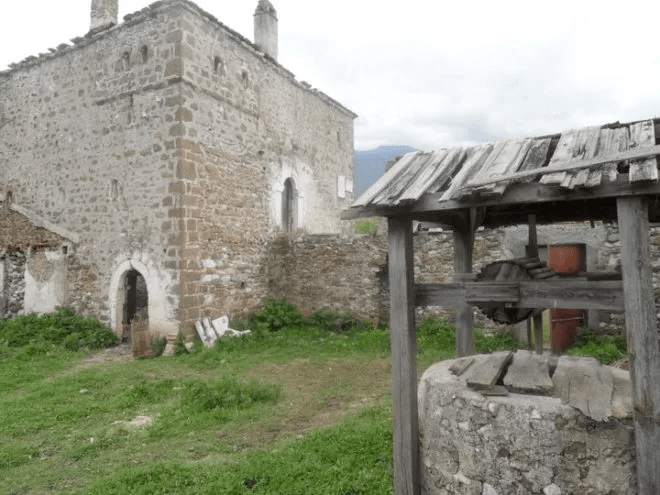
The KNC Conference united all the illegal councils that had operated until then throughout Kosovo. After the delegates from the Kosovo Plain were elected, by December 21, 1944, through Fadil Hoxha and for the Dukagjini Plain through Ismet Shaqiri, the Conference began its work in the historic Sali Man Tower in Bujan.
On January 12, 1944, Fadil Hoxha sent the documents of the NCC to Enver Hoxha for approval, while to Josip B. Tito for information. Enver accepted the Bujani Dossier in its entirety. Tito, on the other hand, authorized Milovan Gjillasi to present his observations, even though it was a matter of official information.39. (39. A KQ PKJ/ 1944, January 12, 1944).
On March 28, 1944, Milovan Gjillasi began his Letter to the Provincial Committee of the PKJ for Kosovo. The Provincial Committee of the Communist Party of Yugoslavia for Kosovo examined M. Gjillasi’s Letter in detail on June 16, 1944 in the Kolosian locality. There, every historical decision of the National Council at the request of M. Gjillasi turned into a defactorization of the anti-fascist War in Kosovo.
The National Council, according to M. Gjillasi’s order, had no right to produce and approve laws; Kosovo and Dukagjini turned into Kosovo and Metohija; the Provincial Committee of the Communist Party of Yugoslavia turned into a Regional Committee; the Main Headquarters of the UNC and AP for Kosovo and the Dukagjini Plain turned into the Operational Headquarters of Kosovo and Metohija; the Aradha “Bajram Curri” (of Kosovo) and the Aradha “Perlat Rexhepi” (of Albania), which had merged as the Aradha “Curri-Rrexhepi”, which had carried out the security of the Bujan Conference, was disbanded. This had the symbolism that: “There is no union of Kosovo with Albania”.40. (40. A. KQ PKJ, 1945/ Analysis of Koca Popovic in 1945 in 5 pages by typewriter, Serbian).
- What are the other arguments for the defactorization of Kosovo by the Yugoslavs
We are highlighting them as a kind of summary
On September 2, 1944, J. B. Tito, by order, degraded the Main Staff of the UNC and AP of Kosovo to the Operational Staff; 2. On November 21, 1944, he amnestied all the Chetniks, who turned into “partisans”; 3. Tito convinced the Serbian side that Kosovo would be part of federal Serbia on October 10, 1944; 4. Tito established a military dictatorship in Banat, Bačka and Baranja on October 18, 1944 to exterminate the Germans and Hungarians; 5.
Tito established a military dictatorship in Kosovo on February 8, 1945 to liquidate the Albanians; 6. Tito, through M. Djillasi and A. Ranković, divided the Sandžak on March 29, 1945 between Montenegro and Serbia; 7. Tito, through M. Djillasi, tried to divide Kosovo between Montenegro, Serbia and Macedonia on February 21, 1945 in Belgrade, trying to have Fadil Hoxha and Miladin Popović present there.
Since Miladin reacted on the spot on February 19 in Djillasi’s office, on February 20 the decision was made that Miladin be sent as ambassador to Poland, while Fadil Hoxha be sent as ambassador to Turkey.41. (41. Mr Hakif Bajrami, Chronology of the Yugoslav War for the Defactorization of the Kosovo Liberation Army, 1976, p. 18).
Thus began the history of Kosovo for war and hope, that one day it will advance to the Republic. This idea and ideal was realized by the war of the KLA and NATO after the collapse of the SFRY, which collapse was declared by Badinter on July 4, 1992. Tito, Ranković and Gjillaš illegally divided all the occupied land wealth, coding their actions with the code: “TIGERS IN A CAGE” (Vojna upravë-military power).
In these circumstances, until the country’s Constitution was approved in early 1946; 1. Tito used Churchill’s statement about Trepca as an argument, which means that Kosovo should belong to Yugoslavia according to the British; 2. Ranković annexed Vojvodina, Kosovo, and half of Sandžak.
While Kumanogave Macedonia to Serbia, to reduce the pride of the Serbs that they had won all of Macedonia in 1912 in Kumanovo. But history willed that in Kumanovo in June 1999, Serbian officers signed the capitulation of their power in occupied Kosovo; 3. Djilas agreed to the annexation of half of Sandzak and the permission for a part of the Montenegrins to colonize the properties of the Germans and Hungarians in Vojvodina; 4.
After the Nazis left Istra, Tito, in a bargain with Ranković and Djilas, annexed it to Croatia, dividing it into Zone “A” and Zone “B”; 5. In 1946, E. Kardel joined the “Big Three”, who managed to “annex” some parts of Istra for Slovenia. 6. In 1949, the Yugoslavs will establish a puppet government in Skopje with Apostol Tanef to devalue Bujani and overthrow the government of Tirana. 6.
In 1953, they will conclude the Gentlemen’s Agreement for the deportation of Albanians to Turkey; 7. In 1955/56, the action of weapons will follow, for the massive persecution of Albanians; 8. In 1956, the Prizren Process will follow for the criminal prosecution of Albanian rulers in Kosovo; 9. In 1957, the Minister of Defense of Albania in Yugoslavia-Panjot Plaku will flee with the slogan “DOSUNT ACTA – Document that does not exist”, which has to do with the decisions of the National Council of Bujani; 10.
The truth is, E. Kardel will swim in the “sea of Tito”, without problems and at the Plenum of the LKJ in 1957 he will explode: “It is natural that we Slovenes and Croats will one day find ourselves oriented towards the West, because of culture and religion. Meanwhile, you Serbs and Montenegrins, it is natural to be oriented towards Russia, because of culture and religion”.
From the Dobrica hall, Qosiq will ask: “And where will the Albanians be oriented? Kardel, Naturally towards unification with Albania.” 42. (42. Yes; Zbornik podatataka o NOBU na Kosovu, Belgrade, Priruçnik, 1976). In 1958 Ranković will try to close Albanian schools in Yugoslavia. Albania’s reaction to the UN regarding the colonial position of Albanians in Yugoslavia will follow.
Fearing sanctions, the CC LKJ will hold an illegal plenum on the rights of MINORITIES, on which occasion the establishment of the Albanian Pedagogical High School will be allowed. A year later (1960) the Faculty of Philosophy will be established; the Faculty of Economics and Law. Albania will de facto leave the Warsaw Pact in 1960.
Meanwhile, the CC LKJ will hold a plenum on DECENTRALIZATION of power in Yugoslavia in 1962. In 1965, the system of power in the municipalities will prevail, and a year later in Brijuni, the synonym of violence and terror against Albanians – A. Ranković – will be removed from power. In 1967, the campaign for the advancement of Kosovo into a Republic will begin in Kosovo, and in 1968, Kosovo, with revolutionary demonstrations, will strongly move towards democratic Europe.
This is what a document owned by Vladimir Dedier says, which proves that the division of Kosovo was over. So the road was open and it was necessary to march with knowledge and educated politics towards the Republic. The Bujan Conference has shown that: those who committed crimes and those who silenced the crimes are the same.
The article is dedicated to: Fadil Hoxha-represents the entire “power” of the Albanians, Hysen Terpeza (represents the entire resistance to the Serbian government) and Adem Demaçi (represents the entire anti-Yugoslav war in 1958-1999), who agreed (in 1998) and declared that- “They are soldiers of the Kosovo Liberation Army, they are with the ideal of Adem JASHARI in their foreheads”. Glory!
Reference


 Balkan Academia