
Authored by Petrit Latifi
The following article shows a few pages from the Albanian linguistic researcher Petro Zhejis book “Albanian and Sanskrit” (“Shqipja dhe Sanskritishja”). The book studies the connection between Albanian and Sanskrit and is very interesting.

Translation:
“do + wn. It is easily proven that -wn serves in English as a verbal ending that is identified with the Albanian ban (it. fare). On the other hand, do- is the Albanian da (ndare, it, separato, diviso). So the English word down is related to Albanian like this:ban dà i ndarë (it. separate fact) he said symbolically.
Yes, we know that: where the last equation gives the English gloss down the meaning it really has. In summary we say:(oh=①)(does DÀ)ex. (down)eng. = share (it. sotto) accomplishments were achieved underfromin: Let us now consider the French word tomber (seq. me rà). Let’s share it to tom + ber. None of these simple participles have an independent meaning of their own in the French language, so French is unable to motivate. But tom is nothing but the Albanian dam (it. diviso, separato) or thym, which means broken, separated (it. diviso, spezzato) which symbolically appears as D.The participle -ber is a verb ending that is identified with Albanian bër (it. fare). Equivalence: Φ =oh”

Translation:
“In German: Dämmerung = darkness, and in Albanian we have: damun ar, in Albanian means gold (it. oro), so the solar principle, so light, and so symbolically O. Oë here we then have damun ar, which means division (damun) of gold, so of light (O), so symbolically.In support of the already known equality (=), we will have:(damon AR)shq.(Dämmerung) Germ. = terr.
Let’s continue with other examples. In Albanian we have: ndan, separate, ndër down (it. sotto), well.. So Albanian lays down the symbolic equation:ohaccomplishments were achieved underThe same symbolic equation was used in Albanian with the language fal (fal-it), as seen above. Mystically this means: Separation from God (0) implies (=) decadence (decline, bankruptcy, degradation…) (9) which corresponds to a universally recognized theological truth.Let’s now look at the English word down, so.We divide it into:identif(splitand pyou are allfromin:gjto th)”

Translation:
“The Jewish myth of the rebel angels, led by Lucifer, shows how they rebelled against God, how they were separated from Him (①), which made Lucifer, vert and a certain DEMI-ur-gu, i.e. a pseudo-creator of a separate world and the First of others, a Demon (lit. damun divided, it, diviso, separato… see Appendix)Albanian gives us the opportunity to reconstruct this myth (as well as many others) in the main points, with this “word game” or almost – meaningful homonymy. her.
Felepjesë, porcion, (it. part, portion, prominent)and for symb.(also deep, from and German Teil),fal (also fal-it)falls (it. cado), and symb.fillsnis (it. I begin, I start)which we, since this is a negative departure (all the Material World according to the Mythic Thought is like that) will denote by 1.This is how Albanian poses:F=Oh =-1Felefal-itbeginNamely:Separation from God (O), fall (caduta). (), beginning of the Material World (-1)In more recent times, the idea that the world was created through a division is found in Hegel.
He actually conceives a Universal, Absolute Spirit, in which, before the Creation of the World, both Spirits, the Subjective and the Objective, were in complete unity (Thesis, Unity of opposites…). In a “second” moment these two spirits are separated and opposed (Antithesis, Lufta e é…”

Translation:
“In addition:andit is.In the Judeo-Christian myth, the cause of the birth of the Material World, of this phenomenal world of ours, conceived with phenomena, is found in the disobedience of Adam and Eve, God, which then formed the dogma of the so-called original sin (it. peccato originale).
But, as we have seen:sin =(separate – dirty) seq. = separation from Goda.ANDFOLAFILL SHUT HIMSELF IN THEIR THONGSIN FISOREAdam, Eve, the Forbidden Tree and the SerpentThe symbol ① is, among other things, that of SEPARATION, while the symbol can also be interpreted as matter, the Material World.In this way, therefore, the Judeo-Christian dogma reaffirms what Paracel-si says and therefore, a fortiori, also the explanation of the derived Latin word through Albanian..”
Translation:
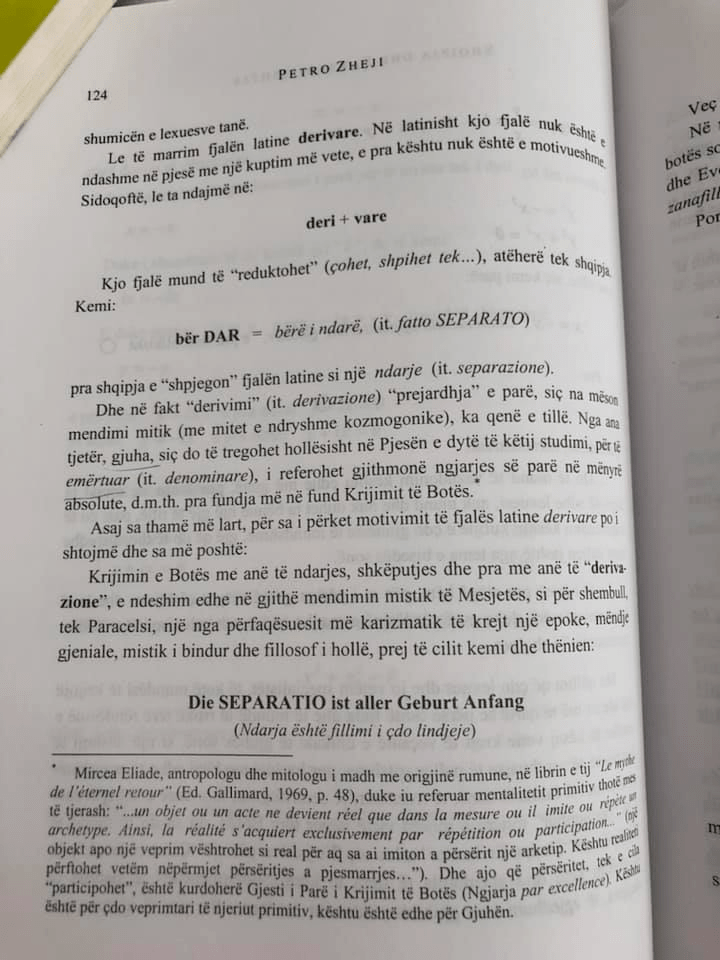
“Let’s take the Latin word derivare. In Latin, this word is not divisible into parts with a separate meaning, so it is not motivated. However, let’s break it down into:deri + limeThis word can be “reduced” (cohet, sphihet to…), then in Albanian we have:do DAR = made separate, (it. fatto SEPARATO)so Albanian “explains” the Latin word as a separation (it. separazione).
And in fact the first “derivation” (it. derivazione) “descent”, as mythical thought (with the various cosmogonic myths) teaches us, was like that. On the other hand, language, as will be shown in detail in the second part of this study, to name (it. denominative), always refers to the first event in an absolute manner, i.e. that is, the end at last of the Creation of the World.
To what we said above, regarding the motivation of the Latin word derivare, we add the following:The creation of the world by means of division, separation and therefore by means of “derivation”, we also encounter in all the mystical thought of the Middle Ages, for example, in Paracelsus, one of the most charismatic representatives of an entire era, a genius mind, a convinced mystic and a subtle philosopher, from whom we have the saying:The SEPARATIO is the beginning of all birth(Parting is the beginning of every birth)
Mircea Eliade, the great anthropologist and mythologist of Romanian origin, in his book “Le mythe of others: “…un objet ou un acte ne devient réel que dans la mesure ou il imite ou répète un object or an action is seen as real insofar as it imitates or repeats an archetype. Thus the archetype reality. Ainsi, la réalité s’acquiert excludable par répétition ou participation…” (it is acquired only through repetition or participation…”).
And what is repeated, in which it is “participated”, is always the First Gesture of the Creation of the World (the Event par excellence). It is the same for every activity of primitive man, it is the same for Language.saveINworld sc and Eve genesis But..”
Translation:
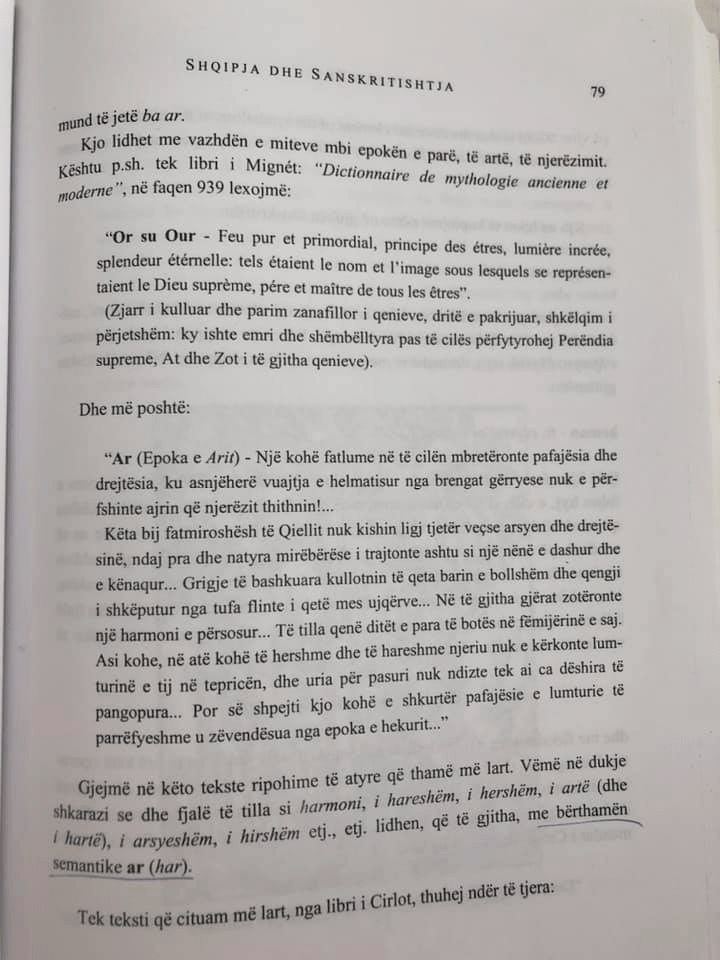
“it can be “ba ar”… This is related to the continuation of myths about the first, golden age of mankind. So e.g. in Mignét’s book: “Dictionnaire de mythologie ancienne et moderne”, on page 939 we read:”Now on Our pure and primordial Fire, principle of beings, uncreated light, eternal splendor: such were the name and the image under which the supreme God, father and master of all beings, was represented.”
(Pure fire and primordial principle of beings, uncreated light, eternal brightness: this was the name and image after which the supreme God, Father and Lord of all beings was imaged).And below:”Gold (Golden Age) – A happy time in which innocence and justice reigned, where never did the suffering poisoned by corrosive worries permeate the air that people breathed!…
These blessed sons of Heaven had no other law than reason and justice, so benevolent nature treated them like a loving and contented mother… United flocks quietly grazed the abundant grass, and the lamb separated from the flock slept peacefully among the wolves… In all things he possesseda perfect harmony… Such were the first days of the world in its childhood.
Once upon a time, in that early and happy time, man did not seek his happiness in excess, and the hunger for wealth did not ignite in him some insatiable desires… But soon this brief time of innocence and unspeakable happiness was replaced by the iron age…”We find in these texts confirmations of what we said above. We clearly point out that words such as harmony, happy, early, golden (and map), reasonable, gracious, etc., etc. are all related to the semantic core ar (har).In the text we quoted above, from Cirlot’s book, it was said, among other things:..”
Translation:
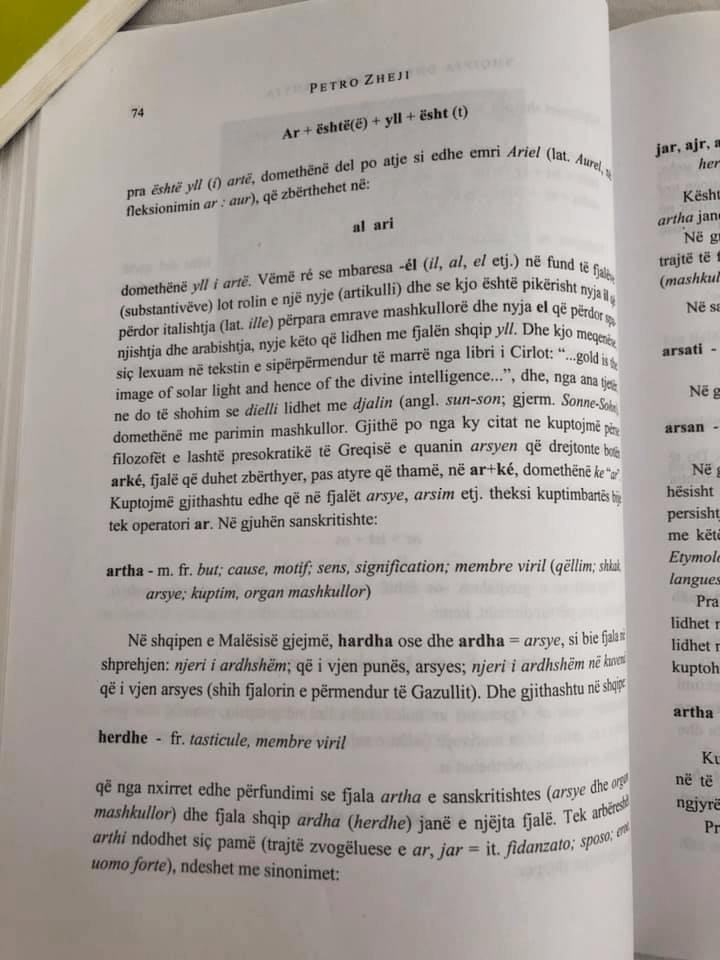
“Ar+ is(s) + star + is(s)so it is a golden star (1), that is, it appears there as well as the name Ariel (lat. Aurel, inflection ar: aur), which breaks down into:al arithat is, the golden vll. We note that the ending -él (il, al, el, etc.) at the end of the word (substantives) plays the role of a node (article) and that this is precisely the node il used by Italian (Lat. ille) before masculine nouns and the node el used by some and Arabic, these nodes are related to the Albanian word vll.
And this being as we read in the above-mentioned text taken from Cirlot’s book: “…gold is image of solar light and hence of the divine intelligence…”, and, on the other hand, we will see that the sun is associated with the son (eng. sun-son; German. Sonne-Soh, that is, with the male principle. All but from this quote we understand that the ancient presocratic philosophers of Greece called the reason that led boe arké, word which must be decomposed, after what we said, into ar+ké, that is, ke “…
We also understand that in the words reason, education, etc., the meaningful emphasis is on the operator ar. In the Sanskrit language:artham Fr. soft; cause, motive; sens, signification; virile member (purpose; cause reason; meaning, male organ)In the Albanian of the Highlands we find, hardha or and ardha = reason, as the word says the expression: future man; that comes to work, reason; the next man in the council who comes to reason (see Gazulli’s mentioned dictionary).
And also in Albanian herd fr. testicle, male memberfrom which the conclusion is drawn that the Sanskrit word artha (masculine arsve and orga) and the Albanian word ardha (herdhe) are the same word. As we saw, arthi is found in arbëresh (diminutive form of ar, jar = it. fidanzato; sposo; ent uomo forte), it encounters synonyms:jar, ajr, aher….
Translation:
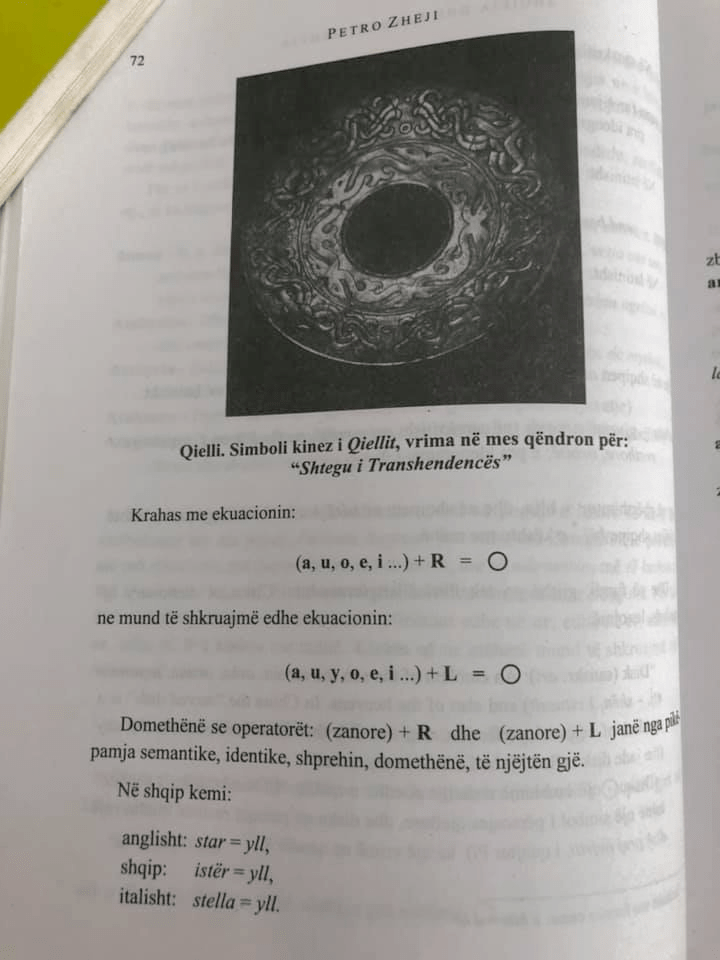
“The sky. The Chinese symbol for Heaven, the hole in the middle stands for: “The Path of Transcendence” Along with the equation: (a, u, o, e, i…) + R = O we can also write the equation: (a, u, y, o, e, i …) + L = O That is to say that the operators: (vowel) + R and (vowel) + L are semantically identical, they express, that is, the same thing. In Albanian we have: English: star = star, Albanian: istar yll, Italian: stella = star.”
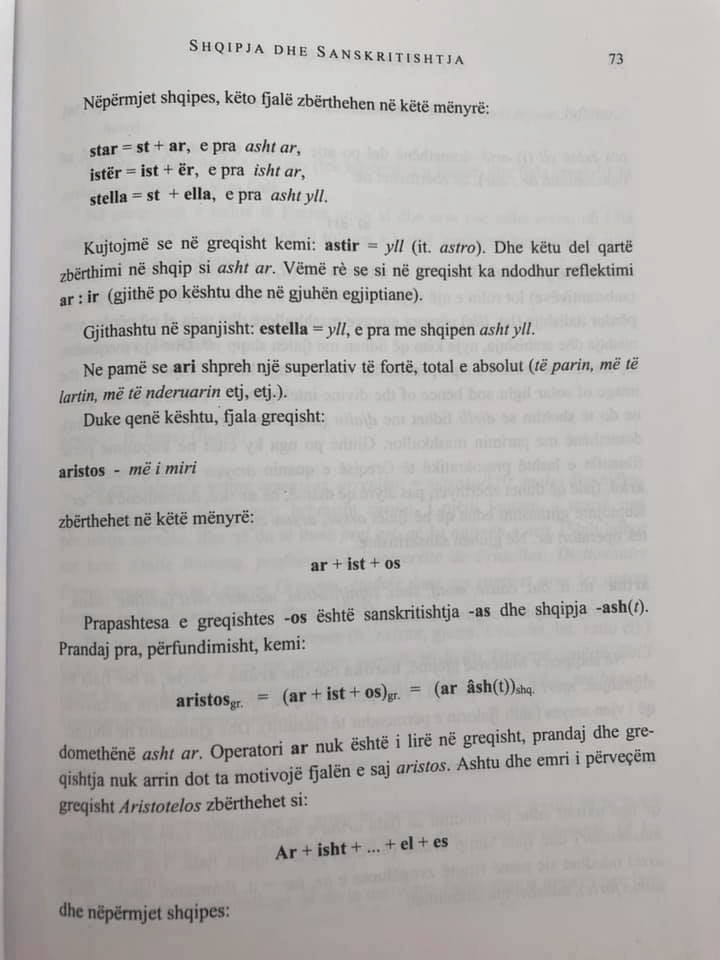
Translation:
“Through Albanian, these words are broken down in this way:starstar, well it’s gold,hysteria, and pra isht ar,stella stella, well it’s a star.73We remember that in Greek we have: astir = star (it. astro). And here the breakdown in Albanian as asht ar comes out clearly. Let’s see how the reflection ar: ir occurred in Greek (all the same in the Egyptian language).
Also in Spanish: estella = star, well in Albanian asht yll.We saw that gold expresses a strong, total and absolute superlative (the first, the highest, the most honorable, etc., etc.).That being so, the Greek word:the best aristosbreaks down like this:ar + ist + osThe suffix of Greek -os is Sanskrit -as and Albanian -ash(t). Therefore, finally, we have:aristosgr. (ar+ist+os)gr. (you have(t))shq.that is, it is gold. The operator ar is not free in Greek, and therefore the Greek cannot motivate its word aristos. Likewise, the Greek proper name Aristotelos breaks down as:Ar+isht + … + el + esand through Albanian: .. “
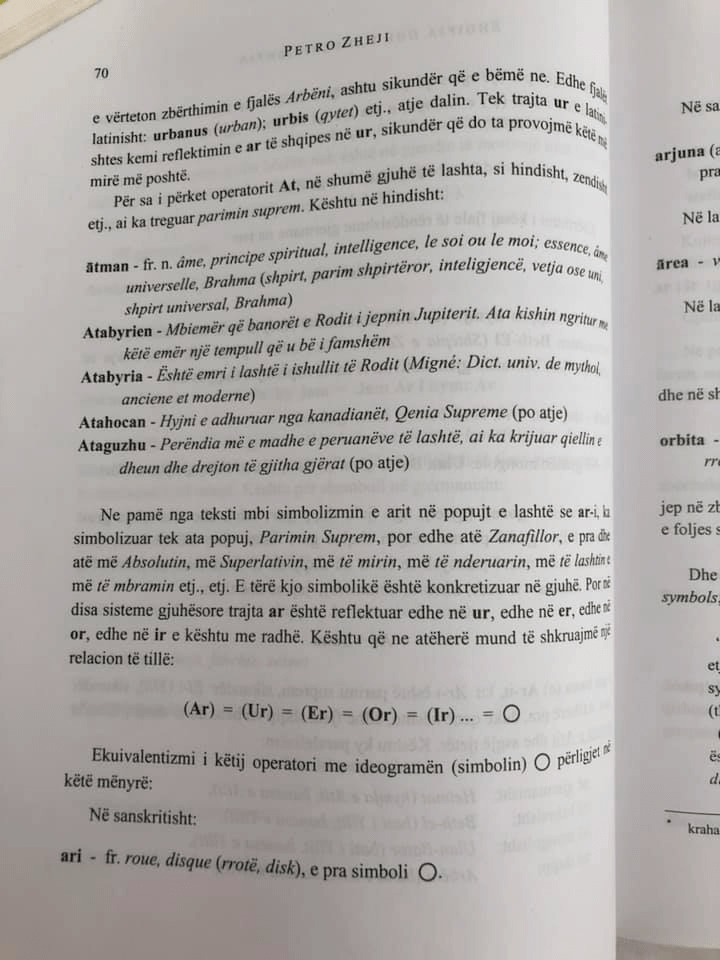
Translation:
“… proves the breakdown of the word Arbëni, just like we did. Also Latin sentence: urbanus (urban); urbis (city), etc., appear there. In the additional Latin form ur, we have the reflection of the Albanian ar in ur, as we will prove this better below.As for the At operator, in many ancient languages, such as Hindi, Zendish, etc., it has indicated the supreme principle.
Thus in Hindi:atman fr. n. âme, spiritual principle, intelligence, le soi ou le moi; essence, ame universelle, Brahma (soul, spiritual principle, intelligence, self or self, universal soul, Brahma)Atabyrien – A surname that the inhabitants of Rhodes gave to Jupiter.
They had erected a temple under this name which became famousAtabyria – It is the ancient name of the island of Rhodes (Migné: Dict. univ. de mythol, anciene et moderne)Atahocan – Deity worshiped by Canadians, Supreme Being (yes there)Ataguzhu – The greatest god of the ancient Peruvians, he created heaven and earth and rules all things (yes there)
We saw from the text on the symbolism of gold in the ancient peoples that gold symbolized in those peoples the Supreme Principle, but also the Genesis, well, the most Absolute, the Superlative, the best, the most honorable, the most ancient, the most ancient, etc., etc. All this symbolism is concretized in language.
But in some linguistic systems the form ar is reflected in ur, er, or, and so on. So then we can write such a relation:(Ar) = (Ur) = (Er) = (Or) = (Ir) … = ΟThe equivalence of this operator with the ideogram (symbol) is justified as follows:In Sanskrit:also fr. wheel, disk (wheel, disk), and for O symbols.In how mucharjuna (aforIn laAreaIn laand in shorbitrrgives in zb of the verb sANDsymbols,Andand(teSdcrash..”

Translation:
“in Albanian. Since, on the other hand, this operator is not free either in Latin or the Sanskrit operator da, which is at the same time a link operator. Thus, all the words (glosses) that we mentioned above were linked in French, nor in Italian, nor in German, nor in Russian, nor in Greek, then we can express without fear a derivative of these foreign glosses from the Sanskrit verb da, “or” from the Albanian verb give me.
However, the alternative “ow” is chosen in favor of Albanian, and this is because the form damun, from which dam, dhaimon, verdammt, Daumen, damba, Damm, to condemn, dannare etc. are derived, does not take part in the inflection (choice) of the Sanskrit verb da, but takes part in the inflection of the Albanian verb da (the part of this verb).
Thus, for example, the free operator (literal root) damun, from which the French words domma-ge, damner, con-damner come, is not found free in the linguistic system & the French language, meaning that there is no equivalence:disturbance = Φfrom which all the above-mentioned French words are automatically derived (through logical analysis and by remaining in the primitive mentality).
The notion of division in French is given by other words (operators) such as: divider, briser, couper, fondre, partager, etc. and these are not related in form to damu. What we said about French is also true for all the other languages listed above. So for example, German:Damm = damdam expressing the notion of separation, being a dam an object that separates, it is clear that it must contain the notion of separation, it must give us the idea of separation, so it must express the situation that creates the ideogram.
However, the notion of separation is given in German by other words such as teilen, zerteilen, trennen, etc., from which the word Damm cannot come. This means then that the Damm operator is not free in German, while on the contrary, it is free in Albanian, like Damm with its own tools, without leaving its lexical system, so we saw inside. Therefore, the German language is not able to motivate the words of st….”
Reference
“Shqipja dhe Sanskritishtja – pjesa e pare” by Petro Zheji.


 Balkan Academia