
Article by Petar Horvatic. Translated by Petrit Latifi.
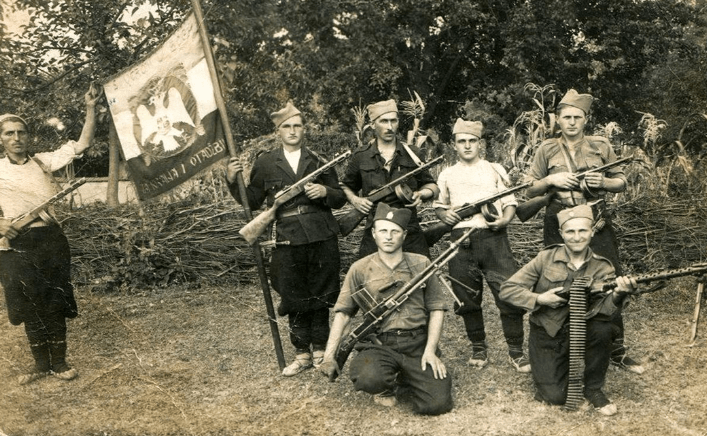
Although Kozara stood out as the greatest crime against children in World War II, and even massacres by nuns were invented, by far the most crimes against children were committed by the JVO – the official army of Yugoslavia known as the Chetniks. They even slaughtered children en masse in their cradles. This was the work of the Chetniks, the dirtiest and most cruel army of World War II in Europe.
Chetniks (JVO) are the official army of Yugoslavia and the refugee government in London in II. world war, and this is hidden after 1945 to this day. The leader of the Serbian Chetniks, Draža Mihajlović, was a general in the Yugoslav army and a minister in the Yugoslav government
A large proportion of the Chetnik victims of these massacres in the NDH and Sandžak were innocent children, just as in Rama (NDH) in 1942, where the Chetniks killed every child taller than a 128 cm Italian short rifle.
Chetniks particularly slaughtered and killed along the border of the Independent State of Croatia with Serbia and Montenegro, on both sides of the border during World War II. The largest massacres were near the tri-border of the Independent State of Croatia, Serbia and Montenegro, where a real genocide was committed against the non-Serb population.
The Chetnik massacre in the east of NDH and Sandžak in February 1943 was the most massive war crime against children in World War II. world war. The massacre was carried out on the territory of Bijelo Polje, Pljevlje, Priboj, and Čajnič and Foča in the NDH. This operation of ethnic cleansing and genocide was directed by the supreme commander of the JVO, General Dragoljub Mihailović, whose headquarters was then located near the killing zone, through his commanders Pavel Đurišić, Vojislav Lukačević and Petar Baćović.
During this operation, several thousand people were killed in Pljevlja, Priboj, Foča and Čajniče, with particular Chetnik hatred towards Muslims. According to Đurišić’s report, around 9,200 Muslims were killed, of whom around 1,200 were men and up to 8,000 were women, the elderly and children. Among them, there was an extremely high proportion of children of the youngest age.
Based on the available list of victims from the municipality of Pljevlja (Sandžak, Montenegro) , we see that in that municipality alone, 1,370 people were killed at that time, mostly small children. The youngest victims were newborns, babies up to a month old, 13 of whom were killed in their cribs. More than half of those killed by the Yugoslav Chetnik army were children up to 14 years of age.
A large number of those killed were not even recorded, because no one had any information about them and because Chetnik victims and refugees were fleeing in all directions. At least 349 people were killed in the municipality of Sočice, 261 in Meljak, 236 in Bukovica, 235 in Bučje, 191 in Boljanići, 56 in Gotovuša, 14 in Kosanica, eight in Ilin Brdo and one each in Hoćevina and Otilovići.
Around 638 victims were slaughtered, 286 burned, 231 killed with a rifle, 106 butchered and 91 drowned. Around 160 women were raped. The biggest crimes took place in Prehari, Goleši and Milunići. In Prehari, 52 children were thrown into the Ćehotina pit, and over 20 women were raped. In Dolovi, 42 women and children were gathered in a house which was then set on fire. Only 245 of those killed were adult men, and the rest were elderly people, women and children.
List of civilians killed in Sanxhak can be found here
https://bosnjaci.net/pdfs/SPISAK_ZRTAVA_FEBRUARSKOG_POKOLJA_1943.pdf
Pljevlja – every fourth victim of slaughter is a child under the age of 4, and more than half of those killed are children under the age of 14
Over a quarter of all those killed (around 26%) are children under the age of four. Over half of the total number of victims (around 53.5%) are children under the age of 14, bosnjaci.net reports.
They threw children, women and old people into houses, filled the houses with straw or hay and then set them on fire; they tied women to oak trees, put straw in their pyres and then burned them while singing:
“About Christmas of the Forty-third”
for the Chetniks, here is happiness,
instead of wood and Christmas tree,
a log of heads from the Turks.”
Records of Chetnik crimes have been preserved:
“ …In the village of Korita, in the house of Novčić, 16 people were killed and burned, and Bega Ličina filled the houses with smoke and set them on fire. The Chetniks raced through the village on horses and shot children who were running away. Murat Mehović, a blind old man of 70 years, was slaughtered and thrown into the fire. Mahmut Beganović was cut into pieces.
Selmo Dervović was cut into pieces and his two daughters were slaughtered. 20 mutilated corpses remained in the courtyard of Aziz Šabanović. Little Hasim, six months old, when he was looking for his dead mother’s breast, was grabbed by the legs, slammed to the ground and thrown into the fire.
They threw Džemo, four years old, Šabanović Šaćir, six years old, Ermo Muharemova and Ragib’s three children into the fire alive. Then Džemo’s three children and Halit’s daughters and Raif, two years old. That’s how the other villages also passed. Along the muddy roads, through thickets and forests, miserable crowds fled, barefoot and naked, with dismayed and frantic looks, some towards Bijela Polje, others towards Rozaje…
The terrible Chetnik crimes in the Bjelopolje region were an ominous prelude a month later to even more massive suffering of Muslims in the Priboj and Pljevljan regions in Sandžak and Čajnički and Fočanski in Bosnia…” (Safet Bandžović: “Emigration Muslims from Sandžak”).
The counties of Čajniče and Foča where these massacres were carried out were parts of the Independent State of Croatia, and the rest of the places where the bloody massacres of the Yugoslav Chetnik army were carried out were located right on the border with Montenegro and Serbia.
These parts are today part of the Republika Srpska in Bosnia and Herzegovina and have been almost completely cleared of the Muslim population, almost only Serbs now live there. What the Yugoslav Army in the Fatherland (JVO, Chetniks) did not do in 1941-1945. was completed by the Yugoslav army, the JNA, in 1992.
The army that Josip Broz Tito created in that very year 1945. In the last war, the JNA and Serbian Chetniks expelled and killed almost all non-Serbs from that area in 1992. Without the JNA, the genocide against Croats in Croatia, and Croats and Bosniaks in Bosnia and Herzegovina, would not have been possible.
Based on the available list of victims of the district of Pljevlja, we see that 1,370 people were killed in that municipality alone, mostly small children, and a large number of children were babies aged one year, a month or less.
The youngest victims were newborns, babies up to one month old, of whom 13 were killed.
Over a quarter of all those killed (around 26%) are children under the age of four.
More than half of the total number of victims (around 53.5%) are children under 14 years of age.
Some of the names of babies in cradles killed in 1943 in the town of Pljevlja by Yugoslav Chetniks Pavle Đurišić:
HASOVIĆ A. JUSUF, born in 1942 (age one year)
MUSIC M. BEGIJA, born in 1943. (baby)
SLJIVO M. HAJRIJA, born in 1943. (baby)
ŠLJUKA Š. EMA, born in 1943. (baby)
MOĆEVIĆ J. SIMBULA, born in 1943. (baby)
MOĆEVIĆ M. ĐUZIDA, born in 1943. (baby)
ČORBO L. LATIFA, born in 1943. (baby)
MUSIC S. HAJRO, born in 1943. (baby)
MAŠOVIĆ A. ELMASA, born in 1943. (baby)
KELEMIŠ J. RAŠID, born in 1943. (baby)
SIJAMIĆ R. ZUMRA, born in 1943. (baby)
MAŠOVIĆ DŽ. HAZBIJA, born in 1943. (baby)
ŠATARA M. NURA, born in 1943. (baby)
HEKALO M. MURADIF, born in 1943. (baby)
KUBUR M. HAMDO, born in 1942. (age one year)
ŠLJUKA M. ZADA, born in 1942. (age one year)
PLAKALO R. NURA, born in 1942. (age one year)
SIJAMIĆ A. ZIZO, born in 1942. (age one year)
GEC P. RABIJA, born in 1942. (age one year)
PRLJAČA R. ADILA, born in 1942. (age one year)
MOĆEVIĆ A. ZLATIJA, born in 1942. (age one year)
DRKENDA DZH. RASIM, born in 1942. (age one year)
KORORA R. SAFIJA, born in 1942. (age one year)
KLAPUH S. FATIMA, born in 1942. (age one year)
PUŠKA M. NAZA, born in 1942. (one year old)
KADRIĆ DZ. MEVLA, born in 1942. (age one year)
KISELICA M. HAŠIM, born in 1942. (one year old)
KISELICA M. SABIT, born in 1942. (one year old)
PUCAR DZH. HAJIRA, born in 1942. (age one year)
Reference


 Balkan Academia