
Authored by Bedri Tahiri. Translation by Petrit Latifi.
In 1920, the Serbian criminal Rashe Pantiqi, after loosing a battle against Azem Bejta in Qyqavicë, collected 84 Albanian civilians from Artakolli, a plan called the “Yrrëfije”, and massacred them all in Rogë e Vjedullave of Qyqavicë.
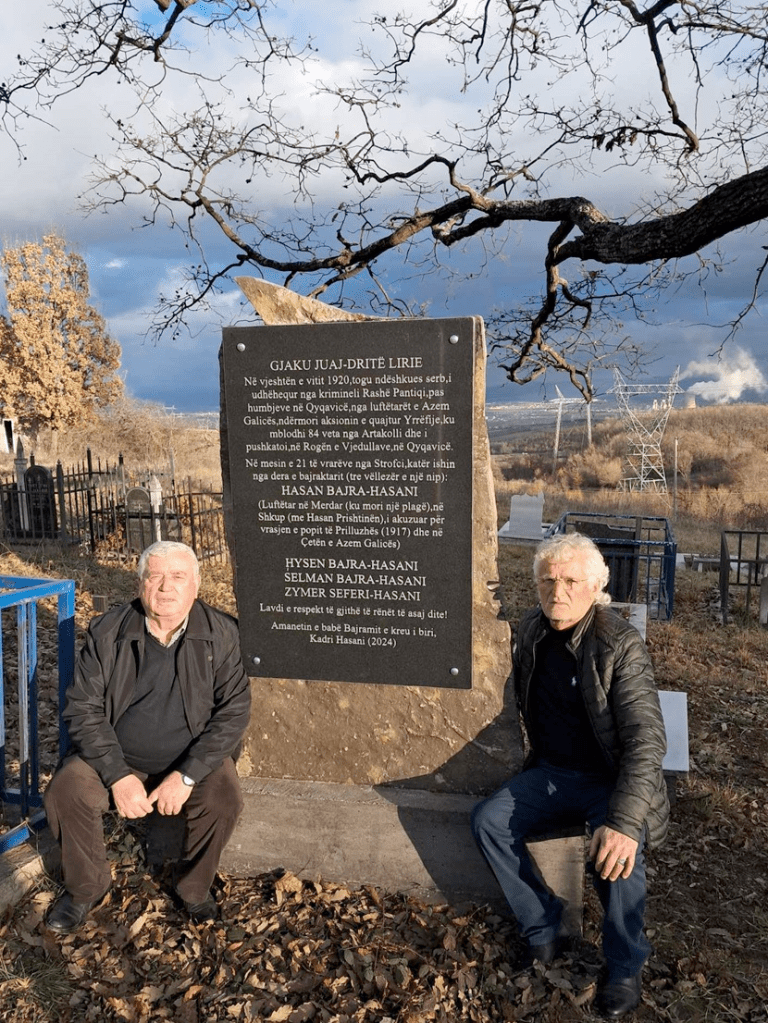
The tombstone reads:
“YOUR BLOOD-LIGHT OF FREEDOM
In the autumn of 1920, the Serbian punitive platoon, led by the criminal Rashe Pantiqi, after the losses in Qyqavica, by the fighters of Azem Galica, undertook the action called Yrrëfije, where they gathered 84 people from Artakolli and shot them, in Rogë e Vjedullave, in Qyqavica.
Among the 21 killed by Strofci, four were from the bajraktar door (three brothers and a nephew):
HASAN BAJRA HASANI
(Fighter in Merdar (where he received a wound), in Skopje (with Hasan Pristina), accused of killing the priest of Prilluzha (1917) and in Azem Galica’s Squad)
HYSEN BAJRA-HASANI SELMAN BAJRA-HASANI ZYMER SEFERI-HASANI
Glory and respect to all the fallen of that day!
Father Bajram’s bequest was carried out by his son, Kadri Hasani (2024)”

“THE LEADERSHIP OF THE GENERATIONS
Whoever honors history, creates the future!
Map of the Albanian Homeland sewn with blood: Drenica-Artakolli-Qyqavica!
Every time the fire of freedom-loving people was lit in heroic Drenica, the rebellious Artakolli also burned. A mutual melody. Perhaps the Hours of the mythical Qyqavica themselves had determined their common fate. History, yesterday and today, best proves this. Perhaps, even the future.
And, always together; in the time of Azem Galica, in the time of Shaban Polluzha, in the time of Adem Jashari.
Our ancestors wrote history with blood and left us this piece of homeland, filled with graves, battles, events, songs…
A homeland filled with invincible Lisas, who successfully faced devastating storms!
Another unforgettable event was Black Tuesday of October 18, 1920, when the Serbian military punitive platoon, led by the criminal Rashe Pantiqi (also known as Captain Rasha, who, since 1910-1912, knew these villages well, because he had moved here first, with a map in hand, presenting himself as a Muslim from Sandzak), after heavy losses in Qyqavica, by Azem Galica’s fighters, undertook the vengeful action called Yrrëfije, where he gathered 84 people from the villages of Artakoll and, tied up, shot them, where they had lost the battle days before, in Roga e Vjedullave in Qyqavica (today Vorret e Qyqavica).
That day, 21 people were killed from Strofci, among them four from the well-known family of the Bajraktar of Strofci (Bajram Hasani, who was the only bajraktar in Artakoll).
So, from this well-known family of patriots and generous people, three brothers were shot: HASAN BAJRA- HASANI (A distinguished fighter in the Battle of Merdar in 1912 (where he was wounded), then in Skopje, in the march of the insurgents led by the great Hasan Prishtina, accused of murdering the priest of Prilluzha (1917) and a vocal member of the Azem Galica Çeta), HYSEN BAJRA- HASANI, SELMAN BAJRA- HASANI and their nephew ZYMER SEFERI- HASANI.
This deeply rooted and branched oak tree, today rests under the centuries-old oak tree that is cared for like an Omen in the Strofc cemetery.
Oak under the oak! Or, better: Oaks under the oak!
A legacy passed down through generations.
And this historical and mythical legacy, which Bajrami (son of Hasan, Azem Galica’s fellow soldier) had carried in his ear, was fulfilled by his son, teacher Kadri Hasani!
Bajrami was a man who could not be beaten by a dog. The waves of life threw him here and there, but he remained upright. He himself had experienced the path paved with nettles of migration to Turkey, but fate had spared him from the deserts of Anatolia, and he had stayed in Skopje for six years and then returned to Kosovo to resume his recovery.
He had many bequests, but as a leitmotif transformed into a life ideal he had ONE: These four men and the two sisters (one in Abri and the other in Druar), who were also killed by the bullet of the centuries-old enemy (the Serbs), but also all those killed in wars and battles, should not dissolve in the dust of oblivion, but should be commemorated, marked, resurrected…
Thus, after more than a century, this common Plaque was placed and four others for each grave, with great historical-national values, which I am calling SACRED SIGNS! If we respected these SACRED SIGNS, we have respected our national history of hundreds of years, which with the glorious war of the Kosovo Liberation Army, crowned our goals for generations and brought FREEDOM!
These Holy Signs speak volumes! These are history past history!
Shouldn’t this good and auspicious work also reflect in the conscience of those who are responsible (the authorities) for a Plaque or Monument of eternity at the scene of the incident, in Qyqavicë!
No comment! History keeps records and does not forgive anyone! The inimitable Hasan Prishtina advised us to guard against the curse of history!
Well, it is not said in vain: He who honors history, creates the future!
Congratulations Kadri Hasani for this immortal work!
Glory and respect to all the fallen of that day and of all historical periods!
Strofc, January 10, 2025
Reference


 Balkan Academia