
Authored by Petrit Latifi
Albania, No. 2, October 1, 1915. — “A dispatch from Salonika, which made the rounds of the press, states:
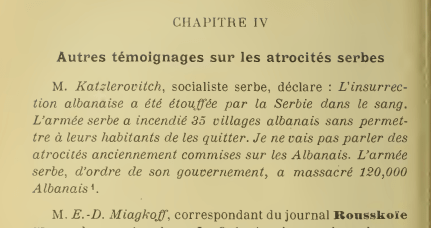
“Several fugitives from New Serbia have again arrived in Salonika. The Greek border authorities have not allowed people from the poor to continue their journey to Salonika; these fugitives are currently camping at the border where they have pitched tents. For the unfortunate inhabitants of the territories annexed by Serbia, whether Bulgarians or Albanians, to have resigned themselves, with the approach of winter, to abandoning their homes and going to live in tents, their suffering must have exceeded the limit.”
The situation of these fugitives must be very sad, but how much sadder is that of their unfortunate brothers who nevertheless had to remain in the country, perhaps because they could not abandon their wives and children or drag them with them.”
Albanie, No. 4, November 1, 1915. “Albanian Martyrs”:
“The Montenegrins have just killed a large number of Albanian patriots arrested in Scutari, whose crime was to love their country. Among these martyrs is also the great publicist Mustafa Hilmi Leskoviki. This noble victim of the Montenegrins’ madness of extermination edited the Albanian nationalist newspaper Combi, formerly published in Monastir.”
Albanie, No. 5, November 16, 1915:
“The Montenegrins’ first action upon entering Scutari was to arrest the elite patriots who were in the town, to imprison some of them, and to banish the others to Cettigné. Some even, for reasons unknown to us, were executed without further ado.”
Albanie, No. 6, December 1, 1915:
“Nor has anyone wanted to remember or note that during the Albanian revolutions that followed one another from 1908 to 1912, no—and we insist on this point—no complaint could be made against the rebels; We also pretend to forget that during the triumphant entry of 30,000 (50) Malissores (Albanian highlanders) into Uskub in 1912, there was not the slightest violence or harassment. Yet these highlanders were irregulars and seven-eighths of them were Muslims, those Muslims who were said to be savages, cruel, and bloodthirsty. All this went unnoticed, and public opinion was not even moved.
The conduct of the armies of the Balkan allies, though regular and claiming to be civilized, when they invaded Albanian territory following their crusade against Turkey, was beyond measure. Thousands and thousands of unarmed Albanians were massacred in cold blood and deliberately; hundreds of villages were razed to the ground or burned; others, also by the hundreds, were methodically pillaged by the Greeks and Serbs; the Montenegrins, after looting it, set fire to the market and a large part of Scutari.”
Albania, No. 8, January 1, 1916:
“We reproduce below the article that The Washington Times devoted to our unfortunate homeland:
“… Information from a very authentic source reaching America has informed us that crimes, which the hardened conscience of Europe would not have tolerated in normal times, have been perpetrated on the soil of this unfortunate Albania, whose poor inhabitants have been caught in the clutches of Greco-Serbian rapacity and greed.
The Albanians are suffering far more than the Belgians have ever suffered, and this without benefiting from the vast and great sympathy that was expressed… to the inhabitants of the small country in northern Europe. It is truly and a thousand times regrettable that, despite the formal commitment made by Ed. Grey, according to which the powers would recognize the legitimate rights of small nations, unfortunate Albania has been abandoned defenseless to the actions of the Greeks and the Serbs, those spoiled children of Europe.”
L’Albanie. No. 11, March 16, 1916:
“Among Albania’s enemies, the most implacable are the Serbs. The latter never miss an opportunity to rush upon their prey to tear it to pieces.
In the aftermath of the First Balkan War, thousands of young Albanians were put to the sword by the Serbs in the most inhuman manner…”
Reference
https://www.strumski.com/books/m.d.skopiansky_atrocites_serbes.pdf


 Balkan Academia